Electrochemistry
Contents: 7 sections
Oxidation number
Oxidation number is a bookkeeping device: it records how electrons have been shared out, and it makes redox reactions countable rather than a matter of judgement.
The rules, applied in order:
- An uncombined element has oxidation number 0. That includes O₂, Cl₂ and P₄.
- A simple ion has the oxidation number of its charge, so Na⁺ is +1 and S²⁻ is -2.
- Group 1 is always +1, Group 2 always +2, fluorine always -1.
- Hydrogen is +1, except in metal hydrides such as NaH where it is -1.
- Oxygen is -2, except in peroxides such as H₂O₂ where it is -1, and in OF₂ where it is +2.
- The oxidation numbers in a neutral compound sum to 0; in an ion they sum to the charge.
Worked example
Find the oxidation number of manganese in MnO₄⁻.
Each oxygen is -2, and there are four of them, giving -8. The overall charge is -1, so
Mn + (-8) = -1, therefore Mn = +7
The same method gives +6 for chromium in Cr₂O₇²⁻: fourteen oxygens contribute -14, the ion carries -2, so the two chromiums share +12 and each is +6.
Oxidation, reduction and agents
| Term | In terms of electrons | In terms of oxidation number |
|---|---|---|
| Oxidation | Loss of electrons | Increase |
| Reduction | Gain of electrons | Decrease |
The mnemonic OIL RIG covers the first column: oxidation is loss, reduction is gain.
The agents are where marks are lost, because the naming feels backwards:
- An oxidising agent oxidises something else, so it is itself reduced and gains electrons.
- A reducing agent reduces something else, so it is itself oxidised and loses electrons.
Common oxidising agents are MnO₄⁻ in acid, Cr₂O₇²⁻ in acid, and the halogens. Common reducing agents are metals, I⁻, Fe²⁺ and SO₂.
Disproportionation
Disproportionation is a reaction in which the same element is both oxidised and reduced.
The classic example is chlorine with cold dilute sodium hydroxide:
Cl₂ + 2NaOH → NaCl + NaClO + H₂O
Chlorine starts at 0. In NaCl it is -1, so it has been reduced; in NaClO it is +1, so it has been oxidised. One element, both directions, in a single reaction.
To identify disproportionation, work out the oxidation number of the element in question on both sides and look for it going up and down from the same starting value.
Building redox equations
Half-equations are combined by making the electrons cancel.
- Write each half-equation, balancing atoms other than O and H first.
- Balance oxygen by adding H₂O, and hydrogen by adding H⁺.
- Balance the charge by adding electrons.
- Multiply each half-equation so the electrons are equal, then add and cancel.
Worked example
Manganate(VII) oxidising iron(II) in acid.
MnO₄⁻ + 8H⁺ + 5e⁻ → Mn²⁺ + 4H₂O
Fe²⁺ → Fe³⁺ + e⁻
The second must be multiplied by 5 so that five electrons appear on each side:
MnO₄⁻ + 8H⁺ + 5Fe²⁺ → Mn²⁺ + 4H₂O + 5Fe³⁺
Check both: the atoms balance, and the charge is (-1) + (+8) + (+10) = +17 on the left and (+2) + (+15) = +17 on the right. A redox equation that balances for atoms but not for charge is wrong, and checking the charge catches it.
Electrolysis
Electrolysis is the decomposition of a molten or aqueous ionic compound by passing electricity through it. The ions must be free to move, which is why a solid ionic compound cannot be electrolysed.
- The cathode is negative and attracts cations, which gain electrons, so reduction happens there.
- The anode is positive and attracts anions, which lose electrons, so oxidation happens there.
Remembering that reduction is at the cathode and oxidation is at the anode covers most of what is asked.
Molten compounds
With a molten compound only the two ions of the compound are present, so the products are simply the element from each. Molten lead(II) bromide gives lead at the cathode and bromine at the anode:
Pb²⁺ + 2e⁻ → Pb
2Br⁻ → Br₂ + 2e⁻
Aqueous solutions
Water is present as well, so there is a competition, and the general rules are:
- At the cathode, hydrogen is released unless the metal is below hydrogen in reactivity, in which case the metal is deposited. Copper is deposited; sodium is not, so hydrogen comes off instead.
- At the anode, a halide gives the halogen. If no halide is present, oxygen is released from water or hydroxide ions.
Concentration matters too. Concentrated sodium chloride solution gives chlorine at the anode; very dilute solution gives oxygen.
Common mistakes
- Saying an oxidising agent is oxidised. It is reduced, because it takes electrons from something else.
- Giving oxygen -2 in hydrogen peroxide. It is -1 there.
- Balancing a redox equation for atoms only. The charge must balance as well.
- Saying the cathode is positive. In electrolysis it is negative, and reduction happens there.
- Calling any reaction where one thing is oxidised and another reduced disproportionation. It has to be the same element doing both.
- Forgetting that a solid ionic compound does not conduct, so it must be molten or in solution.
Check you have it
Question 1
KMnO4 is an oxidising agent. Its reaction with Fe2+ is shown in the following ionic equation. ...X...MnO4 – + ......Fe2+ + ......H+ → ......Mn2+ + ...Y...Fe3+ + ......H2O What are X and Y when the equation is balanced? Each answer gives, in order: X; Y.
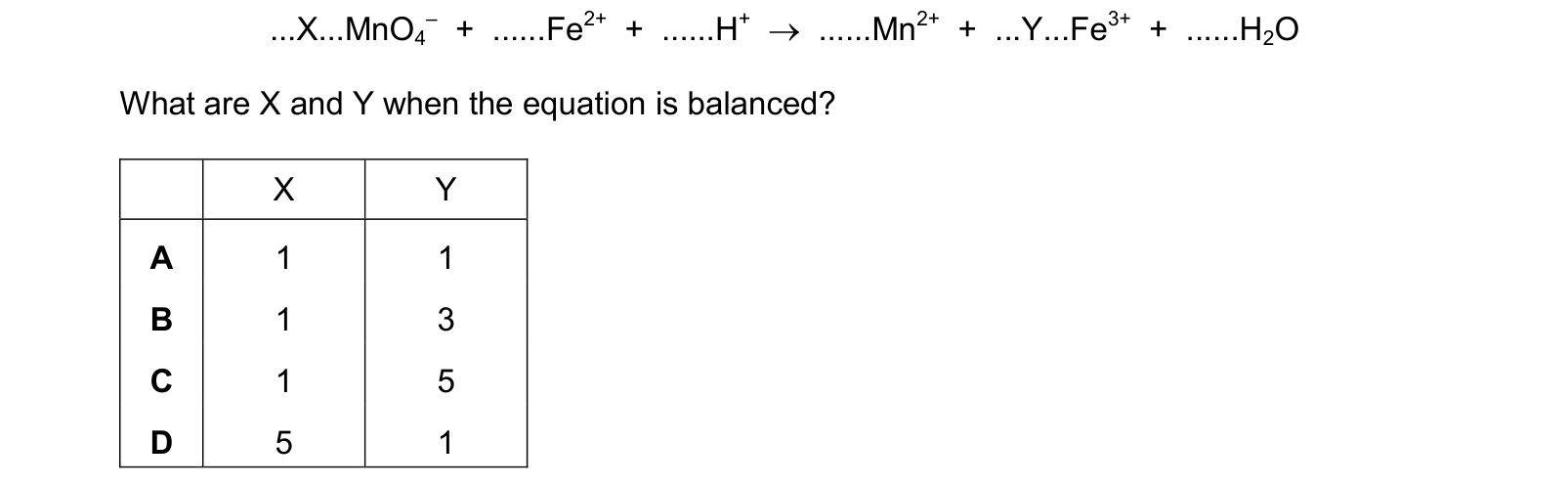
Answer: C.
Manganese goes from +7 in MnO₄⁻ to +2 in Mn²⁺, so each manganese gains 5 electrons.
Iron goes from +2 to +3, so each iron loses 1 electron.
For the electrons to balance, one manganate(VII) ion needs five iron(II) ions:
X = 1 and Y = 5
which is C.
The full equation is
MnO₄⁻ + 5Fe²⁺ + 8H⁺ → Mn²⁺ + 5Fe³⁺ + 4H₂O
and checking the oxygens confirms it: four in the manganate ion and four in the water.
D, 5 and 1, is the ratio the wrong way round, which is the natural slip: the 5 belongs to the species that transfers one electron each, because it takes five of them to supply what one manganese needs.
This is the reaction behind the standard manganate(VII) titration for iron(II), and the 1 : 5 ratio is what makes the calculation work. It is also self-indicating: the purple colour persists as soon as the iron is used up.
Question 2
Chlorine reacts with aqueous sodium hydroxide forming two chlorine-containing products. Which row shows the oxidation states of chlorine in the products under the conditions stated? Each answer gives, in order: conditions; oxidation state of Cl in products.
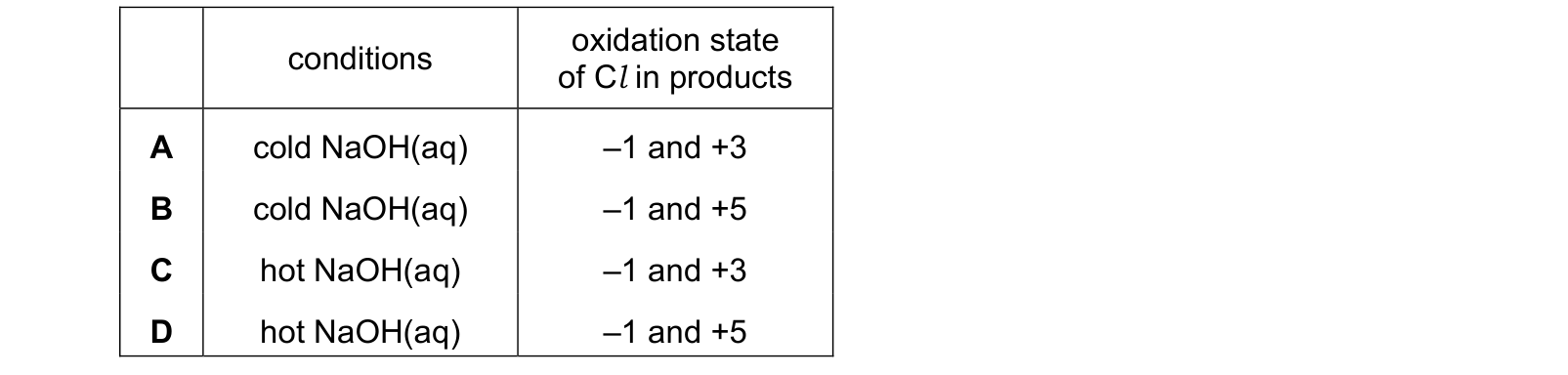
Answer: D.
Cold dilute alkali:
Cl₂ + 2NaOH → NaCl + NaOCl + H₂O
giving chlorine at −1 and +1.
Hot concentrated alkali:
3Cl₂ + 6NaOH → 5NaCl + NaClO₃ + 3H₂O
giving chlorine at −1 and +5.
The only option pairing a condition correctly with its oxidation states is hot with −1 and +5, which is D.
B has the right states with the wrong condition, and A has the right condition with the wrong states, so each is half correct. The two halves have to match.
+3 does not occur in either reaction. Chlorate(III) exists as a compound but is not what forms here, which is why C can be dismissed outright.
The cold reaction is what makes household bleach, where the chlorate(I) does the bleaching. The hot reaction is how chlorate(V) is made for weedkillers and match heads. Both are disproportionations, since in each the chlorine ends up above and below its starting value of zero.
Question 3
The equations for three reactions involving chlorine or its compounds are listed.
1 2KCl O3 → 2KCl + 3O2
2 4KCl O3 → 3KCl O4 + KCl
3 6KOH + 3Cl2 → 3H2O + 5KCl + KCl O3 Which statement about these equations is correct?
Answer: D.
1. 2KClO₃ → 2KCl + 3O₂. Chlorine goes +5 → −1 and oxygen goes −2 → 0. Two different elements change, so this is redox but not disproportionation.
2. 4KClO₃ → 3KClO₄ + KCl. Chlorine goes +5 → +7 and +5 → −1. Disproportionation.
3. 6KOH + 3Cl₂ → 3H₂O + 5KCl + KClO₃. Chlorine goes 0 → −1 and 0 → +5. Disproportionation.
So equations 2 and 3, which is D.
B is the direct contradiction of the working above: equation 1 has oxygen going from −2 to 0, so it certainly is redox.
C misnames the product. In KClO₄ chlorine is +7, so it is potassium chlorate(VII). Chlorate(IV) would be KClO₃ with chlorine at +5, which is chlorate(V).
A points at the wrong equation. The species that kills bacteria in drinking water is chlorate(I), as HClO or ClO⁻, and equation 1 produces neither. Equation 3 is the one that makes a chlorate.
What the syllabus asks for on this topicSyllabus points
Syllabus points
- Calculate oxidation numbers of elements in compounds and ions.
- Use oxidation numbers to identify oxidation, reduction, oxidising agents and reducing agents.
- Explain and use the term disproportionation.
- Construct redox equations from half-equations, balancing for both atoms and charge.
- Describe electrolysis, and predict the products at each electrode.
Related CIE 9701 Chemistry topics
Not the topic you were looking for? Describe what you are stuck on in your own words and we will take you to the notes that answer it.