An introduction to organic chemistry
Contents: 9 sections
The kinds of formula
Six ways of writing the same molecule, each answering a different question:
| Type | Example for ethanoic acid | Shows |
|---|---|---|
| Empirical | CH₂O | Simplest whole-number ratio |
| Molecular | C₂H₄O₂ | Actual atoms present |
| Structural | CH₃COOH | How the atoms are grouped |
| Displayed | Every atom and every bond drawn | Full arrangement |
| Skeletal | A line diagram with carbons implied | The carbon framework |
| General | CₙH₂ₙ₊₁COOH | The pattern for a homologous series |
A homologous series is a family of compounds with the same functional group and general formula, in which each member differs from the next by CH₂. Members show a gradual change in physical properties and very similar chemical properties.
Naming
The IUPAC name is built in three parts: a stem for the longest carbon chain, a suffix for the principal functional group, and prefixes for the substituents.
| Carbons | Stem |
|---|---|
| 1 | meth |
| 2 | eth |
| 3 | prop |
| 4 | but |
| 5 | pent |
| 6 | hex |
| Group | Suffix or prefix |
|---|---|
| Alkane | -ane |
| Alkene | -ene |
| Alcohol | -ol |
| Aldehyde | -al |
| Ketone | -one |
| Carboxylic acid | -oic acid |
| Halogenoalkane | chloro-, bromo-, iodo- |
The rules for numbering: find the longest chain containing the functional group, number from the end that gives the functional group the lowest number, and list substituents alphabetically with di, tri and tetra for repeats.
So CH₃CH(CH₃)CH₂CH₂OH is 3-methylbutan-1-ol, not 2-methylbutan-4-ol, because the alcohol group takes priority in the numbering.
Structural isomerism
Structural isomers have the same molecular formula but different structural formulae. There are three kinds:
- Chain isomerism: the carbon skeleton differs. Butane and 2-methylpropane are both C₄H₁₀.
- Position isomerism: the functional group is at a different place. Propan-1-ol and propan-2-ol are both C₃H₈O.
- Functional group isomerism: the group itself differs. Propanal and propanone are both C₃H₆O; ethanol and methoxymethane are both C₂H₆O.
Stereoisomerism
Stereoisomers have the same structural formula but a different arrangement in space.
Cis-trans isomerism
This arises around a C=C double bond, because there is no rotation about it, and it requires two different groups on each carbon of the double bond.
But-2-ene exists as cis (both methyls on the same side) and trans (on opposite sides). But-1-ene does not show it, because one of the double-bond carbons carries two hydrogens.
The lack of rotation is the whole reason. In an alkane the single bond rotates freely, so the arrangements are not distinct compounds.
Optical isomerism
This arises at a chiral centre: a carbon atom with four different groups attached.
The two forms are non-superimposable mirror images, called enantiomers, related like a left and a right hand. They have identical physical and chemical properties except that they rotate the plane of plane-polarised light in opposite directions, by equal amounts.
A 50:50 mixture of the two, a racemic mixture, shows no rotation overall because the two effects cancel.
The distinction matters outside the exam: enantiomers often behave very differently in the body, because receptors are themselves chiral and fit one hand and not the other.
Breaking bonds
A covalent bond can break in two ways, and which one happens decides the whole mechanism.
Homolytic fission splits the pair evenly, one electron to each atom, giving two free radicals. A free radical is a species with an unpaired electron, shown as a dot. This is what UV light does to Cl₂, and it leads to free-radical substitution.
Heterolytic fission gives both electrons to one atom, producing two ions. This is what happens to a polar bond such as C-Br, giving a carbocation and a bromide ion.
Curly arrows record the movement of electrons. A double-headed arrow shows a pair moving; a half-headed (fishhook) arrow shows a single electron. The arrow starts at the electrons and ends where they go, which is worth being fussy about, because a mechanism mark usually depends on the arrow starting in the right place.
Attacking species
- A nucleophile is an electron pair donor, attracted to a region of positive charge. It has a lone pair. Examples are OH⁻, CN⁻, NH₃ and H₂O.
- An electrophile is an electron pair acceptor, attracted to a region of negative charge such as a C=C double bond. Examples are H⁺, NO₂⁺ and the polarised Br₂ molecule.
- A free radical has an unpaired electron and attacks almost anything.
Which one attacks a molecule is decided by the molecule. An alkene is electron rich, so it attracts electrophiles. A halogenoalkane has a δ+ carbon, so it attracts nucleophiles.
Types of reaction
| Reaction | What happens |
|---|---|
| Addition | Two molecules become one; a double bond is used up |
| Substitution | One atom or group replaces another |
| Elimination | A small molecule is removed and a double bond forms |
| Hydrolysis | A bond is broken by reaction with water |
| Oxidation | Adds oxygen or removes hydrogen |
| Reduction | Adds hydrogen or removes oxygen |
Common mistakes
- Saying cis-trans isomerism happens whenever there is a C=C bond. Each carbon of the double bond needs two different groups.
- Saying a chiral centre needs four groups. It needs four different groups.
- Numbering a chain from the wrong end. The functional group takes the lowest number.
- Drawing a curly arrow from an atom rather than from the electrons, or from a positive charge instead of towards it.
- Confusing nucleophile and electrophile. A nucleophile donates a pair; an electrophile accepts one.
- Calling a racemic mixture optically active. The two enantiomers cancel exactly.
Check you have it
Question 1
Compound X, C5H10O3, has one chiral carbon atom per molecule. Compound X produces bubbles with Na but not with Na2CO3.
Which formula could represent compound X?
Answer: B.
Bubbles with sodium means an O–H group, either an alcohol or a carboxylic acid.
No bubbles with sodium carbonate means no carboxylic acid, since only an acid strong enough to displace CO₂ from a carbonate does that. So the O–H is an alcohol.
That rules out C and D, which both end in CO₂H.
One chiral carbon separates the last two.
A, (CH₃)₂C(OH)CO₂CH₃, has its OH on a carbon carrying two methyl groups. Two identical groups means no chiral centre anywhere in the molecule.
B, HOCH₂CH(CH₃)CO₂CH₃, has a middle carbon carrying CH₃, H, CH₂OH and CO₂CH₃, four different groups. Chiral, so B.
The three oxygens are accounted for as one alcohol OH and one ester, which uses two. That is why both surviving options are esters: an ester is the only way to spend two oxygens without making an acid.
Sodium reacts with any O–H; sodium carbonate reacts only with the acidic one. Using the two reagents together is the standard way of telling an alcohol from a carboxylic acid.
Question 2
A scientist chooses either infrared spectroscopy or mass spectrometry to find a particular piece of information. In which row has the best choice been made? Each answer gives, in order: target information; analytic method used.
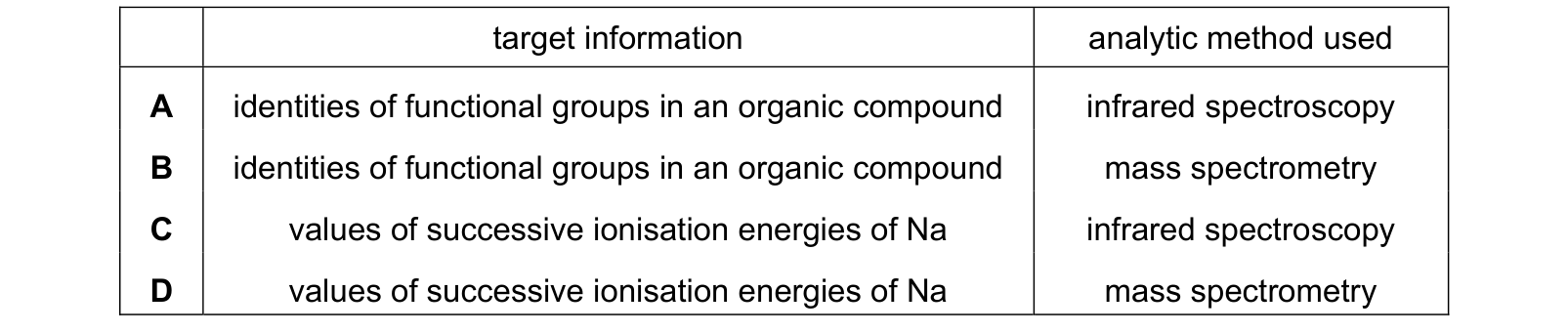
Answer: A.
Mass spectrometry does something different. It measures mass to charge ratio, so it gives the relative molecular mass from the molecular ion peak, the number of carbons from the M+1 peak, and the presence of chlorine or bromine from the M+2 pattern. It says nothing directly about which functional groups are present, though the fragmentation pattern can hint at them.
C and D both ask for successive ionisation energies of sodium, and neither technique measures those. Ionisation energies are found from emission spectra or from electron-impact experiments, not from either method on offer.
The two techniques are complementary in practice. Mass spectrometry tells you how big the molecule is and infrared tells you what is in it, which is why an unknown compound is usually run through both.
Question 3
Compound Q reacts separately with HCN and NaBH4 under suitable conditions.
Both reactions produce an organic product with a chiral centre.
What is compound Q?
Answer: A.
A, butanone, CH₃COCH₂CH₃, has a methyl on one side and an ethyl on the other.
With NaBH₄ it becomes butan-2-ol, CH₃CH(OH)CH₂CH₃, whose second carbon carries OH, H, CH₃ and C₂H₅. Chiral ✓
With HCN it becomes CH₃C(OH)(CN)CH₂CH₃, carrying OH, CN, CH₃ and C₂H₅. Chiral ✓
So A.
D, propanone, fails both. It is symmetrical, with a methyl on each side, so the reduction gives propan-2-ol and the addition gives 2-hydroxy-2-methylpropanenitrile, and each product still has two identical methyls on the key carbon.
B and C are aldehydes, and an aldehyde always fails the reduction half. Reducing CHO gives CH₂OH, a carbon with two hydrogens, which can never be chiral. Both do give chiral products with HCN, since the added CN becomes a fourth different group, so they satisfy one condition and not the other.
The rule that settles it: only an unsymmetrical ketone gives a chiral product on reduction, because only there does the carbonyl carbon already carry two different groups before anything is added.
What the syllabus asks for on this topicSyllabus points
Syllabus points
- Interpret and use empirical, molecular, general, structural, displayed and skeletal formulae.
- Name compounds using IUPAC rules for the functional groups on the syllabus.
- Describe structural isomerism and stereoisomerism, including cis-trans and optical isomerism.
- Explain homolytic and heterolytic fission, and define free radical, nucleophile and electrophile.
- Explain the terms addition, substitution, elimination, hydrolysis, oxidation and reduction as applied to organic reactions.
Related CIE 9701 Chemistry topics
Not the topic you were looking for? Describe what you are stuck on in your own words and we will take you to the notes that answer it.