An introduction to organic chemistry: five questions to try now
Real past-paper questions, the answer key from the mark scheme, and the explanation that goes with it. No account needed to answer them.
Question 1
The general formula for a non-cyclic alcohol is CnH2n+1OH. How many different structural isomers are there for n = 3 and n = 4? Each answer gives, in order: n = 3; n = 4.
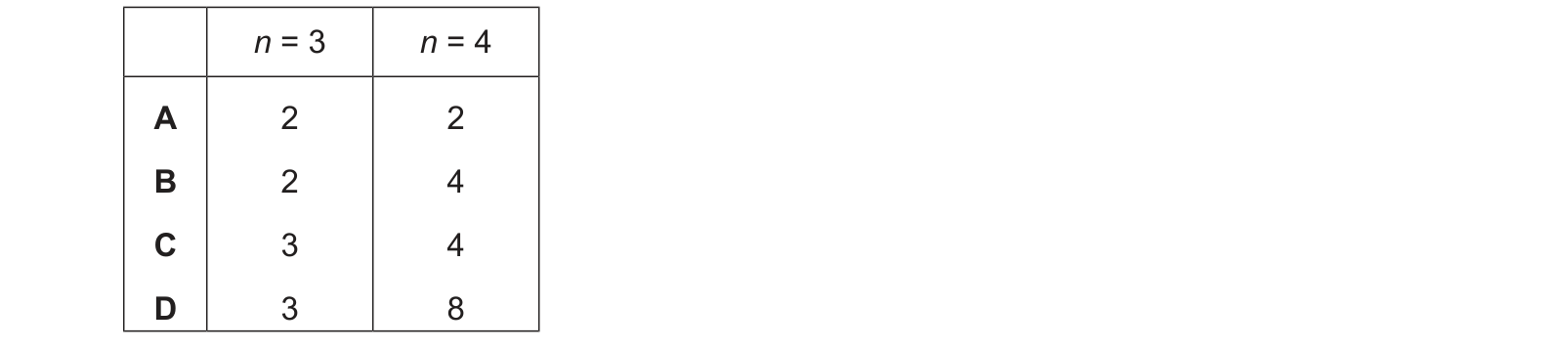
Answer: B.
n = 3, C₃H₇OH. The three-carbon chain has two distinct positions for the OH:
propan-1-ol and propan-2-ol, so 2
That removes C and D.
n = 4, C₄H₉OH. Now the skeleton can branch as well:
butan-1-ol
butan-2-ol
2-methylpropan-1-ol
2-methylpropan-2-ol
which is 4, so B.
The jump from 2 to 4 comes from the branching. With three carbons there is only one skeleton, so only the position of the OH can vary. With four there are two skeletons, straight and branched, and each offers two positions for the OH.
It is worth noticing that the branched skeleton's two positions give one primary and one tertiary alcohol, while the straight one gives a primary and a secondary. So the four C₄H₉OH isomers are two primary, one secondary and one tertiary, which is the set that appears again in every oxidation question about this formula.
Question 2
In the hydrolysis of bromoethane by aqueous NaOH, what is the nature of the attacking group and of the leaving group? Each answer gives, in order: attacking group; leaving group.
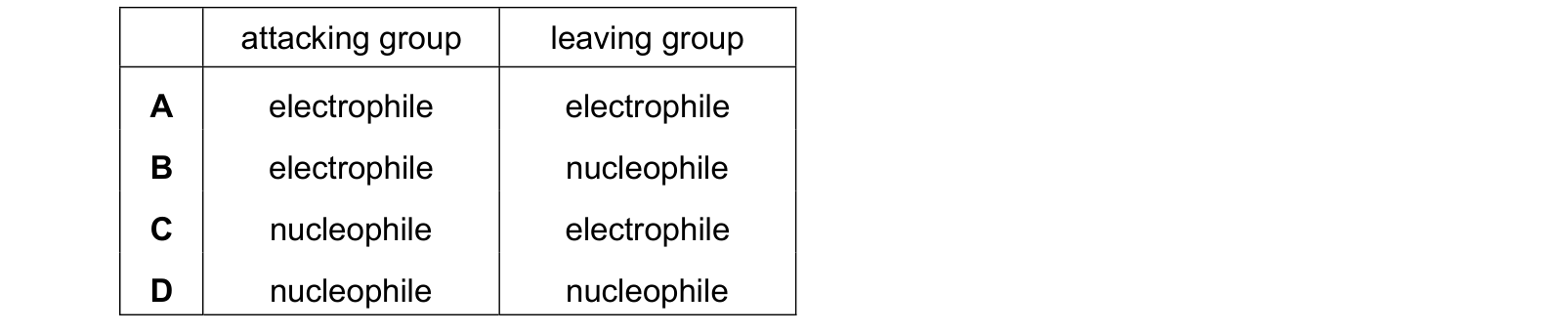
Answer: D.
The attacking group is the hydroxide ion. It has lone pairs and a negative charge, and it attacks the carbon that carries the bromine because that carbon is δ+. An electron-pair donor attacking a positive centre is a nucleophile.
The leaving group is the bromide ion, and it is a nucleophile too. When the C–Br bond breaks heterolytically, the bromine takes both electrons with it, so it leaves as Br⁻ with four lone pairs. A species carrying a lone pair it could donate is a nucleophile by definition, whether or not it is attacking anything at that moment.
So nucleophile and nucleophile, which is D.
The instinct is to expect the two roles to be opposites, which is why every other option pairs a nucleophile with an electrophile or has the labels reversed.
An electrophile is an electron-pair acceptor, and there is none in this reaction at all. The δ+ carbon is the electron-poor site being attacked, but it is part of a molecule rather than a separate attacking species.
Question 3
When 1-methylcyclohexene reacts with Br2 the product is X.
When 1-methylcyclohexene reacts with HBr the major product is Y. Which statement is correct?

Answer: C.
X, from Br2. Bromine adds across the double bond to give 1,2-dibromo-1-methylcyclohexane. Both of those carbons end up chiral. C1 carries Br, CH3 and the two ring paths, which differ because one of them runs through the carbon bearing the other Br. C2 carries Br, H and two different ring paths. Two chiral centres give 2² = 4 stereoisomers, and the intermediate is planar, so bromine can arrive at either face of each centre and all four are formed.
Y, from HBr. Markovnikov puts the H on C2 and the Br on the more substituted C1, giving 1-bromo-1-methylcyclohexane. Now count again at C1: Br, CH3, and the ring going round either way. Those two ring paths are now identical, five CH2 groups back to the start, so C1 is not a chiral centre after all. C2 has become a plain CH2. No chiral centre anywhere, so Y has no stereoisomers.
The whole question is that second count. Adding two different groups creates chirality; adding a hydrogen destroys the very asymmetry that would have created it.
Question 4
The diagram shows the structural formula of mevalonic acid.
mevalonic acid Which reagent and conditions will react with mevalonic acid to produce an organic compound without a chiral carbon atom?
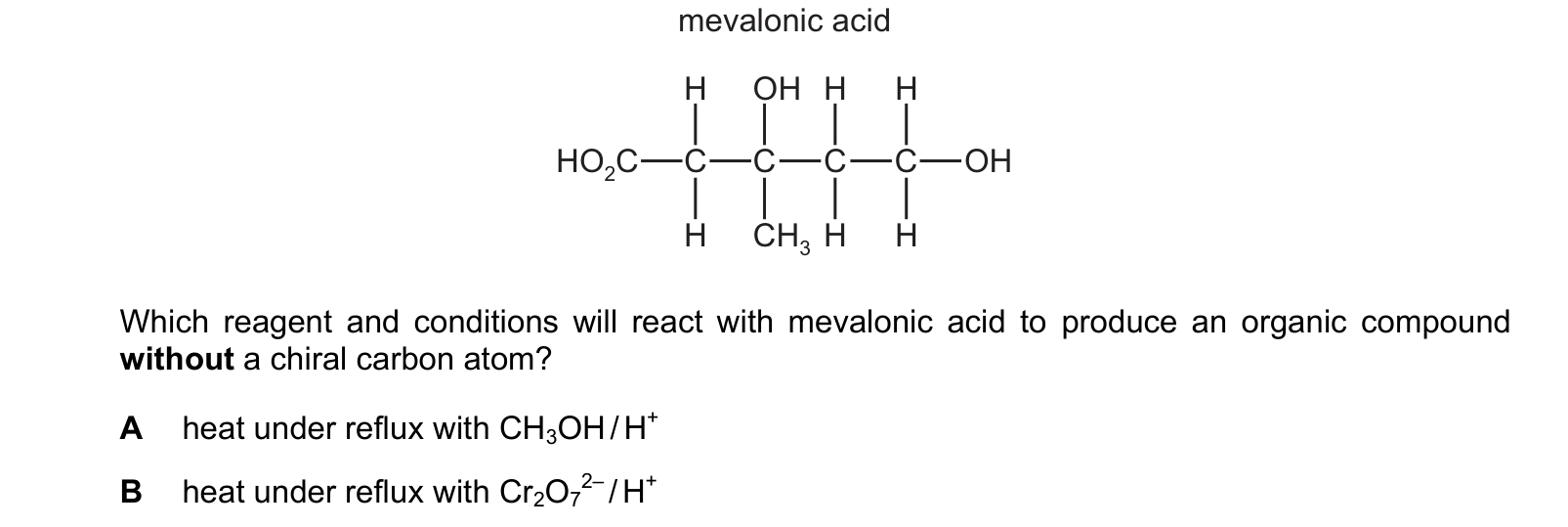
Answer: B.
To destroy the chirality without destroying that carbon, two of those four groups have to be made identical.
B does exactly that. Hot acidified dichromate oxidises the primary alcohol at the far end all the way to a carboxylic acid, giving
HO₂C–CH₂–C(CH₃)(OH)–CH₂–CO₂H
Now the central carbon carries OH, CH₃ and two identical CH₂CO₂H groups, so it is no longer chiral. The tertiary OH on that carbon is untouched, since it has no hydrogen to lose.
A esterifies the acid with methanol, giving a CH₂CO₂CH₃ arm on one side and CH₂CH₂OH on the other. Still four different groups.
C forms sodium salts of the acid and the alcohols, which changes the groups but leaves them all different.
D replaces the OH groups with chlorine using PCl₅, giving CH₂COCl on one side and CH₂CH₂Cl on the other. Different again.
The trick is to look for the reagent that makes the two arms the same, and only oxidation does it, because the two ends differ by exactly the oxidation state of their terminal carbon.
Question 5
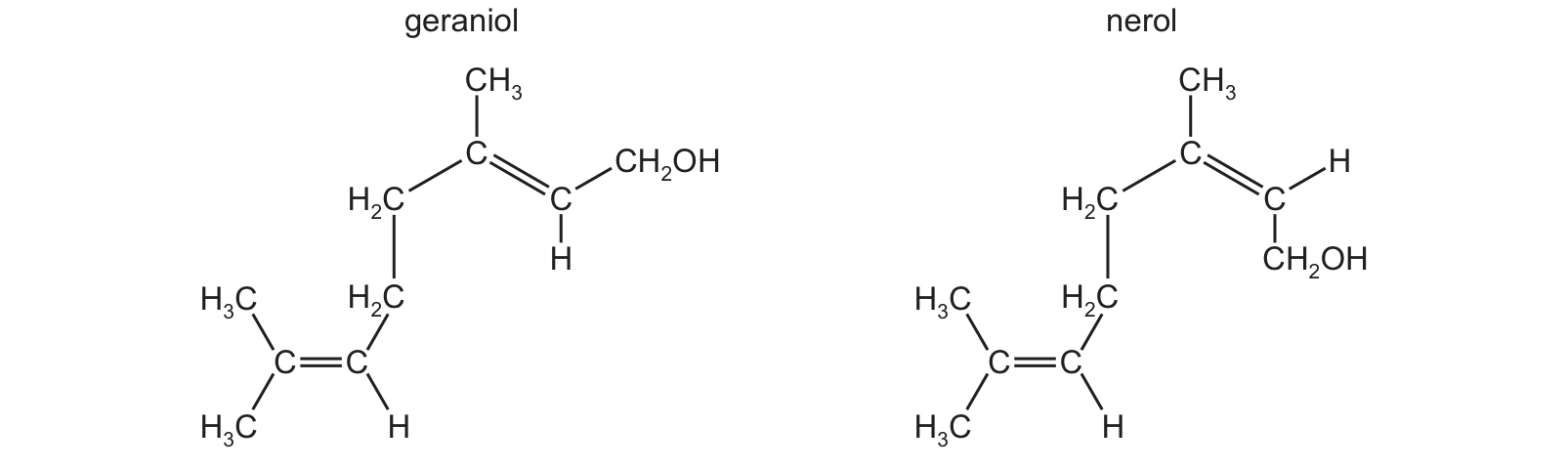
Geraniol and nerol are isomers of each other.
geraniol nerol
CH3 CH3 H3C H2C H3C H2C H3C H H3C H
Which type of isomerism is shown here?
Answer: B.
They have the same molecular formula and the same connectivity: the same chain, the same OH in the same place, the same branches. What differs is the arrangement in space around one C=C, where the two chains sit either on the same side or on opposite sides. Rotation about a double bond is blocked, so the two forms cannot interconvert and are genuinely different compounds, with different smells and different boiling points.
A, chain isomerism, needs a different carbon skeleton, one branched and the other straight. These two skeletons are identical.
D, positional isomerism, needs a functional group on a different carbon. The OH is at the same position in both.
C, optical isomerism, needs a chiral centre, a carbon with four different groups. Neither molecule has one: every carbon here carries either two hydrogens, or a double bond, or two identical methyls.
Both chain and positional isomerism are kinds of structural isomerism, where the atoms are joined up differently. Geometrical and optical isomerism are kinds of stereoisomerism, where the connectivity is identical and only the arrangement in space differs. Deciding which of those two families you are in first cuts the options in half.
What this practice covers
These questions are drawn from past CIE 9701 Chemistry papers. You answer, you find out immediately whether you were right, and you get the reasoning for the correct option and for each distractor. Wrong answers go to a mistakes locker so you can come back to exactly those.
Practice is free. You need an account only so your progress and your mistakes are still there next time.
What examiners see students get wrong here
These are the errors that cost marks on an introduction to organic chemistry, taken from our own topic notes. Read them before you practise and you will recognise the traps in the questions.
- Saying cis-trans isomerism happens whenever there is a C=C bond. Each carbon of the double bond needs two different groups.
- Saying a chiral centre needs four groups. It needs four different groups.
- Numbering a chain from the wrong end. The functional group takes the lowest number.
- Drawing a curly arrow from an atom rather than from the electrons, or from a positive charge instead of towards it.
- Confusing nucleophile and electrophile. A nucleophile donates a pair; an electrophile accepts one.
- Calling a racemic mixture optically active. The two enantiomers cancel exactly.
Revise it first
If any of the above is unfamiliar, work through the notes before practising: An introduction to organic chemistry revision notes.