Hydroxy compounds
Contents: 8 sections
Classifying alcohols
The class is decided by how many carbon atoms are attached to the carbon bearing the OH group.
| Class | Carbons on the C-OH | Example |
|---|---|---|
| Primary | 0 or 1 | Ethanol |
| Secondary | 2 | Propan-2-ol |
| Tertiary | 3 | 2-methylpropan-2-ol |
The classification is worth getting right at the start of any question, because the oxidation behaviour depends entirely on it.
Physical properties
Alcohols contain O-H, so they form hydrogen bonds with one another. That gives them much higher boiling points than alkanes of similar relative molecular mass: ethanol boils at 78 °C while propane, of almost the same mass, boils at -42 °C.
The shorter alcohols are soluble in water, again because they hydrogen bond with it. Solubility falls as the chain lengthens, because the non-polar hydrocarbon part grows and comes to dominate the molecule.
Reactions of alcohols
With sodium
2CH₃CH₂OH + 2Na → 2CH₃CH₂ONa + H₂
Effervescence, and the sodium dissolves. The reaction is like sodium with water but gentler, which shows the alcohol is a very weak acid.
Combustion
Alcohols burn completely in plenty of oxygen to carbon dioxide and water. Ethanol is used as a fuel, and because it can be made by fermenting sugar from crops it is described as carbon neutral in principle, since the carbon dioxide released was taken from the air by the plant. In practice the fuel used in growing, harvesting and distilling reduces that benefit, and land used for fuel crops is land not used for food.
Esterification
An alcohol with a carboxylic acid, warmed with a few drops of concentrated sulfuric acid as catalyst, gives an ester and water:
CH₃COOH + CH₃CH₂OH ⇌ CH₃COOCH₂CH₃ + H₂O
The reaction is reversible and slow, and the sweet smell of the ester is the observation.
Dehydration
Passing the vapour over hot aluminium oxide, or heating with concentrated sulfuric or phosphoric acid, removes water and gives an alkene:
CH₃CH₂OH → CH₂=CH₂ + H₂O
This is an elimination reaction, and it is the reverse of the industrial hydration of ethene.
With halogenating agents
The OH group can be replaced by a halogen:
- With PCl₅, giving a chloroalkane, HCl and POCl₃. The steamy fumes of HCl make this a test for the OH group.
- With HBr, made in situ from NaBr and concentrated sulfuric acid.
- With red phosphorus and iodine, giving an iodoalkane.
Oxidation
This is the heart of the chapter. The oxidising agent is acidified potassium dichromate(VI), and it turns from orange to green when it acts, because chromium goes from +6 to +3.
| Alcohol | Distil | Reflux |
|---|---|---|
| Primary | Aldehyde | Carboxylic acid |
| Secondary | Ketone | Ketone |
| Tertiary | No reaction | No reaction |
The conditions matter as much as the alcohol:
- Distilling removes the aldehyde as it forms, before it can be oxidised further. The aldehyde boils lower than the alcohol because it cannot hydrogen bond to itself.
- Refluxing returns the vapour to the flask, so the aldehyde stays and is oxidised on to the acid.
A tertiary alcohol is not oxidised, because the carbon bearing the OH has no hydrogen on it, and oxidation here means removing hydrogen. The dichromate stays orange, which makes this a way of identifying a tertiary alcohol.
Distinguishing the three classes
- Warm each with acidified potassium dichromate(VI). No colour change means tertiary.
- For the two that turn green, distil off the product and test it with Tollens' reagent. A silver mirror means an aldehyde was formed, so the alcohol was primary; no reaction means a ketone, so it was secondary.
The tri-iodomethane test
Warming with iodine and sodium hydroxide gives a pale yellow precipitate of CHI₃ with a distinctive smell.
It is positive for compounds containing the CH₃CH(OH) group, so ethanol and propan-2-ol give it, and methanol and propan-1-ol do not. It also detects the methyl ketone group CH₃CO, so it is a useful structural test rather than a test for alcohols as a class.
Phenol
Phenol has the OH group attached directly to a benzene ring, and that changes its chemistry.
Phenol is more acidic than an alcohol: it reacts with sodium hydroxide to give a salt, which ethanol does not. The reason is that the negative charge on the phenoxide ion is delocalised into the ring, which stabilises it, so the O-H bond ionises more readily. Phenol is still a weak acid, and weaker than carbonic acid, so it does not react with sodium carbonate.
Phenol is also more reactive than benzene towards electrophiles. A lone pair on the oxygen is delocalised into the ring, increasing the electron density there, so the ring attracts electrophiles more strongly.
The evidence is that phenol reacts with bromine water at room temperature with no catalyst, decolourising it and giving a white precipitate of 2,4,6-tribromophenol. Benzene needs a halogen carrier catalyst and gives only single substitution.
Common mistakes
- Saying a tertiary alcohol resists oxidation because it is bulky. It has no hydrogen on the carbon bearing the OH.
- Giving the carboxylic acid as the product of distillation. Distilling gives the aldehyde; reflux gives the acid.
- Forgetting that the dichromate colour change is orange to green, or giving it the wrong way round.
- Saying phenol reacts with sodium carbonate. It is too weak an acid for that.
- Explaining phenol's reactivity by the OH group being electron withdrawing. The lone pair is donated into the ring.
- Using the tri-iodomethane test as a general alcohol test. It needs the CH₃CH(OH) or CH₃CO group.
Check you have it
Question 1
(CH3)3CCN reacts to form alcohol Y via the reaction sequence shown. H+(aq) LiAl H4 (CH3)3CCN X alcohol Y reaction 1 reaction 2 Which row names the molecule X and the class of alcohol Y? Each answer gives, in order: name of molecule X; class of alcohol Y.
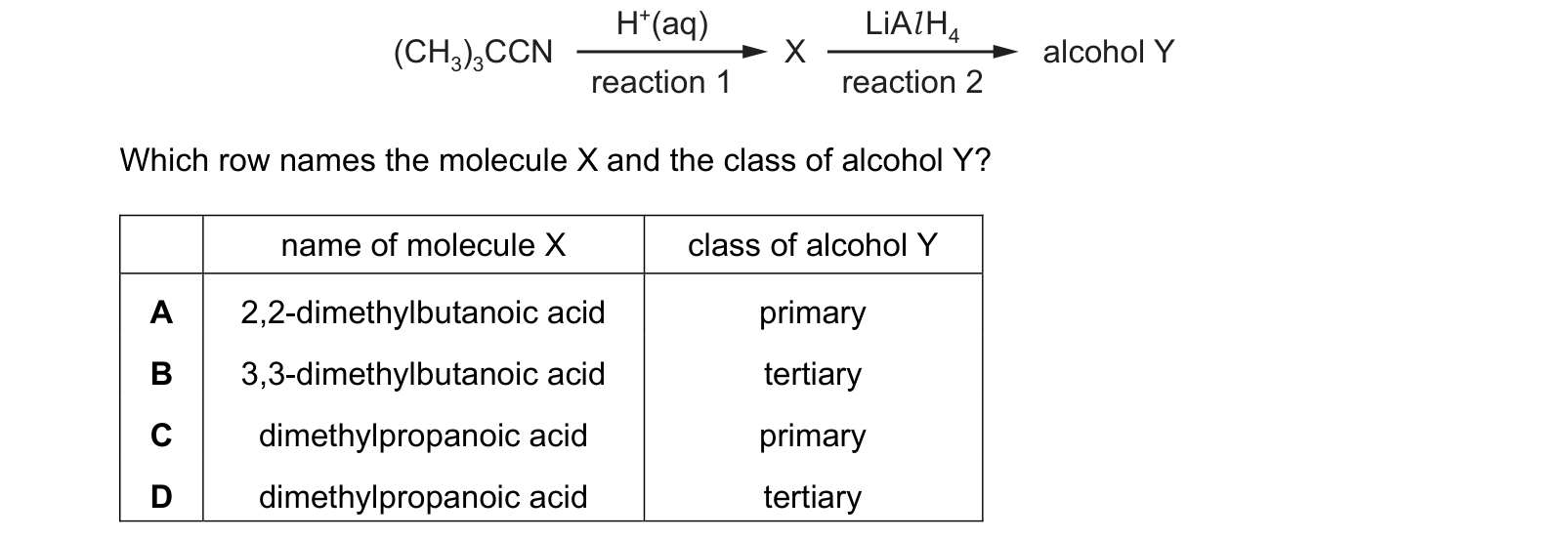
Answer: C.
Reaction 1: acid hydrolysis of the nitrile. H⁺(aq) turns a nitrile into a carboxylic acid, so X is (CH₃)₃C–COOH.
Naming it: the longest chain containing the COOH runs COOH, then the central carbon, then one methyl, which is three carbons, so the parent is propanoic acid, with two methyl groups on carbon 2. That is 2,2-dimethylpropanoic acid, matching the dimethylpropanoic acid of options C and D. A and B both name a butanoic acid, which would need four carbons in the chain.
Reaction 2: reduction with LiAlH₄. A carboxylic acid is reduced to a primary alcohol, and it always is: the COOH becomes CH₂OH, and a carbon carrying two hydrogens and an OH is primary by definition. So Y is (CH₃)₃C–CH₂OH and the class is primary, which makes C the answer.
D calls it tertiary, which is the trap. The molecule certainly contains a carbon attached to three others, the central one, but that carbon does not carry the OH. The classification of an alcohol depends only on the carbon the OH is attached to.
Counting carbons is also a good check on the whole route: the nitrile has five, and neither hydrolysis nor reduction changes that.
Question 2
The compound ‘leaf alcohol’ is partly responsible for the smell of new-mown grass.
leaf alcohol
CH3CH2CH=CHCH2CH2OH
What will be formed when ‘leaf alcohol’ is oxidised using an excess of hot acidified K2Cr2O7(aq)?
Answer: C.
Leaf alcohol is CH₃CH₂CH=CHCH₂CH₂OH, a primary alcohol with a double bond further along the chain. With an excess of the reagent and heat, the CH₂OH group is oxidised through the aldehyde to the carboxylic acid, and the C=C is untouched:
CH₃CH₂CH=CHCH₂CO₂H
which is C.
A and B both attack the double bond, giving a diol and a diketone. Dichromate does not do that; manganate(VII) does, which is what makes those options plausible-looking.
D cleaves the molecule in two, which again is manganate(VII) chemistry, and hot concentrated acidified manganate(VII) is exactly what would give those two fragments.
The pairing worth carrying is that dichromate is the selective oxidising agent for alcohols, while manganate(VII) is the aggressive one that also cleaves alkenes. A question that gives you a molecule with both an alcohol and an alkene is nearly always asking whether you know which reagent leaves the alkene alone.
Question 3
Which compound gives both: ● an orange precipitate with 2,4-DNPH reagent ● and a yellow precipitate with alkaline I2(aq)?
Answer: D.
An orange precipitate with 2,4-DNPH means a carbonyl group, an aldehyde or a ketone. That removes A, ethanol, which is an alcohol.
A yellow precipitate with alkaline iodine means a CH₃CO– group or a CH₃CH(OH)– group.
D, propanone, CH₃COCH₃, has a carbonyl and a methyl directly on it. Both tests positive, so D.
B, methanal, HCHO, has a carbonyl but no carbon attached to it at all, so there is no methyl group to become the CHI₃.
C, propanal, CH₃CH₂CHO, has a carbonyl but the group next to it is an ethyl, not a methyl. One carbon too many, and the test fails.
Ethanal, CH₃CHO, would also pass both and is not offered, which is worth noting because it is the only aldehyde that gives a positive iodoform test.
The two tests together are a standard pair: the first says there is a carbonyl, the second says what is attached to it.
What the syllabus asks for on this topicSyllabus points
Syllabus points
- Classify alcohols as primary, secondary or tertiary.
- Explain the physical properties of alcohols in terms of hydrogen bonding.
- Describe the reactions of alcohols: combustion, with sodium, esterification, oxidation, dehydration and with halogenating agents.
- Describe the oxidation products of primary, secondary and tertiary alcohols, and the conditions used.
- Describe the reactions of phenol and explain why it is more reactive than benzene.
Related CIE 9701 Chemistry topics
Not the topic you were looking for? Describe what you are stuck on in your own words and we will take you to the notes that answer it.