Atoms, molecules and stoichiometry
Contents: 8 sections
Relative masses
Relative atomic mass (Aᵣ) is the weighted mean mass of an atom of an element, relative to 1/12 of the mass of an atom of carbon-12.
The phrase weighted mean is what makes the calculation work. Chlorine is not 35 or 37; it is the average of its isotopes in the proportions in which they occur.
Worked example
Chlorine is 75% ³⁵Cl and 25% ³⁷Cl. Its relative atomic mass is
Relative molecular mass (Mᵣ) is the sum of the Aᵣ values in a molecule; relative formula mass is the same idea for an ionic compound, which has no molecules. Neither has units, because both are ratios.
The mole
One mole is the amount of substance containing the same number of particles as there are atoms in 12 g of carbon-12, which is 6.02 × 10²³, the Avogadro constant.
Three relationships do almost all the work in this topic:
moles = mass ÷ Mᵣ
>
moles = concentration × volume (with volume in dm³)
>
moles = volume ÷ 24.0 (for a gas at room temperature and pressure, volume in dm³)
The molar gas volume of 24.0 dm³ mol⁻¹ applies at room conditions only. Always check whether the question gives conditions before using it.
Two conversions cause more lost marks than any concept here:
- cm³ to dm³: divide by 1000
- g to kg or tonnes: be sure Mᵣ is in the same mass unit as the mass
Empirical and molecular formulae
The empirical formula is the simplest whole-number ratio of atoms. The molecular formula is the actual number in a molecule, and it is always a whole-number multiple of the empirical formula.
The method never changes:
- Divide each mass or percentage by the element's Aᵣ.
- Divide every answer by the smallest of them.
- Multiply up if needed to reach whole numbers.
Worked example
A compound is 40.0% carbon, 6.7% hydrogen and 53.3% oxygen by mass, and its Mᵣ is 180.
| Element | % | ÷ Aᵣ | ÷ smallest |
|---|---|---|---|
| C | 40.0 | 40.0 ÷ 12.0 = 3.33 | 3.33 ÷ 3.33 = 1 |
| H | 6.7 | 6.7 ÷ 1.0 = 6.7 | 6.7 ÷ 3.33 = 2 |
| O | 53.3 | 53.3 ÷ 16.0 = 3.33 | 3.33 ÷ 3.33 = 1 |
The empirical formula is CH₂O, which has a mass of 12.0 + 2.0 + 16.0 = 30.0.
So the molecular formula is C₆H₁₂O₆.
Equations and ionic equations
A balanced equation must have the same number of each type of atom on both sides, and the total charge must balance too.
An ionic equation shows only the species that change. Spectator ions, which appear unchanged on both sides, are left out. For the reaction of silver nitrate with sodium chloride:
Ag⁺(aq) + Cl⁻(aq) → AgCl(s)
The sodium and nitrate ions are spectators. State symbols are expected and are frequently worth a mark on their own.
Reacting quantities
Every calculation of this kind has the same three steps, and writing them out in order is the reliable way through:
- Convert what you are given into moles.
- Use the balancing numbers in the equation as a ratio to get moles of what you want.
- Convert those moles into the quantity the question asks for.
Worked example
What volume of 0.100 mol dm⁻³ hydrochloric acid reacts exactly with 2.50 g of calcium carbonate?
CaCO₃ + 2HCl → CaCl₂ + H₂O + CO₂
Step 1. Mᵣ of CaCO₃ = 40.1 + 12.0 + 48.0 = 100.1
Step 2. The ratio is 1 : 2, so n(HCl) = 2 × 0.0250 = 0.0500 mol.
Step 3.
Limiting reagent and percentage yield
When quantities of two reactants are given, one runs out first and limits the product. Find the moles of each, divide each by its balancing number, and the smaller answer is the limiting reagent.
percentage yield = (actual yield ÷ theoretical yield) × 100
The theoretical yield comes from the limiting reagent, never from the reactant in excess. A yield below 100% is normal: reactions may be reversible, side reactions occur, and product is lost in transfer and purification.
Common mistakes
- Using 24.0 dm³ mol⁻¹ for a gas that is not at room conditions, or for a liquid or solid.
- Forgetting to divide cm³ by 1000 before using moles = c × V.
- Calculating theoretical yield from the reactant in excess rather than the limiting one.
- Rounding intermediate steps. Carry extra figures through and round only at the end.
- Leaving state symbols out of an ionic equation.
- Giving relative atomic mass a unit. It is a ratio and has none.
Check you have it
Question 1
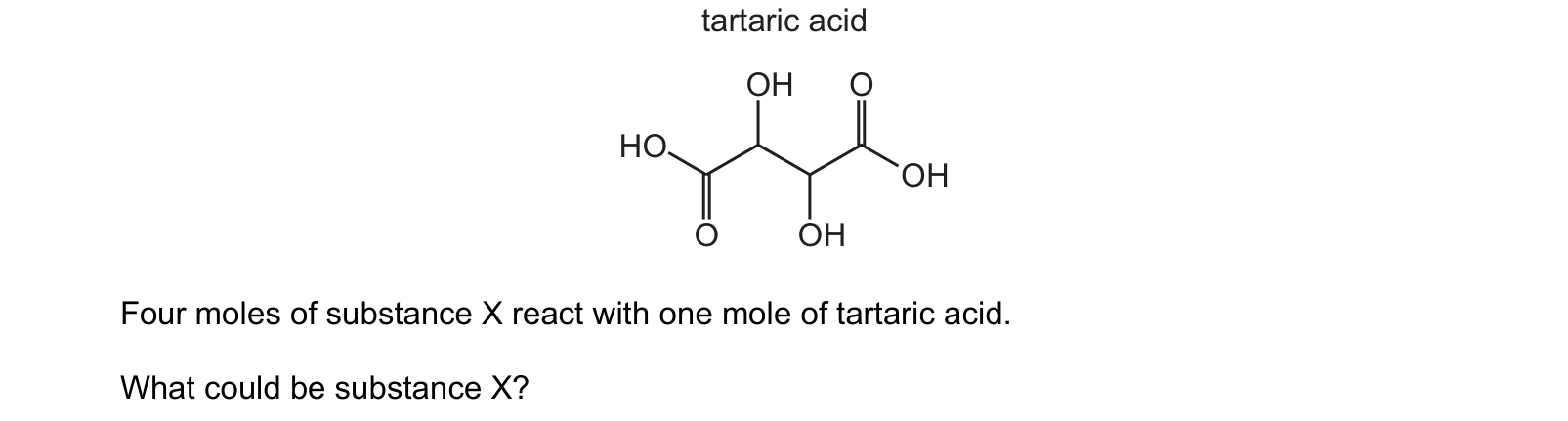
The structure of tartaric acid is shown.
tartaric acid O OH
Four moles of substance X react with one mole of tartaric acid.
What could be substance X?
Answer: A.
Sodium reacts with every O–H group, alcohol and acid alike, releasing hydrogen. So one mole of tartaric acid needs four moles of sodium, which is A.
B, C and D all react only with the carboxylic acid groups. Sodium hydroxide, sodium carbonate and sodium hydrogencarbonate are bases, and an alcohol is far too weakly acidic to react with any of them. So each would react with only the two COOH groups.
The mole ratios differ between those three as well, which is worth noting. Two COOH groups need 2 mol of NaOH or 2 mol of NaHCO₃, but only 1 mol of Na₂CO₃, since the carbonate ion takes two protons.
The pair of reagents is the standard way of telling an alcohol from a carboxylic acid: sodium fizzes with both, and sodium carbonate fizzes only with the acid. Here that distinction is being used quantitatively rather than as a yes-or-no test, and the factor of two between four and two is what identifies the reagent.
Question 2
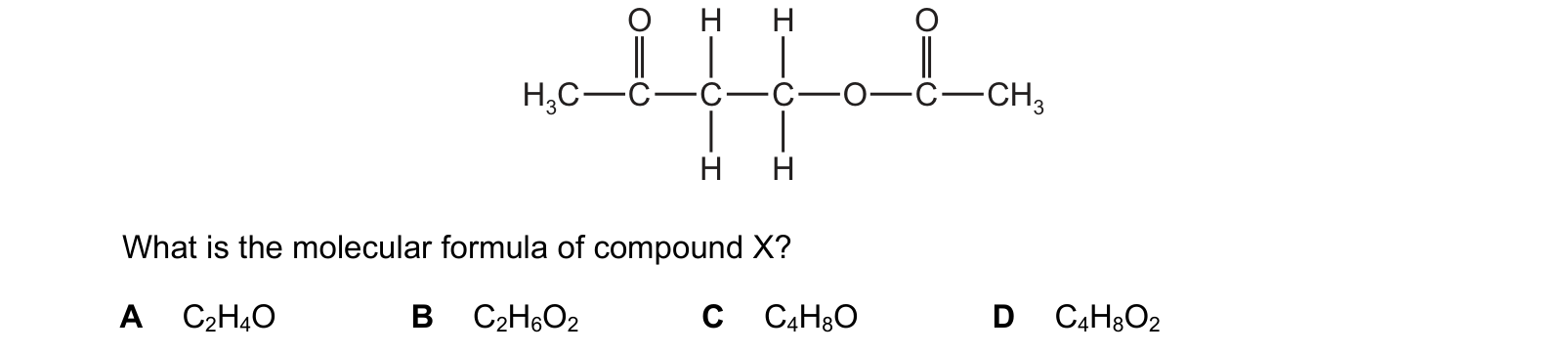
Compound X reacts with ethanoic acid in the presence of an H+ catalyst to produce the compound shown. What is the molecular formula of compound X?
Answer: D.
The product is CH3–CO–CH2–CH2–O–CO–CH3. The ethanoic acid supplied the CH3CO on the right, joined through the ester oxygen. Everything on the other side of that oxygen came from X, and putting the hydrogen back gives:
X = HO–CH2–CH2–CO–CH3
That is 4-hydroxybutan-2-one, a molecule with two functional groups: an alcohol, which is the part that reacted, and a ketone, which is a spectator and survives into the product untouched.
Counting it: C4, from the two CH2 groups, the carbonyl carbon and its methyl. H8, being 2 + 2 + 3 from the carbons and 1 from the OH. O2, the ketone oxygen and the alcohol oxygen.
C, C4H8O, is the answer you get by finding the right skeleton and then counting only one oxygen. Both oxygens in X are visible in the product: one is the ester oxygen, the other is still a C=O on the left.
Only the OH group esterifies. A ketone does not react with a carboxylic acid, which is why it is still there to be counted.
Question 3
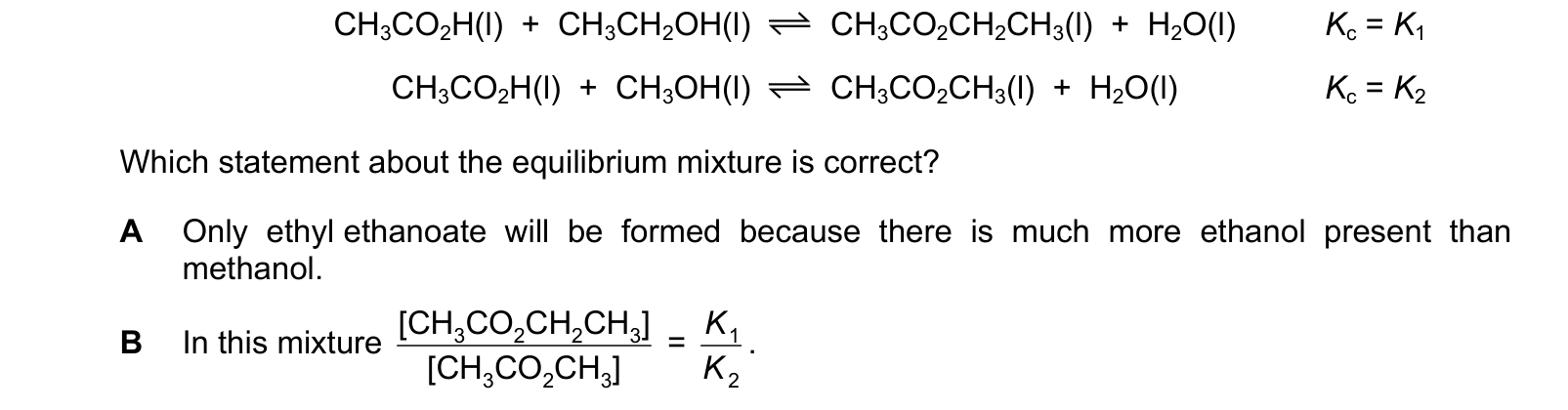
Ethanoic acid is mixed with ethanol.
The ethanol is contaminated with a small amount of methanol.
The following equilibria are established. Which statement about the equilibrium mixture is correct?
Answer: D.
Adding methyl ethanoate pushes the second equilibrium to the left. That releases ethanoic acid and consumes water. Both changes push the first equilibrium to the right, so more ethyl ethanoate forms.
Divide the two Kc expressions and the acid and the water cancel:
[ethyl ethanoate] / [methyl ethanoate] = (K1 / K2) × ([ethanol] / [methanol])
B claims that ratio is just K1/K2, which would need equal amounts of the two alcohols. The question says the methanol is a small contaminant. Water is absent from that relation, which is why C is looking in the wrong place: adding water drives both esterifications back together rather than favouring one ester.
A misreads "much more" as "only". Equilibrium never goes to completion, so the methanol reacts as well and both esters are present.
What the syllabus asks for on this topicSyllabus points
Syllabus points
- Define and use relative atomic, isotopic, molecular and formula mass.
- Define and use the mole and the Avogadro constant.
- Calculate empirical and molecular formulae from composition data.
- Write and balance equations, including ionic equations with state symbols.
- Perform calculations involving reacting masses, volumes of gases and volumes and concentrations of solutions, including limiting reagent and percentage yield.
Related CIE 9701 Chemistry topics
Not the topic you were looking for? Describe what you are stuck on in your own words and we will take you to the notes that answer it.