The Periodic Table: chemical periodicity
Contents: 6 sections
Physical trends across Period 3
Atomic radius decreases from sodium to chlorine. Each step adds a proton to the nucleus and an electron to the same shell, so shielding is essentially unchanged while the nuclear charge rises. The outer electrons are pulled in more tightly.
Ionic radius shows a break rather than a smooth trend, and the break is where the ion changes sign. Na⁺, Mg²⁺ and Al³⁺ have all lost their outer shell, so they are much smaller than their atoms and shrink across the three as the charge rises. P³⁻, S²⁻ and Cl⁻ have gained electrons into the outer shell, so they are larger than their atoms, and they shrink across the three for the same reason. The step up between Al³⁺ and P³⁻ is the feature to know.
First ionisation energy rises across the period, for the same reason the radius falls, with the two dips covered in topic 1: Mg to Al, where the electron comes from a higher-energy 3p orbital, and P to S, where a p electron must pair up.
Melting point and conductivity
These follow structure, not a simple trend, and the period divides into three blocks:
| Elements | Structure | Melting point | Conductivity |
|---|---|---|---|
| Na, Mg, Al | Giant metallic | Rises across the three | High, rising across the three |
| Si | Giant covalent | Very high, the maximum | Semiconductor |
| P, S, Cl, Ar | Simple molecular | Low | None |
Sodium to aluminium rise in melting point because each ion carries a larger charge and contributes more delocalised electrons, so the metallic bonding strengthens. Conductivity rises for the same reason.
Silicon is the peak. It is giant covalent, and melting it means breaking strong covalent bonds throughout the structure.
After silicon the melting points collapse, because only weak intermolecular forces hold the molecules together. Within that block the order follows molecular size: S₈ melts higher than P₄, which melts higher than Cl₂, and argon, a single atom, is lowest of all.
Reactions of the elements
With oxygen, the elements form oxides, and the vigour falls across the period:
- Sodium burns with a yellow flame to Na₂O
- Magnesium burns with a brilliant white flame to MgO
- Aluminium burns to Al₂O₃, though the oxide layer slows it
- Silicon needs strong heating to SiO₂
- Phosphorus burns readily to P₄O₁₀
- Sulfur burns with a blue flame to SO₂
With chlorine, the same pattern gives NaCl, MgCl₂, Al₂Cl₆, SiCl₄, PCl₅ and S₂Cl₂.
With water, only the first two react appreciably:
- Sodium reacts vigorously with cold water, floating and fizzing, giving NaOH and hydrogen. The solution is strongly alkaline, about pH 13.
- Magnesium reacts very slowly with cold water, giving Mg(OH)₂, which is only slightly soluble, so the pH is about 10. With steam it reacts rapidly to give MgO and hydrogen.
The oxides
The acid and base behaviour of the oxides changes across the period, and this is the heart of the topic.
| Oxide | Bonding | Behaviour | pH of the solution |
|---|---|---|---|
| Na₂O | Ionic | Basic | 13 to 14 |
| MgO | Ionic | Basic | 9 (only slightly soluble) |
| Al₂O₃ | Ionic with covalent character | Amphoteric | 7, insoluble |
| SiO₂ | Giant covalent | Weakly acidic | 7, insoluble |
| P₄O₁₀ | Simple molecular | Acidic | 2 |
| SO₂ and SO₃ | Simple molecular | Acidic | 1 to 3 |
The trend is basic to amphoteric to acidic, and it tracks the bonding: metal oxides are ionic and basic, non-metal oxides are covalent and acidic, and aluminium sits on the boundary.
Amphoteric means reacting with both acids and bases, and Al₂O₃ is the example to know:
Al₂O₃ + 6HCl → 2AlCl₃ + 3H₂O
Al₂O₃ + 2NaOH + 3H₂O → 2NaAl(OH)₄
Silicon dioxide is a useful special case: it is insoluble in water, so it does not produce an acidic solution, but it does react with hot concentrated alkali, which is what makes it acidic in character.
The chlorides in water
The chlorides split into two groups, and the difference is bonding again.
Ionic chlorides dissolve. NaCl and MgCl₂ simply dissociate into ions. The solution of NaCl is neutral; MgCl₂ is very slightly acidic, around pH 6.5, because the small highly charged Mg²⁺ ion polarises the water around it.
Covalent chlorides hydrolyse. They react with water rather than dissolving in it, releasing hydrogen chloride fumes and giving strongly acidic solutions:
SiCl₄ + 2H₂O → SiO₂ + 4HCl
PCl₅ + 4H₂O → H₃PO₄ + 5HCl
Aluminium chloride sits between the two, hydrolysing to give an acidic solution of about pH 3.
Steamy fumes of HCl when a chloride meets water is the observation that identifies a covalent chloride, and it is worth remembering as an observation rather than only as an equation.
Common mistakes
- Saying atomic radius increases across a period. It decreases.
- Explaining the melting point trend with one mechanism. It changes with structure, and silicon is the peak.
- Saying Al₂O₃ is basic or acidic. It is amphoteric, and the mark is for saying it reacts with both.
- Saying SiO₂ is basic because it is insoluble. It is weakly acidic and reacts with hot concentrated alkali.
- Saying magnesium reacts vigorously with cold water. It is very slow with cold water and fast only with steam.
- Forgetting that covalent chlorides hydrolyse rather than dissolve, and that the fumes are HCl.
Check you have it
Question 1
Elements Y and Z are both in Period 3 of the Periodic Table.
When the chloride of element Y is added to water, it reacts and a solution of pH 2 is produced.
When the chloride of element Z is added to water, it dissolves and a solution of pH 7 is produced.
Which statement explains these observations?
Answer: D.
Z's chloride dissolves and gives pH 7. A neutral solution means the chloride is ionic and simply dissociates without reacting. Only sodium and magnesium chlorides are ionic, and of those only NaCl is properly neutral: MgCl₂ comes out slightly acidic, around pH 6.5, because Mg²⁺ polarises the water around it. So Z is sodium.
Y's chloride reacts and gives pH 2. That is hydrolysis, which is what the covalent chlorides do:
SiCl₄ + 2H₂O → SiO₂ + 4HCl
so Y is silicon. That is D.
A is directly contradicted by the stem, which says Z's chloride dissolves while Y's reacts, and a pH of 7 is the proof that no hydrolysis happened.
B fails on Y: magnesium chloride is ionic and nowhere near pH 2.
C fails on Z: aluminium chloride is covalent enough to hydrolyse strongly, giving about pH 3, not 7. Its Y is fine, since phosphorus chlorides do give pH 2, which is what makes C the tempting option.
The dividing line runs between magnesium and aluminium. To its left the chlorides are ionic and dissolve; to its right they are covalent and hydrolyse, because the cation becomes too small and too highly charged to hold an ionic lattice together.
Question 2
A student investigated the chloride of a Period 3 element. This is what the student wrote down as a record.
The compound was a white crystalline solid. It dissolved easily in water to give a solution of pH 12. When placed in a test-tube and heated in a roaring Bunsen flame, the compound melted after several minutes heating.
What can be deduced from this record?

Answer: A.
A solution of pH 12 is strongly alkaline, and no Period 3 chloride gives that. The ionic ones simply dissolve: NaCl gives pH 7 and MgCl₂ about pH 6.5, slightly acidic. The covalent ones hydrolyse and give strongly acidic solutions: AlCl₃ about pH 3, and SiCl₄ and PCl₅ about pH 2.
So the pH is impossible, and at least one observation must be wrong, which is A.
B, magnesium chloride, and D, sodium chloride, are both white crystalline solids that dissolve easily, so they fit the first two observations, but neither could give pH 12. NaCl also melts at 801 °C, far above what a Bunsen flame reaches, so the melting observation is wrong for it too.
C, phosphorus pentachloride, is a solid that hydrolyses violently, but it gives pH 2, at the opposite end of the scale, and it sublimes rather than melting.
The question is unusual in rewarding you for not finding a match. The way in is to know the pH range the Period 3 chlorides actually cover, which runs from about 2 to 7 and never above it. An alkaline solution would need an oxide of sodium or magnesium, not a chloride.
Question 3
Sodium, magnesium, aluminium, silicon and phosphorus are all elements in Period 3 of the Periodic Table.
Three statements about the oxides and chlorides of these elements are given.
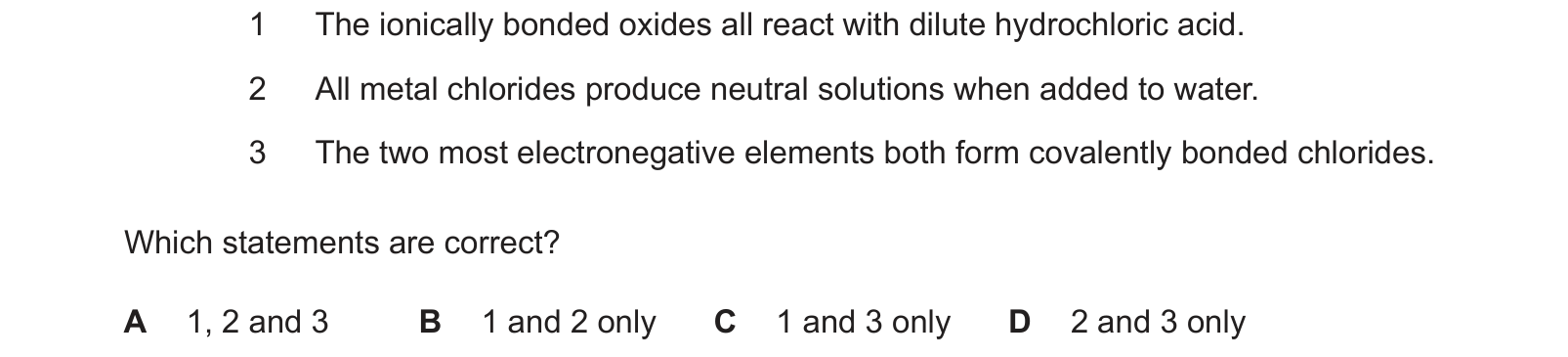
1 The ionically bonded oxides all react with dilute hydrochloric acid.
2 All metal chlorides produce neutral solutions when added to water.
3 The two most electronegative elements both form covalently bonded chlorides.
Which statements are correct?
Answer: C.
1 is correct. The ionically bonded Period 3 oxides are the metal oxides, Na2O and MgO, and they are basic, so both neutralise dilute hydrochloric acid to give the chloride and water.
3 is correct. Of sodium, magnesium, aluminium, silicon and phosphorus, electronegativity rises across the period, so the two highest are silicon and phosphorus. Both form covalent chlorides, SiCl4 and PCl5, which is exactly why they fume in moist air and hydrolyse rather than dissolving.
2 is wrong, and it is the whole question. NaCl does dissolve to a neutral solution, but MgCl2 gives a slightly acidic one and AlCl3 gives a strongly acidic one, around pH 3. The small, highly charged Al³⁺ ion polarises the water molecules around it enough to release H⁺. The word doing the damage in statement 2 is "all".
Bonding changes gradually across Period 3 rather than switching at one point, so a statement that treats all the metals alike is usually the one to check first.
What the syllabus asks for on this topicSyllabus points
Syllabus points
- Describe and explain the trends across Period 3 in atomic radius, ionic radius, melting point and electrical conductivity.
- Describe and explain the trend in first ionisation energy across Period 3.
- Describe the reactions of the Period 3 elements with oxygen, chlorine and water.
- Describe and explain the acid and base behaviour of the Period 3 oxides.
- Describe the reactions of the Period 3 chlorides with water.
Related CIE 9701 Chemistry topics
Not the topic you were looking for? Describe what you are stuck on in your own words and we will take you to the notes that answer it.