Group 17
Contents: 7 sections
The elements
| Halogen | Appearance at room temperature | Colour in solution |
|---|---|---|
| Chlorine | Pale green gas | Very pale green |
| Bromine | Red-brown liquid | Orange |
| Iodine | Grey-black solid, sublimes to purple vapour | Brown in water, violet in an organic solvent |
Volatility decreases down the group, so the melting and boiling points rise. Each atom has more electrons, so the van der Waals forces between molecules are stronger and more energy is needed to separate them. Note that the covalent bond inside the molecule is not being broken here; only the forces between molecules are.
The colours deepen down the group, which is why the organic-solvent test works.
Reactivity as oxidising agents
The halogens are oxidising agents: each gains one electron to form a 1- ion.
Oxidising power decreases down the group. Going down, the atomic radius increases and there is more shielding, so the incoming electron is attracted less strongly and the halogen accepts it less readily.
So chlorine is a stronger oxidising agent than bromine, which is stronger than iodine.
Displacement reactions
A more reactive halogen displaces a less reactive one from its halide:
Cl₂ + 2KBr → 2KCl + Br₂
The solution turns from colourless to orange, because bromine has been released. Chlorine has been reduced and the bromide oxidised.
Cl₂ + 2KI → 2KCl + I₂ turns the solution brown.
Br₂ + 2KI → 2KBr + I₂ also gives brown.
Iodine displaces neither, because it is the weakest oxidising agent of the three. Adding a little organic solvent and shaking makes the results clearer: bromine gives orange in the solvent layer, iodine gives violet.
Reactions of halide ions
With silver nitrate
This is the standard test. Acidify with dilute nitric acid, then add silver nitrate solution:
| Halide | Precipitate | With dilute ammonia | With concentrated ammonia |
|---|---|---|---|
| Chloride | White | Dissolves | Dissolves |
| Bromide | Cream | Stays | Dissolves |
| Iodide | Pale yellow | Stays | Stays |
Ag⁺ + Cl⁻ → AgCl
The ammonia step is what makes the test reliable, because white, cream and pale yellow are hard to tell apart by eye. Solubility in ammonia falls down the group, so the sequence separates them cleanly.
Nitric acid is added first to remove carbonate and hydroxide ions, which would give their own precipitates.
With concentrated sulfuric acid
This one distinguishes the halides by how strongly they reduce, and the products change down the group:
- Chloride gives steamy HCl fumes only. Chloride is too weak a reducing agent to reduce sulfuric acid, so this is simply an acid displacement.
- Bromide gives HBr, and then some red-brown Br₂ vapour and SO₂, because bromide is a strong enough reducing agent to reduce the sulfur from +6 to +4.
- Iodide gives HI, then purple I₂ vapour, and reduces the sulfur further still, to H₂S with its bad-egg smell, and to yellow sulfur.
The trend to state is that reducing power increases down the group, which is the mirror image of the oxidising trend of the elements. The larger the ion, the more easily it gives up its electron.
Chlorine with sodium hydroxide
Cold and dilute sodium hydroxide:
Cl₂ + 2NaOH → NaCl + NaClO + H₂O
Chlorine goes from 0 to -1 in NaCl and to +1 in NaClO, so this is disproportionation. The product, sodium chlorate(I), is the active ingredient of household bleach.
Hot and concentrated sodium hydroxide:
3Cl₂ + 6NaOH → 5NaCl + NaClO₃ + 3H₂O
Again disproportionation, but now to -1 and +5. Sodium chlorate(V) is used as a weedkiller.
The pair is a favourite question, and the temperature is the only thing that distinguishes them.
Chlorine in water treatment
Chlorine reacts with water in a further disproportionation:
Cl₂ + H₂O ⇌ HCl + HClO
Chloric(I) acid, HClO, is the active species. It kills bacteria, and adding chlorine to drinking water has prevented enormous numbers of deaths from cholera and typhoid.
There are real risks alongside that benefit. Chlorine is toxic, and it can react with organic matter in water to form chlorinated hydrocarbons, some of which are suspected carcinogens. The syllabus expects the judgement as well as the facts: the benefits of disinfection are generally considered to outweigh the risks, and that is a decision about weighing harms rather than a purely chemical conclusion.
Common mistakes
- Saying the covalent bonds break when iodine sublimes. Only van der Waals forces between molecules are overcome.
- Saying oxidising power increases down the group. It decreases; reducing power of the halide ions increases.
- Skipping the ammonia step in the silver nitrate test, when the precipitate colours are hard to distinguish.
- Forgetting to acidify with nitric acid before adding silver nitrate.
- Mixing up the two sodium hydroxide reactions. Cold and dilute gives chlorate(I); hot and concentrated gives chlorate(V).
- Saying chlorine itself kills the bacteria in water treatment. The active species is HClO.
Check you have it
Question 1
A mixture of ethane and an excess of chlorine is exposed to UV light.
How many different products, each containing only two carbon atoms and at least one chlorine atom per molecule, can be formed?
Answer: B.
C₂H₅Cl chloroethane: 1
C₂H₄Cl₂: 1,1-dichloroethane and 1,2-dichloroethane: 2
C₂H₃Cl₃: 1,1,1-trichloroethane and 1,1,2-trichloroethane: 2
C₂H₂Cl₄: 1,1,1,2- and 1,1,2,2-tetrachloroethane: 2
C₂HCl₅ pentachloroethane: 1
C₂Cl₆ hexachloroethane: 1
1 + 2 + 2 + 2 + 1 + 1 = 9, which is B.
The two-carbon condition excludes ethane itself, which has no chlorine, and excludes hydrogen chloride, which has no carbon. It also excludes any longer chain made by two radicals joining.
The isomers are what make this more than a count to six. Two, three and four chlorines each allow a choice of how they are shared between the two carbons, and one, five and six do not: with one chlorine there is only one place to put it, with five there is only one place left for the last hydrogen, and with six there is no choice at all.
The symmetry is worth noticing as a check. The list reads 1, 2, 2, 2, 1, 1 rather than a neat palindrome, because C₂H₄Cl₂ and C₂H₂Cl₄ mirror each other while the ends do not.
Question 2
Chlorine and bromine have different volatilities. Which row identifies the more volatile of the two elements, and gives the correct explanation? Each answer gives, in order: identity of the more volatile element; explanation for the difference in volatility.
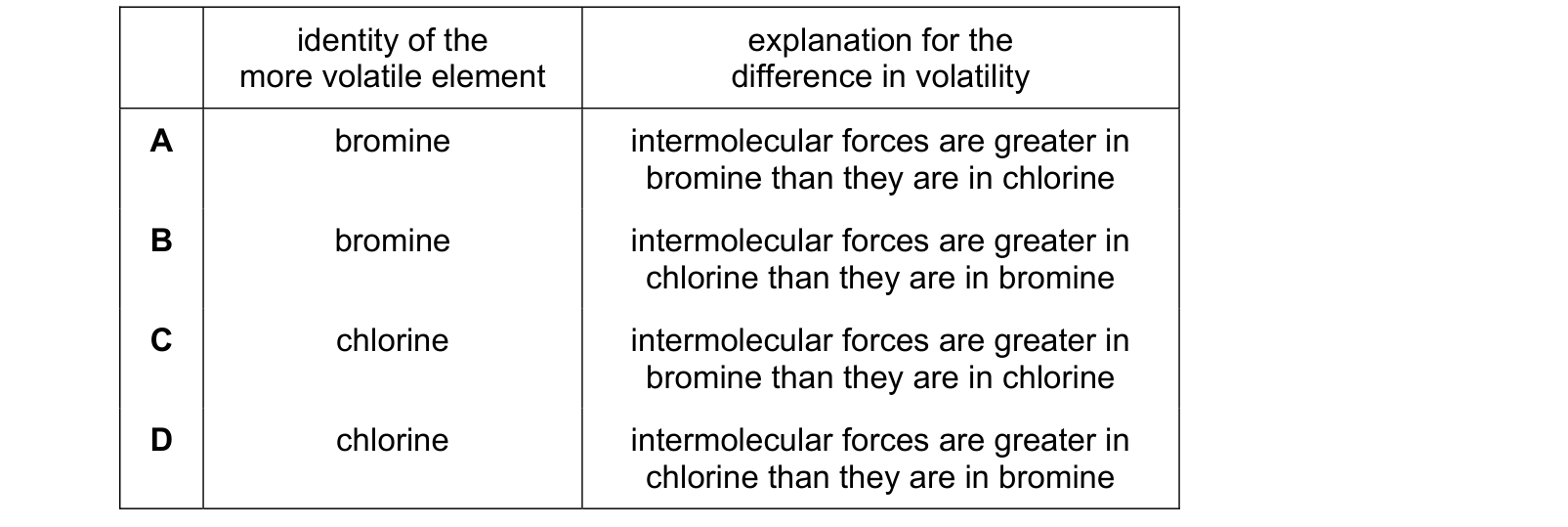
Answer: C.
Both are non-polar diatomic molecules, so the only forces between their molecules are instantaneous dipole-induced dipole forces. A bromine molecule has far more electrons than a chlorine molecule, so its electron cloud is more easily distorted and those forces are stronger.
Stronger forces mean more energy is needed to separate the molecules, so the substance is less volatile. That is why chlorine is a gas at room temperature and bromine a liquid.
The trap is the direction of the link. Volatility and intermolecular force strength run opposite ways, so the more volatile element is the one with the weaker forces. Options A and D pair the right element with the wrong explanation and vice versa, so getting the element right is only half the marks.
The trend continues down the group: iodine has more electrons still and is a solid, and this is one of the clearest demonstrations that instantaneous dipole forces grow with the number of electrons.
Question 3
HOCl(aq) is the molecule that kills bacteria when chlorine is added to water.
The following reaction produces this molecule.
Cl 2(g) + H2O(I) ⇋HOCl(aq) + H+(aq) + Cl –(aq)
Which statement about this reaction is correct?
Answer: A.
Chlorine starts as the element, so its oxidation number is 0.
In Cl⁻ it is −1, so that chlorine has been reduced.
In HOCl the hydrogen is +1 and the oxygen is −2, so the chlorine is +1, and that one has been oxidised.
One atom up and one down, from a single starting species. Chlorine is both oxidised and reduced, which is A, and the process is disproportionation.
B describes only half of it, which is the usual slip: the HOCl is easy to spot as an oxidation and the chloride ion easy to dismiss as just a spectator.
C and D look at the hydrogen, which is +1 in water and +1 in both products, so it does not change at all. The oxygen is likewise −2 throughout.
This is the reaction that makes chlorinated water work. The HOCl is the active part, because it is small and uncharged and can cross a bacterial cell membrane, which the chloride ion cannot. It is also a weak acid, so much of it stays undissociated and available.
What the syllabus asks for on this topicSyllabus points
Syllabus points
- Describe the trends in volatility and colour of the halogens.
- Describe and explain the relative reactivity of the halogens as oxidising agents, including displacement reactions.
- Describe the reactions of halide ions with silver nitrate and with concentrated sulfuric acid.
- Describe and explain the reaction of chlorine with cold and with hot aqueous sodium hydroxide.
- Explain the use of chlorine in water treatment, and the balance of risks and benefits.
Related CIE 9701 Chemistry topics
Not the topic you were looking for? Describe what you are stuck on in your own words and we will take you to the notes that answer it.