Group 17: five questions to try now
Real past-paper questions, the answer key from the mark scheme, and the explanation that goes with it. No account needed to answer them.
Question 1
ICl is made when Cl2 and I2 react together. ICl reacts with water. Which row is correct? Each answer gives, in order: oxidation number of I in ICl; reaction occurring when ICl reacts with H2O.
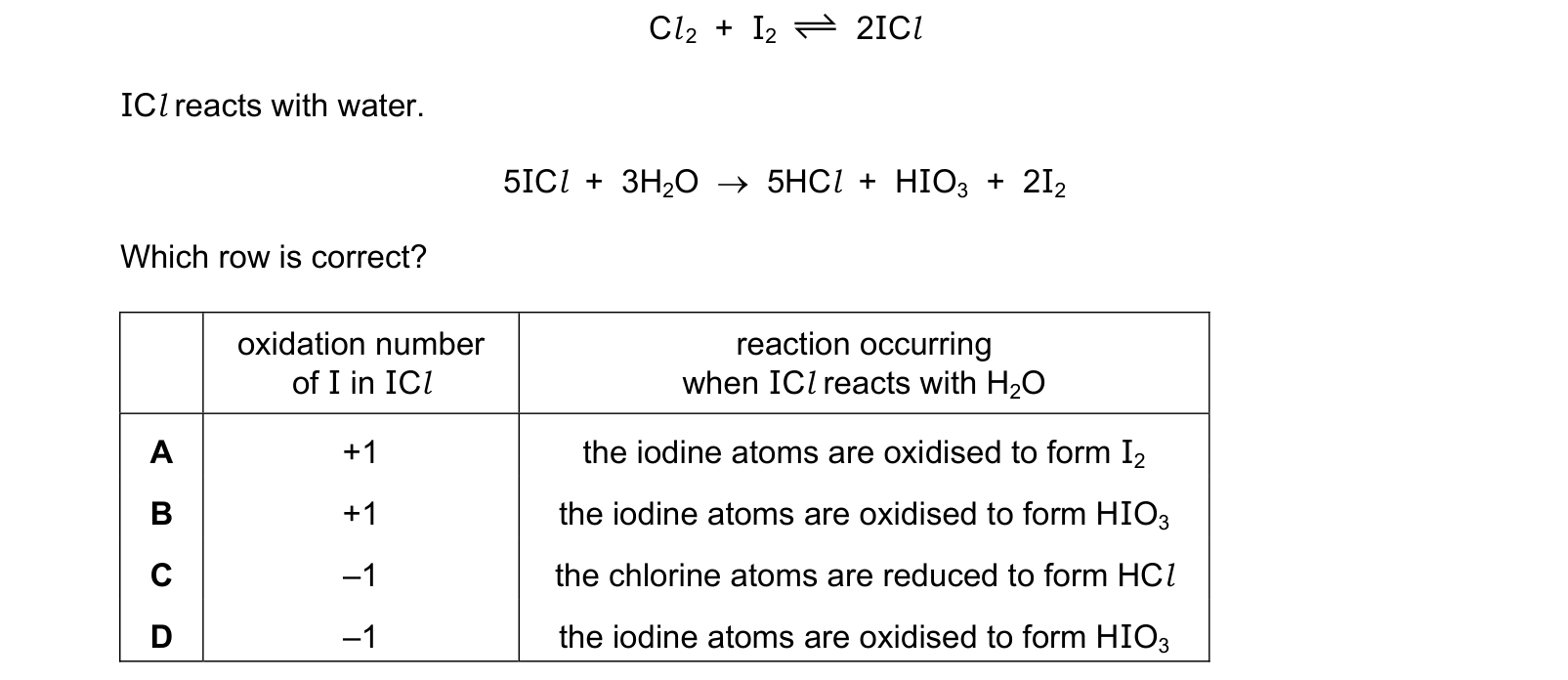
Answer: B.
The oxidation number. In a compound between two non-metals, the more electronegative atom takes the negative number. Chlorine is more electronegative than iodine, so chlorine is –1 and iodine is +1. That alone eliminates C and D, which is worth doing first because it is the quick half.
Iodine only ever takes a negative oxidation number when it is bonded to something less electronegative than itself, as in HI or NaI.
What the water does. With iodine starting at +1, look at where each option would take it. HIO3 has iodine at +5, since the three oxygens give –6 and the hydrogen gives +1. Going from +1 to +5 is a rise, so it is genuinely oxidation, and B is consistent.
A is self-contradictory and worth spotting for that reason alone. I2 is an element, so its iodine is 0, and moving from +1 down to 0 is a reduction. An option cannot describe a fall in oxidation number and call it oxidation.
Check the arithmetic before the chemistry on these rows. Two of the four options here can be dismissed on the numbers without knowing anything about how interhalogen compounds hydrolyse.
Question 2
The table refers to the hydrogen halides. Which row is correct? Each answer gives, in order: oxidation; thermal stability.
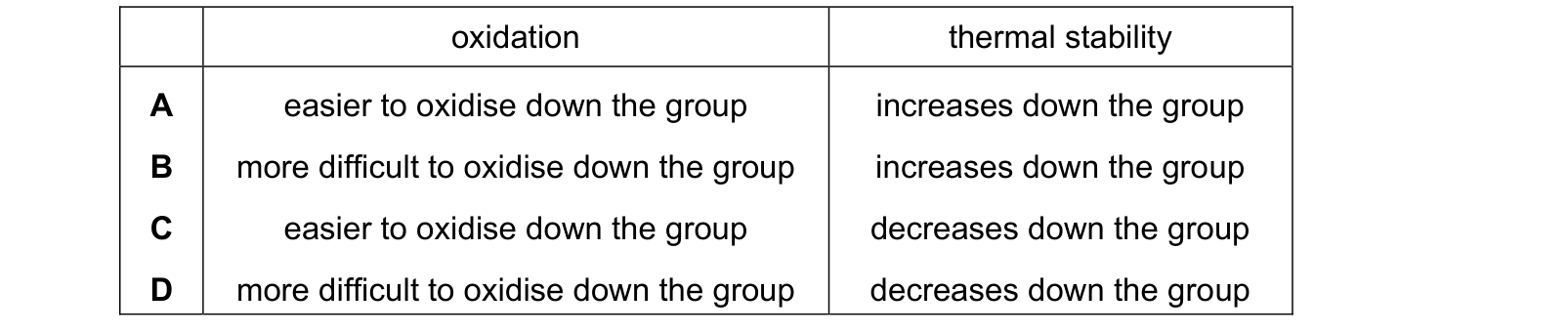
Answer: C.
Ease of oxidation: easier down the group. Oxidising a hydrogen halide means taking electrons from the halide, and a larger halide ion holds its outer electrons less tightly. HI is oxidised so readily that it reduces concentrated sulfuric acid all the way to H₂S, while HCl cannot reduce it at all.
Thermal stability: decreases down the group. A weaker bond breaks at a lower temperature. HCl is stable well past 1000 °C, while HI decomposes noticeably at around 300 °C.
So easier to oxidise and less stable, which is C.
The two trends run in opposite directions as written, which is what makes the four options look symmetrical, but they have the same underlying cause. Anything that makes the bond weaker makes the compound both easier to break up by heat and easier to oxidise.
Hydrogen fluoride is the outlier at the top, with a bond so strong that HF is exceptionally stable, and it is also the only one of the four that is a weak acid in water for the same reason.
Question 3
When bromoethane reacts with hot ethanolic sodium hydroxide a colourless gas is formed. This gas decolourises aqueous bromine.
What is the colourless gas?
Answer: C.
Hot ethanolic sodium hydroxide gives elimination. The hydroxide acts as a base, pulling a hydrogen off the carbon next to the C–Br, and the bromide leaves:
CH₃CH₂Br + OH⁻ → CH₂=CH₂ + Br⁻ + H₂O
so the gas is ethene, which is C.
The confirmation is in the stem. Ethene decolourises aqueous bromine, which is the standard test for a carbon-carbon double bond, and only an unsaturated compound does that.
B is what the other conditions would give. Warm aqueous sodium hydroxide gives substitution, with the hydroxide acting as a nucleophile to make ethanol. But ethanol is a liquid at room temperature, not a colourless gas, and it does not decolourise bromine.
A is a product of the test, not of the reaction: the ethene adds bromine to give 1,2-dibromoethane, and that is a liquid.
D, hydrogen bromide, is colourless but would not decolourise bromine water.
The pair to hold on to is aqueous and warm gives substitution, ethanolic and hot gives elimination. The same reagent behaves as a nucleophile in one and a base in the other.
Question 4
Ethane reacts with an excess of chlorine in the presence of ultraviolet light to form a mixture of products.
How many of these products contain two carbon atoms and one or more chlorine atoms?
Answer: D.
C₂H₅Cl chloroethane: 1
C₂H₄Cl₂: 1,1-dichloroethane and 1,2-dichloroethane: 2
C₂H₃Cl₃: 1,1,1-trichloroethane and 1,1,2-trichloroethane: 2
C₂H₂Cl₄: 1,1,1,2- and 1,1,2,2-tetrachloroethane: 2
C₂HCl₅ pentachloroethane: 1
C₂Cl₆ hexachloroethane: 1
1 + 2 + 2 + 2 + 1 + 1 = 9, which is D.
The two-carbon condition excludes ethane itself, which has no chlorine, and excludes hydrogen chloride, which has no carbon. It also excludes any longer chain made by two radicals joining.
The isomers are what make this more than a count to six. Two, three and four chlorines each allow a choice of how they are shared between the two carbons, and one, five and six do not: with one chlorine there is only one place to put it, with five there is only one place left for the last hydrogen, and with six there is no choice at all.
The symmetry is worth noticing as a check. The list reads 1, 2, 2, 2, 1, 1 rather than a neat palindrome, because C₂H₄Cl₂ and C₂H₂Cl₄ mirror each other while the ends do not.
Question 5
The colours of the silver halides AgCl, AgBr and AgI differ. The solubilities of these halides in aqueous ammonia also differ. Which row is correct? Each answer gives, in order: colour of AgBr; silver halide that is most soluble in NH3(aq).
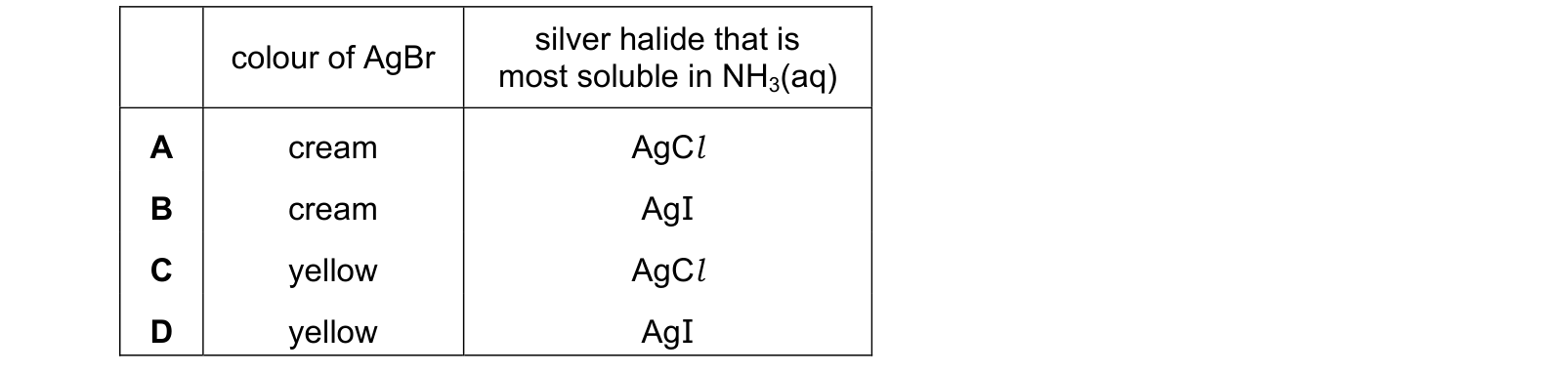
Answer: A.
The colours. AgCl is white, AgBr is cream, and AgI is yellow. So AgBr is cream, which removes C and D.
The ammonia solubilities. AgCl dissolves in dilute ammonia, AgBr needs concentrated ammonia, and AgI dissolves in neither. So the most soluble is AgCl, which makes A the answer.
Both trends run the same way down the group, which is worth noticing: the larger the halide ion, the deeper the colour and the more insoluble the silver salt. The two are connected, since both reflect the increasing covalent character of the silver halide as the anion becomes larger and more easily polarised by the small Ag⁺ ion.
The ammonia step is what makes the test usable in practice. The three precipitate colours are genuinely hard to tell apart by eye, particularly in dim light or against a white tile, but the solubilities are unambiguous: add dilute ammonia first, then concentrated, and whichever stage the precipitate dissolves at identifies the halide.
What this practice covers
These questions are drawn from past CIE 9701 Chemistry papers. You answer, you find out immediately whether you were right, and you get the reasoning for the correct option and for each distractor. Wrong answers go to a mistakes locker so you can come back to exactly those.
Practice is free. You need an account only so your progress and your mistakes are still there next time.
What examiners see students get wrong here
These are the errors that cost marks on group 17, taken from our own topic notes. Read them before you practise and you will recognise the traps in the questions.
- Saying the covalent bonds break when iodine sublimes. Only van der Waals forces between molecules are overcome.
- Saying oxidising power increases down the group. It decreases; reducing power of the halide ions increases.
- Skipping the ammonia step in the silver nitrate test, when the precipitate colours are hard to distinguish.
- Forgetting to acidify with nitric acid before adding silver nitrate.
- Mixing up the two sodium hydroxide reactions. Cold and dilute gives chlorate(I); hot and concentrated gives chlorate(V).
- Saying chlorine itself kills the bacteria in water treatment. The active species is HClO.
Revise it first
If any of the above is unfamiliar, work through the notes before practising: Group 17 revision notes.