Nitrogen compounds
Contents: 7 sections
Amines
An amine is ammonia with one or more hydrogens replaced by an alkyl or aryl group. They are classified by how many groups are attached to the nitrogen:
| Class | Groups on N | Example |
|---|---|---|
| Primary | 1 | CH₃NH₂ |
| Secondary | 2 | (CH₃)₂NH |
| Tertiary | 3 | (CH₃)₃N |
Note that this is not the same rule as for alcohols, where the count is of carbons attached to the carbon bearing the OH. Here it is groups attached to the nitrogen itself. Mixing the two up is easy and costly.
Making amines
From a halogenoalkane, heated with excess ammonia in ethanol in a sealed tube:
CH₃CH₂Br + 2NH₃ → CH₃CH₂NH₂ + NH₄Br
Excess ammonia is specified because the amine produced is itself a nucleophile and reacts further, giving secondary and tertiary amines and finally a quaternary ammonium salt. Excess ammonia makes the first substitution the most likely, but the product is still a mixture, so this is not a clean synthesis.
From a nitrile, by reduction with LiAlH₄ in dry ether, or with hydrogen over a nickel catalyst:
CH₃CN + 4[H] → CH₃CH₂NH₂
This route is cleaner, and it combines usefully with the KCN reaction from topic 15: halogenoalkane to nitrile adds a carbon, then reduction gives the amine.
Phenylamine is made by reducing nitrobenzene with tin and concentrated hydrochloric acid, then adding alkali.
Basicity
Amines are bases, because the lone pair on the nitrogen can accept a proton:
CH₃NH₂ + H⁺ → CH₃NH₃⁺
Anything that makes that lone pair more available makes the amine a stronger base. The order is
aliphatic amine > ammonia > phenylamine
- An alkyl group pushes electron density towards the nitrogen, making the lone pair more available. So ethylamine is a stronger base than ammonia.
- In phenylamine the lone pair is delocalised into the benzene ring, so it is much less available to accept a proton. Phenylamine is therefore a much weaker base than ammonia.
That is the same delocalisation argument as for phenol's acidity, working in the opposite direction, and noticing the pattern makes both easier to remember.
Amides
An amide contains CONH₂. They are made by reacting an acyl chloride with ammonia or with an amine:
CH₃COCl + 2NH₃ → CH₃CONH₂ + NH₄Cl
Amides are not basic, unlike amines, because the nitrogen lone pair is delocalised onto the carbonyl oxygen and is not available.
Hydrolysis breaks them apart:
- With dilute acid, giving the carboxylic acid and an ammonium salt.
- With dilute alkali, giving the carboxylate salt and ammonia.
Amino acids
An amino acid has both an amino group and a carboxylic acid group. The ones in proteins are 2-amino acids, with both groups on the same carbon, general formula RCH(NH₂)COOH.
Except for glycine, where R is hydrogen, that carbon has four different groups, so it is a chiral centre and amino acids exist as optical isomers.
Zwitterions
Amino acids are crystalline solids with unexpectedly high melting points and good solubility in water, and the explanation is the zwitterion: the acid group donates its proton to the amino group of the same molecule, giving a species with both a positive and a negative charge and no overall charge.
⁺NH₃CHRCOO⁻
The strong ionic attraction between zwitterions is what gives the high melting point, and it is why an amino acid behaves more like an ionic solid than like a small organic molecule.
The charge depends on pH, and this is the standard question:
| Conditions | Form | Overall charge |
|---|---|---|
| Low pH, acidic | ⁺NH₃CHRCOOH | Positive |
| Isoelectric point | ⁺NH₃CHRCOO⁻ | Zero |
| High pH, alkaline | NH₂CHRCOO⁻ | Negative |
In acid the extra H⁺ protonates the carboxylate; in alkali the OH⁻ removes a proton from the ammonium group. Working out which group changes at which pH is the whole of the question.
Peptides and proteins
Two amino acids join by a condensation reaction, losing water, and the bond formed between the carbon of one carboxyl group and the nitrogen of the next amino group is a peptide bond, which is an amide link.
A dipeptide has two residues; a polypeptide has many. Two different amino acids can form two different dipeptides, depending on which one contributes its acid group, and that is worth checking in questions asking how many products are possible.
Hydrolysis reverses it, breaking the protein into its amino acids. Refluxing with 6 mol dm⁻³ hydrochloric acid for several hours is the usual laboratory method.
Common mistakes
- Classifying an amine by the carbons on the adjacent carbon. Count the groups on the nitrogen.
- Saying phenylamine is a stronger base than ammonia. The delocalised lone pair makes it much weaker.
- Saying amides are basic like amines. The lone pair is delocalised onto the carbonyl oxygen.
- Forgetting excess ammonia in the halogenoalkane route, or claiming the product is pure.
- Drawing the zwitterion with the wrong groups charged. The acid loses its proton and the amine gains it.
- Saying an amino acid is negative in acid. In acid it is positive.
Check you have it
Question 1
Propyl propanoate can be synthesised in three steps using propanenitrile as the only organic starting material.
In step 1, the nitrile is converted into compound X.
In step 2, compound X is converted into compound Y.
In step 3, compound Y is reacted with more of compound X to give propyl propanoate.
step 1 step 2 step 3 Which reagents are suitable for carrying out step 1 and step 2? Each answer gives, in order: step 1; step 2.
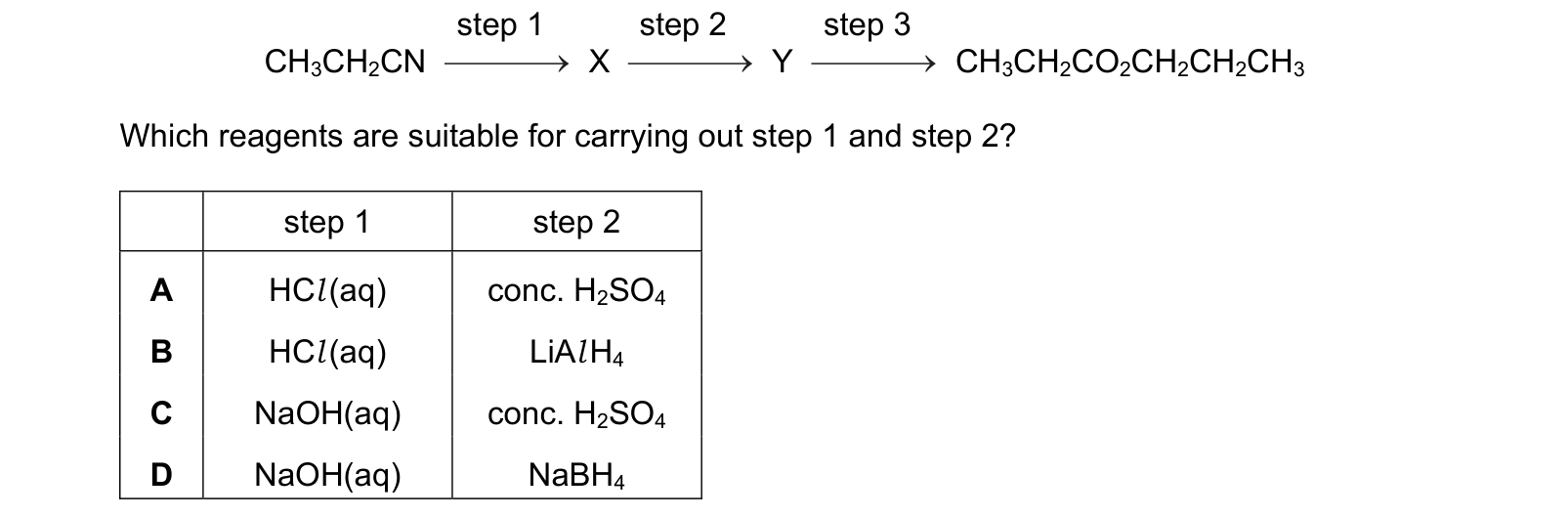
Answer: B.
The target is propyl propanoate, CH3CH2COO–CH2CH2CH3, and step 3 makes it by esterifying Y with X. An ester comes from an acid and an alcohol, so one of them is propanoic acid and the other propan-1-ol. Since X is made first and directly from the nitrile, X is the acid and Y the alcohol.
Step 1, nitrile to acid. Hydrolysing CH3CH2CN under acidic conditions gives the carboxylic acid itself. Hydrolysing it with NaOH(aq) would give the sodium carboxylate salt instead, which needs a further acidification before it can be esterified, and no such step is offered. That rules out C and D.
Step 2, acid to alcohol. Reducing a carboxylic acid to a primary alcohol needs LiAlH4, which is strong enough. NaBH4 is not: it reduces aldehydes and ketones but leaves a carboxylic acid untouched, which is the other reason D fails.
A puts concentrated H2SO4 in step 2, but that is the catalyst for step 3, the esterification. It converts nothing into an alcohol.
Both carbon chains in the product are three carbons long, which is the clue that a single starting material can supply both halves.
What the syllabus asks for on this topicSyllabus points
Syllabus points
- Describe the formation of amines from halogenoalkanes and by the reduction of nitriles.
- Explain the basicity of amines and compare aliphatic amines, ammonia and phenylamine.
- Describe the formation and hydrolysis of amides.
- Describe the structure of amino acids and explain zwitterion formation.
- Describe the formation of peptide bonds and the hydrolysis of proteins.
Related CIE 9701 Chemistry topics
Not the topic you were looking for? Describe what you are stuck on in your own words and we will take you to the notes that answer it.