Chemical bonding
Contents: 7 sections
The three strong bonds
| Bond | Formed between | Held together by |
|---|---|---|
| Ionic | Metal and non-metal | Electrostatic attraction between oppositely charged ions |
| Covalent | Non-metal and non-metal | Shared pair of electrons attracted to both nuclei |
| Metallic | Metal atoms | Attraction between positive ions and delocalised electrons |
A dative covalent (or co-ordinate) bond is a covalent bond in which both electrons come from the same atom. Once formed it is identical to any other covalent bond. The standard examples are NH₄⁺, where the lone pair on nitrogen bonds to H⁺, and Al₂Cl₆.
Electronegativity and polarity
Electronegativity is the ability of an atom to attract the bonding electrons in a covalent bond.
It increases across a period, because nuclear charge rises while the atomic radius falls, and decreases down a group, because the bonding pair is further from the nucleus and better shielded. The most electronegative elements are fluorine, oxygen, nitrogen and chlorine.
When two different atoms are bonded, the electrons sit closer to the more electronegative one. This produces a permanent dipole, written δ+ and δ-.
A molecule with polar bonds is not necessarily a polar molecule. CO₂ is non-polar even though each C=O bond is polar, because the molecule is linear and the two dipoles point in opposite directions and cancel. H₂O is polar because it is bent, so the dipoles do not cancel. Symmetry decides it.
Shapes of molecules
The rule is short: electron pairs repel and arrange themselves as far apart as possible, and lone pairs repel more strongly than bonding pairs.
The order of repulsion is lone/lone > lone/bonding > bonding/bonding. Each lone pair squeezes the bond angle by roughly 2.5°.
| Electron pairs | Lone pairs | Shape | Bond angle |
|---|---|---|---|
| 2 | 0 | Linear | 180° |
| 3 | 0 | Trigonal planar | 120° |
| 4 | 0 | Tetrahedral | 109.5° |
| 4 | 1 | Pyramidal | 107° |
| 4 | 2 | Bent | 104.5° |
| 5 | 0 | Trigonal bipyramidal | 120° and 90° |
| 6 | 0 | Octahedral | 90° |
The ammonia and water sequence is worth learning as a set, because it shows the rule working. Methane has four bonding pairs and no lone pairs, so 109.5°. Ammonia has three bonding pairs and one lone pair, so 107°. Water has two bonding pairs and two lone pairs, so 104.5°.
To work out a shape: count the electron pairs around the central atom, decide how many are lone pairs, then read off the arrangement.
Intermolecular forces
These are far weaker than covalent bonds and act between molecules. They decide melting point, boiling point and solubility, not the strength of the substance's own bonds.
Van der Waals forces (induced dipole to induced dipole) exist between all molecules. Electrons move at random, so at any instant a molecule has a temporary dipole, which induces one in its neighbour. They get stronger as the number of electrons increases, which is why boiling points rise down Group 17 and along the alkanes.
Permanent dipole forces act between polar molecules and are stronger than van der Waals forces of comparable size.
Hydrogen bonding is the strongest of the three. It occurs when hydrogen is bonded to nitrogen, oxygen or fluorine and is attracted to a lone pair on the N, O or F of another molecule. Those three elements are highly electronegative and small, so the δ+ on hydrogen is large and the approach is close.
Why water is anomalous
Water boils at 100 °C, far above what its Mᵣ of 18 would suggest, because breaking apart the liquid means breaking many hydrogen bonds.
Ice is less dense than water, which is unusual and biologically important. In ice each water molecule forms four hydrogen bonds in a rigid tetrahedral lattice that holds the molecules further apart than in the liquid. Ice therefore floats, and ponds freeze from the top down.
Water also has a high surface tension and a high specific heat capacity for the same reason.
Structure and properties
| Structure | Example | Melting point | Conducts? |
|---|---|---|---|
| Giant ionic | NaCl | High | Only when molten or aqueous |
| Giant covalent | Diamond, SiO₂ | Very high | No (graphite is the exception) |
| Simple molecular | I₂, CO₂ | Low | No |
| Giant metallic | Mg | High | Yes, solid or liquid |
A simple molecular substance melts at a low temperature because only the intermolecular forces are broken, not the covalent bonds inside the molecules. Saying that the covalent bonds break when iodine melts is a serious error, and a common one.
Graphite conducts because each carbon uses only three of its four outer electrons in bonding, leaving one delocalised electron per atom free to move.
Common mistakes
- Saying covalent bonds break when a simple molecular solid melts. Only the intermolecular forces break.
- Calling CO₂ polar. The bonds are polar; the linear molecule is not.
- Saying hydrogen bonding occurs whenever hydrogen is present. It needs H bonded to N, O or F.
- Forgetting that lone pairs count when working out a shape, or forgetting they repel more.
- Writing the ammonia bond angle as 109.5°. One lone pair reduces it to 107°.
- Describing metallic bonding as attraction between atoms. It is between positive ions and delocalised electrons.
Check you have it
Question 1
An ion contains 1 nitrogen atom and 2 hydrogen atoms. It has an H–N–H bond angle of approximately 105°. Which row is correct? Each answer gives, in order: number of lone pairs around N in ion; overall charge on ion.
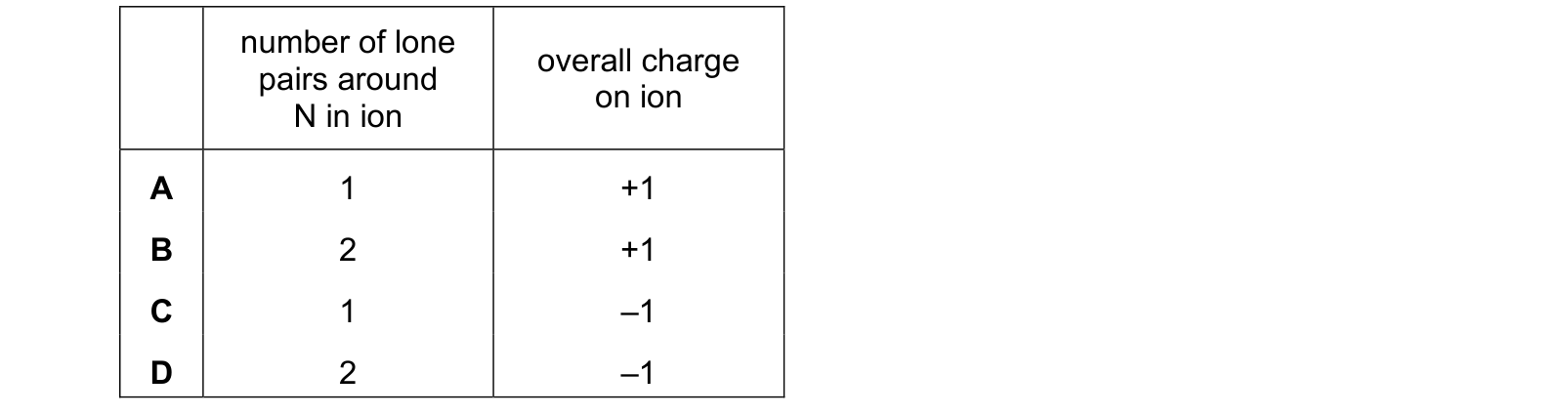
Answer: D.
Two bonding pairs on their own would give a linear shape at 180°. An angle near 105° means there are extra regions of electron density pushing the bonds together, and the closer the angle is to 104.5°, the more lone pairs are doing the pushing.
With two bonding pairs and two lone pairs there are four regions, arranged tetrahedrally, and the two lone pairs squeeze the bonds to about 104 or 105°. That matches, so 2 lone pairs.
Now count the electrons. Nitrogen brings 5, two bonds use 2 of them, leaving 3. For two full lone pairs the nitrogen needs 4 non-bonding electrons, so one extra has been gained and the ion carries a charge of −1.
So 2 lone pairs and a charge of −1, which is D. The ion is NH₂⁻, the amide ion.
A and B offer +1, which would be NH₂⁺. That ion has one lone pair, since nitrogen's 5 electrons less 2 for bonds less 1 for the charge leaves 2, and with only one lone pair the angle would be considerably wider, closer to 120°.
The angle is doing all the work here, and the sequence to remember is 109.5° for no lone pairs, 107° for one and about 104.5° for two.
Question 2
Phosphorus forms a compound with hydrogen called phosphine, PH3. This compound can react with a hydrogen ion, H+.
Which type of interaction occurs between PH3 and H+?
Answer: A.
The phosphorus donates both electrons of its lone pair to form the new bond, and a bond in which one atom supplies both electrons is a dative covalent, or coordinate, bond. That is A, and the product is the phosphonium ion PH₄⁺.
D is ruled out because an ionic bond needs electrons to be transferred to form separate ions. Here the electrons are shared, and the charge ends up spread over the whole PH₄⁺ ion.
B and C are both intermolecular forces, which act between molecules that already exist. The question is about a new bond being made, and neither dipole-dipole attraction nor hydrogen bonding creates one.
C is also impossible on its own terms: hydrogen bonding needs hydrogen attached to N, O or F, and phosphorus is none of those.
Question 3
Ammonium ions, NH4 +, are formed when ammonia gas reacts with hydrogen chloride gas.
Which statement about the changes that occur in this reaction is correct?
Answer: C.
B is the wrong direction, and it is the one worth getting right. Losing the lone pair removes its extra repulsion, so the H–N–H angle increases from about 107° to 109.5°.
A is wrong because NH₄⁺ is a symmetrical tetrahedron: its four identical N–H bond dipoles cancel, so it has no net dipole moment at all, while ammonia is pyramidal and definitely polar.
D describes ionic bond formation. No electron is transferred here: the hydrogen chloride's H–Cl bond breaks heterolytically, the chlorine keeping both electrons, and the nitrogen's own lone pair forms the new bond.
What the syllabus asks for on this topicSyllabus points
Syllabus points
- Describe ionic, covalent, dative covalent and metallic bonding.
- Use electronegativity to explain bond polarity.
- Predict the shapes of simple molecules and ions, and their bond angles, using electron pair repulsion.
- Describe hydrogen bonding, permanent dipole and van der Waals forces, and explain their effect on physical properties.
- Explain the anomalous properties of water in terms of hydrogen bonding.
Related CIE 9701 Chemistry topics
Not the topic you were looking for? Describe what you are stuck on in your own words and we will take you to the notes that answer it.