Chemical bonding: five questions to try now
Real past-paper questions, the answer key from the mark scheme, and the explanation that goes with it. No account needed to answer them.
Question 1
VSEPR theory should be used in answering this question.
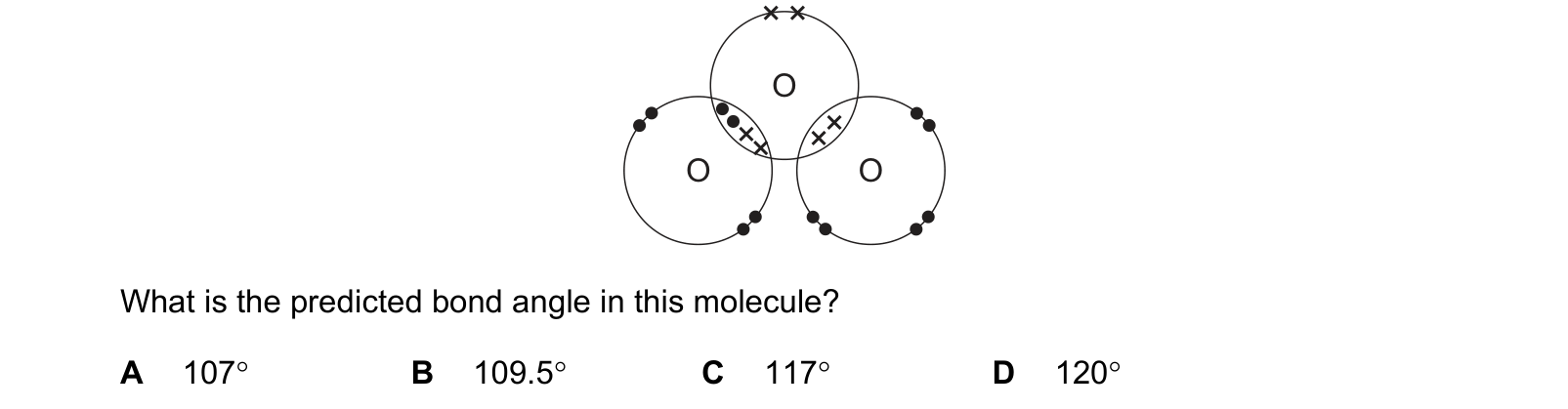
The dot-and-cross diagram for an ozone, O3, molecule is shown. What is the predicted bond angle in this molecule?
Answer: C.
The dot-and-cross diagram shows the central atom with two bonded oxygens and one lone pair, which is three regions in total.
Three regions repel to a trigonal planar arrangement, whose ideal angle is 120°. But a lone pair is held by one nucleus rather than shared between two, so it spreads out more and pushes the bonding pairs together harder than they push each other. The angle closes slightly, to a little under 120°.
Of the values offered, 117° is the only one just below 120°, and it is the accepted figure for ozone.
D, 120°, is the answer with the lone pair ignored, which would describe a molecule like BF3.
A, 107°, and B, 109.5°, both belong to four regions of electron density: 109.5° for four bonding pairs as in methane, and 107° for three bonding pairs and one lone pair as in ammonia. Reaching for 107 because there is one lone pair is the trap, since the number of lone pairs matters only after the total number of regions has fixed the basic shape.
Question 2
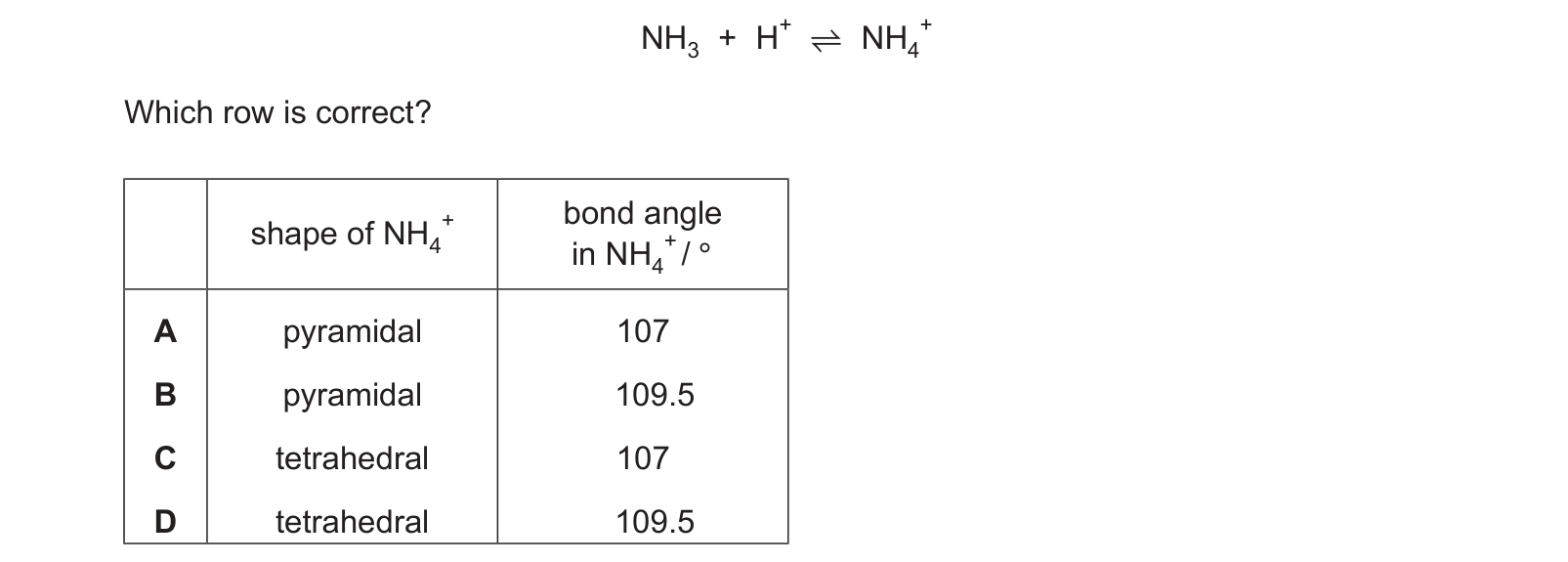
Ammonia reacts with acids to form the ammonium ion. NH 3 + H + ⇋1+ NH 4 + Which row is correct? Each answer gives, in order: shape of NH4 +; bond angle in NH4 +/°.
Answer: D.
Nitrogen has five outer electrons. Three form ordinary bonds to hydrogen, and the lone pair forms a coordinate bond to the fourth hydrogen, the H⁺ it accepted. So there are four bonding pairs and no lone pairs.
Four bonding pairs repel to the maximum separation, which is tetrahedral with a bond angle of 109.5°. That is D.
A and C both say 107°, which is ammonia's angle. There the lone pair is still a lone pair, and a lone pair repels more strongly than a bonding pair, so it squeezes the three N–H bonds together.
A and B say pyramidal, which is again ammonia. A pyramid is what four regions look like when one of them is a lone pair you cannot see.
The 2.5° difference is the whole point of the pair. Donating the lone pair away removes the extra repulsion and lets the bonds open out to the ideal angle, and it also makes all four N–H bonds identical, since a coordinate bond is indistinguishable from an ordinary one once formed.
Question 3
VSEPR theory should be used to answer this question.
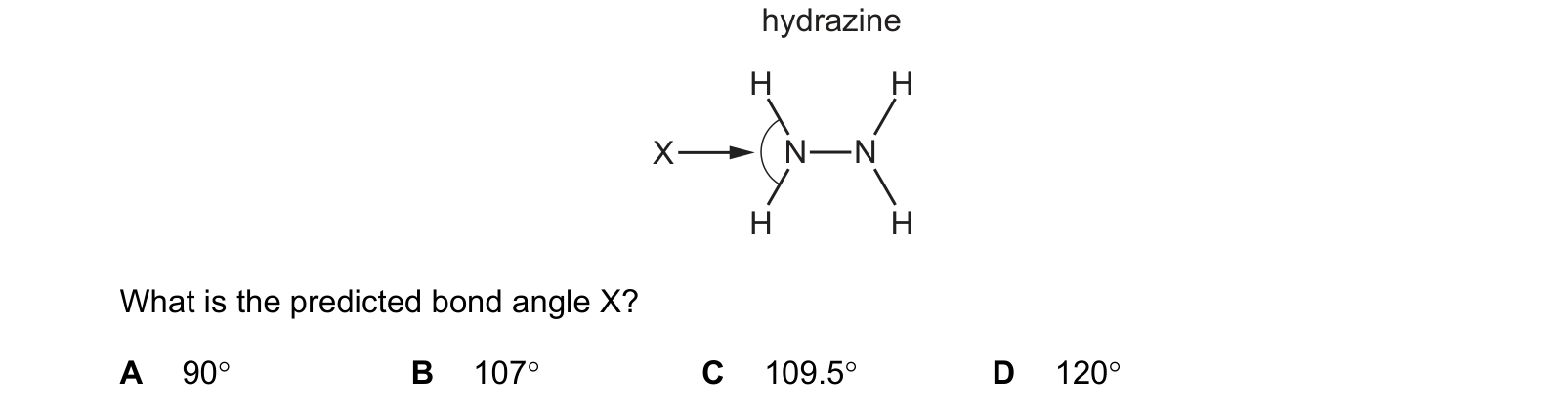
Hydrazine has the following structure.
hydrazine What is the predicted bond angle X?
Answer: B.
Nitrogen has five outer electrons. It uses three in bonds, two to hydrogen and one to the other nitrogen, which leaves one lone pair.
That is four regions of electron density: three bonding pairs and one lone pair. Four regions arrange themselves tetrahedrally, but a lone pair repels more strongly than a bonding pair, so it squeezes the bonds slightly closer together. The angle falls from the ideal 109.5° to about 107°, which is B.
C, 109.5°, is the angle with four bonding pairs and no lone pair, as in methane or NH₄⁺.
D, 120°, needs three regions, as in BF₃.
A, 90°, belongs to an octahedron.
Hydrazine's nitrogen is in exactly the same situation as ammonia's: three bonds and one lone pair. The only difference is that one of the three bonds goes to another nitrogen rather than to a hydrogen, and that makes no difference to the count of regions, which is all VSEPR cares about.
The sequence to hold is 109.5° for no lone pairs, 107° for one, 104.5° for two, each step of about 2.5° as another lone pair crowds the bonds.
Question 4
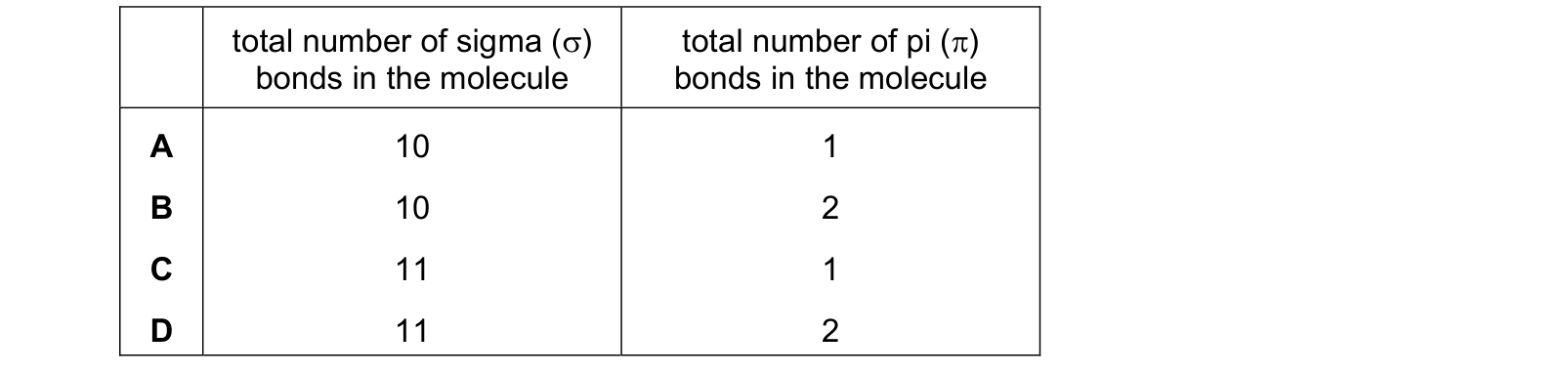
Which row shows the correct number of covalent bonds in a molecule of methylpropene? Each answer gives, in order: total number of sigma (σ) bonds in the molecule; total number of pi (π) bonds in the molecule.
Answer: C.
Every single bond is one sigma bond, and a double bond is one sigma plus one pi.
C–H bonds: there are 8 hydrogens, each with one bond, giving 8 sigma.
C–C single bonds: the central carbon carries two methyl groups, giving 2 sigma.
The C=C double bond: 1 sigma and 1 pi.
sigma total = 8 + 2 + 1 = 11
pi total = 1
which is C.
A, 10 and 1, misses the sigma bond inside the double bond, which is the commonest error: it is easy to count the double bond as contributing only its pi.
The rule that prevents it is worth stating plainly. Every bond between two atoms, single, double or triple, contains exactly one sigma bond. The extra bonds are all pi. So the number of sigma bonds is simply the number of lines in the structural formula counted once each, and the pi bonds are the extra lines beyond the first in any multiple bond.
Question 5
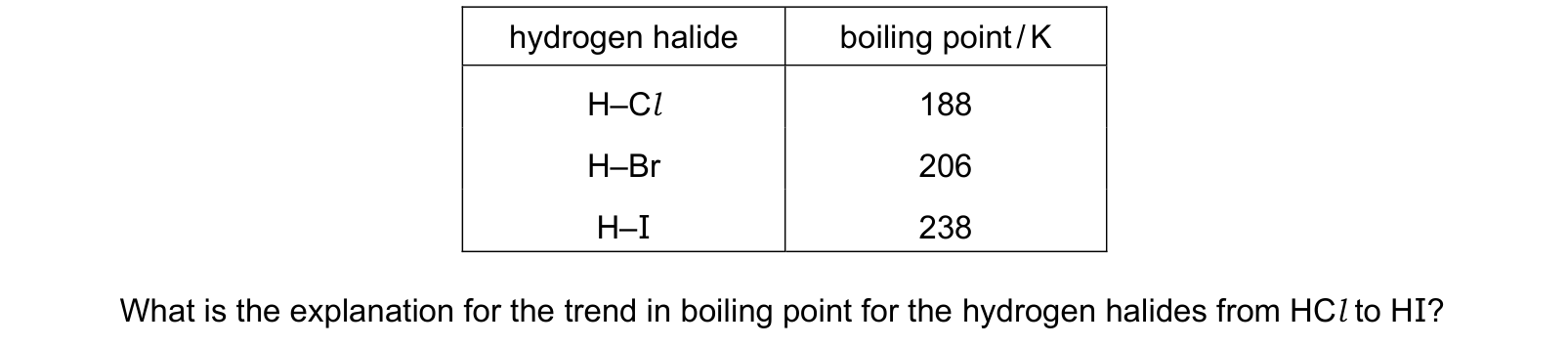
The boiling points of some hydrogen halides are shown. hydrogen halide boiling point / K H–Cl 188 H–Br 206 H–I 238 What is the explanation for the trend in boiling point for the hydrogen halides from HCl to HI?
Answer: B.
All three are polar molecules, so they attract by permanent dipole forces, but the dominant and changing factor is the instantaneous dipole-induced dipole force. Going from HCl to HI the molecules gain many more electrons, so their electron clouds are more easily distorted and those forces get stronger. More energy is needed to separate the molecules, so the boiling point rises. That is B.
A confuses two different bonds. Boiling separates molecules from each other and does not break the H–X bond inside them. In any case the bond energies decrease from HCl to HI, so the statement is false as well as irrelevant.
C invokes hydrogen bonding, which requires hydrogen attached to N, O or F. Chlorine, bromine and iodine are none of those, so none of these three hydrogen bonds at all. HF does, which is exactly why it breaks the trend and boils higher than HCl.
D has the trend backwards. Electronegativity decreases down Group 17, so the H–X bond becomes less polar from HCl to HI. If polarity were what mattered, the boiling points would fall.
Two of the four options describe a real trend running the opposite way, which is what makes them tempting.
What this practice covers
These questions are drawn from past CIE 9701 Chemistry papers. You answer, you find out immediately whether you were right, and you get the reasoning for the correct option and for each distractor. Wrong answers go to a mistakes locker so you can come back to exactly those.
Practice is free. You need an account only so your progress and your mistakes are still there next time.
What examiners see students get wrong here
These are the errors that cost marks on chemical bonding, taken from our own topic notes. Read them before you practise and you will recognise the traps in the questions.
- Saying covalent bonds break when a simple molecular solid melts. Only the intermolecular forces break.
- Calling CO₂ polar. The bonds are polar; the linear molecule is not.
- Saying hydrogen bonding occurs whenever hydrogen is present. It needs H bonded to N, O or F.
- Forgetting that lone pairs count when working out a shape, or forgetting they repel more.
- Writing the ammonia bond angle as 109.5°. One lone pair reduces it to 107°.
- Describing metallic bonding as attraction between atoms. It is between positive ions and delocalised electrons.
Revise it first
If any of the above is unfamiliar, work through the notes before practising: Chemical bonding revision notes.