Chemical energetics
Contents: 7 sections
Exothermic and endothermic
Enthalpy change (ΔH) is the heat energy exchanged with the surroundings at constant pressure.
| ΔH | Energy | Temperature of surroundings | |
|---|---|---|---|
| Exothermic | Negative | Released to surroundings | Rises |
| Endothermic | Positive | Taken from surroundings | Falls |
The sign convention is from the point of view of the chemicals, not the beaker. An exothermic reaction loses energy, so its ΔH is negative, even though the thermometer reading goes up. Getting that the wrong way round is the single most common error in the topic.
On an energy profile, an exothermic reaction has products below reactants; an endothermic reaction has products above. The hump in between is the activation energy, and it exists whichever way ΔH points.
The standard enthalpy changes
Standard conditions are 298 K and 100 kPa, with all substances in their standard states, and the symbol is ΔH<sup>⦵</sup>.
- Enthalpy change of formation (ΔH<sub>f</sub>): one mole of a compound is formed from its elements in their standard states. It follows that the ΔH<sub>f</sub> of an element is zero, which several questions rely on.
- Enthalpy change of combustion (ΔH<sub>c</sub>): one mole of a substance is burned completely in oxygen.
- Enthalpy change of neutralisation: one mole of water is formed from the reaction of an acid with an alkali.
- Enthalpy change of reaction: the quantities are those in the equation as written.
Notice how often "one mole" appears, and of what. In combustion it is one mole of the fuel; in neutralisation it is one mole of water. Reading the wrong substance is a frequent slip.
Measuring an enthalpy change
q = mcΔT
where m is the mass of the solution being heated in grams, c is its specific heat capacity (4.18 J g⁻¹ K⁻¹ for water) and ΔT is the temperature change.
Then
with n the number of moles of the limiting reactant, and the minus sign giving the right convention for an exothermic change.
Worked example
50.0 cm³ of 1.00 mol dm⁻³ hydrochloric acid is neutralised by 50.0 cm³ of 1.00 mol dm⁻³ sodium hydroxide. The temperature rises by 6.80 °C. Find the enthalpy change of neutralisation.
Step 1: heat released. The total volume is 100 cm³, so the mass of solution is 100 g.
Step 2: moles of water formed.
Acid and alkali are present in equal moles, so 0.0500 mol of water forms.
Step 3: enthalpy change.
The mass used is the mass of the solution, not of the solute, because it is the solution that is being warmed. Experimental values come out below the accepted figure mainly because heat is lost to the surroundings and to the apparatus.
Hess's law
Hess's law states that the total enthalpy change for a reaction is independent of the route taken, provided the initial and final conditions are the same.
It works because enthalpy is a state function, and it lets you find enthalpy changes that cannot be measured directly, such as the formation of methane from carbon and hydrogen.
Two cycle patterns cover almost every question.
Using enthalpies of formation, the arrows point up from the elements into both reactants and products:
Using enthalpies of combustion, the arrows point down from both reactants and products into the combustion products:
The two are subtractions in opposite orders, and mixing them up is the usual mistake. A safe way to avoid it is to draw the cycle, put the arrows on, and follow them: going against an arrow reverses the sign of that enthalpy change.
Worked example
Given ΔH<sub>f</sub> values of CO₂ = -394 and H₂O = -286 kJ mol⁻¹, and CH₄ = -75 kJ mol⁻¹, find ΔH for
CH₄ + 2O₂ → CO₂ + 2H₂O
Oxygen is an element, so its ΔH<sub>f</sub> is zero.
Bond energies
Bond energy is the energy needed to break one mole of a bond in the gaseous state. Breaking bonds is always endothermic; making bonds is always exothermic.
A result from bond energies is only approximate, for two reasons worth stating precisely:
- Bond energies are average values taken across many different compounds, and the same bond differs slightly depending on what surrounds it.
- They apply to the gaseous state, so any substance that is a liquid or solid introduces an error.
Common mistakes
- Giving an exothermic reaction a positive ΔH because the temperature rose.
- Using the mass of the solute in q = mcΔT rather than the mass of the solution.
- Subtracting the wrong way round in a Hess cycle. Formation goes products minus reactants; combustion goes reactants minus products.
- Forgetting that ΔH<sub>f</sub> of an element is zero.
- Saying bond breaking releases energy. It absorbs it.
- Forgetting that enthalpy of neutralisation is per mole of water, not per mole of acid.
Check you have it
Question 1
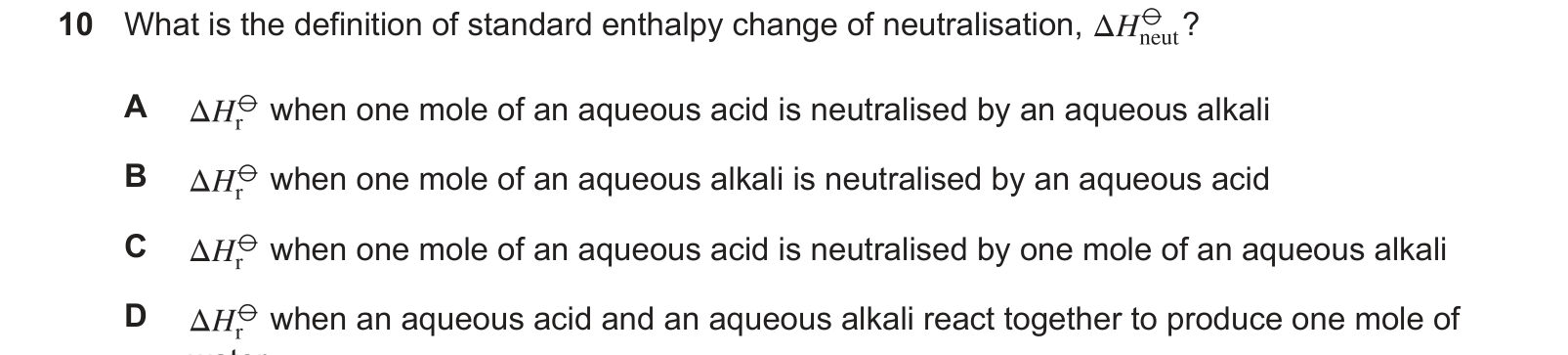
What is the definition of standard enthalpy change of neutralisation, ?
Answer: D.
Water is the one product common to every neutralisation, and defining the quantity by it is what makes different acids and alkalis comparable. The essential reaction is always the same:
H⁺(aq) + OH⁻(aq) → H2O(l)
which is why the value for any strong acid with any strong alkali comes out near –57 kJ mol⁻¹.
A and B define it per mole of acid or per mole of alkali, and that breaks as soon as the acid is not monobasic. One mole of H2SO4 fully neutralised produces two moles of water and releases roughly twice as much energy, so a value quoted per mole of acid would be about –114 for sulfuric acid and –57 for hydrochloric, describing the same underlying reaction with two different numbers.
C sounds more careful because it names both amounts, but it has the same fault and adds a new one: one mole of acid and one mole of alkali do not generally react exactly, again because of H2SO4.
Enthalpy definitions each fix on one mole of one specific thing: one mole of compound formed for enthalpy of formation, one mole of substance burned for combustion, and one mole of water for neutralisation.
Question 2
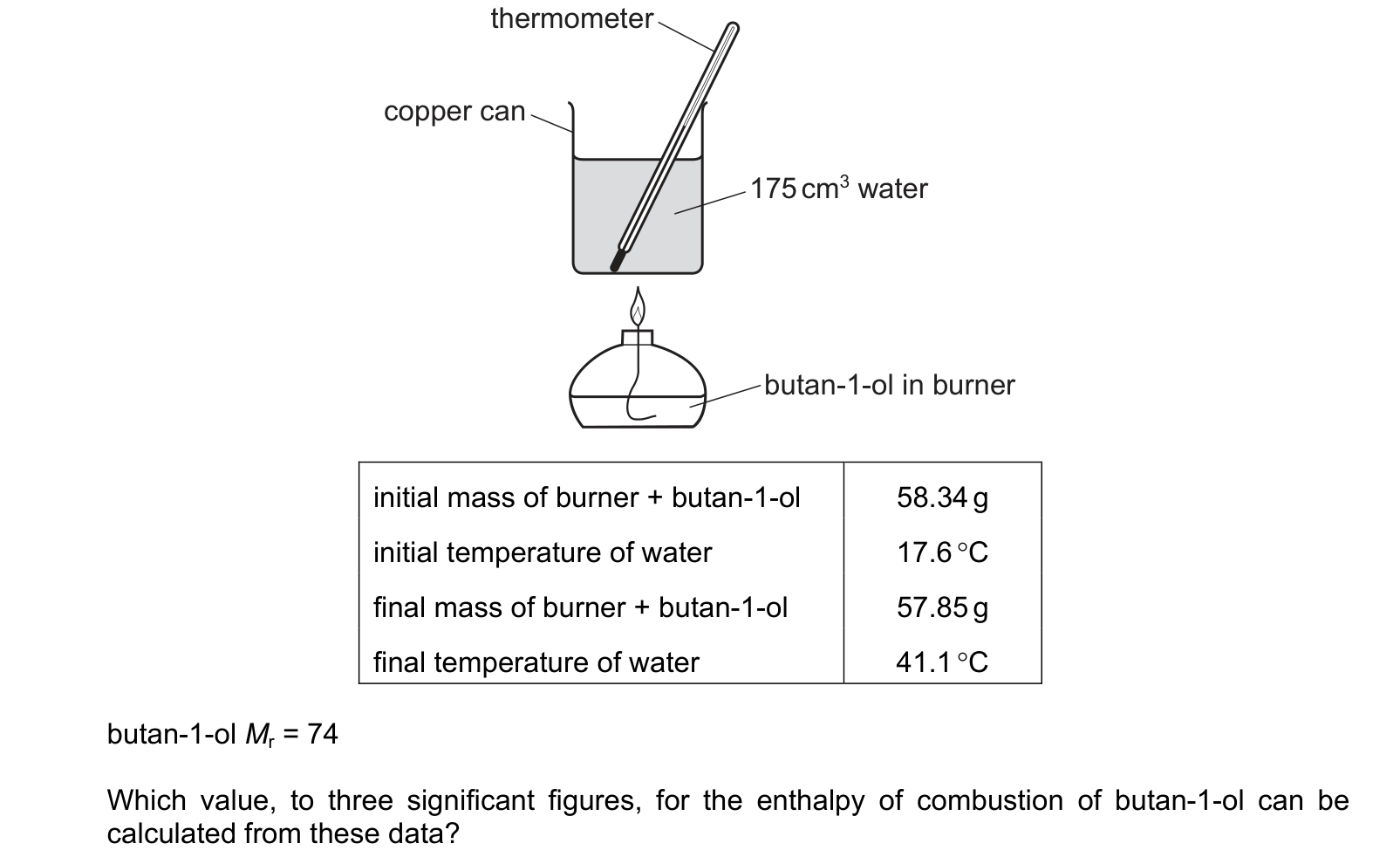
The apparatus used to determine a value for the enthalpy of combustion of butan-1-ol is shown. The mass of 1.00 cm³ of water is 1.00 g. butan-1-ol Mr = 74
Which value, to three significant figures, for the enthalpy of combustion of butan-1-ol can be calculated from these data?
Answer: C.
Energy given to the water. The water is 175 cm³, and since 1.00 cm³ has a mass of 1.00 g, that is 175 g. The temperature rise is 41.1 – 17.6 = 23.5 °C.
q = mcΔT = 175 × 4.18 × 23.5 = 17 190 J, or 17.19 kJ
Moles of fuel burned. The burner lost 58.34 – 57.85 = 0.49 g, and with Mr = 74:
n = 0.49 / 74 = 6.62 × 10⁻³ mol
Enthalpy of combustion.
ΔHc = –17.19 / 6.62 × 10⁻³ = –2600 kJ mol⁻¹
B, –17.2, is the energy released by the 0.49 g and not by a mole of it, so the division was never done. D, –4540, comes from using the final temperature of 41.1 in place of the rise of 23.5, which is the single most expensive slip available here.
The value is negative because combustion releases energy, and it is smaller in magnitude than the true value for butan-1-ol, around –2670, because a copper can loses a good deal of heat to the surrounding air.
Question 3
Which reaction has an enthalpy change equal to the standard enthalpy change of formation of propane?
Answer: C.
Carbon's standard state is solid graphite, and hydrogen's is the gas H₂. Propane at room temperature is a gas. So the equation is
3C(s) + 4H₂(g) → C₃H₈(g)
which is C.
A uses C(g), gaseous carbon atoms, which is not a standard state. Turning graphite into gaseous atoms itself costs about 715 kJ mol⁻¹ per carbon, so A's value would be badly wrong.
B compounds that with H(g), separate hydrogen atoms rather than molecules.
D is the same reaction as C but forms liquid propane. Propane boils at −42 °C, so under standard conditions it is a gas, and D would give a value more negative by the enthalpy of condensation.
Every state symbol in a formation equation is doing work, which is exactly why the question offers three equations with the right atoms and the wrong states.
What the syllabus asks for on this topicSyllabus points
Syllabus points
- Explain that chemical reactions are accompanied by enthalpy changes, and that these can be exothermic or endothermic.
- Define standard enthalpy changes of reaction, formation, combustion and neutralisation.
- Calculate enthalpy changes from experimental results using q = mcΔT.
- Apply Hess's law to construct energy cycles and calculate an enthalpy change indirectly.
- Use bond energies to calculate an approximate enthalpy change, and explain why the result is approximate.
Related CIE 9701 Chemistry topics
Not the topic you were looking for? Describe what you are stuck on in your own words and we will take you to the notes that answer it.