Chemical energetics: five questions to try now
Real past-paper questions, the answer key from the mark scheme, and the explanation that goes with it. No account needed to answer them.
Question 1
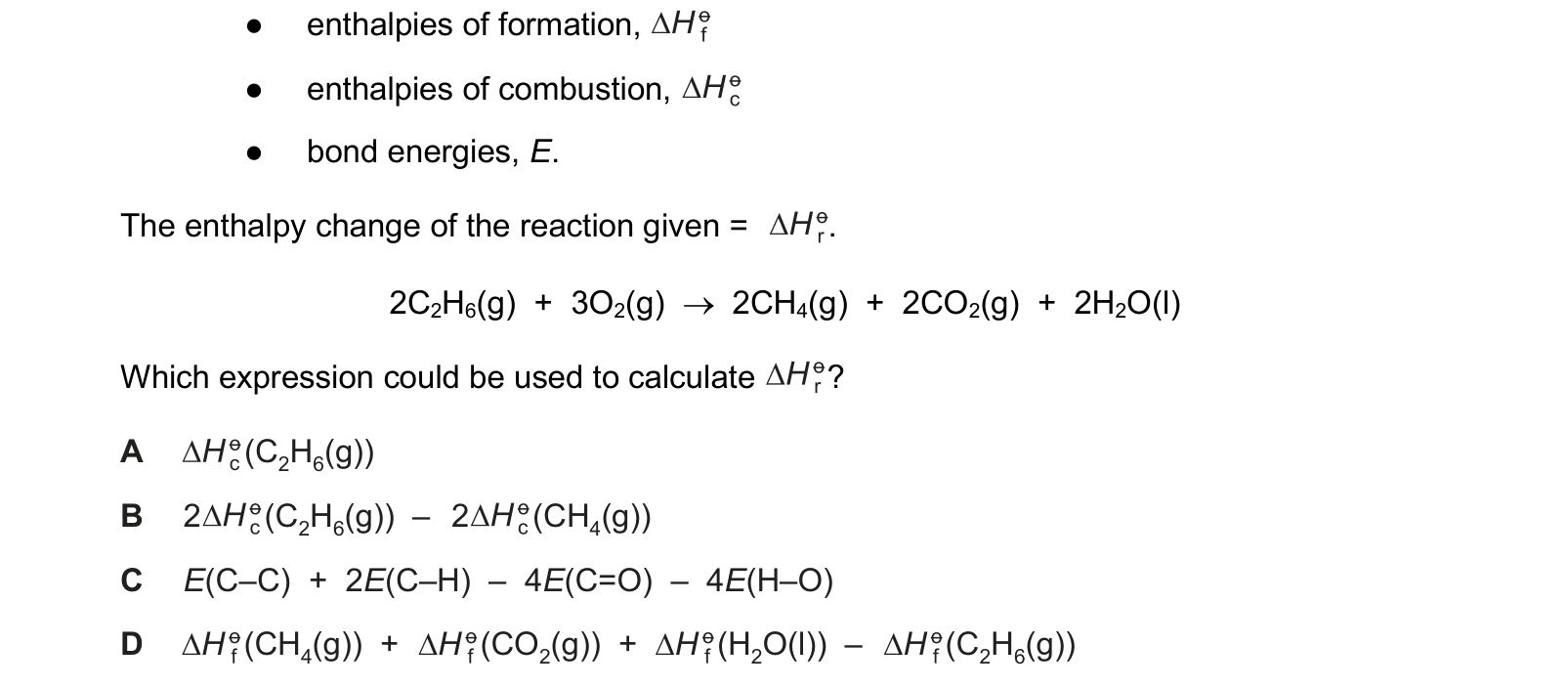
The enthalpy change for a reaction can be calculated from values of: The enthalpy change of the reaction given = . Which expression could be used to calculate ?
Answer: B.
CO2 and H2O are the products of combustion, so their enthalpies of combustion are zero, and O2 is an element in its standard state with a value of zero too. That leaves only the two burnable species, each with the coefficient 2 from the equation.
A drops the CH4 term and the coefficient. D has the right idea for enthalpies of formation, products minus reactants, but every coefficient of 2 is missing, so it would compute the enthalpy change of an equation that is not this one.
C fails twice. The bond energy sum needs 3E(O=O) for the oxygen being broken, and that term is absent. Bond energies also apply to gaseous species, while the water here is a liquid, so a bond energy calculation cannot reach this equation at all.
Question 2
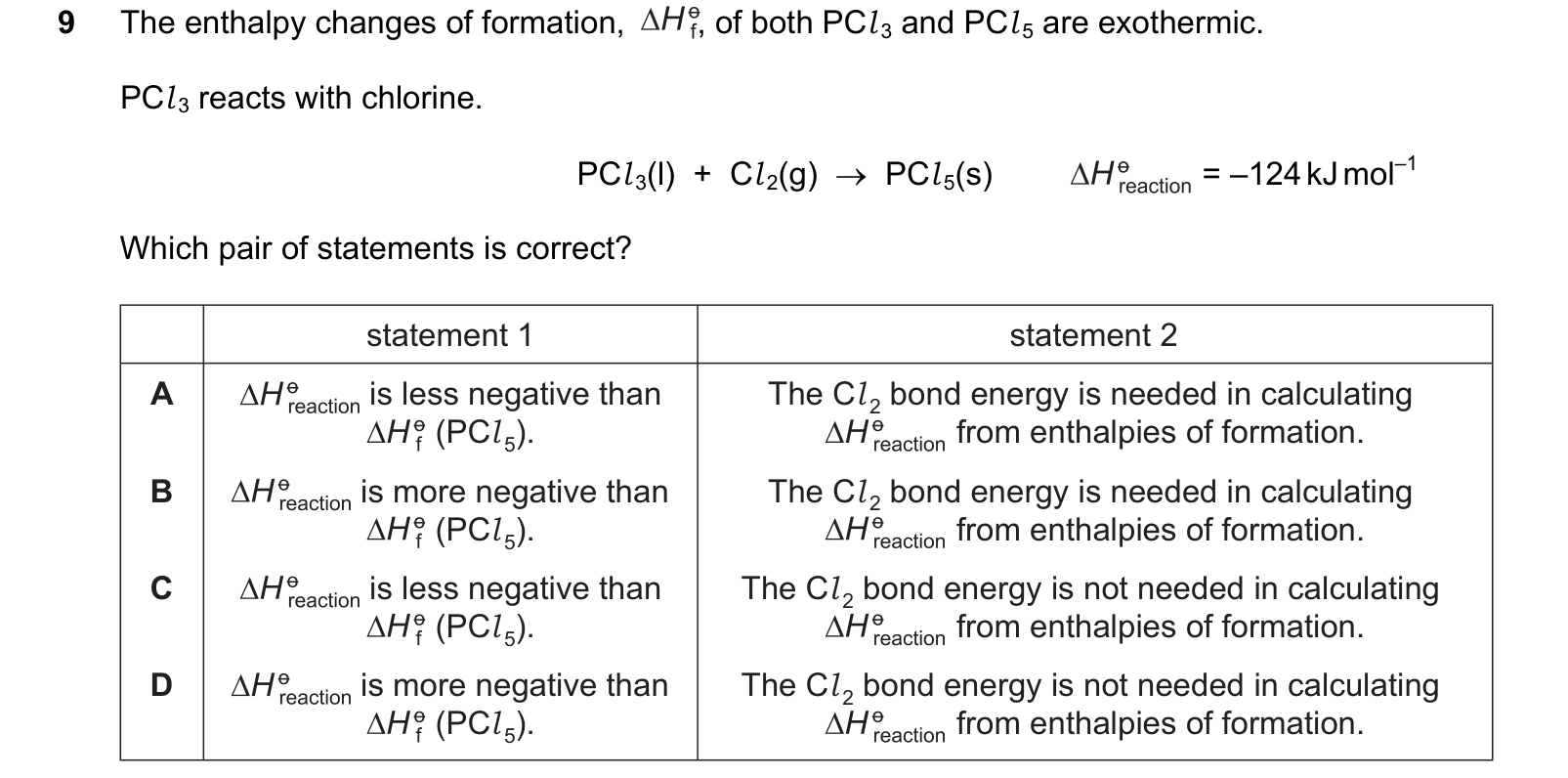
The enthalpy changes of formation, , of both PCl3 and PCl5 are exothermic. PCl3 reacts with chlorine. Which pair of statements is correct?
Answer: C.
Statement 1. For PCl3(l) + Cl2(g) → PCl5(s), calculated from enthalpies of formation:
ΔHreaction = ΔHf(PCl5) – ΔHf(PCl3)
The question says ΔHf(PCl3) is exothermic, so it is negative, and subtracting a negative number adds to the total. ΔHreaction is therefore ΔHf(PCl5) plus a positive amount, which makes it less negative than ΔHf(PCl5). That rules out B and D.
You can see it with numbers too: ΔHf(PCl5) is about –444 and ΔHf(PCl3) about –320, and –444 – (–320) = –124, the value given.
Statement 2. No bond energy is needed. Chlorine is an element in its standard state, so its enthalpy of formation is zero by definition and it simply drops out of the sum. Bond energies belong to the other route to an enthalpy change, the one that breaks everything into gaseous atoms, and the two methods are not mixed.
Enthalpies of formation and bond energies each give a complete method on their own. Reaching for a bond energy in the middle of a formation calculation is the error being tested, and it also double counts, since the Cl–Cl bond is already accounted for inside ΔHf(PCl5).
Question 3
Two standard enthalpy change of formation values are given. What is the enthalpy change for the reaction 3VCl2 → 2VCl3 + V ?

Answer: D.
3VCl2 → 2VCl3 + V
ΔH = [2 × ΔHf(VCl3) + ΔHf(V)] – [3 × ΔHf(VCl2)]
Vanadium on the right is an element in its standard state, so its enthalpy of formation is zero and it contributes nothing.
ΔH = [2 × (–573)] – [3 × (–452)]
ΔH = –1146 – (–1356) = –1146 + 1356 = +210 kJ mol⁻¹
The sign is the whole question. Both formation values are negative, so it is easy to assume the answer must be too, but the coefficients decide it: three moles of VCl2 hold more total released energy, 1356, than the two moles of VCl3, 1146, so energy has to be put in.
A, –210, is the same arithmetic with the subtraction the wrong way round, reactants minus products. B and C, ±121, come from using the values without their coefficients: 573 – 452 = 121.
Write the coefficients into the expression before putting any numbers in. Two of the four options here exist purely to catch a calculation done without them.
Question 4
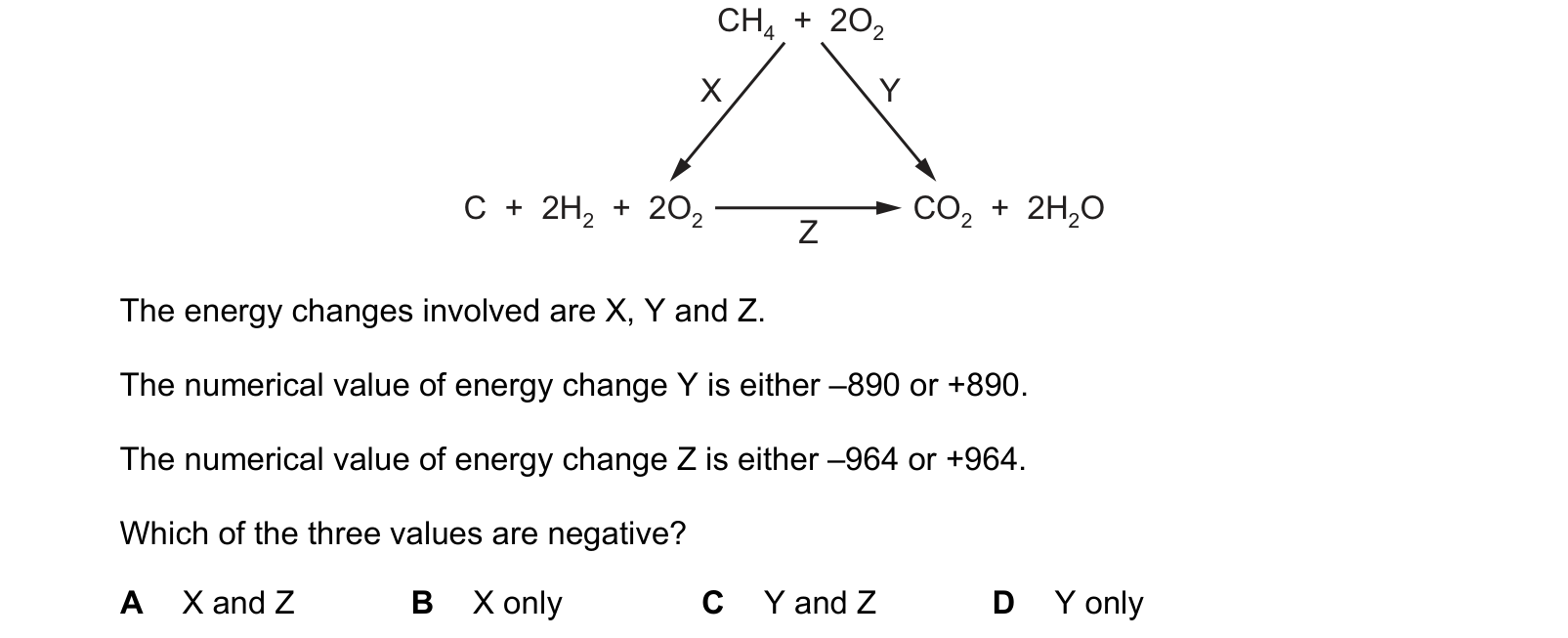
An energy cycle is shown. The energy changes involved are X, Y and Z.
The numerical value of energy change Y is either –890 or +890.
The numerical value of energy change Z is either –964 or +964.
Which of the three values are negative?
Answer: C.
Y goes from CH4 + 2O2 to CO2 + 2H2O. That is methane burning, and combustion is always exothermic, so Y is –890.
Z goes from C + 2H2 + 2O2 to CO2 + 2H2O. That is carbon and hydrogen burning, which is the same thing as forming CO2 and two H2O from their elements. Also exothermic, so Z is –964.
X goes downwards from CH4 + 2O2 to C + 2H2 + 2O2. The oxygen is a spectator, so X is methane being pulled apart into its elements, which is the reverse of forming it. Forming methane releases energy, so breaking it up absorbs energy and X is positive.
The cycle checks itself: X + Z = Y, so X = –890 – (–964) = +74, which is the enthalpy of formation of methane with its sign turned round.
The habit worth taking from this is to name each arrow as a familiar enthalpy change, combustion or formation, forwards or reversed. An arrow pointing from a compound to its elements is a formation reversed, and its sign flips.
Question 5
Three processes are described.
1 H+(aq) + OH–(aq) → H2O(l)
2 CH4(g) + 2O2(g) → CO2(g) + 2H2O(l)
3 NH3(g) → NH3(l)
Which statement is correct?
Answer: A.
1. H⁺(aq) + OH⁻(aq) → H₂O(l) is neutralisation. Forming the O–H bond releases energy, and neutralisation is always exothermic, about −57 kJ mol⁻¹ for a strong acid with a strong alkali. Negative.
2. CH₄(g) + 2O₂(g) → CO₂(g) + 2H₂O(l) is combustion. Burning always gives heat out, and methane's value is about −890 kJ mol⁻¹. Negative.
3. NH₃(g) → NH₃(l) is condensation. Going from a gas to a liquid means the molecules are coming closer together and forming intermolecular attractions, which releases energy. It is the reverse of vaporisation, so its sign is the reverse too. Negative.
None of the three is positive, so A.
Process 3 is the one that catches people, because a change of state looks different in kind from a reaction and it is easy to assume any change of state costs energy. The direction is what matters: melting and boiling are endothermic, freezing and condensing are exothermic.
The general rule underneath all three is that making bonds or attractions releases energy. Every one of these processes forms something, so every one is exothermic.
What this practice covers
These questions are drawn from past CIE 9701 Chemistry papers. You answer, you find out immediately whether you were right, and you get the reasoning for the correct option and for each distractor. Wrong answers go to a mistakes locker so you can come back to exactly those.
Practice is free. You need an account only so your progress and your mistakes are still there next time.
What examiners see students get wrong here
These are the errors that cost marks on chemical energetics, taken from our own topic notes. Read them before you practise and you will recognise the traps in the questions.
- Giving an exothermic reaction a positive ΔH because the temperature rose.
- Using the mass of the solute in q = mcΔT rather than the mass of the solution.
- Subtracting the wrong way round in a Hess cycle. Formation goes products minus reactants; combustion goes reactants minus products.
- Forgetting that ΔH<sub>f</sub> of an element is zero.
- Saying bond breaking releases energy. It absorbs it.
- Forgetting that enthalpy of neutralisation is per mole of water, not per mole of acid.
Revise it first
If any of the above is unfamiliar, work through the notes before practising: Chemical energetics revision notes.