Halogen compounds
Contents: 7 sections
Why halogenoalkanes react
The carbon-halogen bond is polar, because the halogen is more electronegative than carbon. The carbon carries a δ+ charge, and that is what attracts a nucleophile.
Everything in this chapter follows from that single feature.
Nucleophilic substitution
Three reagents, three products, and the conditions matter as much as the reagent:
| Reagent | Conditions | Product | Use |
|---|---|---|---|
| NaOH(aq) | Warm, aqueous | Alcohol | Hydrolysis |
| KCN in ethanol | Heat under reflux | Nitrile | Adds one carbon to the chain |
| Excess NH₃ in ethanol | Heat in a sealed tube | Amine | Route to amines |
The cyanide reaction deserves attention because it is the only way on the AS syllabus to lengthen the carbon chain, which makes it a key step in synthesis questions. 1-bromopropane gives butanenitrile, with four carbons from three.
With ammonia, excess ammonia is specified because the amine produced is itself a nucleophile and will react further, giving secondary and tertiary amines and eventually a quaternary salt. Using excess ammonia makes the first product the most likely.
The mechanism
For a primary halogenoalkane the mechanism is one step:
- A curly arrow from a lone pair on the nucleophile to the δ+ carbon.
- A curly arrow from the C-Br bond to the bromine.
Both happen together, so the nucleophile attacks as the halide leaves. The arrow must start at the lone pair, not at the negative sign, and that detail is regularly worth a mark.
Rates of hydrolysis
The order of reactivity is
iodo > bromo > chloro > fluoro
so an iodoalkane hydrolyses fastest.
The explanation is bond energy, not polarity, and this is the trap. The C-F bond is the most polar, so on polarity alone fluoroalkanes should react fastest. They are in fact the slowest by a wide margin, because the C-F bond is much the strongest and the rate depends on how easily that bond breaks.
| Bond | Bond energy in kJ mol⁻¹ |
|---|---|
| C-F | 467 |
| C-Cl | 340 |
| C-Br | 280 |
| C-I | 240 |
The experiment
Warm each halogenoalkane with aqueous silver nitrate in ethanol. Ethanol is there because halogenoalkanes do not dissolve in water. As the halide ion is released it precipitates with the silver:
- Iodoalkane gives a pale yellow precipitate fastest
- Bromoalkane gives a cream precipitate more slowly
- Chloroalkane gives a white precipitate slowest
- Fluoroalkane gives essentially nothing
Elimination
Change the solvent and the same hydroxide ion does something entirely different:
| Substitution | Elimination | |
|---|---|---|
| Reagent | NaOH | NaOH |
| Solvent | Water | Ethanol |
| Temperature | Warm | Hot, reflux |
| Hydroxide acts as | Nucleophile | Base |
| Product | Alcohol | Alkene |
CH₃CH₂CH₂Br + NaOH → CH₃CH=CH₂ + NaBr + H₂O
The hydroxide removes a hydrogen from the carbon next to the one bearing the halogen, and a double bond forms as the halide leaves.
The solvent is the whole answer to "how do you get one rather than the other", and it is a favourite question. Aqueous conditions favour substitution; ethanolic conditions favour elimination.
Where the halogenoalkane is unsymmetrical, more than one alkene can form. 2-bromobutane gives both but-1-ene and but-2-ene, and but-2-ene, the more substituted alkene, predominates.
Uses and the environment
Halogenoalkanes have been used as solvents, refrigerants, propellants and flame retardants, because they are unreactive, volatile and non-flammable.
Chlorofluorocarbons (CFCs) were valued for exactly that unreactivity, and it turned out to be the problem. Being unreactive, they survive long enough to reach the stratosphere, where UV light breaks the C-Cl bond by homolytic fission:
CCl₃F → •CCl₂F + Cl•
The chlorine radical then destroys ozone in a chain:
Cl• + O₃ → ClO• + O₂
ClO• + O₃ → Cl• + 2O₂
The chlorine radical is regenerated in the second step, so a single one destroys many thousands of ozone molecules before it is removed. Thinner ozone means more UV reaching the surface, and more skin cancer and cataracts.
CFCs have been phased out under the Montreal Protocol and replaced by HFCs, which contain no chlorine and so cannot produce chlorine radicals.
The episode is a useful case study in unintended consequences: the property that made CFCs safe to handle is the property that made them persistent enough to do damage.
Common mistakes
- Explaining the hydrolysis trend with polarity. It is bond energy, and polarity would predict the opposite.
- Forgetting that the solvent decides substitution against elimination.
- Drawing the nucleophile's curly arrow from the charge rather than from the lone pair.
- Forgetting excess ammonia, and so not explaining why further substitution is suppressed.
- Missing that KCN adds a carbon to the chain, which is usually the point of a synthesis question.
- Saying CFCs damage ozone because they are reactive. They cause harm because they are unreactive and persist.
Check you have it
Question 1
The diagram shows the structures of two halogenoalkanes, P and Q. P Q C2H5 C2H5 Both compounds can be hydrolysed. Which row is correct? Each answer gives, in order: compound more readily hydrolysed; reaction mechanism.
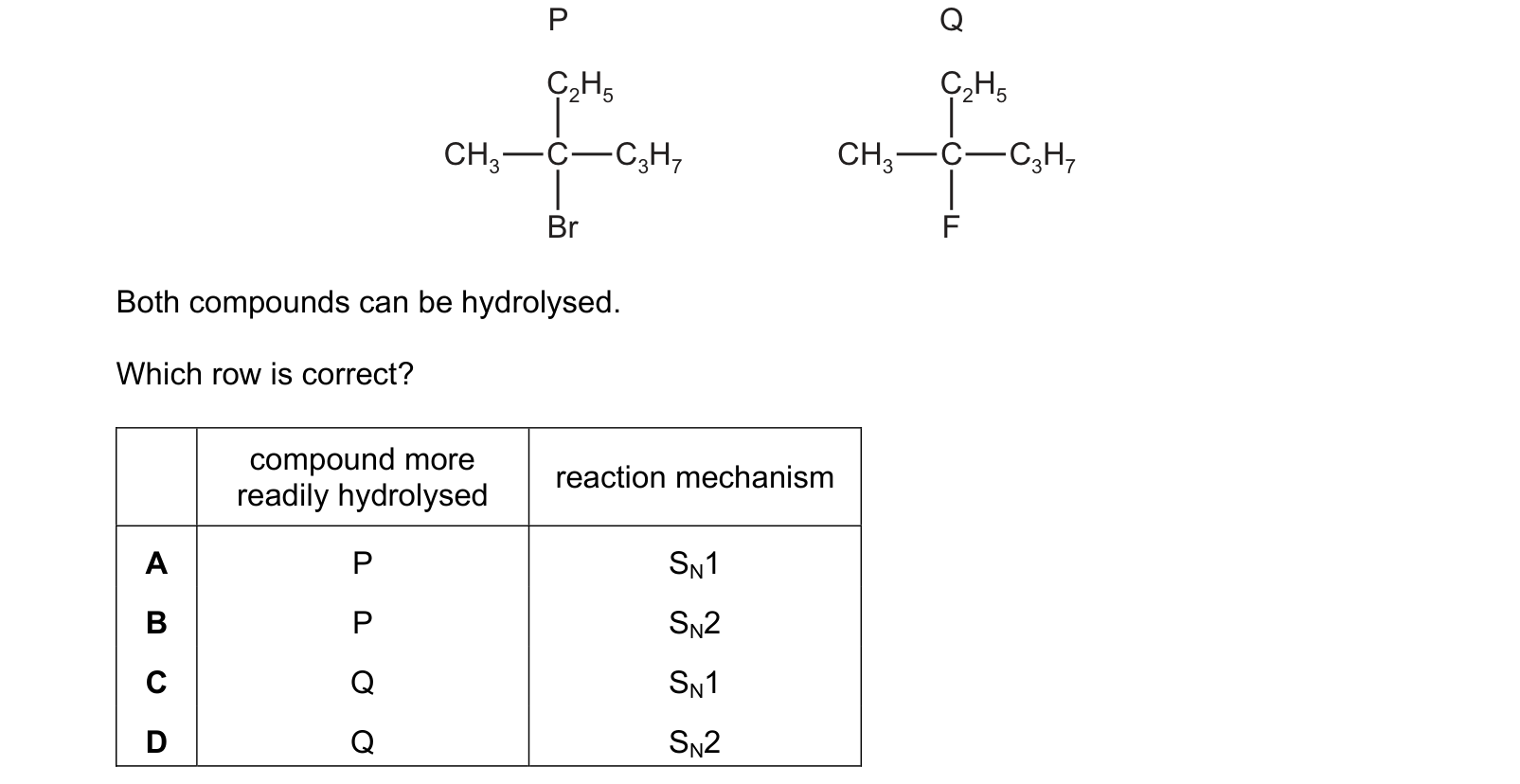
Answer: A.
Both molecules are tertiary halogenoalkanes: the carbon carrying the halogen also carries a methyl, an ethyl and a propyl group. Three alkyl groups both stabilise the carbocation by their positive inductive effect and block the back of the molecule to an incoming nucleophile, so the two-step SN1 route wins over SN2 for either compound. That alone rules out B and D.
Between the two, what decides the rate is the carbon to halogen bond enthalpy, not electronegativity. C–F is about 467 kJ mol⁻¹ and C–Br about 290 kJ mol⁻¹, so the C–Br bond in P breaks far more easily.
Fluorine is the most electronegative halogen, so the C–F bond is the most polar and looks like the obvious target for a nucleophile. Following that reasoning gives Q and it is the wrong answer. Bond strength beats bond polarity for the whole halogenoalkane series.
Question 2
Compound R can be formed from 1-bromopropane using a nucleophilic substitution reaction followed by an oxidation reaction.
What is the identity of R?
Answer: A.
Nucleophilic substitution on 1-bromopropane with aqueous hydroxide replaces the bromine with an OH:
CH₃CH₂CH₂Br → CH₃CH₂CH₂OH, propan-1-ol
Oxidation of a primary alcohol with acidified dichromate under reflux takes it through the aldehyde all the way to the carboxylic acid:
CH₃CH₂CH₂OH → CH₃CH₂CHO → CH₃CH₂COOH, propanoic acid
So A.
B, propanone, would need a secondary alcohol, which means starting from 2-bromopropane rather than the 1-isomer. The bromine's position decides which alcohol you get and therefore which oxidation product.
C, propylamine, comes from nucleophilic substitution with ammonia, which is a perfectly good first step but leaves nothing for an oxidation to do usefully.
D, propyl ethanoate, is an ester, made from propan-1-ol and ethanoic acid. That second step is esterification, not oxidation, and it adds two carbons.
Counting carbons is a quick check: the answer must still have three, which D fails.
Question 3
Halogenoalkanes react with hot ethanolic potassium cyanide.
The reaction mechanism is either SN1 or SN2.
Which statement is correct?
Answer: D.
B describes the wrong mechanism's first step. In SN1 the halogenoalkane breaks apart on its own in the slow step, and the nucleophile only arrives afterwards. That is precisely why the rate of an SN1 reaction does not depend on the nucleophile's concentration.
A is too absolute. Secondary halogenoalkanes react by a mixture of SN1 and SN2, since their cation is stable enough to form sometimes but the carbon is still open enough to attack.
C has it backwards. Chloroethane is primary, so it reacts by SN2. A primary carbocation is far too unstable for the SN1 route.
The pattern to hold is that stability of the cation pushes towards SN1 and openness of the carbon pushes towards SN2, and the two move in opposite directions as branching increases.
What the syllabus asks for on this topicSyllabus points
Syllabus points
- Describe the nucleophilic substitution reactions of halogenoalkanes with hydroxide, cyanide and ammonia.
- Describe the elimination reaction with ethanolic hydroxide.
- Explain the relative rates of hydrolysis of fluoro, chloro, bromo and iodo compounds.
- Explain the difference in conditions that leads to substitution rather than elimination.
- Describe the uses of halogenoalkanes and the environmental concerns about CFCs.
Related CIE 9701 Chemistry topics
Not the topic you were looking for? Describe what you are stuck on in your own words and we will take you to the notes that answer it.