Halogen compounds: five questions to try now
Real past-paper questions, the answer key from the mark scheme, and the explanation that goes with it. No account needed to answer them.
Question 1
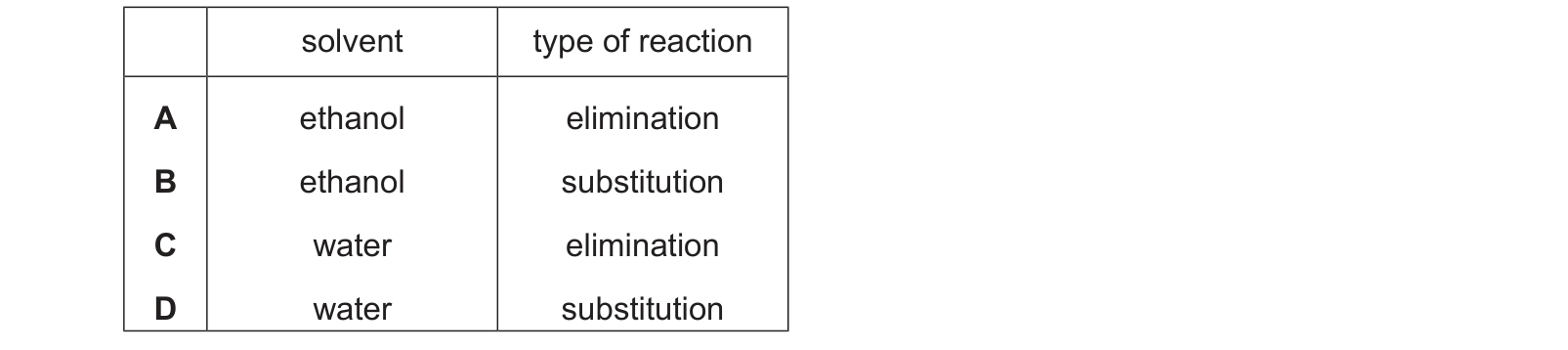
Which row describes the solvent used and type of reaction occurring when bromoethane reacts with NaOH to form ethene? Each answer gives, in order: solvent; type of reaction.
Answer: A.
Elimination requires the hydroxide to act as a base, pulling a hydrogen off the carbon next to the C–Br, and that happens in ethanol rather than in water. So ethanol and elimination, which is A.
The solvent is what decides the hydroxide's role. In water the hydroxide ion is heavily solvated by hydrogen bonds, which makes it a weaker base but leaves it able to act as a nucleophile, attacking the carbon and giving ethanol by substitution. In ethanol it is less solvated, so it is more basic and goes for the hydrogen instead.
C pairs the right reaction with the wrong solvent, which is the sharpest distractor: the reaction type is correct and only the conditions are wrong.
The pair to hold is aqueous and warm gives substitution, ethanolic and hot gives elimination, and the product tells you which happened: an alcohol means substitution, an alkene means elimination.
Question 2
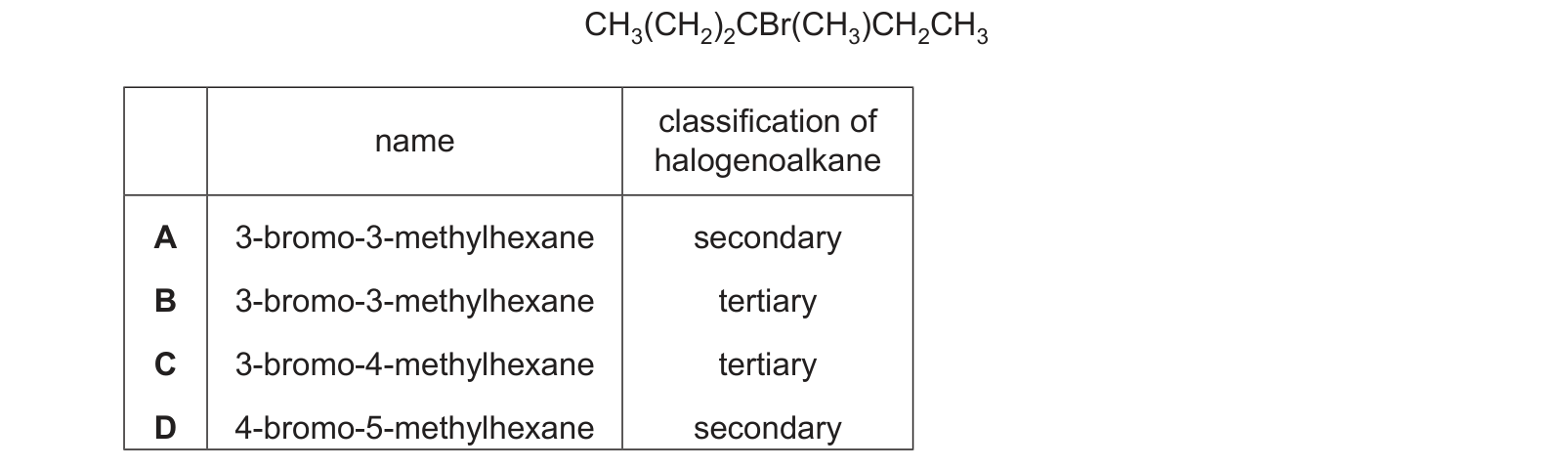
Which row shows the correct name and classification of the halogenoalkane shown? Each answer gives, in order: name; CH3(CH2)2CBr(CH3)CH2CH3 classification of halogenoalkane.
Answer: B.
CH₃–CH₂–CH₂–CBr(CH₃)–CH₂–CH₃
The longest chain runs through six carbons, so the parent is hexane. Numbering from the right-hand end puts the substituted carbon at position 3; from the left it would be position 4, and the rule is to take the lower locant. So the name is 3-bromo-3-methylhexane, which removes C and D.
The classification depends on how many carbons are attached to the carbon carrying the bromine. That carbon is bonded to the propyl chain on one side, the ethyl chain on the other, and the methyl branch, which is three carbons. A halogenoalkane with three is tertiary. That is B.
The methyl group is easy to overlook, because it is written inside the condensed formula and looks like part of the chain rather than a branch. Drawing the structure out properly is what makes both halves of the answer clear at once.
Being tertiary matters for the chemistry as well as the name: this compound would hydrolyse by SN1, through a stable tertiary carbocation, and would react considerably faster than a primary isomer.
Question 3
1,1-dichloropropane reacts with aqueous sodium hydroxide in a series of steps to give propanal. Which term describes the first step of this reaction?

Answer: D.
1,1-dichloropropane is CH3CH2CHCl2, with both chlorines on the same carbon. Hydroxide is a nucleophile, attracted to the carbon that the electronegative chlorines have left δ+. It attacks that carbon and a chloride ion leaves, so one Cl is replaced by an OH. Nothing is added to the molecule and nothing is removed from it beyond the group swapped out, which is exactly what substitution means.
What follows is what makes the question interesting. The product, CH3CH2CH(OH)Cl, has an OH and a Cl on the same carbon, and that arrangement is unstable. It loses HCl to give the C=O of propanal, which is why the overall result is an aldehyde from an alkane derivative with no oxidising agent anywhere.
A, addition, would need a double bond to add across. B, elimination, is what hot ethanolic NaOH does to a halogenoalkane, removing HCl to give an alkene; aqueous NaOH favours substitution instead, and the solvent is the thing that decides between them. C, oxidation, would need the carbon's oxidation number to rise in this step, and swapping a Cl for an OH leaves it unchanged.
Question 4
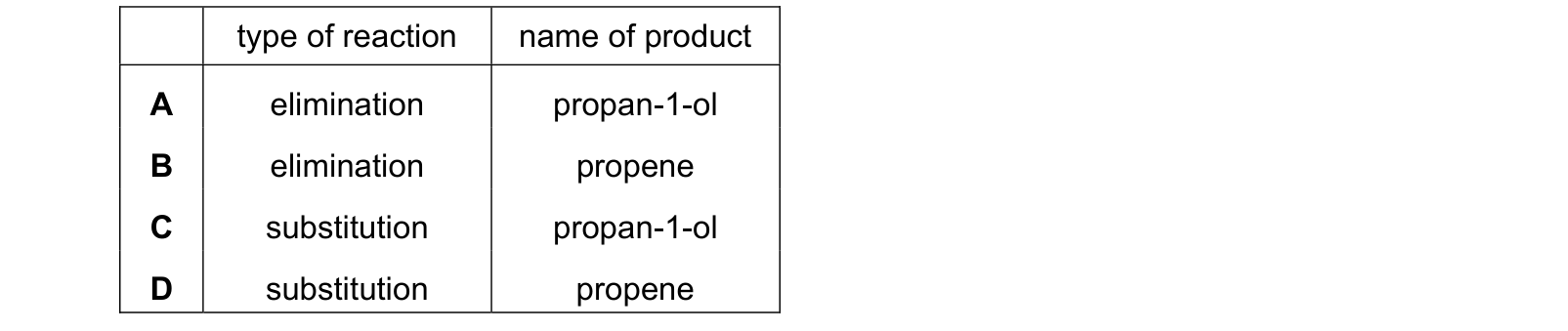
A reaction occurs when a sample of 1-chloropropane is heated under reflux with sodium hydroxide dissolved in ethanol. Which row is correct? Each answer gives, in order: type of reaction; name of product.
Answer: B.
Sodium hydroxide dissolved in ethanol, under reflux, makes the hydroxide act as a base. It removes a hydrogen from the carbon next to the C–Cl, and the chloride leaves, giving an alkene:
CH₃CH₂CH₂Cl → CH₃CH=CH₂ + HCl
That is elimination, and the product is propene, which is B.
C and D name substitution, which is what the same reagent does in aqueous solution, where the hydroxide acts as a nucleophile instead. The product there is propan-1-ol.
A pairs the right reaction type with the substitution product, which is the sharpest distractor: eliminating from a halogenoalkane cannot produce an alcohol, because no OH is added.
The pair to hold is aqueous and warm gives substitution, ethanolic and hot gives elimination. One reagent, two roles: as a nucleophile it attacks the carbon carrying the halogen, and as a base it attacks a hydrogen on the neighbouring carbon. The solvent decides which, because ethanol is less able to solvate the hydroxide and leaves it more basic.
Question 5
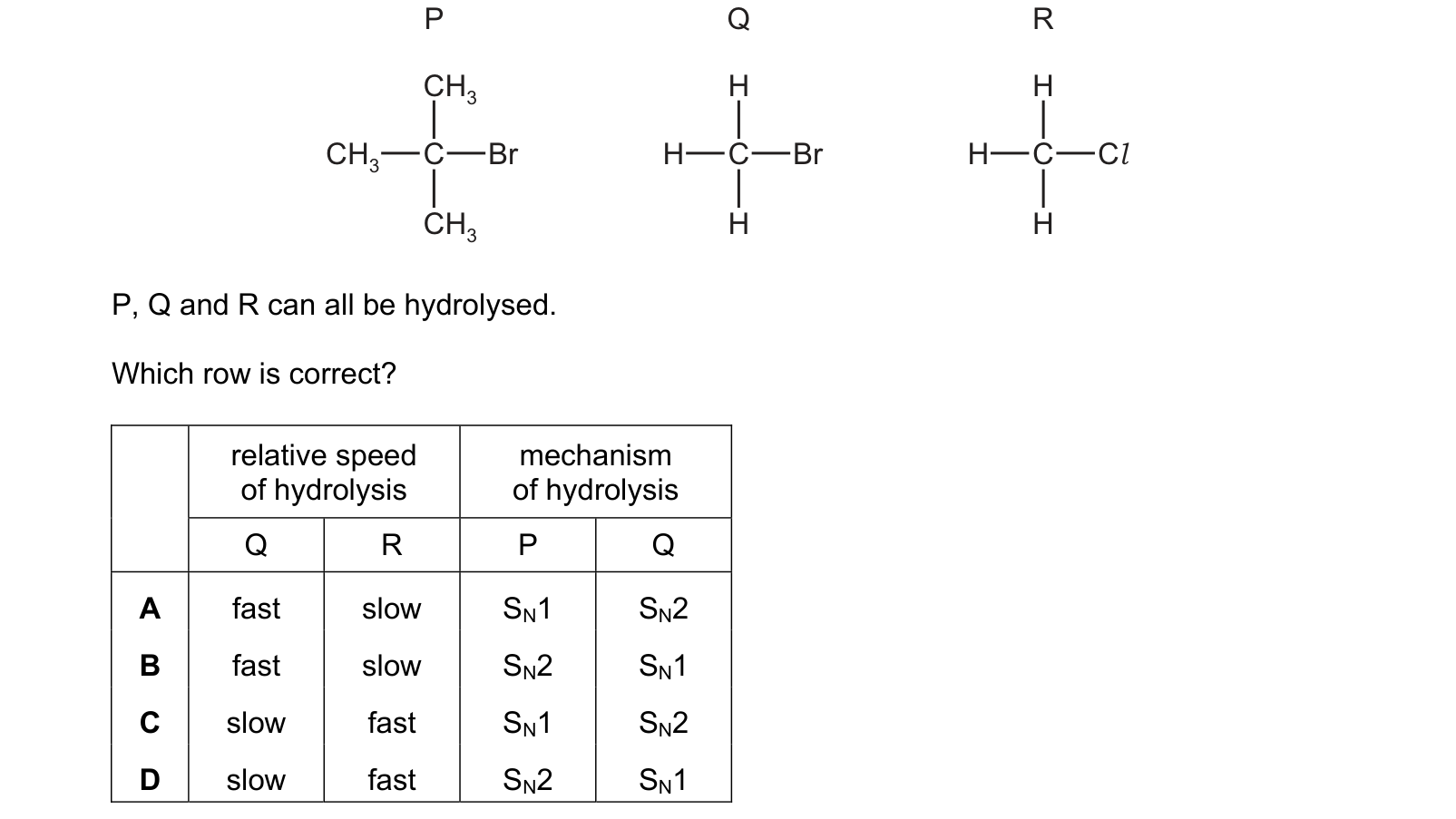
The diagram shows the structures of three halogenoalkanes. P Q R P, Q and R can all be hydrolysed. Which row is correct? Each answer gives, in order: relative speed of hydrolysis Q; R; mechanism P; of hydrolysis Q.
Answer: A.
Q against R: which hydrolyses faster? They have the same carbon skeleton, so the only difference is the halogen. The rate-determining step is breaking the carbon-halogen bond, and C–Br is weaker than C–Cl, at about 280 against 340 kJ mol⁻¹. So Q is fast and R is slow. That removes C and D.
The bond polarity points the other way, since chlorine is more electronegative, but bond strength wins comfortably, and that is the single most useful fact in this topic.
The mechanisms. P is tertiary, so the halide leaves first and gives a carbocation stabilised by three alkyl groups: that is SN1. Q is a methyl halide, with no alkyl groups to stabilise a cation and nothing blocking an attack from behind: that is SN2.
So fast, slow, SN1 and SN2, which is A.
B has the two mechanisms swapped, which is the sharper of the two remaining errors, since the rates are right. The rule is that crowding pushes towards SN1 and openness towards SN2, and a methyl halide is the least crowded carbon there is.
What this practice covers
These questions are drawn from past CIE 9701 Chemistry papers. You answer, you find out immediately whether you were right, and you get the reasoning for the correct option and for each distractor. Wrong answers go to a mistakes locker so you can come back to exactly those.
Practice is free. You need an account only so your progress and your mistakes are still there next time.
What examiners see students get wrong here
These are the errors that cost marks on halogen compounds, taken from our own topic notes. Read them before you practise and you will recognise the traps in the questions.
- Explaining the hydrolysis trend with polarity. It is bond energy, and polarity would predict the opposite.
- Forgetting that the solvent decides substitution against elimination.
- Drawing the nucleophile's curly arrow from the charge rather than from the lone pair.
- Forgetting excess ammonia, and so not explaining why further substitution is suppressed.
- Missing that KCN adds a carbon to the chain, which is usually the point of a synthesis question.
- Saying CFCs damage ozone because they are reactive. They cause harm because they are unreactive and persist.
Revise it first
If any of the above is unfamiliar, work through the notes before practising: Halogen compounds revision notes.