Carboxylic acids and derivatives
Contents: 7 sections
Making carboxylic acids
Three routes, and each appears in synthesis questions:
- Oxidation of a primary alcohol, refluxed with acidified potassium dichromate(VI). Refluxing is essential; distilling would give the aldehyde.
- Oxidation of an aldehyde, with the same reagent, or with Tollens' or Fehling's.
- Hydrolysis of a nitrile, by refluxing with dilute acid or alkali. This matters because the nitrile route came from a halogenoalkane with KCN, so the pair together adds a carbon and then converts it to an acid.
Reactions of carboxylic acids
Carboxylic acids are weak acids: they dissociate only partially in water.
RCOOH ⇌ RCOO⁻ + H⁺
They show the reactions of any acid, and two of them are useful as tests:
| Reagent | Product | Observation |
|---|---|---|
| Reactive metal | Salt and hydrogen | Effervescence |
| Base or alkali | Salt and water | Neutralisation |
| Carbonate | Salt, water and carbon dioxide | Effervescence |
| Alcohol, with acid catalyst | Ester and water | Sweet smell |
| LiAlH₄ in dry ether | Primary alcohol | Reduction |
The carbonate reaction is the one to remember as a test, because it distinguishes a carboxylic acid from phenol and from an alcohol. Only the carboxylic acid is a strong enough acid to release carbon dioxide from a carbonate.
Why carboxylic acids are the strongest of the three
The order of acidity is
carboxylic acid > phenol > alcohol
The reason in each case is how well the negative charge on the anion is stabilised, because a more stable anion means the O-H bond ionises more readily.
- In a carboxylate ion the charge is delocalised over two oxygen atoms, both highly electronegative. This is the most effective stabilisation, and the two carbon-oxygen bonds become identical in length.
- In a phenoxide ion the charge is delocalised into the benzene ring, which helps but spreads it over carbon atoms rather than oxygen.
- In an alkoxide ion there is no delocalisation at all, so the charge stays on one oxygen, and the alkyl group pushes electron density towards it, making it worse still.
Electron-withdrawing groups increase acidity for the same reason. Chloroethanoic acid is a stronger acid than ethanoic acid, because the chlorine pulls electron density away and spreads the charge further.
Esters
Formation
An alcohol and a carboxylic acid, warmed with a few drops of concentrated sulfuric acid:
CH₃COOH + CH₃CH₂OH ⇌ CH₃COOCH₂CH₃ + H₂O
The reaction is reversible and reaches equilibrium, so the yield is limited. The acid is a catalyst, not a reactant.
Naming an ester runs alcohol part first, acid part second: ethyl ethanoate comes from ethanol and ethanoic acid. Reading the name off the structure the wrong way round is a frequent error, and the giveaway is that the alkyl group attached to the single-bonded oxygen is the one from the alcohol.
Esters are used as flavourings and perfumes because of their smell, and as solvents.
Hydrolysis
Two routes, giving different products, and the difference is the exam question:
Acid hydrolysis, refluxing with dilute sulfuric acid, is the reverse of esterification and is reversible:
CH₃COOCH₂CH₃ + H₂O ⇌ CH₃COOH + CH₃CH₂OH
Alkaline hydrolysis, refluxing with sodium hydroxide, goes to completion:
CH₃COOCH₂CH₃ + NaOH → CH₃COONa + CH₃CH₂OH
It goes to completion because the product is the carboxylate salt, not the acid, so the reverse reaction cannot occur. That is why alkaline hydrolysis gives the better yield, and it is the reason soap is made this way from fats, a process called saponification.
To get the free acid from the alkaline route, the salt must be acidified afterwards.
Acyl chlorides
Acyl chlorides, RCOCl, are made from the acid with PCl₅ or SOCl₂. They are far more reactive than the acid, because chlorine is a good leaving group and the carbonyl carbon is strongly δ+.
All four reactions below are vigorous at room temperature and produce steamy fumes of HCl:
| Reagent | Product |
|---|---|
| Water | Carboxylic acid |
| Alcohol | Ester |
| Ammonia | Amide |
| Primary amine | N-substituted amide |
The reaction with an alcohol is the useful one, because it gives an ester in a reaction that is fast and not reversible, unlike direct esterification. When a question asks for a good yield of an ester, the acyl chloride route is usually the intended answer.
Common mistakes
- Distilling rather than refluxing when a carboxylic acid is wanted from a primary alcohol.
- Naming an ester backwards. The alkyl group on the single-bonded oxygen comes from the alcohol and is named first.
- Saying alkaline hydrolysis gives the carboxylic acid. It gives the salt, which must be acidified.
- Explaining acid strength by the number of oxygens. It is the delocalisation of the charge over two oxygens that matters.
- Forgetting that only carboxylic acids release carbon dioxide from carbonates, which is what distinguishes them from phenol.
- Treating the sulfuric acid in esterification as a reactant. It is a catalyst.
Check you have it
Question 1
An unsaturated carboxylic acid reacts with alcohol X to form an ester. The structure of the ester is shown. Which geometrical isomer is shown in this ester and to which class of alcohol does X belong? Each answer gives, in order: geometrical isomer; class of alcohol X.
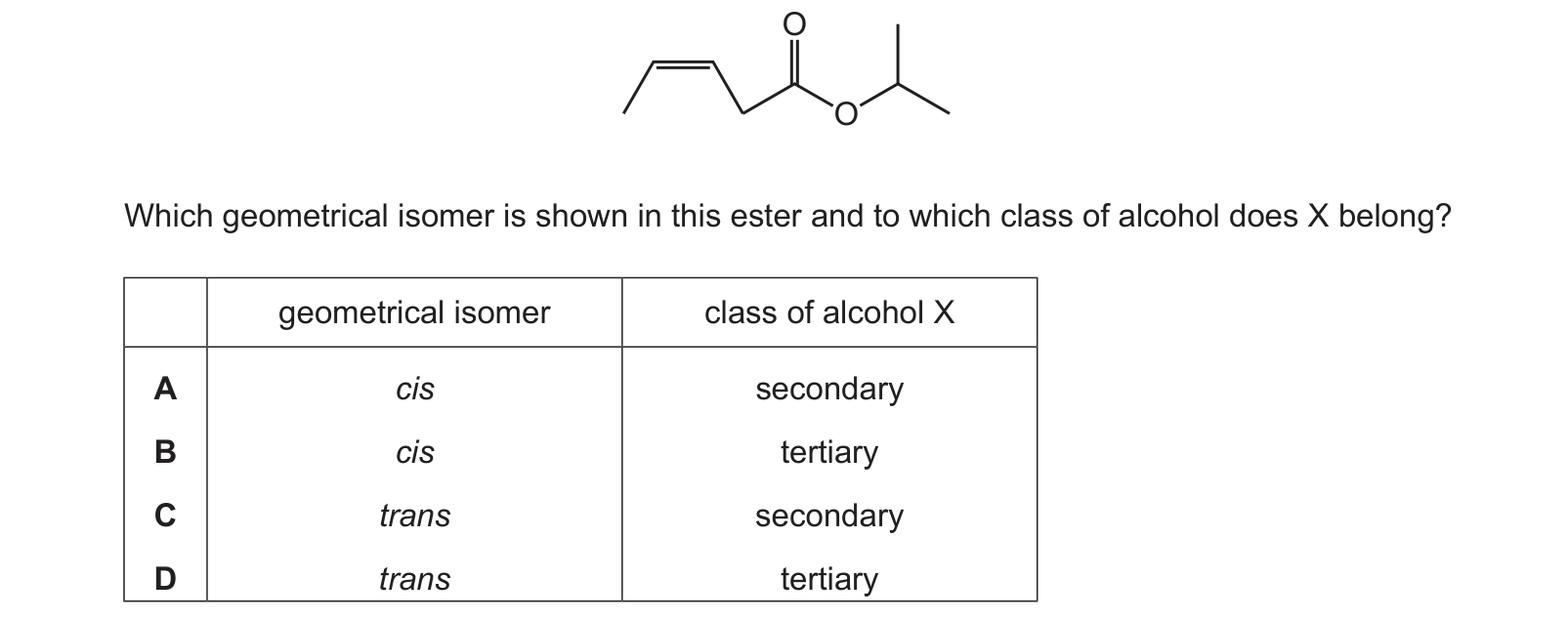
Answer: A.
Geometry. Follow the C=C at the left end. The chain arrives from the lower left and leaves to the lower right, so both carbon substituents sit on the same side of the double bond. That is cis. A trans double bond is drawn as a zigzag straight through, with one group up and one down.
The alcohol. Split the ester at the single C–O bond, the one between the oxygen and the carbon that has no double bond on it. Everything to the left of that oxygen came from the acid; the fragment to the right, –CH(CH3)2, came from the alcohol. Put the H back and X is (CH3)2CHOH, propan-2-ol.
Its OH carbon carries two alkyl groups and one hydrogen, so it is secondary. A tertiary alcohol would need three alkyl groups on that carbon and no hydrogen, which would show as a branch point with no H, not as the plain fork drawn here.
Splitting an ester at the correct bond is most of the marks. The oxygen with the double bond stays with the acid.
Question 2
An ester is shown. Which two compounds react to form this ester?

Answer: B.
The structure is CH₃CH₂–CO–O–C(CH₃)₃.
The acid half is the part with the C=O: CH₃CH₂CO–, which is three carbons, so it came from propanoic acid.
The alcohol half is the part attached to the single-bonded oxygen: –C(CH₃)₃, a carbon carrying three methyl groups. Adding the OH back gives (CH₃)₃COH, which is 2-methylpropan-2-ol.
So 2-methylpropan-2-ol and propanoic acid, which is B.
A offers 2-methylpropan-1-ol, which would attach to the oxygen through a CH₂ group. The diagram shows the oxygen bonded to a carbon carrying three methyls and no hydrogen, so it is the 2-ol.
C swaps the branching to the wrong half, putting it on the acid instead of the alcohol.
D has the right alcohol and the wrong acid: ethanoic acid would give only two carbons on the acid side, and the diagram clearly shows three.
The reliable method is to find the carbonyl carbon and count outwards from it for the acid, then count the carbons on the far side of the single-bonded oxygen for the alcohol. The oxygen between them belongs to the alcohol.
Question 3
Which ester may be hydrolysed to produce two products, one of which may be reduced to the other?
Answer: B.
B, CH₃CH(CH₃)CO₂CH₂CH(CH₃)₂, hydrolyses to 2-methylpropanoic acid and 2-methylpropan-1-ol. Reducing the acid gives exactly that alcohol, so one product can be reduced to the other. That is B.
A gives propanoic acid and methanol. Reducing the acid gives propan-1-ol, which has three carbons against methanol's one.
C gives propanoic acid and propan-2-ol. The carbon count matches, but reduction of an acid always gives a primary alcohol, so it would give propan-1-ol and not the secondary isomer.
D gives 2-methylpropanoic acid and propan-2-ol, wrong on both counts.
The two checks to apply are therefore the same number of carbons in the same arrangement, and the alcohol must be primary. C is the sharper distractor because it passes the first and fails the second.
What the syllabus asks for on this topicSyllabus points
Syllabus points
- Describe the formation of carboxylic acids from alcohols, aldehydes and nitriles.
- Describe the reactions of carboxylic acids with bases, carbonates, alcohols and reducing agents.
- Explain the relative acidities of carboxylic acids, phenol and alcohols.
- Describe the formation and hydrolysis of esters, in acid and in alkali.
- Describe the reactions of acyl chlorides with water, alcohols, ammonia and amines.
Related CIE 9701 Chemistry topics
Not the topic you were looking for? Describe what you are stuck on in your own words and we will take you to the notes that answer it.