Carbonyl compounds
Contents: 9 sections
The carbonyl group
Both aldehydes and ketones contain C=O, and the difference is what else is attached:
- An aldehyde has the carbonyl carbon at the end of the chain, so it carries at least one hydrogen. Suffix -al.
- A ketone has the carbonyl carbon in the middle, with carbon on both sides. Suffix -one.
That single hydrogen is the reason the two behave differently, and almost every test in this chapter depends on it.
The C=O bond is polar, because oxygen is much more electronegative than carbon. The carbon carries δ+, which makes it a target for nucleophiles. Contrast this with the C=C bond of an alkene, which is electron rich and attracts electrophiles: same double bond, opposite chemistry, because of the polarity.
Carbonyl compounds cannot hydrogen bond to each other, since they have no O-H, so their boiling points are lower than the corresponding alcohols. They can hydrogen bond to water, so the shorter ones are soluble.
Making them
Aldehydes and ketones come from oxidising alcohols with acidified potassium dichromate(VI), which turns orange to green:
- Primary alcohol, distilled gives an aldehyde. Distilling removes it before it is oxidised further.
- Secondary alcohol, refluxed gives a ketone, which resists further oxidation.
Reduction
The reverse reaction uses NaBH₄ in aqueous solution, or LiAlH₄ in dry ether:
- Aldehyde gives a primary alcohol
- Ketone gives a secondary alcohol
The reducing agent supplies a hydride ion, H⁻, which acts as a nucleophile and attacks the δ+ carbon. In equations the reducing agent is often shown simply as [H].
Nucleophilic addition of HCN
Warm with HCN in the presence of a small amount of NaCN or dilute alkali:
CH₃CHO + HCN → CH₃CH(OH)CN
The product is a hydroxynitrile, and the reaction is valuable because it adds a carbon atom to the chain, which makes it a key step in synthesis.
The mechanism
- A curly arrow from a lone pair on the CN⁻ ion to the δ+ carbonyl carbon.
- A curly arrow from the C=O bond to the oxygen, giving a negatively charged oxygen.
- A curly arrow from a lone pair on that oxygen to a hydrogen of an HCN molecule, giving the OH group and regenerating CN⁻.
The cyanide ion is a catalyst in effect, which is why a trace of NaCN is specified: HCN alone dissociates too little to provide enough nucleophile.
A detail worth noticing: attack can happen from either face of the flat carbonyl group, so if the product has four different groups on that carbon, a racemic mixture results. Ethanal gives a racemic hydroxynitrile for exactly this reason.
Distinguishing aldehydes from ketones
An aldehyde has a hydrogen on the carbonyl carbon and can be oxidised to a carboxylic acid. A ketone cannot, because oxidation would mean breaking a carbon-carbon bond. Every test below exploits that.
| Test | Aldehyde | Ketone |
|---|---|---|
| Tollens' reagent, warmed | Silver mirror | No change |
| Fehling's solution, warmed | Brick-red precipitate | Stays blue |
| Acidified dichromate(VI) | Orange to green | No change |
Tollens' reagent is ammoniacal silver nitrate. The aldehyde reduces Ag⁺ to silver metal, which deposits as a mirror on the tube.
Fehling's solution contains a copper(II) complex. The aldehyde reduces Cu²⁺ to copper(I) oxide, the brick-red precipitate.
Both reagents are themselves oxidising agents, and the aldehyde is the reducing agent. Saying it the wrong way round is a common slip.
Detecting the carbonyl group
2,4-dinitrophenylhydrazine, often written 2,4-DNPH or Brady's reagent, gives an orange or yellow precipitate with any aldehyde or ketone. It confirms a carbonyl group but does not distinguish the two, so it is used first and one of the tests above afterwards.
The precipitate is a crystalline solid with a sharp melting point that differs from compound to compound, so purifying it and measuring that melting point identifies the specific carbonyl compound. That was an important method before spectroscopy.
The tri-iodomethane test
Warming with iodine and sodium hydroxide gives a pale yellow precipitate of CHI₃ with a distinctive antiseptic smell.
It is positive for a methyl ketone, CH₃CO, and for the CH₃CH(OH) group that can be oxidised to one. So:
- Ethanal and propanone give it
- Propanal and butanone do not, because their carbonyl carbon does not carry a methyl group
It is a test for a structural feature rather than for a class of compound, which is what makes it useful in deducing structures.
Common mistakes
- Saying a ketone is oxidised by Fehling's or Tollens'. It is not, because there is no hydrogen on the carbonyl carbon.
- Calling Tollens' reagent a reducing agent. It is the oxidising agent; the aldehyde reduces it.
- Using 2,4-DNPH to distinguish an aldehyde from a ketone. It detects both.
- Forgetting that HCN addition adds a carbon, which is usually why it appears in a synthesis question.
- Drawing the nucleophile's arrow to the oxygen rather than to the δ+ carbon.
- Saying propanone gives a positive tri-iodomethane test because it is a ketone. It is positive because it is a methyl ketone.
Check you have it
Question 1
A carbonyl compound has the structural formula CH3COCHO. Which row is correct for the observations made when this compound is treated with the given reagents? Each answer gives, in order: 2,4-DNPH reagent; Fehling’s reagent.
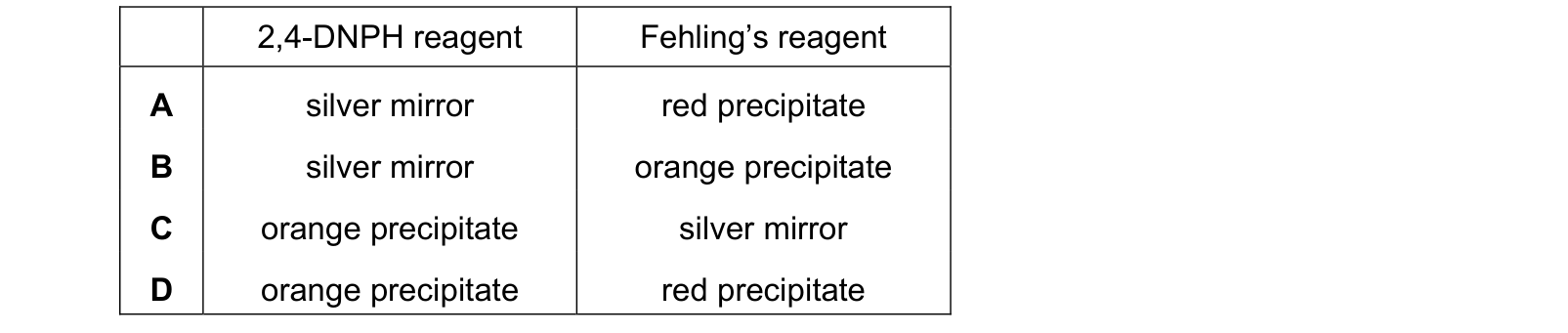
Answer: D.
2,4-DNPH reacts with any aldehyde or ketone, giving an orange precipitate. This compound has both, so the result is positive.
Fehling's reagent oxidises aldehydes only, and the copper(II) is reduced to copper(I), giving a red precipitate of Cu₂O. The aldehyde end of the molecule gives that.
So orange precipitate then red precipitate, which is D.
A and B both name a silver mirror for the DNPH test, and a silver mirror belongs to Tollens' reagent, which is a different test using silver(I). DNPH never gives a mirror.
C swaps the two results, giving the mirror to Fehling's.
The colours are worth keeping distinct: DNPH gives orange, Fehling's gives red, and Tollens' gives silver. The first says there is a carbonyl; the other two say it is specifically an aldehyde.
Question 2
But-2-ene reacts with cold dilute acidified KMnO4 to give product X.
But-2-ene reacts with an excess of hot concentrated acidified KMnO4 to give product Y.
Which statement about X and Y is correct?
Answer: C.
An excess of hot concentrated acidified manganate(VII) cleaves it, and each carbon of the double bond carries a methyl and a hydrogen, so Y is ethanoic acid, CH₃COOH.
C is correct. Sodium reacts with any O–H group, giving hydrogen. X has two alcohol OH groups and Y has the OH of a carboxylic acid, so both effervesce with sodium.
A and the DNPH question. Neither X nor Y has an aldehyde or a ketone. A diol has no carbonyl, and a carboxylic acid's C=O does not react with 2,4-DNPH. So it is not that only one reacts: neither does.
B is only half true. Y is an acid and neutralises sodium hydroxide; X is an alcohol and does not. Alcohols are far too weakly acidic to react with aqueous alkali.
D reverses a reaction that does not run that way. Reducing ethanoic acid with lithium tetrahydridoaluminate gives ethanol, a two-carbon alcohol, not the four-carbon diol.
Sodium is the broadest of these tests, which is what makes it the one both compounds pass: it responds to alcohols, phenols and acids alike, so it proves an O–H is present and nothing more.
Question 3
But-2-ene reacts with cold dilute acidified KMnO4 to give product X.
But-2-ene reacts with hot concentrated acidified KMnO4 to give product Y.
Which statement about product X and product Y is correct?
Answer: B.
Cold dilute acidified manganate(VII) adds two OH groups across the double bond without breaking it, so X is the diol butane-2,3-diol, CH₃CH(OH)CH(OH)CH₃.
Hot concentrated acidified manganate(VII) cleaves the double bond. Each carbon of it carries a methyl and a hydrogen, so each becomes a carboxylic acid: Y is ethanoic acid, CH₃COOH, two molecules of it.
2,4-DNPH reacts with aldehydes and ketones and with nothing else. A diol has no carbonyl at all, and a carboxylic acid's C=O is not reactive towards it, because the neighbouring OH feeds electron density into the carbonyl carbon. So neither X nor Y responds.
That the DNPH test is specific to aldehydes and ketones is the whole point. It is easy to see the C=O in a carboxylic acid or an ester and assume a positive result, and it is exactly that assumption the question is set to catch.
So neither, which is B.
What the syllabus asks for on this topicSyllabus points
Syllabus points
- Describe the formation of aldehydes and ketones from primary and secondary alcohols.
- Describe the reduction of aldehydes and ketones to alcohols.
- Describe the addition of hydrogen cyanide and explain the nucleophilic addition mechanism.
- Describe the use of Fehling's and Tollens' reagents to distinguish aldehydes from ketones.
- Describe the use of 2,4-dinitrophenylhydrazine to detect the carbonyl group, and the tri-iodomethane test.
Related CIE 9701 Chemistry topics
Not the topic you were looking for? Describe what you are stuck on in your own words and we will take you to the notes that answer it.