Polymerisation
Contents: 6 sections
Addition polymerisation
An addition polymer forms when many alkene monomers join by the opening of their C=C double bonds. Nothing else is produced, so the polymer has the same empirical formula as the monomer.
n CH₂=CH₂ → -(CH₂-CH₂)ₙ-
| Monomer | Polymer |
|---|---|
| Ethene | Poly(ethene) |
| Propene | Poly(propene) |
| Chloroethene | Poly(chloroethene), PVC |
| Phenylethene | Poly(phenylethene), polystyrene |
| Tetrafluoroethene | PTFE |
Deducing the repeat unit
From the monomer: draw the C=C, open the double bond, and put a bond out from each carbon. Keep all the side groups exactly where they were.
The repeat unit must be drawn with the two bonds sticking out and the square brackets with the n. A common way to lose the mark is to draw the repeat unit with a double bond still in it, which would mean the polymerisation had not happened.
Deducing the monomer
Working backwards from a section of polymer is the harder direction and appears often.
- Find the repeating pattern in the chain. The backbone of an addition polymer is all carbon, and the repeat unit is two carbon atoms long.
- Take one repeat unit of two carbons.
- Put the double bond back between them and remove the two spare bonds.
So a chain drawn as -CH₂-CH(CH₃)-CH₂-CH(CH₃)- has the repeat unit -CH₂-CH(CH₃)-, and the monomer is CH₂=CH(CH₃), which is propene.
The step people get wrong is taking a repeat unit of the wrong length. Count carefully until the pattern genuinely repeats.
Condensation polymerisation
A condensation polymer forms when monomers join with the loss of a small molecule, usually water or HCl. Each monomer needs two functional groups, one at each end, so that the chain can grow in both directions.
Polyesters
Made from a diol and a dicarboxylic acid, joined by ester links with the loss of water. Terylene, also called PET, is the standard example.
The ester link is -COO-.
Polyamides
Made from a diamine and a dicarboxylic acid, joined by amide links with the loss of water. Nylon is the example, and proteins are natural polyamides.
The amide link is -CONH-.
An acyl chloride can be used in place of the acid, in which case HCl is lost rather than water, and the reaction is faster.
Deducing the monomers
Find the linkage in the chain and break it, then add back what was lost:
- Break an ester link between the carbonyl carbon and the single-bonded oxygen. Add OH to the carbon side to make the acid, and H to the oxygen side to make the alcohol.
- Break an amide link between the carbonyl carbon and the nitrogen. Add OH to the carbon side, and H to the nitrogen side.
Adding water back is the step that gets forgotten, and it leaves the answer one OH and one H short.
Comparing the two
| Addition | Condensation | |
|---|---|---|
| Monomer | One, an alkene | Two, each with two functional groups |
| Small molecule lost | None | Water or HCl |
| Backbone | Carbon only | Contains C-O or C-N links |
| Hydrolysed? | No | Yes |
The last row is the most important, and it explains the environmental difference.
An addition polymer has a backbone of nothing but strong, non-polar carbon-carbon bonds. There is no δ+ carbon for a nucleophile to attack, so it is not hydrolysed and is chemically inert. That is exactly what makes poly(ethene) useful and also what makes it persist in the environment for centuries.
A condensation polymer has polar ester or amide links in its backbone, which can be hydrolysed by acid or alkali, and slowly by water. So polyesters and polyamides are biodegradable, at least in principle.
Disposal
Several routes, each with a real drawback:
- Landfill is cheap but takes space, and addition polymers do not break down.
- Incineration recovers energy but releases carbon dioxide, and burning PVC releases HCl, which is toxic and acidic, so the flue gases must be scrubbed.
- Recycling is the best option in principle but requires sorting by polymer type, and mixed or contaminated plastic is difficult and expensive to process.
- Biodegradable and photodegradable polymers are being developed, and condensation polymers are inherently better suited to this.
- Cracking waste polymers back to monomers or to fuel is a form of chemical recycling.
The judgement the syllabus expects is that no single route solves it, and that the properties which make polymers useful, their durability and inertness, are the same properties that make disposal difficult.
Common mistakes
- Drawing a repeat unit that still contains a C=C double bond.
- Omitting the two bonds sticking out of the repeat unit, or the brackets and the n.
- Taking a repeat unit of the wrong length when deducing a monomer from a polymer chain.
- Forgetting to add water back when breaking an ester or amide link to find the monomers.
- Saying addition polymers are biodegradable. Their carbon backbone cannot be hydrolysed.
- Forgetting that burning PVC produces HCl, which is the reason it needs special treatment.
Check you have it
Question 1
One molecule of an addition polymer containing 2000 repeat units has an Mr of 112 000.
The polymer molecule contains chiral centres.
What is a possible monomer for this polymer?
Answer: C.
112 000 / 2000 = 56
For an addition polymer the repeat unit has the same formula as the monomer, so the monomer is C₄H₈, which rules out propene at 42 and pent-1-ene at 70.
That leaves two four-carbon alkenes, and the chiral centre decides between them.
C, but-1-ene, CH₂=CHCH₂CH₃, gives the repeat unit –CH₂–CH(C₂H₅)–. The substituted carbon carries a hydrogen, an ethyl group, and the two halves of the chain running away from it, which are different from each other. Four different groups, so chiral. That is C.
B, methylpropene, (CH₃)₂C=CH₂, gives –CH₂–C(CH₃)₂–. That carbon carries two identical methyl groups, so it can never be a chiral centre.
The general point is that an addition polymer has a chiral centre whenever the monomer's substituted carbon ends up with one hydrogen and one different group on it. Poly(propene) is chiral at every other carbon for exactly this reason, and controlling those centres is what separates the useful form of the plastic from the soft one.
Question 2
An addition polymer is made from monomer Z.
monomer Z What is the structure of the polymer made from this monomer?
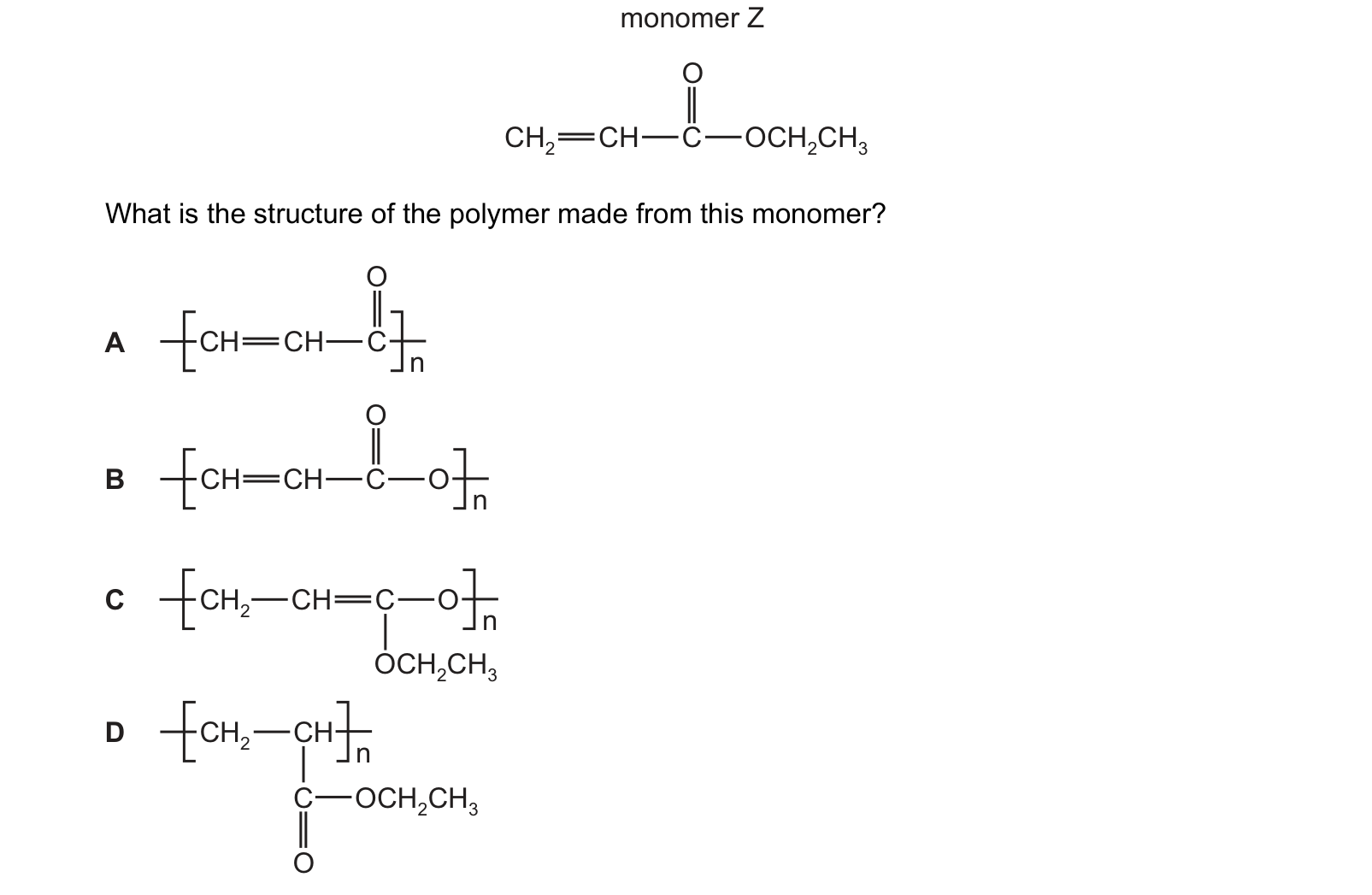
Answer: D.
In addition polymerisation the only thing that happens is that the C=C opens and its two carbons bond to the neighbouring units. Nothing is added, nothing is lost, and everything hanging off those two carbons is carried through unchanged.
So the backbone becomes –CH2–CH–, and the whole ester group –COOCH2CH3 stays attached as a side group on the second carbon. That is exactly D.
A and B keep a C=C in the backbone. If the double bond were still there it would not have polymerised, so any option showing one has undone the reaction it is meant to represent. B compounds the error by threading the ester oxygen into the chain.
C keeps a double bond too and puts an oxygen in the backbone. An oxygen in the main chain is the signature of a condensation polymer, a polyester, which is made from a diol and a diacid with water eliminated. This monomer has one C=C and no second functional group to condense with.
The test that settles all four: an addition polymer's repeat unit has exactly the same atoms as its monomer. Count them in D and they match Z atom for atom.
Question 3
The formula shows the repeat unit of an addition polymer.
–CH(CH3)CH(CH2CH3)–
What is the correct name of the monomer from which this polymer is made?
Answer: C.
The repeat unit is –CH(CH₃)–CH(CH₂CH₃)–, so the monomer is
CH(CH₃)=CH(CH₂CH₃), which written out is CH₃CH=CHCH₂CH₃
That is a five-carbon chain with the double bond between carbons 2 and 3: pent-2-ene, which is C.
D, pent-1-ene, has the same formula but the double bond at the end, so its repeat unit would be –CH₂–CH(CH₂CH₂CH₃)–, with one carbon carrying two hydrogens and the other a propyl group.
A and B are not proper names. '1-methyl-2-ethylethene' and '1-ethylprop-1-ene' both describe the right molecule, but neither uses the longest chain, which is what systematic naming requires. Counting through the double bond gives five carbons in a row, so the parent is pentene and both substituent names disappear.
The check that catches errors here is to count the carbons in the repeat unit: 1 + 1 in the backbone plus the methyl plus the two of the ethyl gives five, and the monomer must have five too, since addition polymerisation loses nothing.
What the syllabus asks for on this topicSyllabus points
Syllabus points
- Describe addition polymerisation and deduce the repeat unit from a monomer, and the monomer from a section of polymer.
- Describe condensation polymerisation to form polyesters and polyamides.
- Deduce the repeat unit and the monomers of a condensation polymer.
- Compare the properties of addition and condensation polymers, including their resistance to hydrolysis.
- Discuss the environmental problems of polymer disposal and the ways they are addressed.
Related CIE 9701 Chemistry topics
Not the topic you were looking for? Describe what you are stuck on in your own words and we will take you to the notes that answer it.