Polymerisation: five questions to try now
Real past-paper questions, the answer key from the mark scheme, and the explanation that goes with it. No account needed to answer them.
Question 1
Synthetic resins can be made by polymerisation of a variety of monomers including prop-2-en-1-ol, CH2=CHCH2OH.
Which structure represents the repeat unit in the polymer poly(prop-2-en-1-ol)?
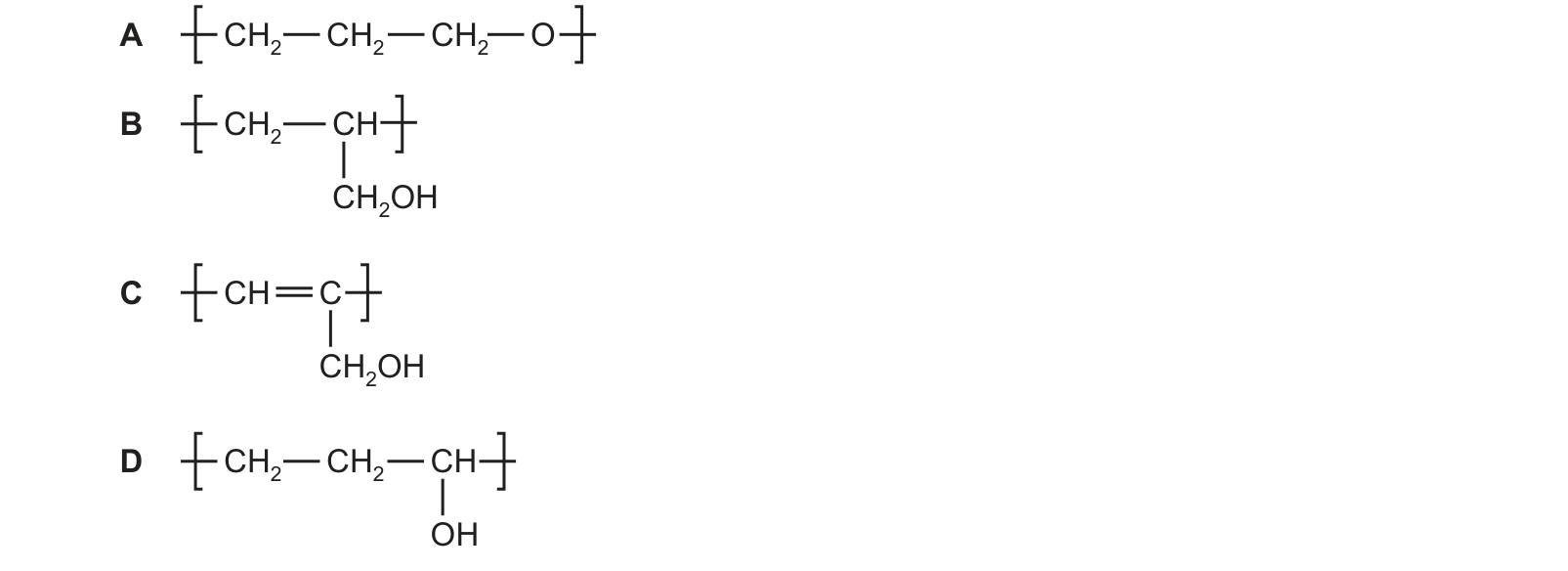
Answer: B.
The monomer is CH2=CH–CH2OH. In addition polymerisation the only change is that the C=C opens and its two carbons bond to the units on either side. Nothing is added, nothing is lost, and every group already attached is carried straight through.
So the two carbons of the double bond become the backbone, –CH2–CH–, and the CH2OH stays hanging off the second one as a side group.
A puts an oxygen in the backbone, which is the signature of a condensation polymer such as a polyester or a polyether. That would require water to be eliminated, and it would also mean the repeat unit no longer has the same atoms as the monomer.
C keeps a double bond in the chain. If the C=C were still there it would not have polymerised.
D moves the OH so that it sits on a backbone carbon rather than on the side group, which rearranges the molecule rather than polymerising it.
The check that settles all four: an addition polymer's repeat unit contains exactly the same atoms as its monomer, C3H6O here. Count them in B and they match.
Question 2
A section showing two repeat units of an addition polymer is shown. What is the identity of the monomer that produced this polymer?

Answer: B.
Read one repeat unit off the chain. The backbone alternates between a carbon carrying CH3 and Cl and a carbon carrying two CH3 groups, so the repeat unit is –C(CH3)(Cl)–C(CH3)2–.
In addition polymerisation the C=C becomes a C–C and nothing is added or lost, so undo it: put the double bond back between those two carbons and the monomer is (CH3)(Cl)C=C(CH3)2.
Naming it, the longest chain through the double bond is four carbons, but-2-ene, with a chlorine on C2 and a methyl on C3. That is 2-chloro-3-methylbut-2-ene.
A, 2-chloro-3-methylbutane, has the right skeleton and no double bond, so it cannot add to anything. C, 2-chloropent-2-ene, has five carbons in the chain and only one methyl branch, so its polymer would carry a CH2CH3 rather than the pair of methyls drawn.
D is the neat trap: it is a saturated name for roughly the fragment shown, which is the polymer, not the monomer. The monomer of an addition polymer always has the same empirical formula as the repeat unit and always contains a double bond.
Question 3
Compound V polymerises to form polymer W. A section of polymer W is shown.
polymer W What is the correct name of compound V?
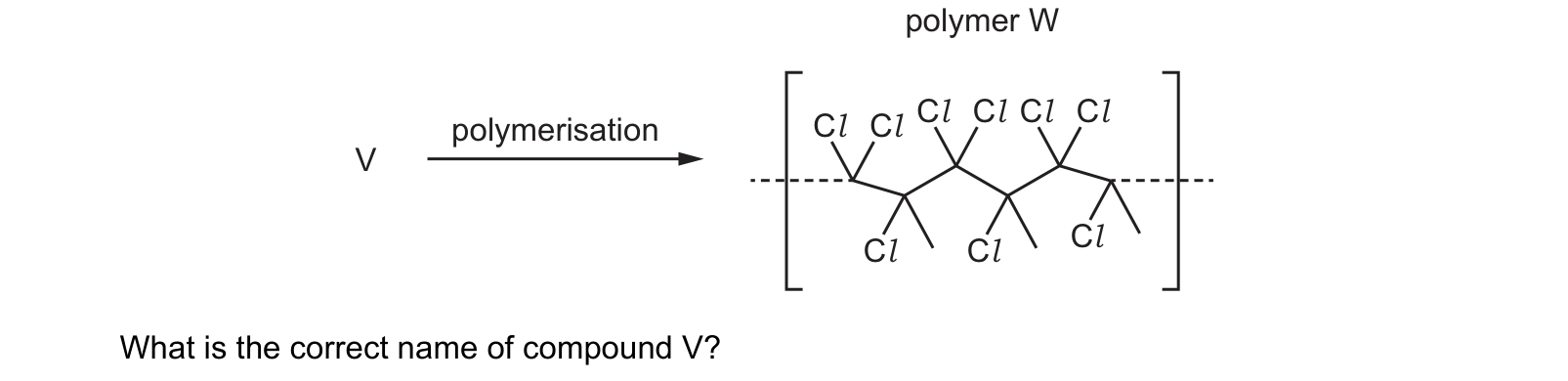
Answer: C.
Read one repeat unit off the chain. The backbone alternates between a carbon carrying two chlorines and a carbon carrying one chlorine and one methyl, so the repeat unit is –CCl2–CCl(CH3)–.
Addition polymerisation only opens the C=C, so put it back between those two carbons:
V = CCl2=CCl–CH3
Name it as a propene, since the longest chain is three carbons. Number from the end that gives the double bond the lower locant: C1 carries two chlorines, C2 carries one, and C3 is the methyl. That gives 1,1,2-trichloropropene.
B, 1,1,2-trichloroethene, is the answer if the methyl branch is missed. Its polymer would have a hydrogen where the drawing has a CH3. A, the butene, needs four carbons in the chain, so its polymer would carry an ethyl group.
D is not a workable name at all. Ethene has only two carbons and the two of them are already the double bond, so a 2-methyl group and a 2-chloro group cannot both be there. If it were forced to mean anything it would mean the same molecule as C, named against the rules.
The number of carbons in the monomer chain is always the number of backbone carbons in one repeat unit. Here that is two, plus a methyl branch, making three in the name.
Question 4
A molecule of a polymer contains the sequence shown. Which monomer could produce this polymer by addition polymerisation?

Answer: B.
Working along it, the carbons alternate between CH₂ groups and CHCl groups, in pairs. Some pairs run CH₂ then CHCl and others CHCl then CH₂, which is why the chlorines look irregularly placed, but every pair of carbons carries exactly one chlorine and three hydrogens between them.
That is the repeat unit –CH₂–CHCl–, and putting the double bond back between those two carbons gives
CH₂=CHCl, chloroethene
which is B. The polymer is PVC.
A, CHCl=CHCl, would give a chlorine on every carbon of the backbone.
C, CH₃CCl=CHCl, would give a methyl branch as well as two chlorines per pair.
D, CH₃CCl=CH₂, would give a repeat unit with a methyl and a chlorine on the same carbon and two hydrogens on the next.
Counting chlorines per two backbone carbons settles it immediately: the chain shows one, and only B provides one.
The irregular arrangement is worth a word. Most units join head to tail, but a few join head to head, which puts two CHCl groups next to each other. That does not change the monomer, only the order in which the units happen to have added.
Question 5
One molecule of an addition polymer containing 2000 repeat units has an Mr of 112 000.
The polymer molecule contains chiral centres.
What is a possible monomer for this polymer?
Answer: C.
112 000 / 2000 = 56
For an addition polymer the repeat unit has the same formula as the monomer, so the monomer is C₄H₈, which rules out propene at 42 and pent-1-ene at 70.
That leaves two four-carbon alkenes, and the chiral centre decides between them.
C, but-1-ene, CH₂=CHCH₂CH₃, gives the repeat unit –CH₂–CH(C₂H₅)–. The substituted carbon carries a hydrogen, an ethyl group, and the two halves of the chain running away from it, which are different from each other. Four different groups, so chiral. That is C.
B, methylpropene, (CH₃)₂C=CH₂, gives –CH₂–C(CH₃)₂–. That carbon carries two identical methyl groups, so it can never be a chiral centre.
The general point is that an addition polymer has a chiral centre whenever the monomer's substituted carbon ends up with one hydrogen and one different group on it. Poly(propene) is chiral at every other carbon for exactly this reason, and controlling those centres is what separates the useful form of the plastic from the soft one.
What this practice covers
These questions are drawn from past CIE 9701 Chemistry papers. You answer, you find out immediately whether you were right, and you get the reasoning for the correct option and for each distractor. Wrong answers go to a mistakes locker so you can come back to exactly those.
Practice is free. You need an account only so your progress and your mistakes are still there next time.
What examiners see students get wrong here
These are the errors that cost marks on polymerisation, taken from our own topic notes. Read them before you practise and you will recognise the traps in the questions.
- Drawing a repeat unit that still contains a C=C double bond.
- Omitting the two bonds sticking out of the repeat unit, or the brackets and the n.
- Taking a repeat unit of the wrong length when deducing a monomer from a polymer chain.
- Forgetting to add water back when breaking an ester or amide link to find the monomers.
- Saying addition polymers are biodegradable. Their carbon backbone cannot be hydrolysed.
- Forgetting that burning PVC produces HCl, which is the reason it needs special treatment.
Revise it first
If any of the above is unfamiliar, work through the notes before practising: Polymerisation revision notes.