Carbonyl compounds: five questions to try now
Real past-paper questions, the answer key from the mark scheme, and the explanation that goes with it. No account needed to answer them.
Question 1
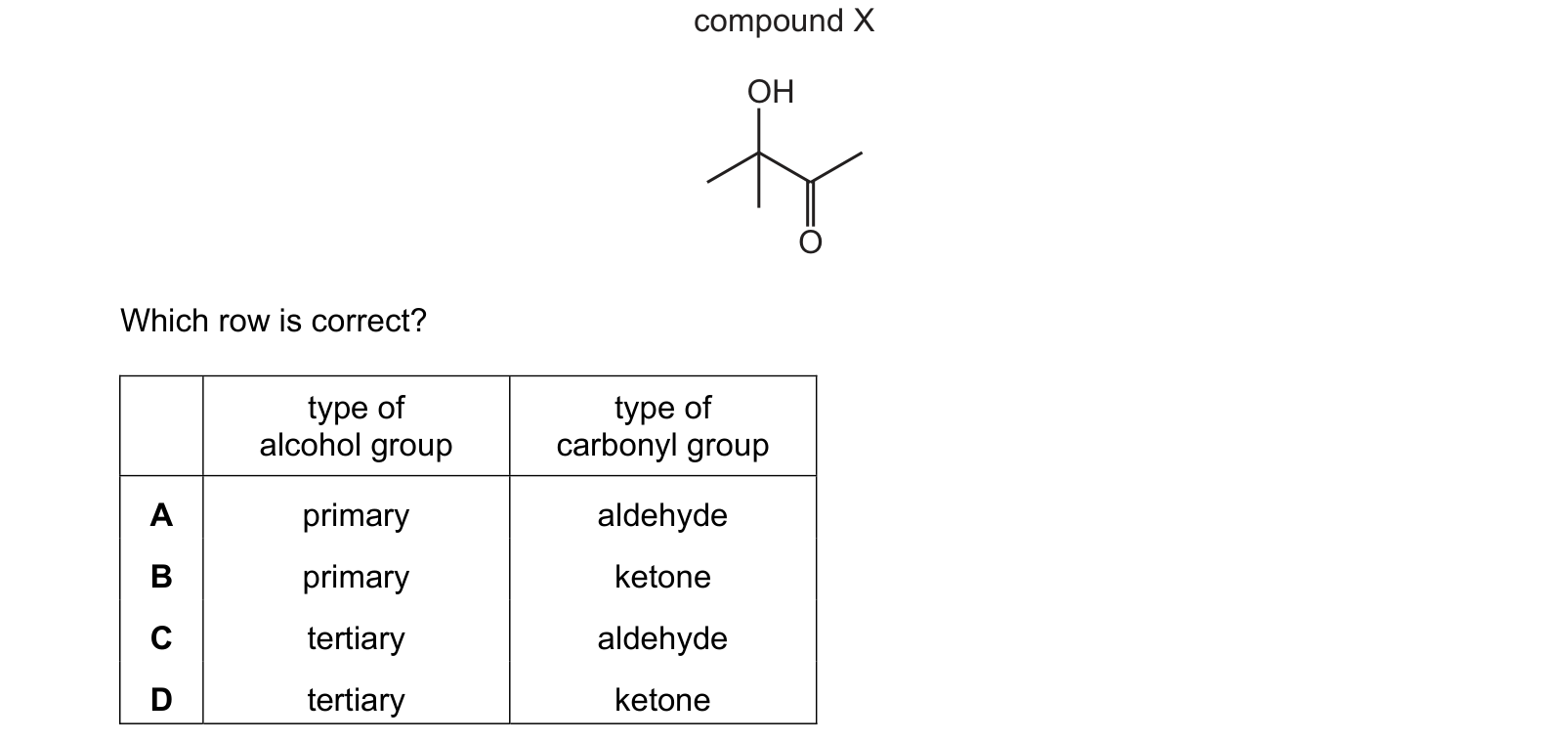
Compound X contains an alcohol group and a carbonyl group. compound X Which row is correct? Each answer gives, in order: type of alcohol group; type of carbonyl group.
Answer: D.
The alcohol. The carbon carrying the OH is attached to two methyl groups and the carbonyl carbon, so it has three carbon atoms on it and no hydrogen. Three carbons makes it a tertiary alcohol. That removes A and B.
The carbonyl. The C=O carbon is attached to the alcohol carbon on one side and a methyl on the other, so it has two carbon groups and no hydrogen. A carbonyl with no hydrogen on it is a ketone. That is D.
An aldehyde would need the carbonyl carbon to carry a hydrogen, which happens only at the end of a chain. Here it is in the middle, so it cannot be one.
The two classifications are decided by the same question asked twice: how many carbons are attached? For the alcohol carbon, three means tertiary; for the carbonyl carbon, two means ketone.
The practical consequence is worth noting. This compound would give a positive 2,4-DNPH test, because it has a carbonyl, but a negative Tollens' and Fehling's test, because that carbonyl is a ketone, and it would not be oxidised by dichromate, because its alcohol is tertiary.
Question 2
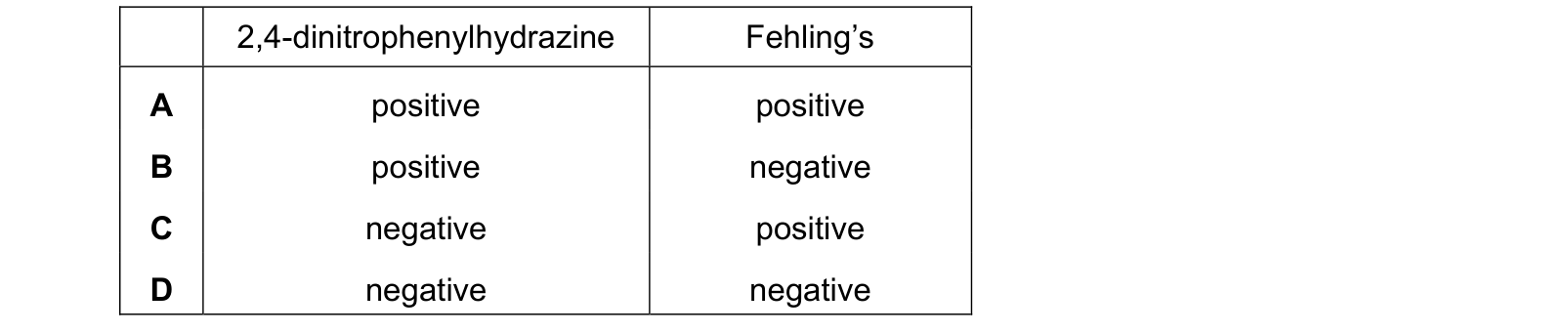
Butanedione, CH3COCOCH3, is a yellow liquid. How does butanedione react with 2,4-dinitrophenylhydrazine reagent and Fehling’s reagent? Each answer gives, in order: 2,4-dinitrophenylhydrazine; Fehling’s.
Answer: B.
2,4-DNPH reacts with any aldehyde or ketone, so the result is positive, giving the orange precipitate.
Fehling's reagent oxidises aldehydes only. It works by oxidising the C–H bond on the carbonyl carbon, and a ketone has no such hydrogen. Oxidising it would mean breaking a carbon-carbon bond, which Fehling's is far too mild to do. So the result is negative, with no red precipitate.
So positive then negative, which is B.
That pairing is exactly what the two reagents are for. DNPH says there is a carbonyl; Fehling's or Tollens' says whether it is an aldehyde. A positive DNPH with a negative Fehling's identifies a ketone unambiguously.
The yellow colour of the liquid mentioned in the stem is a distraction: it is a property of the compound itself and has nothing to do with either test result.
Question 3
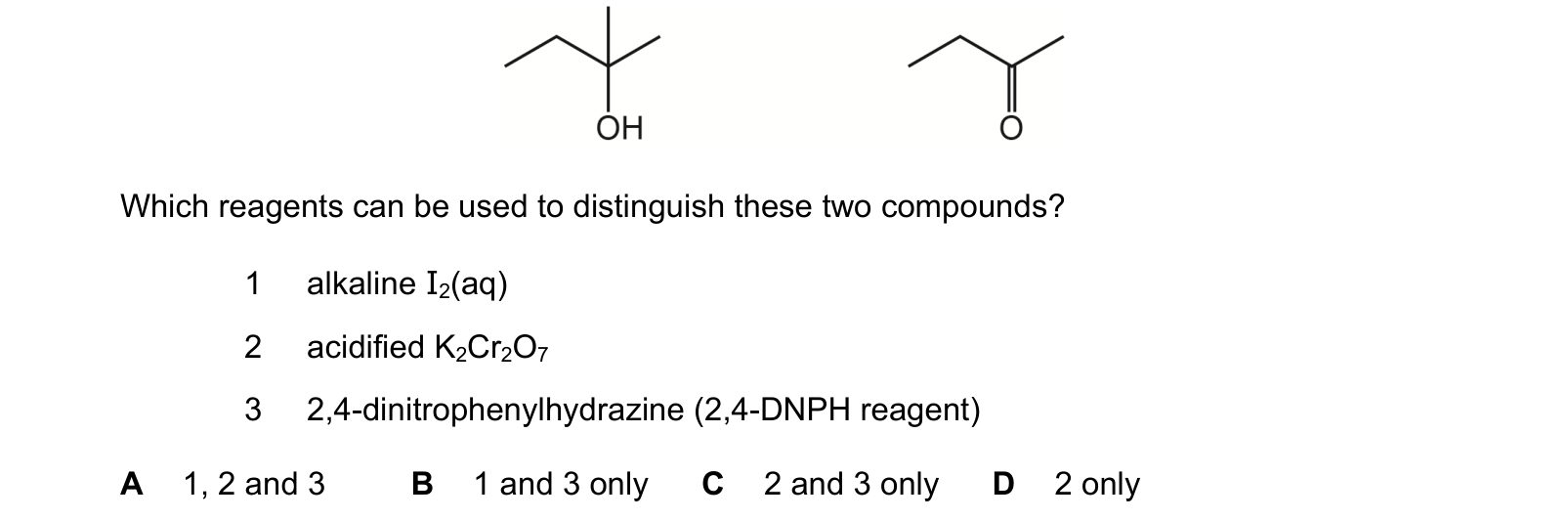
The skeletal formulae of two organic compounds are shown.
Which reagents can be used to distinguish these two compounds?
1 alkaline I2(aq)
2 acidified K2Cr2O7
3 2,4-dinitrophenylhydrazine (2,4-DNPH reagent)
Answer: B.
1, alkaline I2(aq), is the iodoform test. It needs a CH3CO group or a CH3CH(OH) group. Butanone has the methyl ketone and gives the pale yellow precipitate of CHI3. The alcohol has no hydrogen on its carbinol carbon, so it cannot be oxidised to a methyl ketone either. Different results, so it works.
3, 2,4-DNPH, gives an orange precipitate with any aldehyde or ketone. Butanone does, the alcohol does not. It works.
2, acidified K2Cr2O7, is the trap. It oxidises primary and secondary alcohols, but this alcohol is tertiary and there is no hydrogen on the C–OH carbon to remove. Ketones resist oxidation as well. Both give the same negative result, orange staying orange, and a reagent that does nothing to either compound distinguishes nothing.
Question 4
A carbonyl compound, X, reacts with HCN in the presence of NaCN to make a compound with Mr 85. Compound X does not react with Fehling’s reagent.
What is compound X?
Answer: D.
Mr(X) = 85 − 27 = 58
A carbonyl compound CₙH₂ₙO with Mr 58 is C₃H₆O, which is either propanal or propanone.
X does not react with Fehling's reagent, and Fehling's is positive for aldehydes only, so X is the ketone: propanone, which is D.
C, propanal, has the right formula and would give a red precipitate with Fehling's, so the second condition is there entirely to separate those two.
A and B both have four carbons and Mr 72, which would give a product of 99 rather than 85.
The mass arithmetic is worth doing carefully. Addition means nothing is lost, so the product's Mr is simply the sum of the two reactants. If the reaction had been a substitution or a condensation there would be a small molecule to subtract, and 85 would point somewhere else entirely.
The NaCN in the stem is there to supply the cyanide ion that actually attacks; HCN alone dissociates too little to give a useful rate.
Question 5
Compound X: ● does not react with Tollens’ reagent ● forms a yellow precipitate with alkaline I2(aq) ● does not react with sodium.
What could be the identity of X?
Answer: B.
No reaction with Tollens' reagent means not an aldehyde, which removes A, ethanal.
No reaction with sodium means no O–H group, which removes D, propan-2-ol.
A yellow precipitate with alkaline iodine needs a CH₃CO– or CH₃CH(OH)– group. That removes C, ethyl ethanoate: an ester's methyl is attached to the carbonyl through the chain in CH₃CO₂C₂H₅, but esters do not give the iodoform reaction, because the neighbouring oxygen makes the carbonyl far less reactive.
What is left is B, C₂H₅COCH₃, which is butanone. It is a ketone, so Tollens' is negative; it has no O–H, so sodium does nothing; and it has a methyl directly on the carbonyl, so the iodoform test is positive.
Butanone is the smallest compound that satisfies all three at once, and the three conditions between them separate the four main classes on offer: aldehyde, ketone, ester and alcohol.
What this practice covers
These questions are drawn from past CIE 9701 Chemistry papers. You answer, you find out immediately whether you were right, and you get the reasoning for the correct option and for each distractor. Wrong answers go to a mistakes locker so you can come back to exactly those.
Practice is free. You need an account only so your progress and your mistakes are still there next time.
What examiners see students get wrong here
These are the errors that cost marks on carbonyl compounds, taken from our own topic notes. Read them before you practise and you will recognise the traps in the questions.
- Saying a ketone is oxidised by Fehling's or Tollens'. It is not, because there is no hydrogen on the carbonyl carbon.
- Calling Tollens' reagent a reducing agent. It is the oxidising agent; the aldehyde reduces it.
- Using 2,4-DNPH to distinguish an aldehyde from a ketone. It detects both.
- Forgetting that HCN addition adds a carbon, which is usually why it appears in a synthesis question.
- Drawing the nucleophile's arrow to the oxygen rather than to the δ+ carbon.
- Saying propanone gives a positive tri-iodomethane test because it is a ketone. It is positive because it is a methyl ketone.
Revise it first
If any of the above is unfamiliar, work through the notes before practising: Carbonyl compounds revision notes.