Carboxylic acids and derivatives: five questions to try now
Real past-paper questions, the answer key from the mark scheme, and the explanation that goes with it. No account needed to answer them.
Question 1
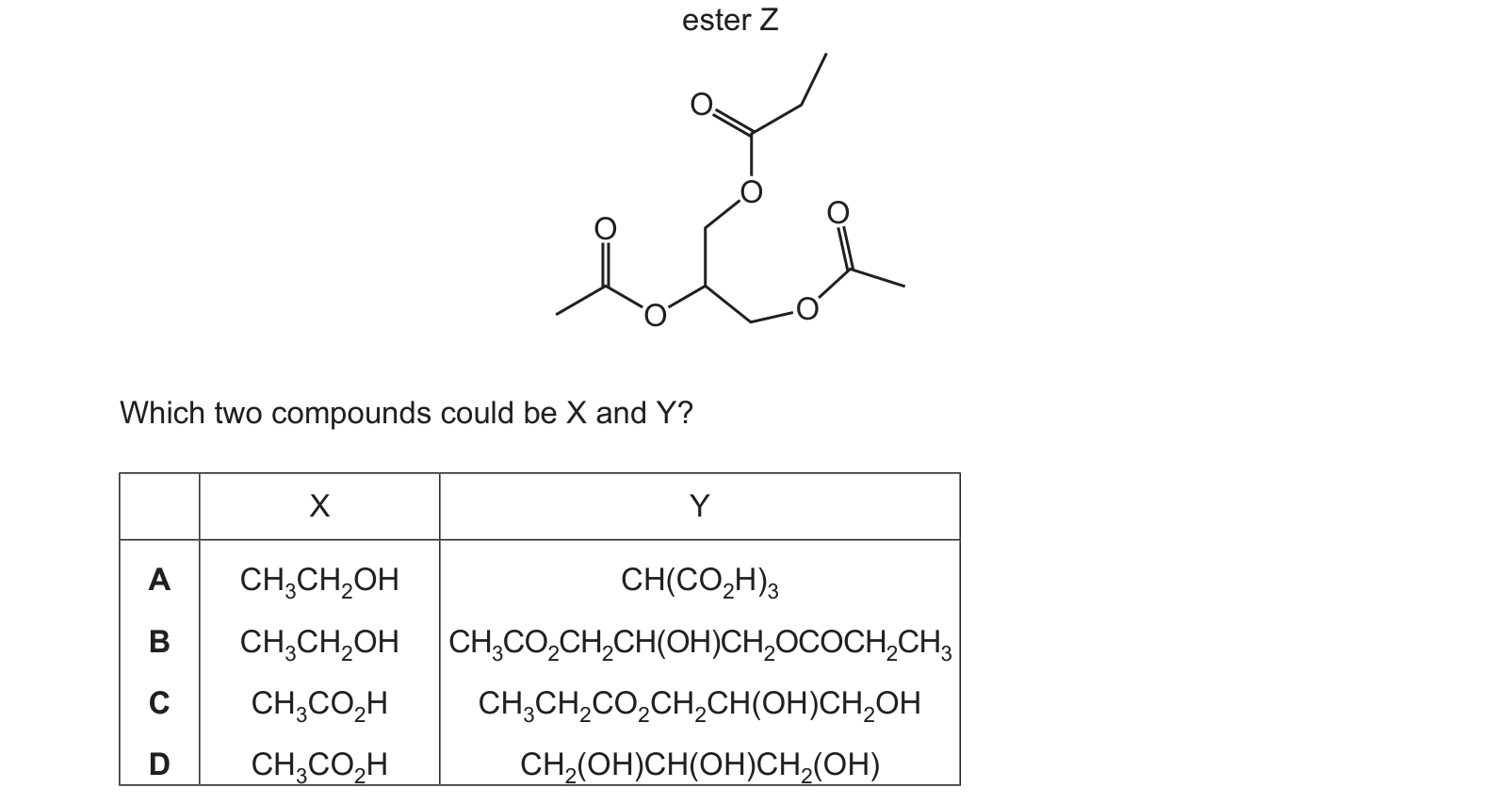
Two compounds, X and Y, are mixed and a little concentrated H2SO4 is added.
Ester Z is found in the resulting mixture of products.
ester Z Which two compounds could be X and Y?
Answer: C.
Esterification joins a carboxylic acid to an alcohol. To end up with two different acyl groups you need a starting material that already carries one of them, plus the acid that supplies the other.
C gives you exactly that. Y is glycerol that already has the propanoate in place on one end, leaving two free OH groups, and X is ethanoic acid to esterify both of them. Every part of Z is accounted for.
D is the tempting one: glycerol plus ethanoic acid. It builds a perfectly good triester, but all three acyl groups would be ethanoate and Z has a propanoate. Nothing in the mixture could supply that extra carbon.
B has both acyl groups already in place and offers ethanol, but the only free group left is the OH on the middle carbon, and an alcohol does not esterify another alcohol. A has the wrong carbon skeleton altogether.
Question 2
A carboxylic acid, P, has no chain isomers. It reacts with an alcohol, Q, that has only one positional isomer.
What could be the ester formed from a reaction between P and Q?
Answer: A.
P has no chain isomers. Branching needs at least four carbons, so butanoic acid already has one, 2-methylpropanoic acid. That means P has three carbons or fewer: methanoic, ethanoic or propanoic acid.
Q has only one positional isomer. The OH must have exactly one other place it could go on the same chain. Propan-1-ol has one alternative, propan-2-ol, and butan-1-ol has one, butan-2-ol. Pentan-1-ol has two, since the OH could go on carbon 2 or carbon 3.
Now test the options:
A, butyl propanoate. Propanoic acid has three carbons, so no chain isomers ✓, and butan-1-ol has exactly one positional isomer ✓. That is A.
B, ethyl butanoate. Butanoic acid does have a chain isomer ✗
C, pentyl ethanoate. Ethanoic acid is fine, but pentan-1-ol has two positional isomers ✗
D, propyl pentanoate. Pentanoic acid has several chain isomers ✗
The two kinds of isomerism are being kept deliberately apart. Chain isomerism is about how the carbons branch; positional isomerism is about where the functional group sits on a fixed skeleton.
Question 3
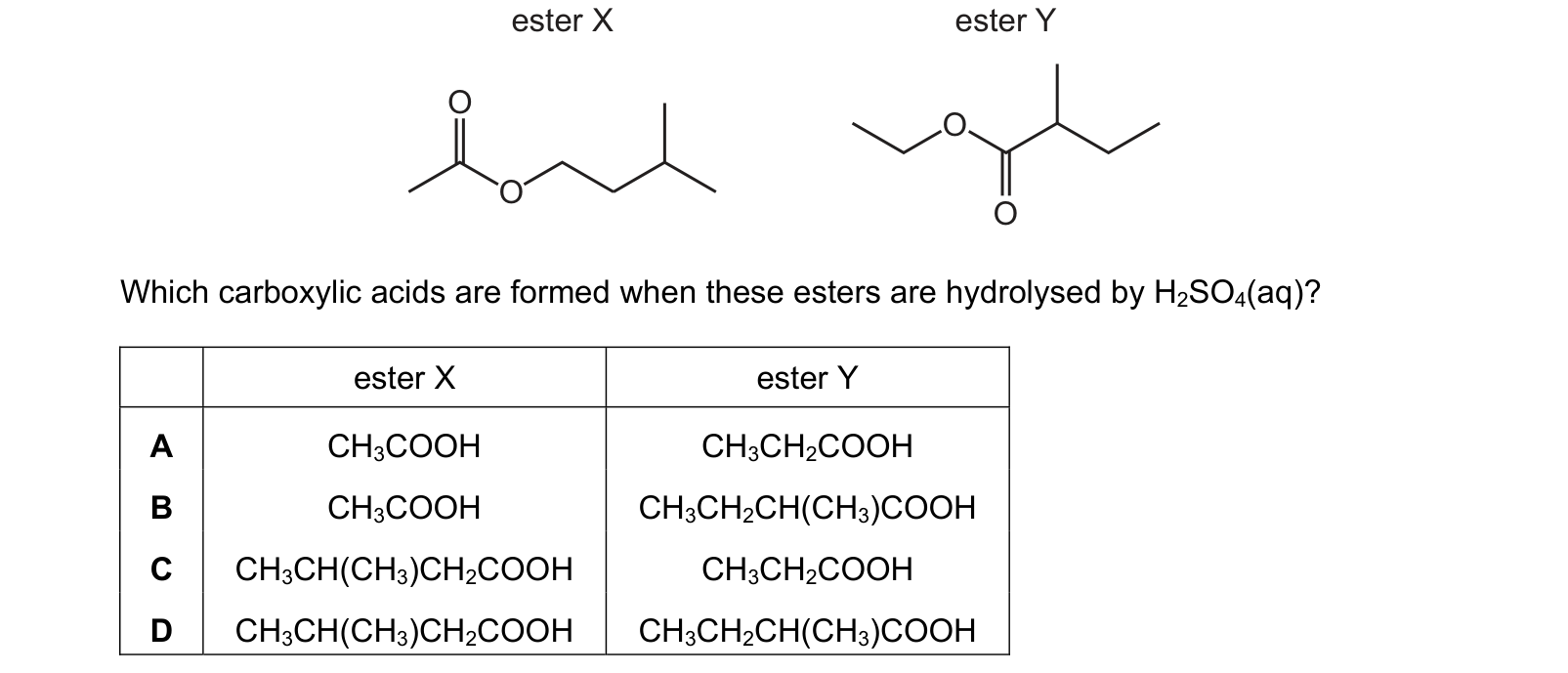
The diagrams show the structures of two esters, X and Y, that are formed in ripening apples. ester X ester Y Which carboxylic acids are formed when these esters are hydrolysed by H2SO4(aq)? Each answer gives, in order: ester X; ester Y.
Answer: B.
Ester X is CH3–CO–O–CH2CH2CH(CH3)2. The acyl side is just CH3CO, so the acid is CH3COOH, ethanoic acid. The branched three-methylbutyl group is the alcohol half and leaves as 3-methylbutan-1-ol.
Ester Y is CH3CH2–O–CO–CH(CH3)CH2CH3. Here the plain ethyl is on the oxygen side, so it is the alcohol and leaves as ethanol. The branched group is attached to the carbonyl carbon, so the acid is CH3CH2CH(CH3)COOH, 2-methylbutanoic acid.
The whole question is that the branch is on opposite halves in the two molecules, and C and D are built for anyone who assumes the branched fragment is always the acid. In X it is the alcohol.
Find the carbonyl carbon and follow its bonds. The carbon holding the C=O belongs to the acid along with everything on its far side; the oxygen with only single bonds belongs to the alcohol.
Acid hydrolysis is reversible and gives the carboxylic acid itself. Hydrolysis with hot alkali instead would go to completion and give the carboxylate salt, which would have to be acidified to reach these answers.
Question 4
The ester ethyl butanoate can be hydrolysed using an excess of dilute sodium hydroxide solution.
Which substance is a product of this reaction?
Answer: A.
Hydrolysis with an excess of sodium hydroxide breaks the ester into the salt of the acid and the alcohol:
CH₃CH₂CH₂CO₂CH₂CH₃ + NaOH → CH₃CH₂CH₂CO₂Na + CH₃CH₂OH
So sodium butanoate, which is A.
B, sodium ethanoate, reads the ester the wrong way round, taking the ethyl group as the acid half.
C, sodium ethoxide, would require the alcohol to be deprotonated. Ethanol is far too weak an acid for aqueous sodium hydroxide to do that, so it comes off as the neutral alcohol.
D, water, is not a product here. Water is a product when an acid neutralises an alkali, but in this hydrolysis a water molecule is consumed in splitting the ester.
The salt rather than the free acid is the product because the excess alkali immediately neutralises any butanoic acid formed. That also makes alkaline hydrolysis irreversible, which is why it goes to completion while acid hydrolysis settles at an equilibrium.
Question 5
In the mass spectrum of compound J, the ratio of the height of the M +1 ion peak to the height of the M + ion peak is 4:91.
Compound J forms a carboxylic acid when heated with acidified K2Cr2O7.
What is compound J?
Answer: A.
number of carbons ≈ (height of M+1 / height of M) × 100 / 1.1
Here that is
(4 / 91) × 100 / 1.1 = 4.40 / 1.1 = 4 carbons
That leaves butanal and butanone, since propan-1-ol and propanenitrile have only three.
The second clue separates them. Heating with acidified dichromate gives a carboxylic acid, which needs either a primary alcohol or an aldehyde. Butanone is a ketone, and ketones are not oxidised by dichromate at all, because the carbonyl carbon has no hydrogen to lose.
So J is butanal, which is A, and it is oxidised to butanoic acid.
The M+1 method is worth practising as a quick division. A ratio of about 1 : 91 would mean one carbon, 1 : 45 two carbons, and so on, so a 4 : 91 ratio is four times the single-carbon case. Reading it that way avoids the arithmetic entirely.
What this practice covers
These questions are drawn from past CIE 9701 Chemistry papers. You answer, you find out immediately whether you were right, and you get the reasoning for the correct option and for each distractor. Wrong answers go to a mistakes locker so you can come back to exactly those.
Practice is free. You need an account only so your progress and your mistakes are still there next time.
What examiners see students get wrong here
These are the errors that cost marks on carboxylic acids and derivatives, taken from our own topic notes. Read them before you practise and you will recognise the traps in the questions.
- Distilling rather than refluxing when a carboxylic acid is wanted from a primary alcohol.
- Naming an ester backwards. The alkyl group on the single-bonded oxygen comes from the alcohol and is named first.
- Saying alkaline hydrolysis gives the carboxylic acid. It gives the salt, which must be acidified.
- Explaining acid strength by the number of oxygens. It is the delocalisation of the charge over two oxygens that matters.
- Forgetting that only carboxylic acids release carbon dioxide from carbonates, which is what distinguishes them from phenol.
- Treating the sulfuric acid in esterification as a reactant. It is a catalyst.
Revise it first
If any of the above is unfamiliar, work through the notes before practising: Carboxylic acids and derivatives revision notes.