Nitrogen compounds: one question to try now
Real past-paper questions, the answer key from the mark scheme, and the explanation that goes with it. No account needed to answer them.
Question 1
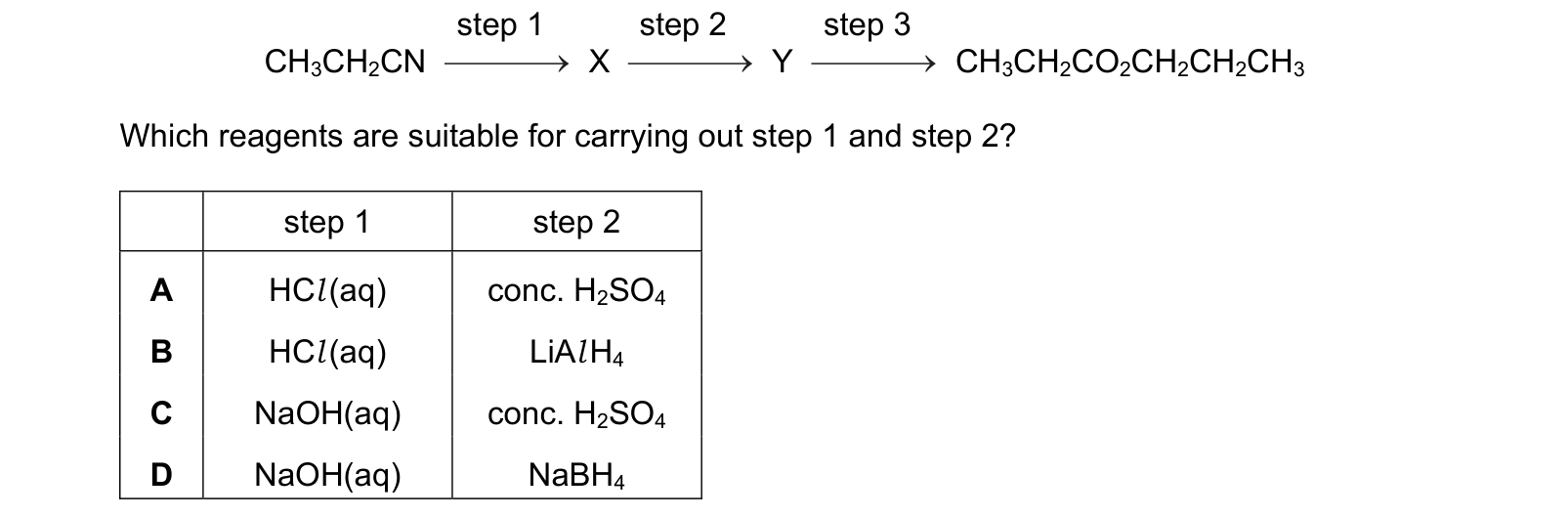
Propyl propanoate can be synthesised in three steps using propanenitrile as the only organic starting material.
In step 1, the nitrile is converted into compound X.
In step 2, compound X is converted into compound Y.
In step 3, compound Y is reacted with more of compound X to give propyl propanoate.
step 1 step 2 step 3 Which reagents are suitable for carrying out step 1 and step 2? Each answer gives, in order: step 1; step 2.
Answer: B.
The target is propyl propanoate, CH3CH2COO–CH2CH2CH3, and step 3 makes it by esterifying Y with X. An ester comes from an acid and an alcohol, so one of them is propanoic acid and the other propan-1-ol. Since X is made first and directly from the nitrile, X is the acid and Y the alcohol.
Step 1, nitrile to acid. Hydrolysing CH3CH2CN under acidic conditions gives the carboxylic acid itself. Hydrolysing it with NaOH(aq) would give the sodium carboxylate salt instead, which needs a further acidification before it can be esterified, and no such step is offered. That rules out C and D.
Step 2, acid to alcohol. Reducing a carboxylic acid to a primary alcohol needs LiAlH4, which is strong enough. NaBH4 is not: it reduces aldehydes and ketones but leaves a carboxylic acid untouched, which is the other reason D fails.
A puts concentrated H2SO4 in step 2, but that is the catalyst for step 3, the esterification. It converts nothing into an alcohol.
Both carbon chains in the product are three carbons long, which is the clue that a single starting material can supply both halves.
What this practice covers
These questions are drawn from past CIE 9701 Chemistry papers. You answer, you find out immediately whether you were right, and you get the reasoning for the correct option and for each distractor. Wrong answers go to a mistakes locker so you can come back to exactly those.
Practice is free. You need an account only so your progress and your mistakes are still there next time.
What examiners see students get wrong here
These are the errors that cost marks on nitrogen compounds, taken from our own topic notes. Read them before you practise and you will recognise the traps in the questions.
- Classifying an amine by the carbons on the adjacent carbon. Count the groups on the nitrogen.
- Saying phenylamine is a stronger base than ammonia. The delocalised lone pair makes it much weaker.
- Saying amides are basic like amines. The lone pair is delocalised onto the carbonyl oxygen.
- Forgetting excess ammonia in the halogenoalkane route, or claiming the product is pure.
- Drawing the zwitterion with the wrong groups charged. The acid loses its proton and the amine gains it.
- Saying an amino acid is negative in acid. In acid it is positive.
Revise it first
If any of the above is unfamiliar, work through the notes before practising: Nitrogen compounds revision notes.