The Periodic Table: chemical periodicity: five questions to try now
Real past-paper questions, the answer key from the mark scheme, and the explanation that goes with it. No account needed to answer them.
Question 1
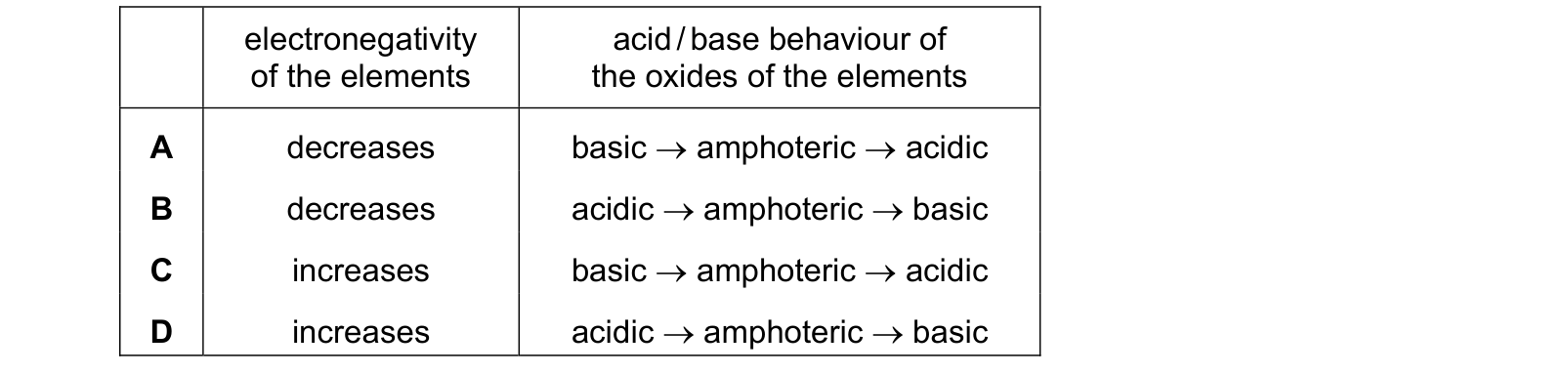
The elements in Period 3 and their compounds show trends across the period from sodium to chlorine. Which row is correct? Each answer gives, in order: electronegativity of the elements; acid / base behaviour of the oxides of the elements.
Answer: C.
Electronegativity increases from sodium to chlorine. Going across the period the nuclear charge rises while the electrons enter the same shell, so the pull on a shared pair of electrons strengthens. That removes A and B.
The oxides go from basic through amphoteric to acidic. Na₂O and MgO are basic, metal oxides that react with acids. Al₂O₃ is amphoteric, reacting with both acids and alkalis. SiO₂, P₄O₁₀, SO₃ and Cl₂O are acidic, non-metal oxides that react with alkalis. That is C.
The two trends are connected. Metals on the left have low electronegativity and form ionic oxides containing the O²⁻ ion, which is a base and reacts with acid. Non-metals on the right have high electronegativity and form covalent oxides, which react with water to give acids.
Aluminium sits at the crossover, where the bonding is on the border between ionic and covalent, which is exactly why its oxide behaves both ways.
Question 2
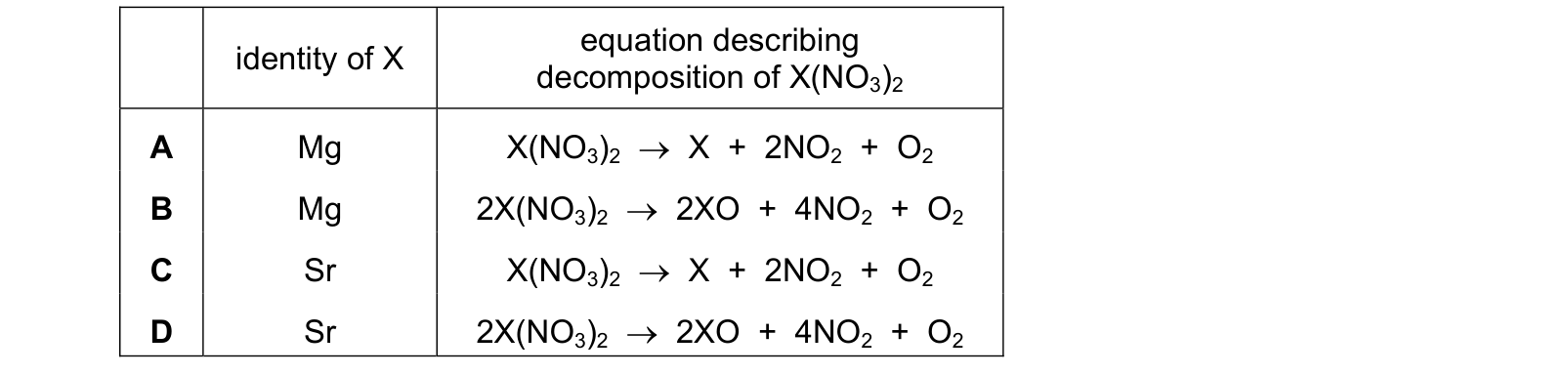
X is a Group 2 element in either Period 3 or Period 5. X(OH)2 is less soluble in water than Ca(OH)2. When X(NO3)2 is heated, it decomposes. Which row is correct? Each answer gives, in order: identity of X; equation describing decomposition of X(NO3)2.
Answer: B.
X(OH)₂ is less soluble than Ca(OH)₂. Hydroxide solubility increases down Group 2, so a less soluble hydroxide means X is above calcium. That makes X magnesium, and removes C and D.
The decomposition equation. Group 2 nitrates decompose to the oxide, not to the metal:
2X(NO₃)₂ → 2XO + 4NO₂ + O₂
so B.
A gives the metal as the product, which no thermal decomposition does. Producing magnesium from magnesium nitrate would mean reducing the metal ion, and there is nothing present to supply the electrons. Heating a nitrate drives off the nitrogen and some of the oxygen and leaves the metal still combined with oxygen.
A also fails to balance: with one X(NO₃)₂ there are six oxygens on the left and only 2 × 2 + 2 = 6 on the right, which happens to work, but the redox is impossible whatever the arithmetic says.
Magnesium nitrate being the least thermally stable of the Group 2 nitrates is consistent with X being magnesium, since the question says it does decompose on heating.
Question 3
Q is a semi-conductor. The chloride of Q reacts with water to form white fumes and an acidic solution.
Which Period 3 element is Q?
Answer: C.
Q is a semiconductor. In Period 3 that is silicon, and only silicon. Sodium, magnesium and aluminium are metals and conduct well; phosphorus, sulfur and chlorine are non-metals and do not conduct at all. Silicon sits between them, which is why it is the basis of every microchip. That is C.
The second clue confirms it. Silicon tetrachloride is covalent and hydrolyses vigorously:
SiCl₄ + 2H₂O → SiO₂ + 4HCl
The HCl comes off as a gas and meets moisture in the air to give white fumes, and what dissolves makes the solution strongly acidic.
A is ruled out on both counts: magnesium is a metal, and MgCl₂ is ionic, so it dissolves without fuming and gives a near-neutral solution.
B and D would both fume and give acidic solutions, since AlCl₃ and PCl₅ hydrolyse too, so only the semiconductor clue separates them from the answer.
Silicon's reaction is worth contrasting with carbon's. CCl₄ does not hydrolyse, because carbon has no d orbitals to accept a lone pair from an attacking water molecule, while silicon does. Same group, opposite behaviour.
Question 4
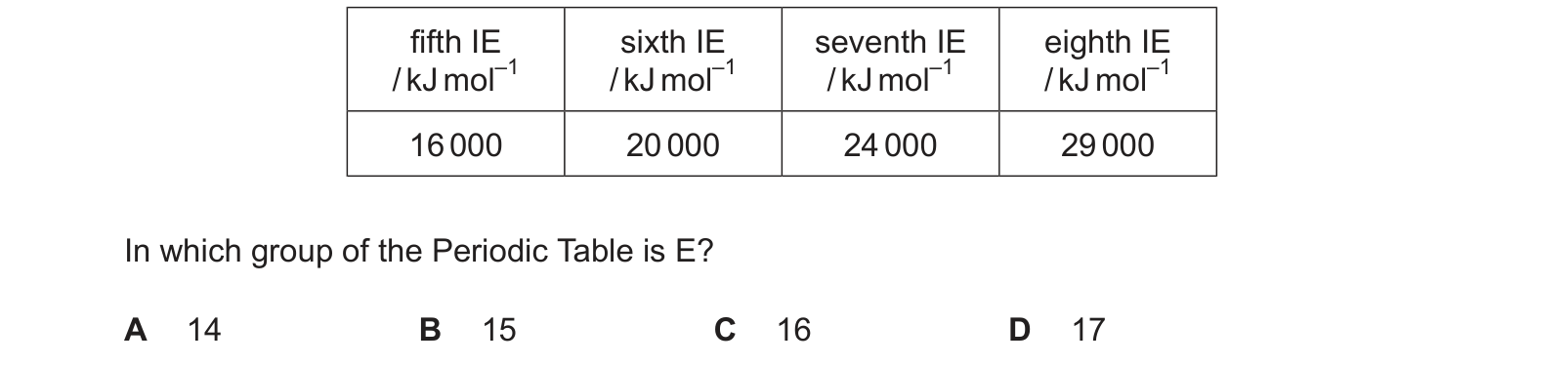
Four successive ionisation energies (IE) of element E are shown. Element E is in Period 3 of the Periodic Table. fifth IE sixth IE seventh IE eighth IE /kJ mol⁻¹ /kJ mol⁻¹ /kJ mol⁻¹ /kJ mol⁻¹ 16000 20000 24000 29000 In which group of the Periodic Table is E?
Answer: A.
A big jump appears when an electron has to be taken from a new shell, closer to the nucleus. Since there is no jump anywhere in this run, all four of these electrons are coming from the same shell.
Their size is what places them. Values of 16 000 kJ mol⁻¹ and above are far too large for an outer-shell electron in Period 3, where those run in the low thousands. So by the fifth ionisation the outer shell is already empty, and the big jump must have come between the fourth and the fifth.
An element whose outer shell holds exactly four electrons is in Group 14, which is A.
The element is silicon, and the figures match it closely: its fifth to eighth ionisation energies are 16 091, 19 805, 23 780 and 29 287 kJ mol⁻¹.
The general rule is that the big jump comes immediately after the group number, so counting how many ionisations happen before it identifies the group. Here the jump is not shown at all, and the question is answered by noticing where it must already have been.
Question 5
Two Period 3 elements, X and Y, burn separately in oxygen to form solid oxides.
The oxide of X is insoluble in water.
The oxide of Y dissolves in water to form a solution which dissolves the oxide of X.
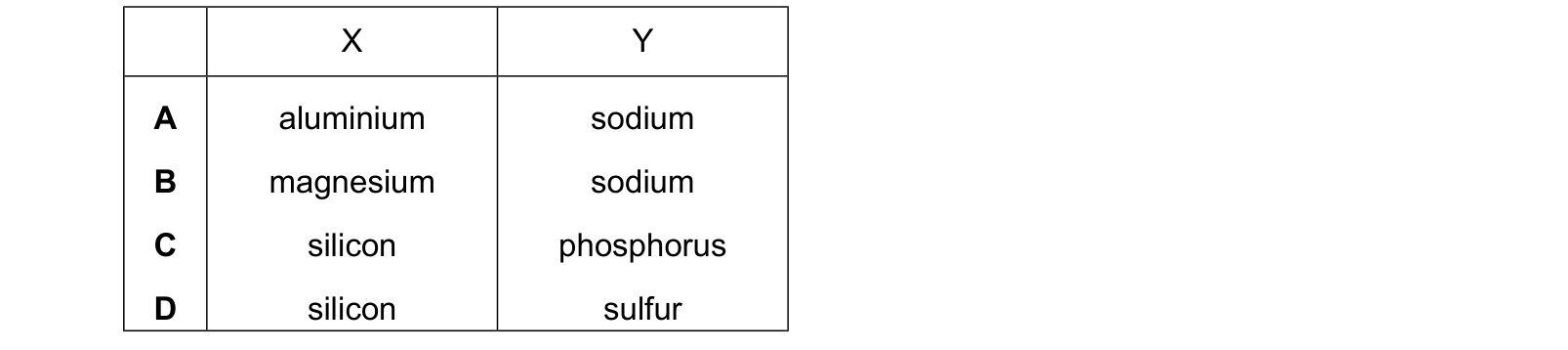
What could X and Y be? Each answer gives, in order: X; Y.
Answer: A.
Y must give a strongly alkaline solution, so its oxide is a soluble basic oxide. In Period 3 that is sodium, whose Na₂O gives NaOH.
X must be aluminium, whose Al₂O₃ is insoluble in water but dissolves in sodium hydroxide:
Al₂O₃ + 2OH⁻ + 3H₂O → 2[Al(OH)₄]⁻
So aluminium and sodium, which is A.
B fails on X. Magnesium oxide is basic, and a base does not dissolve in an alkali.
C and D fail on Y. Phosphorus and sulfur give acidic oxides, so their solutions are acids, and an acid would not dissolve silicon dioxide. Silicon dioxide is a plausible X, since it is insoluble in water and does dissolve in hot concentrated alkali, but neither of the elements offered alongside it provides that alkali.
Aluminium's amphoteric oxide is the crossover point of the whole period, sitting between the basic metal oxides and the acidic non-metal ones.
What this practice covers
These questions are drawn from past CIE 9701 Chemistry papers. You answer, you find out immediately whether you were right, and you get the reasoning for the correct option and for each distractor. Wrong answers go to a mistakes locker so you can come back to exactly those.
Practice is free. You need an account only so your progress and your mistakes are still there next time.
What examiners see students get wrong here
These are the errors that cost marks on the periodic table: chemical periodicity, taken from our own topic notes. Read them before you practise and you will recognise the traps in the questions.
- Saying atomic radius increases across a period. It decreases.
- Explaining the melting point trend with one mechanism. It changes with structure, and silicon is the peak.
- Saying Al₂O₃ is basic or acidic. It is amphoteric, and the mark is for saying it reacts with both.
- Saying SiO₂ is basic because it is insoluble. It is weakly acidic and reacts with hot concentrated alkali.
- Saying magnesium reacts vigorously with cold water. It is very slow with cold water and fast only with steam.
- Forgetting that covalent chlorides hydrolyse rather than dissolve, and that the fumes are HCl.
Revise it first
If any of the above is unfamiliar, work through the notes before practising: The Periodic Table: chemical periodicity revision notes.