Atoms, molecules and stoichiometry: five questions to try now
Real past-paper questions, the answer key from the mark scheme, and the explanation that goes with it. No account needed to answer them.
Question 1
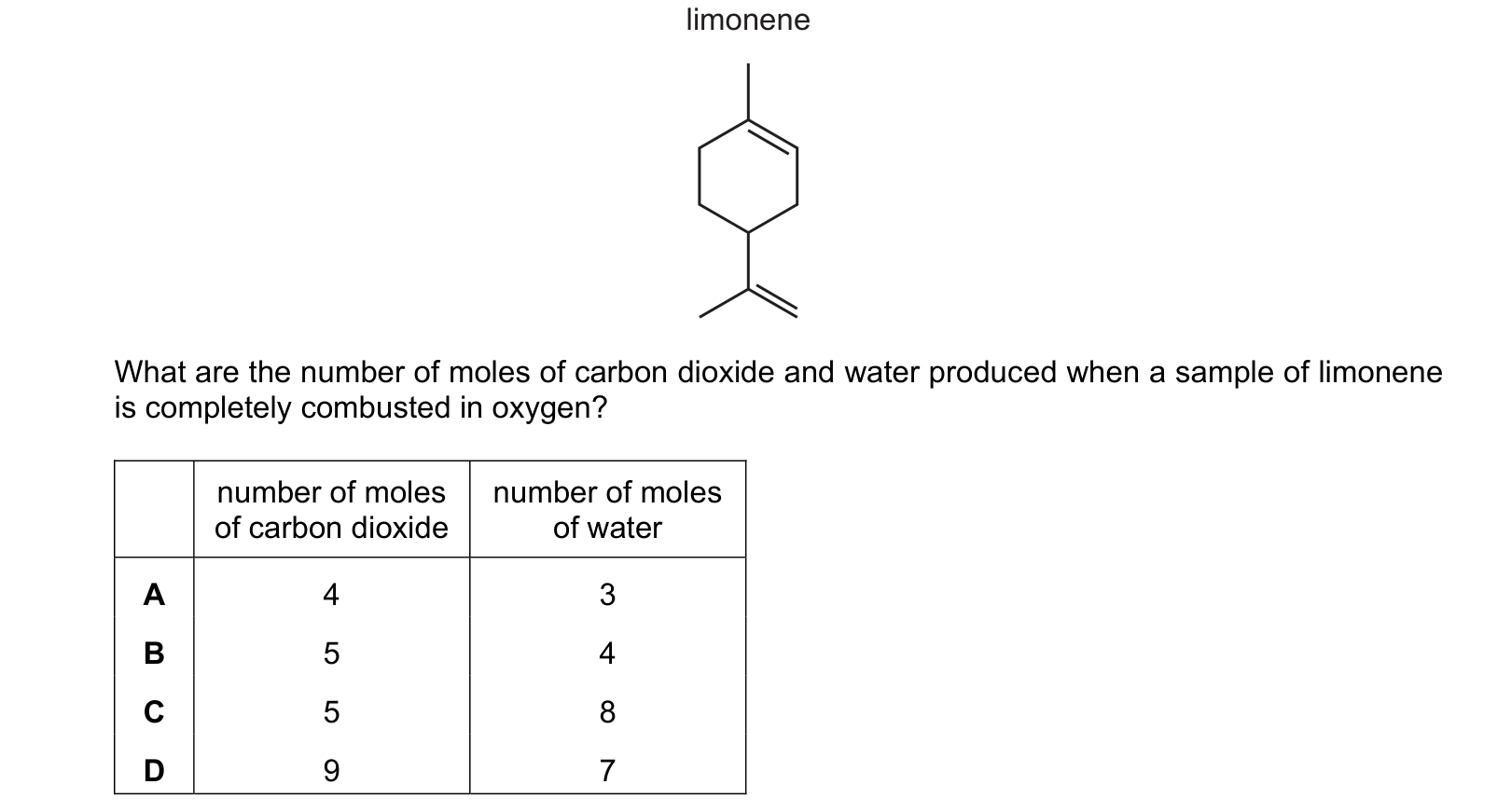
The structure of limonene is shown.
limonene
What are the number of moles of carbon dioxide and water produced when a sample of limonene is completely combusted in oxygen?
Answer: B.
Carbons: 10. Six in the ring, one methyl on the ring, and three more in the isopropenyl group hanging below it.
Hydrogens: 16. Round the ring, the carbon carrying the methyl is part of the C=C and has none, the other alkene carbon has one, then two CH2 groups give four, the carbon carrying the side chain gives one, and the last CH2 gives two: eight in the ring. Add three from the ring methyl and five from the side chain, which is a CH3 and a =CH2.
So limonene is C10H16, and complete combustion sends every carbon to CO2 and every two hydrogens to one H2O:
C10H16 + 14O2 → 10CO2 + 8H2O
The ratio is therefore 10 : 8, which simplifies to 5 : 4, and B is the only row in that ratio. It corresponds to burning half a mole.
C, 5 and 8, keeps the right carbon figure and forgets to halve the hydrogens, which is the commonest slip in any combustion equation. Hydrogen atoms are counted in pairs because water has two of them.
Every wrong option here fails the ratio test, so checking CO2 against H2O is faster than checking either alone.
Question 2
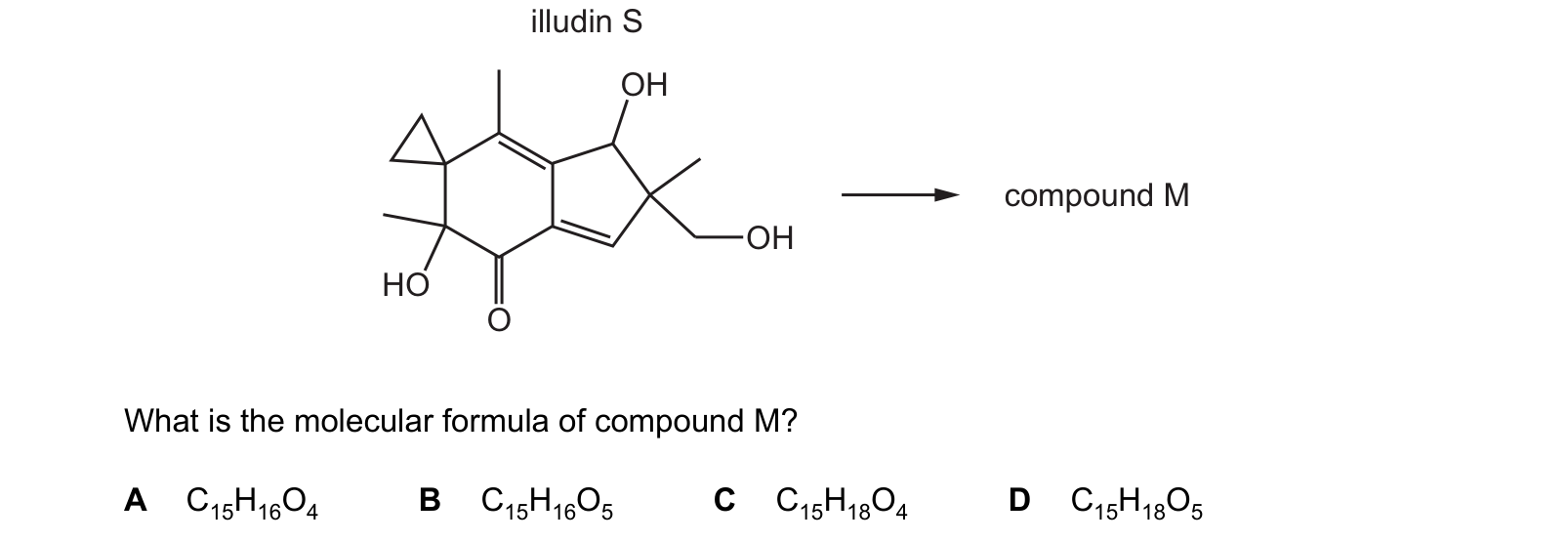
When illudin S is heated under reflux with an excess of acidified potassium dichromate(VI), compound M is formed.
illudin S What is the molecular formula of compound M?
Answer: B.
The secondary OH, on the carbon at the top right, is oxidised to a ketone. That removes 2 hydrogens and adds no oxygen.
The primary CH₂OH, on the right, is oxidised all the way to a carboxylic acid, since the reagent is in excess and the mixture is refluxed. CH₂OH becoming COOH removes 2 more hydrogens and adds 1 oxygen.
The tertiary OH, at the bottom left, is not oxidised at all. Its carbon carries no hydrogen, so there is nothing to remove without breaking the carbon skeleton.
The existing ketone is already oxidised and does not change.
So from C₁₅H₂₀O₄ take away four hydrogens and add one oxygen:
C₁₅H₁₆O₅, which is B.
The carbon count never changes, which is why all four options have 15, and the question is entirely about how many hydrogens go and whether an oxygen arrives.
Spotting the tertiary alcohol and leaving it alone is what separates B from D. Oxidising all three groups would take six hydrogens rather than four.
Question 3
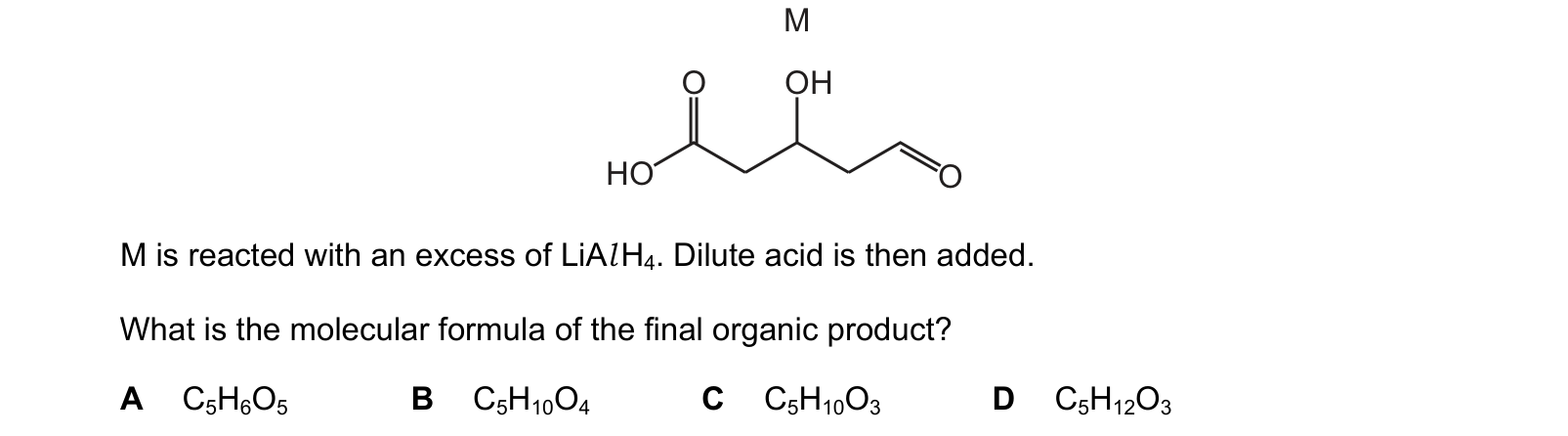
The skeletal formula of M is shown.
M M is reacted with an excess of LiAl H4. Dilute acid is then added.
What is the molecular formula of the final organic product?
Answer: D.
An excess of lithium tetrahydridoaluminate reduces both carbonyl-containing groups, and it is powerful enough to reduce a carboxylic acid, which sodium tetrahydridoborate is not.
The carboxylic acid becomes a primary alcohol. –COOH becomes –CH₂OH, which loses one oxygen and gains two hydrogens.
The aldehyde becomes a primary alcohol. –CHO becomes –CH₂OH, which gains two hydrogens and keeps its oxygen.
The existing alcohol is unchanged, since there is nothing for a reducing agent to do to it.
Starting from C₅H₈O₄ and applying both: hydrogens go from 8 to 12, and oxygens from 4 to 3.
The product is C₅H₁₂O₃, which is D, and it is pentane-1,3,5-triol.
C, C₅H₁₀O₃, is what you get by reducing the acid and forgetting the aldehyde.
The carbon count never changes, which is why every option has five, and the whole question is whether both groups are reduced and what each does to the oxygen count. The acid is the one that loses an oxygen; the aldehyde does not.
Question 4
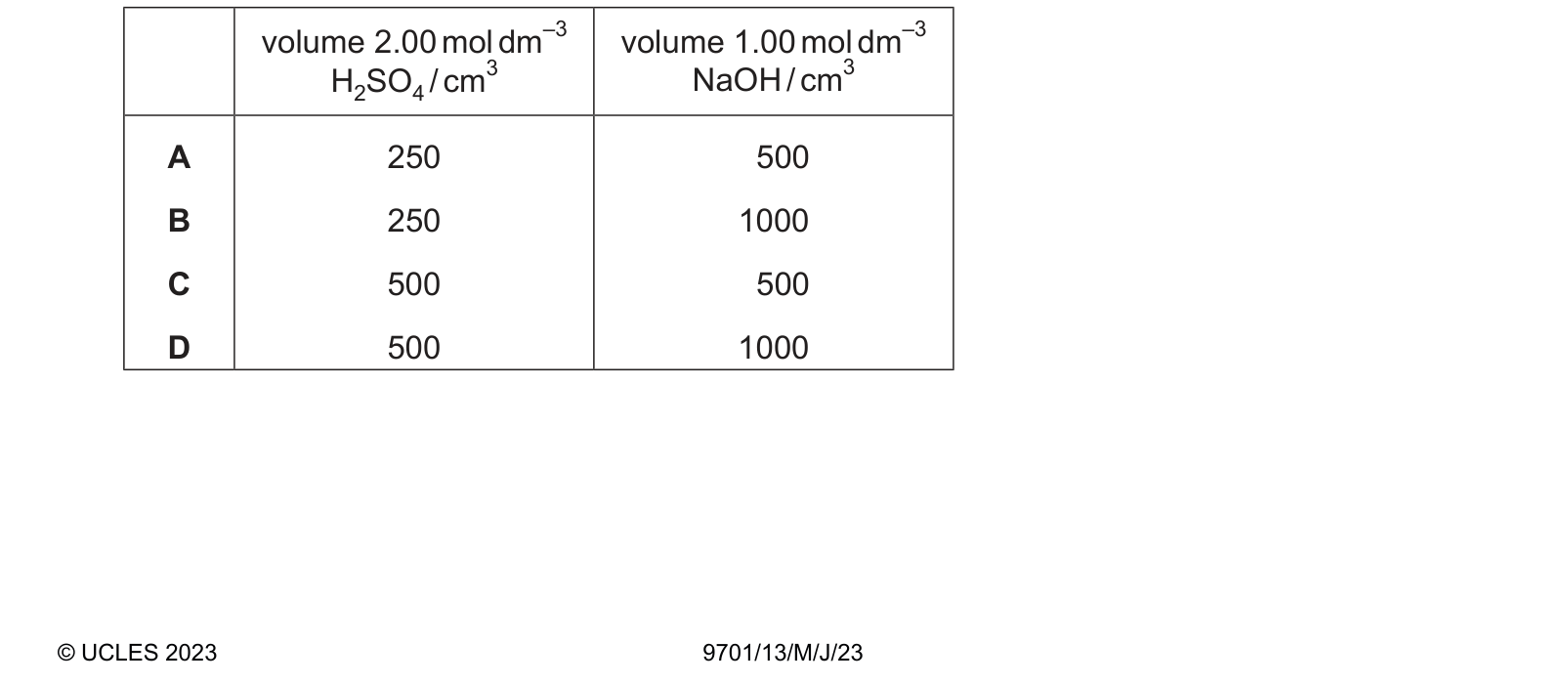
Which mixture will react to form exactly one mole of water? Each answer gives, in order: volume of 2.00 mol dm⁻³ H2SO4 / cm³; volume of 1.00 mol dm⁻³ NaOH / cm³.
Answer: B.
H2SO4 + 2NaOH → Na2SO4 + 2H2O
In B: 0.250 dm³ × 2.00 = 0.500 mol H2SO4, and 1.000 dm³ × 1.00 = 1.00 mol NaOH. That is exactly the 1:2 ratio, so both reagents are used up completely and 1.00 mol of water forms.
A and C both give 0.500 mol of water. In each of them the NaOH runs out first, and since every OH⁻ makes one H2O, the water formed equals the moles of NaOH.
Be aware that D also produces exactly one mole of water: 1.00 mol of acid with 1.00 mol of alkali leaves the alkali limiting, and 1.00 mol of OH⁻ still makes 1.00 mol of H2O, with half a mole of acid left over. Cambridge's mark scheme credits only B, where the two reagents match exactly and nothing is left, so B is the answer to give. The safest way to read the question is "which mixture reacts completely to form one mole of water".
Counting moles of H⁺ and OH⁻ rather than moles of acid and alkali makes the whole family of these questions one line of arithmetic.
Question 5
Hexamine is a crystalline solid used as a fuel in portable stoves.
The diagram shows its skeletal structure.
hexamine What is the empirical formula of hexamine?
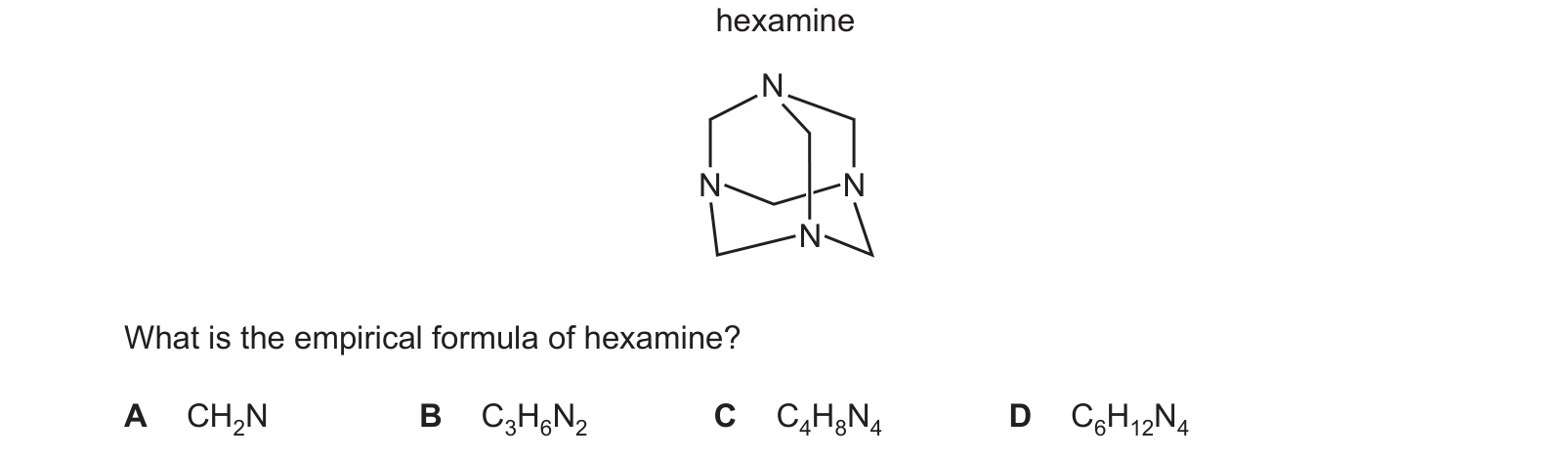
Answer: B.
Counting from the skeletal structure, hexamine is a cage of six CH2 groups bridged by four nitrogens: C6H12N4. Every line end and junction is a carbon, and each of those carbons carries two hydrogens to complete its four bonds.
Now divide through by the highest common factor of 6, 12 and 4, which is 2:
C6H12N4 ÷ 2 = C3H6N2
D, C6H12N4, is the molecular formula, and it is the answer to a question that was not asked. That is the trap the question is built on: the hard work of reading the cage gives you D, and one more step is needed.
A, CH2N, comes from dividing by 4, which works for the carbon and hydrogen but leaves the nitrogen at 1 rather than 1.33. Check the division on every element before accepting it.
C, C4H8N4, is not a simplification of anything here.
What this practice covers
These questions are drawn from past CIE 9701 Chemistry papers. You answer, you find out immediately whether you were right, and you get the reasoning for the correct option and for each distractor. Wrong answers go to a mistakes locker so you can come back to exactly those.
Practice is free. You need an account only so your progress and your mistakes are still there next time.
What examiners see students get wrong here
These are the errors that cost marks on atoms, molecules and stoichiometry, taken from our own topic notes. Read them before you practise and you will recognise the traps in the questions.
- Using 24.0 dm³ mol⁻¹ for a gas that is not at room conditions, or for a liquid or solid.
- Forgetting to divide cm³ by 1000 before using moles = c × V.
- Calculating theoretical yield from the reactant in excess rather than the limiting one.
- Rounding intermediate steps. Carry extra figures through and round only at the end.
- Leaving state symbols out of an ionic equation.
- Giving relative atomic mass a unit. It is a ratio and has none.
Revise it first
If any of the above is unfamiliar, work through the notes before practising: Atoms, molecules and stoichiometry revision notes.