Hydroxy compounds: five questions to try now
Real past-paper questions, the answer key from the mark scheme, and the explanation that goes with it. No account needed to answer them.
Question 1
Compound Z is formed by the reaction scheme shown.
warm with reflux with CH3CH2Br compound X compound Z KCN in ethanol dilute HCl
What is the formula of compound Z?

Answer: D.
Warm with KCN in ethanol. Cyanide substitutes for the bromine, and this adds a carbon:
CH₃CH₂Br + CN⁻ → CH₃CH₂CN, propanenitrile
so compound X has three carbons.
Reflux with dilute HCl. Acid hydrolysis turns a nitrile into a carboxylic acid:
CH₃CH₂CN → CH₃CH₂COOH, propanoic acid
which is D.
B, CH₃CH₂CN, is compound X, the intermediate, so it stops one step early.
C, CH₃COOH, has only two carbons and forgets that the cyanide brought one in.
A, CH₃CH₂Cl, would be a straight swap of bromine for chlorine, which is not what either reagent does.
Counting carbons is the quickest way through any synthesis question. The starting material has two and the answer has three, so a carbon must have been added somewhere, and cyanide is the only reagent on the syllabus that does it. That alone identifies the route and rules out A and C.
The solvent matters too: KCN in ethanol substitutes, while HCN in water would add to a carbonyl instead.
Question 2
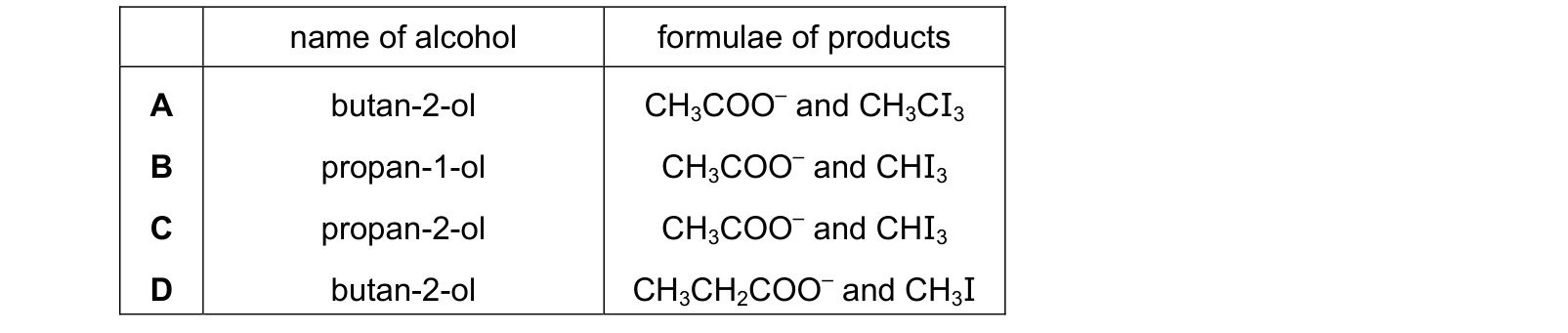
Four different alcohols are treated with alkaline I2(aq). Which row is correct? Each answer gives, in order: name of alcohol; formulae of products.
Answer: C.
C is correct. Propan-2-ol is CH₃CH(OH)CH₃, so it responds. Removing the CH₃ that becomes CHI₃ leaves a two-carbon fragment, which is the ethanoate ion, CH₃COO⁻. So the products are CH₃COO⁻ and CHI₃.
B names propan-1-ol, which is primary: the carbon bearing the OH carries two hydrogens rather than a methyl, so the test is negative and no products form at all.
A and D both name butan-2-ol, which does respond, but neither gets the products right. Butan-2-ol is CH₃CH(OH)CH₂CH₃, so the fragment left behind has three carbons and gives propanoate, not ethanoate. D has that part right and then names CH₃I instead of CHI₃, and A has the carboxylate wrong as well as writing a formula, CH₃CI₃, that is not the product of any of this.
The pattern to hold is CH₃CH(OH)R gives RCOO⁻ and CHI₃, so counting the carbons on the far side of the carbinol carbon gives the carboxylate directly.
Question 3
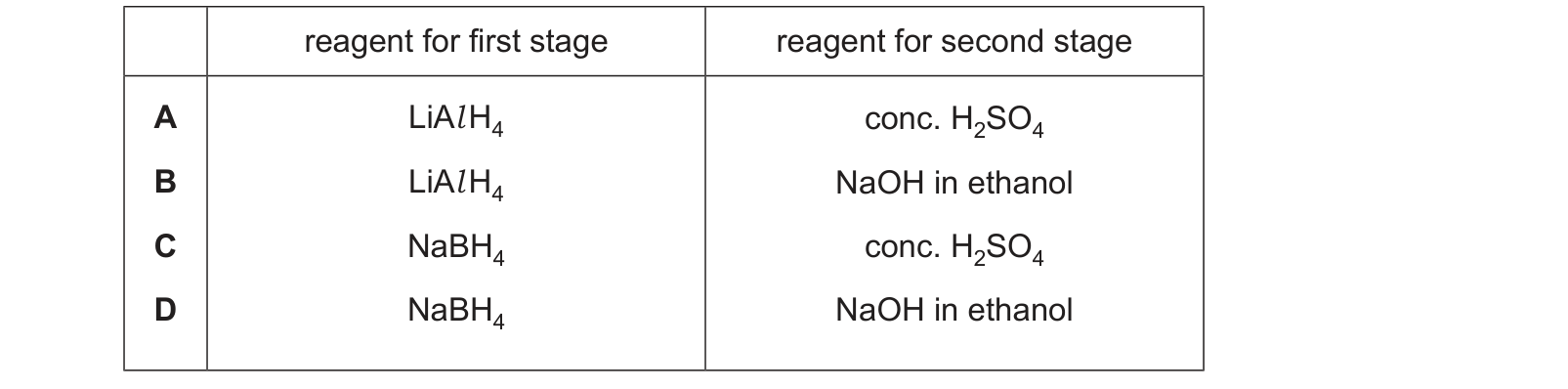
Propanoic acid can be used to make propene by a two-stage synthesis. Which row shows suitable reagents for this synthesis? Each answer gives, in order: reagent for first stage; reagent for second stage.
Answer: A.
First stage: reduction. CH₃CH₂COOH → CH₃CH₂CH₂OH. This needs LiAlH₄, lithium tetrahydridoaluminate, which is powerful enough to reduce a carboxylic acid. NaBH₄ is not: it reduces aldehydes and ketones but leaves carboxylic acids alone. That removes C and D.
Second stage: dehydration. CH₃CH₂CH₂OH → CH₃CH=CH₂, which needs concentrated sulfuric acid and heat. That is A.
B offers NaOH in ethanol for the second stage, which is the reagent for eliminating HX from a halogenoalkane. There is no halogen in propan-1-ol for it to remove, so nothing would happen.
The distinction between the two reducing agents is worth holding, because it is the only place the syllabus asks you to choose between them. NaBH₄ reduces carbonyls; LiAlH₄ reduces carbonyls and carboxylic acids as well, and LiAlH₄ has to be used in dry ether because it reacts violently with water.
Question 4
Compound X contains a single ester group.
X contains 27.6% by mass of oxygen.
Which pair of products could be produced by the hydrolysis of X?
Answer: A.
Mr = 32.0 / 0.276 = 116
Now find the pair whose ester has that mass. An ester from an acid and an alcohol loses one water, so its formula is the two combined minus H₂O.
A, butan-1-ol (74) and ethanoic acid (60): 74 + 60 − 18 = 116 ✓ butyl ethanoate, C₆H₁₂O₂
B, ethanol (46) and propanoic acid (74): 46 + 74 − 18 = 102
C, methanol (32) and methanoic acid (46): 32 + 46 − 18 = 60
D, propan-2-ol (60) and butanoic acid (88): 60 + 88 − 18 = 130
So A.
A faster route is to count carbons. C₆H₁₂O₂ has Mr 116, so the ester needs six carbons in total, and only A splits six as 4 + 2. B and D split five and seven, and C splits two.
The 27.6% is a useful shape to recognise. Since every simple ester has exactly two oxygens, the percentage of oxygen alone fixes the molar mass, whatever the rest of the molecule looks like.
Question 5
2-methylbut-2-ene is reacted with hot, concentrated, acidified potassium manganate(VII) solution.
What are the products of this reaction?
Answer: B.
a carbon with two alkyl groups becomes a ketone
a carbon with one alkyl group and one hydrogen becomes a carboxylic acid
a carbon with two hydrogens is oxidised right through to CO₂
2-methylbut-2-ene is CH₃–C(CH₃)=CH–CH₃.
The left carbon of the double bond carries two methyl groups, so it becomes propanone, (CH₃)₂C=O.
The right carbon carries a methyl and a hydrogen, so it becomes ethanoic acid, CH₃COOH.
So ethanoic acid and propanone, which is B.
A stops at the aldehyde. Under these hot, concentrated conditions ethanal would immediately be oxidised further, so the acid is what is isolated. An aldehyde is never a final product of this reagent.
C and D contain alcohols, which is the wrong direction entirely: this is an oxidation.
The rule is worth stating as a single sentence. Count the hydrogens on each carbon of the double bond: none gives a ketone, one gives an acid, two give carbon dioxide.
What this practice covers
These questions are drawn from past CIE 9701 Chemistry papers. You answer, you find out immediately whether you were right, and you get the reasoning for the correct option and for each distractor. Wrong answers go to a mistakes locker so you can come back to exactly those.
Practice is free. You need an account only so your progress and your mistakes are still there next time.
What examiners see students get wrong here
These are the errors that cost marks on hydroxy compounds, taken from our own topic notes. Read them before you practise and you will recognise the traps in the questions.
- Saying a tertiary alcohol resists oxidation because it is bulky. It has no hydrogen on the carbon bearing the OH.
- Giving the carboxylic acid as the product of distillation. Distilling gives the aldehyde; reflux gives the acid.
- Forgetting that the dichromate colour change is orange to green, or giving it the wrong way round.
- Saying phenol reacts with sodium carbonate. It is too weak an acid for that.
- Explaining phenol's reactivity by the OH group being electron withdrawing. The lone pair is donated into the ring.
- Using the tri-iodomethane test as a general alcohol test. It needs the CH₃CH(OH) or CH₃CO group.
Revise it first
If any of the above is unfamiliar, work through the notes before practising: Hydroxy compounds revision notes.