Group 2: five questions to try now
Real past-paper questions, the answer key from the mark scheme, and the explanation that goes with it. No account needed to answer them.
Question 1
Which row correctly describes the separate reactions of calcium and strontium with water? Each answer gives, in order: substance reduced; substance oxidised; more vigorous reaction.
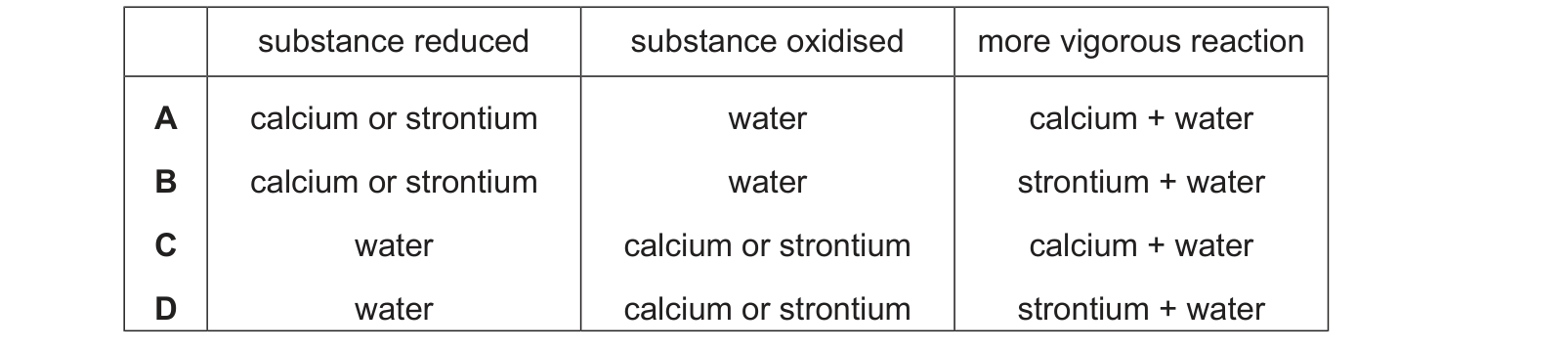
Answer: D.
M + 2H₂O → M(OH)₂ + H₂
What is oxidised? The metal goes from 0 as the element to +2 in the hydroxide, losing electrons. So calcium or strontium is oxidised.
What is reduced? The hydrogen in the water goes from +1 to 0 as hydrogen gas, gaining electrons. So water is reduced. That removes A and B, which have the two the wrong way round.
Which is more vigorous? Reactivity increases down Group 2, because the outer electrons are further from the nucleus and better shielded, so they are lost more readily. Strontium is below calcium, so its reaction is the more vigorous. That makes D the answer.
The oxygen is worth checking as well, since it appears on both sides: it is −2 in water and −2 in the hydroxide, so it takes no part in the redox at all. Only the metal and the hydrogen change.
A useful way to keep oxidation and reduction straight here is that the metal is the reducing agent: it gives its electrons away, which is why it is itself oxidised, and what it reduces is the hydrogen in the water.
Question 2
Which row is correct? Each answer gives, in order: the temperature needed to decompose Group 2 metal nitrates; the solubility of Group 2 sulfates.
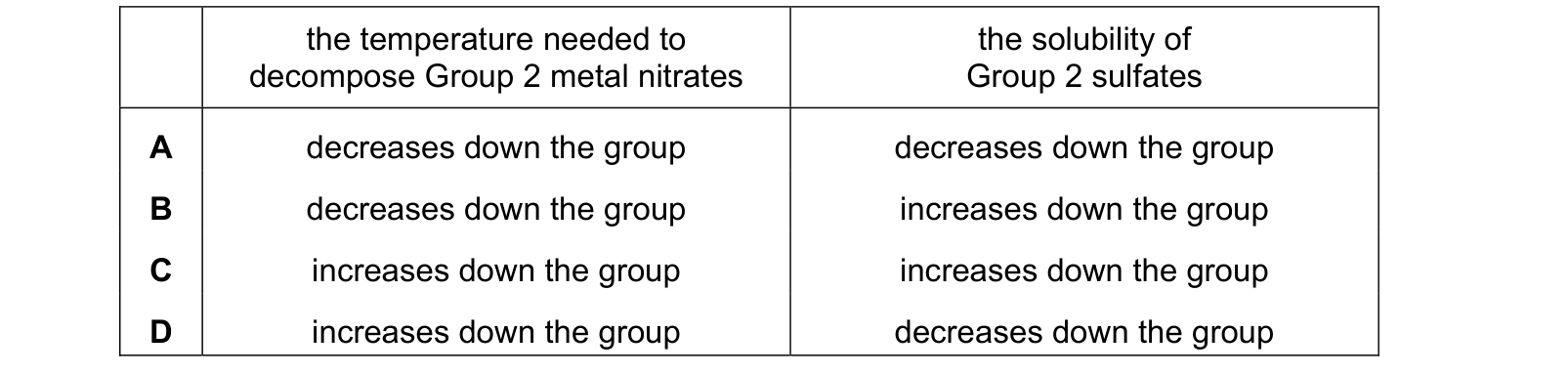
Answer: D.
Nitrate decomposition temperature increases down the group. Thermal stability rises as the cation gets larger, because a bigger ion polarises the nitrate ion less and weakens its N–O bonds less. Magnesium nitrate decomposes most readily and barium nitrate needs the highest temperature.
Sulfate solubility decreases down the group. MgSO₄ is very soluble and BaSO₄ is insoluble enough to be the standard test for sulfate ions.
So increases then decreases, which is D.
The reason they oppose each other lies in the size of the anion. For thermal stability the argument is about the cation polarising the anion, and a larger cation does that less, so stability rises. For solubility it is a contest between lattice energy and hydration enthalpy, and with the large sulfate ion the lattice energy hardly changes down the group while the hydration enthalpy falls, so dissolving becomes less favourable.
The hydroxides run the other way from the sulfates, becoming more soluble down the group, because the hydroxide ion is small enough for the lattice energy to fall faster.
Question 3
The table compares calcium with barium and calcium carbonate with barium carbonate. Which row is correct? Each answer gives, in order: reactivity of the element with water; thermal stability of the metal carbonate.
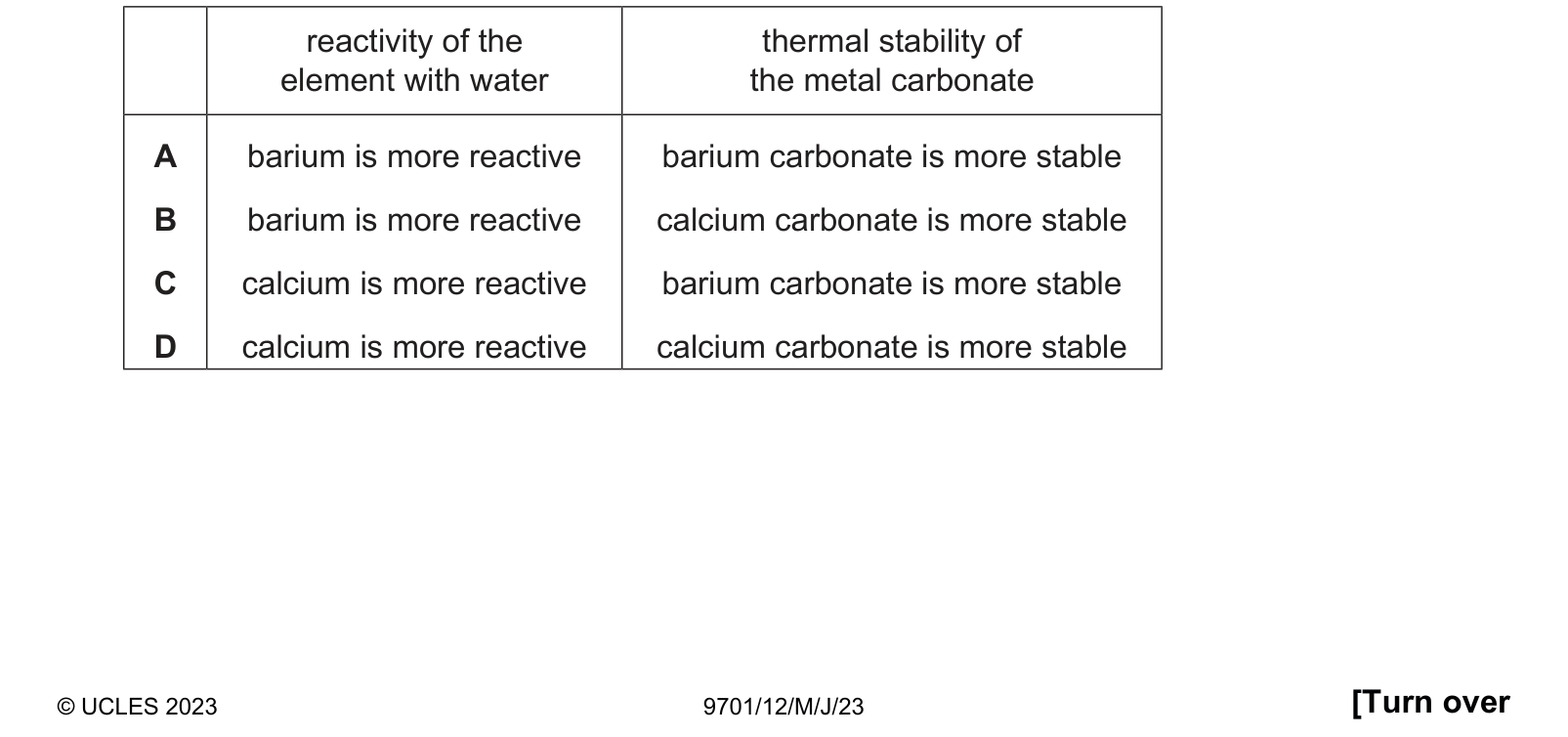
Answer: A.
Reactivity with water increases down the group. The outer electrons are further from the nucleus and better shielded, so they are lost more readily. Barium is the more reactive, reacting steadily with cold water while calcium reacts more slowly.
Thermal stability of the carbonates increases down the group. A larger cation polarises the carbonate ion less, so the C–O bonds are weakened less and a higher temperature is needed to break them. Barium carbonate is the more stable, decomposing at about 1360 °C against calcium carbonate's 900 °C.
So barium on both counts, which is A.
The polarising-power argument is the one worth carrying, because it explains the thermal stability trend for the nitrates and hydroxides as well. A small, highly charged cation distorts the electron cloud of a large anion and destabilises it, and going down the group the cation gets bigger and does this less.
That both trends point the same way makes B and C, which mix them, wrong on one half each.
Question 4
L and M are both compounds of Group 2 elements.
L and M are both soluble in water.
When solutions of L and M are mixed, a white precipitate is formed.
What could be L and M?
Answer: A.
A works. Barium chloride is soluble, since all Group 2 chlorides are, and magnesium sulfate is soluble, since sulfate solubility is high at the top of the group. Mixing them swaps the partners:
Ba²⁺(aq) + SO₄²⁻(aq) → BaSO₄(s)
and barium sulfate is the white precipitate. That is A.
B fails the first condition. Barium sulfate is insoluble, so it never makes a solution to mix.
D fails the same way. Barium carbonate is insoluble too. All Group 2 carbonates are.
C passes the solubility test and fails the reaction. Barium nitrate and magnesium chloride are both soluble, but swapping partners gives barium chloride and magnesium nitrate, and both of those are also soluble. Nothing precipitates and the mixture just stays clear.
The solubility rules that settle it are worth holding as a short list: all nitrates are soluble, all Group 2 chlorides are soluble, Group 2 carbonates are insoluble, and Group 2 sulfates go from soluble at magnesium to insoluble at barium.
Question 5
Four properties of beryllium, Be, or a beryllium compound are listed.
Which property is different from the property of magnesium or the equivalent magnesium compound?
Answer: D.
D is the answer. BeCl₂ is covalent, because Be²⁺ would be so small and so highly charged that it polarises chloride severely. Covalent chlorides hydrolyse, giving fumes of HCl. MgCl₂ is ionic, so it simply dissolves and gives no fumes at all. A real difference.
The other three are all false, and each fails for the same reason: it claims magnesium does not do something it plainly does.
A. Magnesium certainly reacts with oxygen when heated in air. Burning magnesium ribbon is one of the first reactions anyone sees, and it gives white MgO.
B. Magnesium reacts readily with dilute sulfuric acid to give magnesium sulfate and hydrogen. It is a standard way of preparing hydrogen in a school laboratory.
C. Magnesium nitrate decomposes on heating exactly as described, to MgO, NO₂ and O₂. Being the least stable Group 2 nitrate, it is the easiest to decompose, not an exception to it.
Beryllium's difference always comes back to the size of its ion. It is the reason BeCl₂ is covalent, the reason BeO and Be(OH)₂ are amphoteric rather than basic, and the reason beryllium resembles aluminium more than it resembles the rest of its own group.
What this practice covers
These questions are drawn from past CIE 9701 Chemistry papers. You answer, you find out immediately whether you were right, and you get the reasoning for the correct option and for each distractor. Wrong answers go to a mistakes locker so you can come back to exactly those.
Practice is free. You need an account only so your progress and your mistakes are still there next time.
What examiners see students get wrong here
These are the errors that cost marks on group 2, taken from our own topic notes. Read them before you practise and you will recognise the traps in the questions.
- Getting the two solubility trends the wrong way round. Hydroxides become more soluble down the group; sulfates become less.
- Saying magnesium reacts vigorously with cold water. It is very slow, and only fast with steam.
- Giving Mg(OH)₂ as the product with steam. Steam gives MgO, not the hydroxide.
- Explaining thermal stability by ionisation energy. The reason is polarisation by the cation.
- Forgetting to acidify before adding barium chloride in the sulfate test.
- Saying barium compounds are safe because barium sulfate is used medically. It is safe only because it is so insoluble.
Revise it first
If any of the above is unfamiliar, work through the notes before practising: Group 2 revision notes.