Reaction kinetics: five questions to try now
Real past-paper questions, the answer key from the mark scheme, and the explanation that goes with it. No account needed to answer them.
Question 1
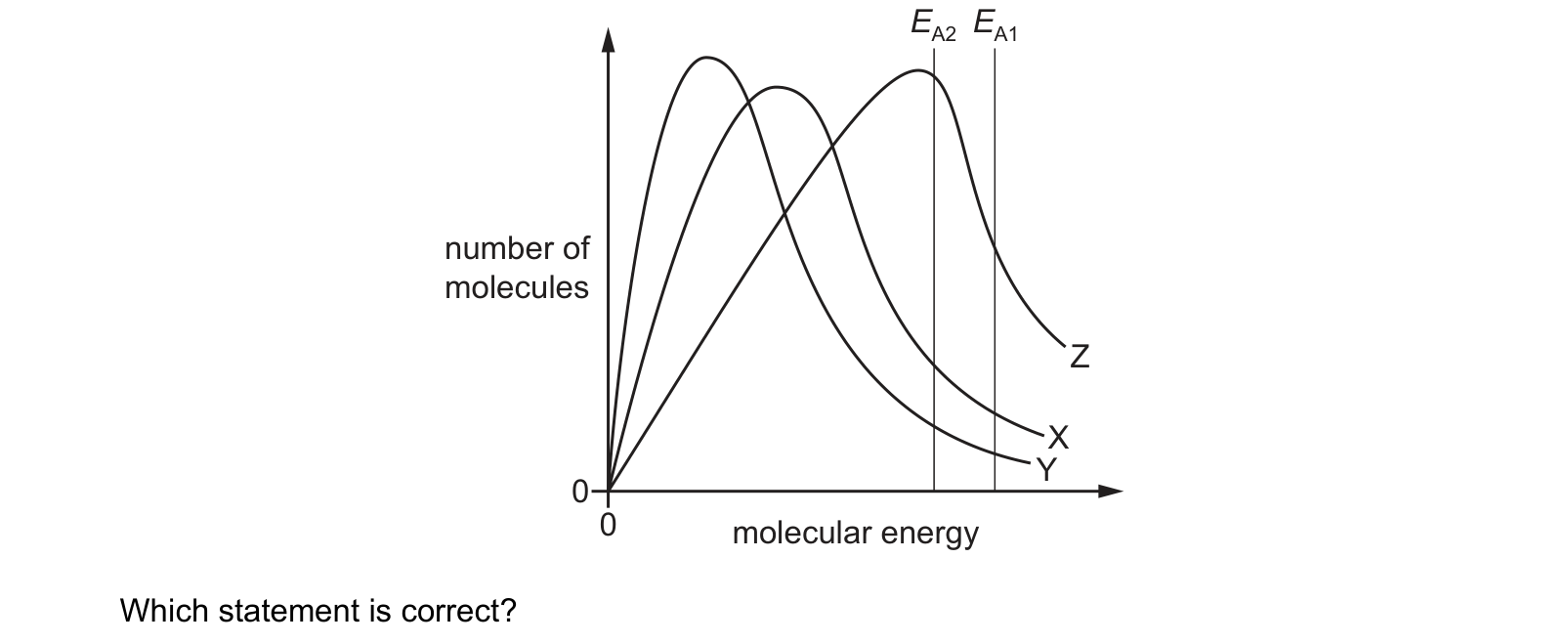
In the diagram, X is the Boltzmann distribution for the energies of the particles in a reaction and EA1 is the activation energy for that reaction. Which statement is correct?
Answer: C.
A and B fall together. Activation energy is a property of the reaction route, not of the temperature. Heating a mixture gives the molecules more energy; it does not lower the barrier they have to clear. Two different values of Ea on one diagram mean an uncatalysed route and a catalysed one, so EA2 belongs to a catalyst, not to a different temperature.
Y is lower. Compared with X, Y peaks further left and higher, and its tail is the lowest of the three. Cooler molecules have less energy on average, so the most probable energy falls and the spread narrows, which forces the peak up because the area under the curve is the number of molecules and that cannot change.
Z is not simply hotter. Z peaks further right than X, which looks right for heating, but look at the height: Z's peak is taller than X's as well. Further right and taller together means a larger area, which would mean more molecules than the sample contains. Heating flattens a distribution as it spreads it, so a hotter curve is always lower at the peak. Z cannot be X at a higher temperature.
Whenever a Boltzmann question offers several curves, check the area before anything else. Any curve enclosing more or less than the original is not the same sample under new conditions.
Question 2
Gas Q decomposes slowly at room temperature.
Q(g) → X(g) + Z(g)
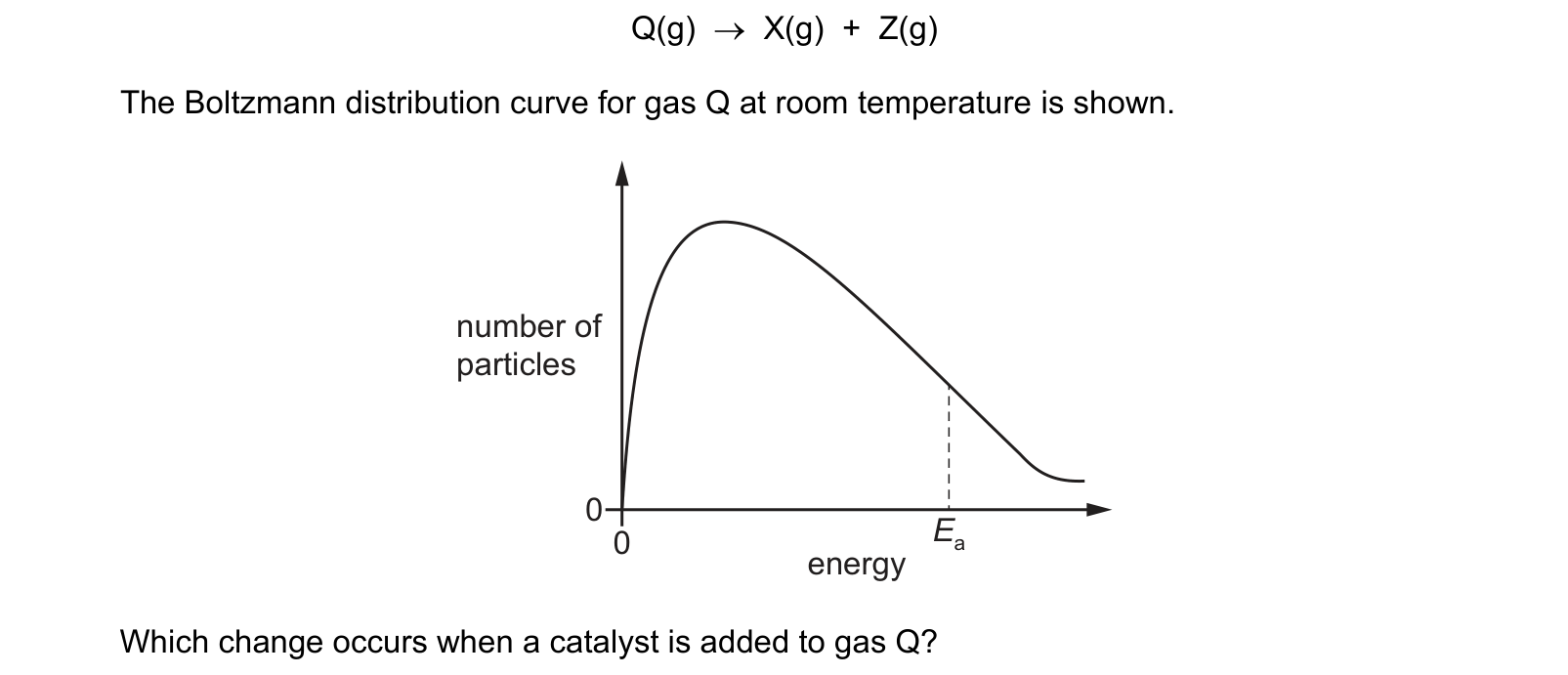
The Boltzmann distribution curve for gas Q at room temperature is shown. Which change occurs when a catalyst is added to gas Q?
Answer: B.
Nothing about the molecules themselves changes. The curve is fixed by temperature, and the catalyst supplies a different route rather than heat, so both A and C describe what heating would do. A moves the peak, C raises the average kinetic energy, and a catalyst does neither.
D gets the physics right and the direction wrong, which makes it the one worth being careful about. Lowering Ea moves the dotted line left, not right. Left is the whole point: the area under the curve to the right of that line is the fraction of molecules that can react, and sliding the line down the steep part of the tail captures many more of them.
That is why a catalyst can multiply a rate enormously while changing nothing you could measure about the gas. The molecules are the same molecules with the same energies; the bar they have to clear is lower.
Worth adding: the catalyst has no effect on how much X and Z eventually form, only on how quickly. Gas Q decomposes slowly at room temperature and would get there in the end regardless.
Question 3
Hydrogen peroxide decomposes slowly at 20 °C to form water and oxygen. The reaction is faster when a catalyst is present.
Which statement is correct?

Answer: B.
The reason is that a catalyst speeds up the forward and reverse reactions by the same factor. It lowers the activation energy of a route, and that route runs in both directions, so both rates rise together and the position at which they balance is exactly where it was. Kc depends only on temperature.
C claims the value rises. Nothing but a temperature change moves Kc, which is worth holding onto as a flat rule: not pressure, not concentration, not a catalyst.
D has the mechanism half right and the direction wrong. A catalyst does provide a different reaction mechanism, but with a lower activation energy. A higher one would slow the reaction down.
A misdescribes what happens to the molecules. The Boltzmann distribution is set by temperature alone, so the molecules have exactly the energies they had before. What changes is the barrier, not the energy available to clear it, and this distinction is the single most common error in this topic.
Manganese(IV) oxide catalyses this particular decomposition, and so does the enzyme catalase, which is why blood or liver fizzes vigorously in hydrogen peroxide.
Question 4
Lactide is an intermediate in the manufacture of a synthetic fibre.
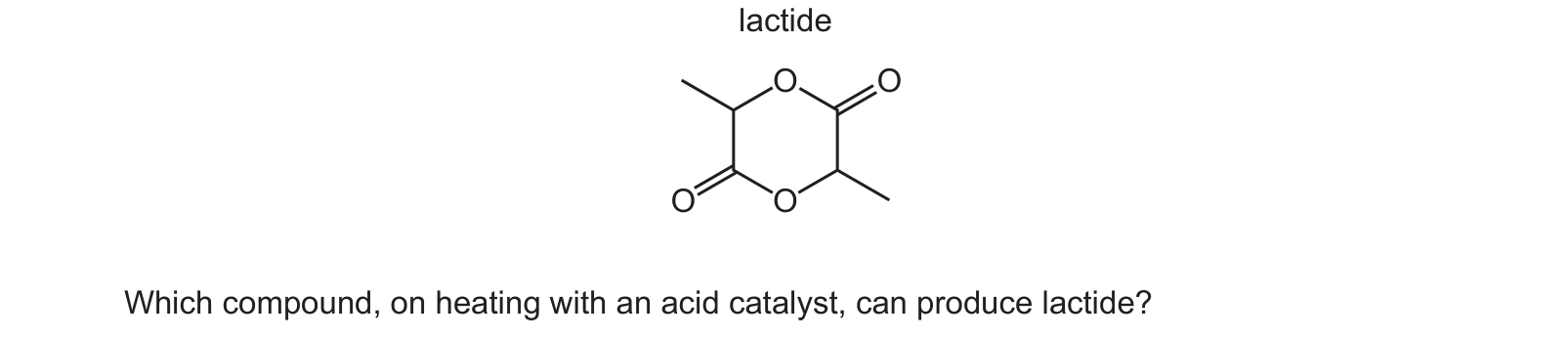
lactide Which compound, on heating with an acid catalyst, can produce lactide?
Answer: C.
Break the ring at its two ester links. Each half comes out as CH3–CH(OH)–COOH: a three-carbon acid with the OH on carbon 2, the carbon next to the COOH group.
Heating with an acid catalyst lets the OH of one molecule esterify the COOH of another, twice over, closing a six-membered ring and releasing two molecules of water.
A, hydroxyethanoic acid, has only two carbons and would give a ring with no methyl branches. B, 2-hydroxybutanoic acid, has the OH in the right place but one carbon too many, so its ring would carry ethyl groups rather than methyl groups.
D is the sharpest distractor. 3-hydroxypropanoic acid has the same formula as C but the OH sits one carbon further along, and joining two of those head to tail closes an eight-membered ring. Position, not just formula, decides the ring size.
Question 5
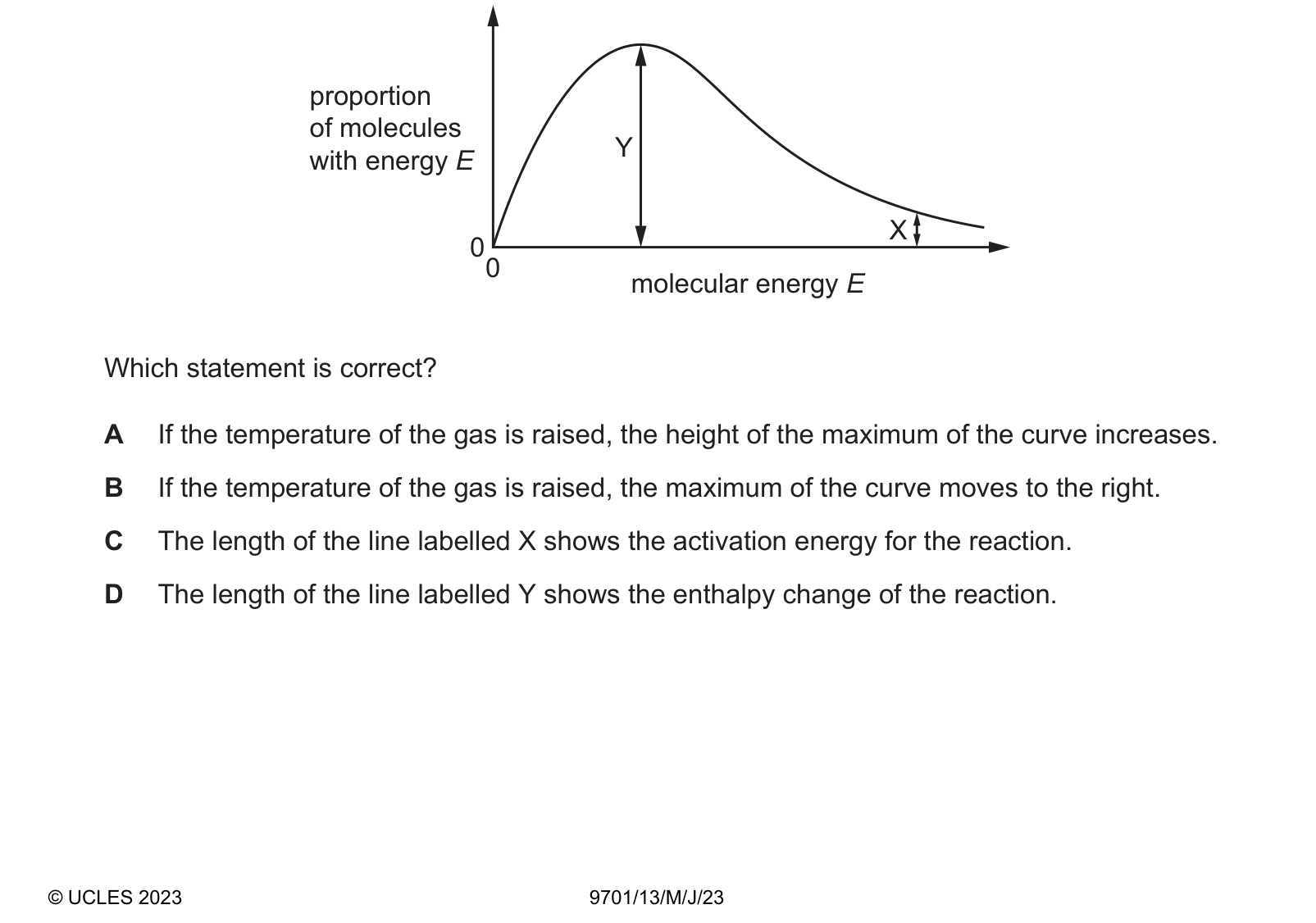
The diagram shows the Boltzmann distribution of the energy of gaseous molecules at a particular temperature. Which statement is correct?
Answer: B.
A is the other half of the same change and gets it backwards. The area under the curve is the total number of molecules, and heating does not create molecules, so the area is fixed. Spreading the distribution over a wider range of energies therefore has to lower the peak. Flatter, broader and further right is one single change, and it is worth learning as one.
C and D fail on something you can see rather than recall. Look at the arrows: X and Y are both vertical. They measure heights against the axis labelled proportion of molecules. An activation energy and an enthalpy change are both energies, and energy on this graph runs along the horizontal axis. A vertical measurement can never be either of them, whatever it is drawn next to.
Y is the height of the peak, the proportion of molecules at the most probable energy. X is the height of the tail, the much smaller proportion at some high energy. Neither is an energy at all.
What this practice covers
These questions are drawn from past CIE 9701 Chemistry papers. You answer, you find out immediately whether you were right, and you get the reasoning for the correct option and for each distractor. Wrong answers go to a mistakes locker so you can come back to exactly those.
Practice is free. You need an account only so your progress and your mistakes are still there next time.
What examiners see students get wrong here
These are the errors that cost marks on reaction kinetics, taken from our own topic notes. Read them before you practise and you will recognise the traps in the questions.
- Saying a catalyst lowers the energy of the reaction. It lowers the activation energy only, and ΔH is unaffected.
- Explaining the temperature effect purely by faster movement. The dominant reason is the larger proportion of molecules exceeding Eₐ.
- Drawing a Boltzmann curve that starts above the origin, or one that does not cross the original curve.
- Saying a catalyst shifts the Boltzmann curve. It moves the activation energy line instead.
- Saying a catalyst increases the yield at equilibrium. It only gets there faster.
- Forgetting orientation. Energy alone does not make a collision successful.
Revise it first
If any of the above is unfamiliar, work through the notes before practising: Reaction kinetics revision notes.