Physical quantities and units: five questions to try now
Real past-paper questions, the answer key from the mark scheme, and the explanation that goes with it. No account needed to answer them.
Question 1
A physical quantity consists of a magnitude and a unit. Which row does not show a correct combination of a quantity and its unit? Each answer gives, in order: quantity; unit.
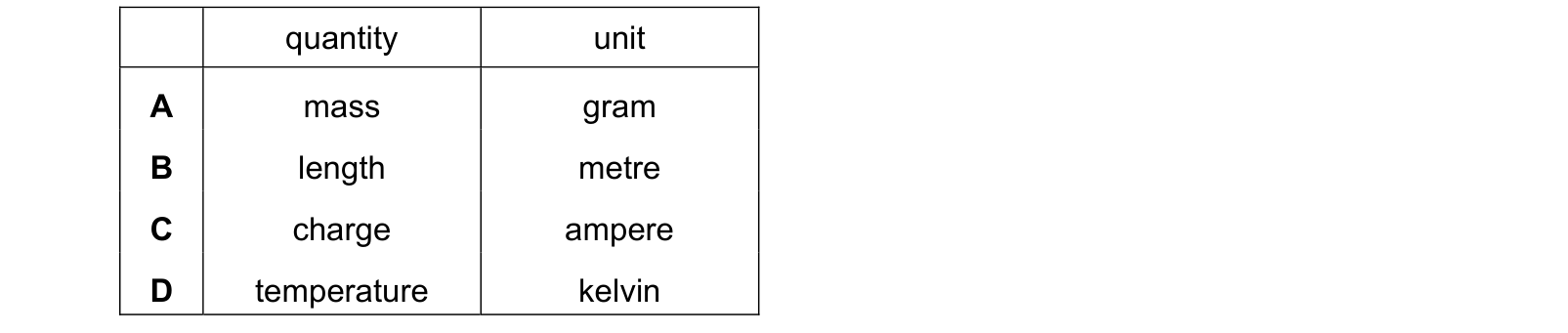
Answer: C.
C is the answer. Charge is measured in coulombs, not amperes. The ampere measures current, which is charge per unit time, so one ampere is one coulomb per second. The two are related but are different quantities.
A is a correct combination. The gram is a genuine unit of mass. It is not the SI base unit, which is the kilogram, but the question asks for a correct quantity-and-unit pair rather than a base unit, so it passes.
B is correct, and the metre is the base unit of length.
D is correct, and the kelvin is the base unit of thermodynamic temperature.
A is worth pausing on, because a similar question asking for SI base units would reject it. Reading exactly what is being asked matters: here it is only whether the unit measures the quantity named.
Charge and current are the pair most often confused because they are so closely linked, and the way to keep them apart is that the ampere is one of the seven base units and the coulomb is derived from it, as an ampere second.
Question 2
Two physical quantities combined together as a product can produce a scalar quantity or a vector quantity.
Which product of two quantities produces a scalar quantity?
Answer: A.
A is the definition of work done: force multiplied by the displacement in the direction of the force. Work is energy, and energy is a scalar. So A is the answer.
The other three all produce vectors:
B, mass × acceleration, is the resultant force.
C, pressure × area, is also a force.
D, velocity × time, is a displacement.
The pattern is that multiplying a vector by a scalar keeps the direction and so gives a vector, which covers B, C and D. A multiplies two vectors in a way that throws the direction away, and the words "in the direction of the force" in the option are the signal that this is happening.
Question 3
Which row shows a physical quantity and its base unit in the SI system? Each answer gives, in order: quantity; unit.
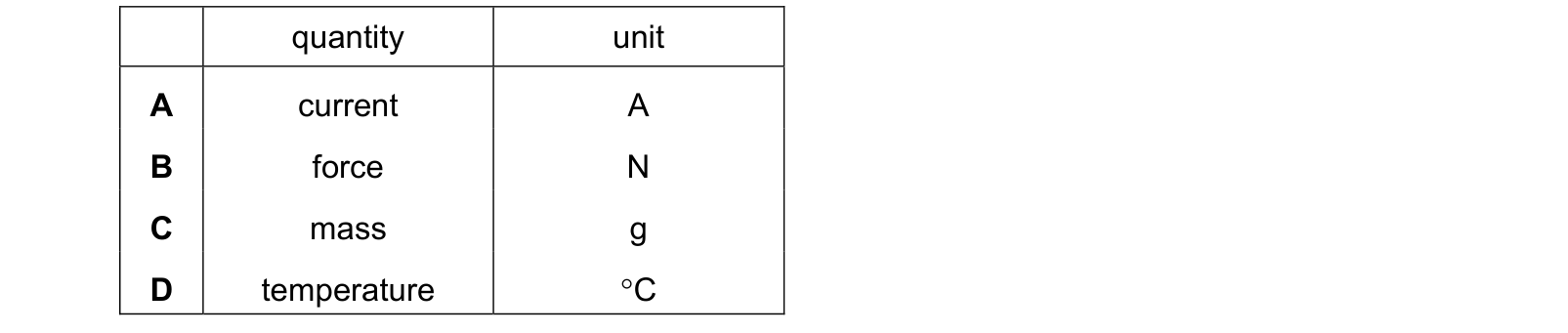
Answer: A.
A, current in amperes, is a base quantity with a base unit ✓ so A.
B, force in newtons, is derived. From F = ma, a newton is a kg m s⁻², built from three base units.
C, mass in grams, has the right quantity and the wrong unit. The base unit of mass is the kilogram, which is the only base unit carrying a prefix.
D, temperature in degrees Celsius, likewise. The base unit is the kelvin. Celsius measures the same thing on a shifted scale and is not the SI base unit.
C and D are the more interesting distractors, because both name a genuine base quantity and then give a unit that is not the base one. The question asks for a matching pair, so both halves have to be right.
Being able to reduce any unit to base units is worth practising, because it is how you check whether an equation is dimensionally sensible: a joule is a kg m² s⁻², and a volt is a kg m² s⁻³ A⁻¹.
Question 4
A copper pipe has a true diameter of 42.03 mm.
A builder measures the diameter of the pipe five times using digital calipers. The measurements are shown.
diameter / mm
48.01
47.99
48.01
48.00
47.99
What describes the builder’s measurements?

Answer: D.
Precision is about how closely repeated readings agree with each other. The five values run from 47.99 to 48.01 mm, a spread of only 0.02 mm, so the calipers are very precise.
Accuracy is about how close the readings are to the true value. The pipe is genuinely 42.03 mm, and every reading sits near 48.00 mm, almost 6 mm too large. Not accurate at all.
The pattern, tight readings clustered around the wrong value, is the signature of a systematic error. Something is adding the same amount to every measurement, most likely a zero error: the calipers reading about 5.97 mm when closed.
The important consequence is that repeating a measurement cannot expose this. Averaging five readings improves the estimate of a random error and does nothing whatever about a systematic one, so the builder could take a hundred readings, get a beautifully consistent answer, and still be 6 mm out.
Checking the zero before use is the only way to catch it, which is why every practical exam asks for it.
The reverse case exists too: readings scattered widely but centred on the true value are accurate on average and not precise. All four combinations are possible, which is why all four are offered.
Question 5
A hollow cylinder, which is open at both ends, has a radius of (3.0 ± 0.1) cm and a length of (15.0 ± 0.1) cm.
What is the value, with its absolute uncertainty, of the surface area of the cylinder?
Answer: A.
A = 2πrl = 2π × 3.0 × 15.0 = 282.7 cm²
Now the uncertainty. Area is a product of r and l, so the percentage uncertainties add:
r: 0.1 / 3.0 = 3.3%
l: 0.1 / 15.0 = 0.7%
total = 4.0%
Absolute uncertainty = 0.040 × 282.7 = 11 cm², which is quoted as 10 cm² to one significant figure.
That rounding is the point of the question. An uncertainty of ±10 means the digits after the tens column are meaningless, so the value must be rounded to match it: (280 ± 10) cm², which is A.
B has the right area but pairs it with ±0.2, an uncertainty a hundred times too small and quoted to a precision the measurements cannot support. C and D come from a surface area that is not the one this cylinder has.
What this practice covers
These questions are drawn from past CIE 9702 Physics papers. You answer, you find out immediately whether you were right, and you get the reasoning for the correct option and for each distractor. Wrong answers go to a mistakes locker so you can come back to exactly those.
Practice is free. You need an account only so your progress and your mistakes are still there next time.
What examiners see students get wrong here
These are the errors that cost marks on physical quantities and units, taken from our own topic notes. Read them before you practise and you will recognise the traps in the questions.
- Giving the gram as the base unit of mass.
- Writing the unit of temperature as °K.
- Forgetting to cube or square the prefix, so 1 cm³ becomes 10⁻² m³.
- Treating a homogeneous equation as proof that the equation is correct.
- Saying repeating readings reduces a systematic error.
- Swapping precision and accuracy, particularly when the question gives a true value.
- Adding percentage uncertainties when the quantities are being added rather than multiplied.
- Using cos where the angle is measured from the vertical.
Revise it first
If any of the above is unfamiliar, work through the notes before practising: Physical quantities and units revision notes.