D.C. circuits: five questions to try now
Real past-paper questions, the answer key from the mark scheme, and the explanation that goes with it. No account needed to answer them.
Question 1
Some resistors and a battery of electromotive force (e.m.f.) E and negligible internal resistance are connected in series, as shown.
E
Which statement is correct?

Answer: D.
Two distinctions are being tested at once, and getting either wrong picks a different option.
E.m.f. belongs to a source, potential difference to a component. E.m.f. is energy converted into electrical form per unit charge, which only a battery, cell or generator does. Potential difference is energy converted out of electrical form per unit charge, which is what happens in a resistor. So an "e.m.f. across a resistor" is meaningless, and that disposes of A and C immediately.
In series the voltages add, they do not repeat. Each resistor takes a share of the supply in proportion to its resistance, and the shares add up to the whole. So B is wrong: the p.d. across each resistor is only part of E, not all of it.
Since the internal resistance is negligible, none of the e.m.f. is lost inside the battery, so the whole of E appears across the external resistors:
E = V₁ + V₂ + V₃ + …
This is just conservation of energy round the loop, which is Kirchhoff's second law: every joule the battery gives a coulomb is delivered somewhere before that coulomb returns.
Question 2
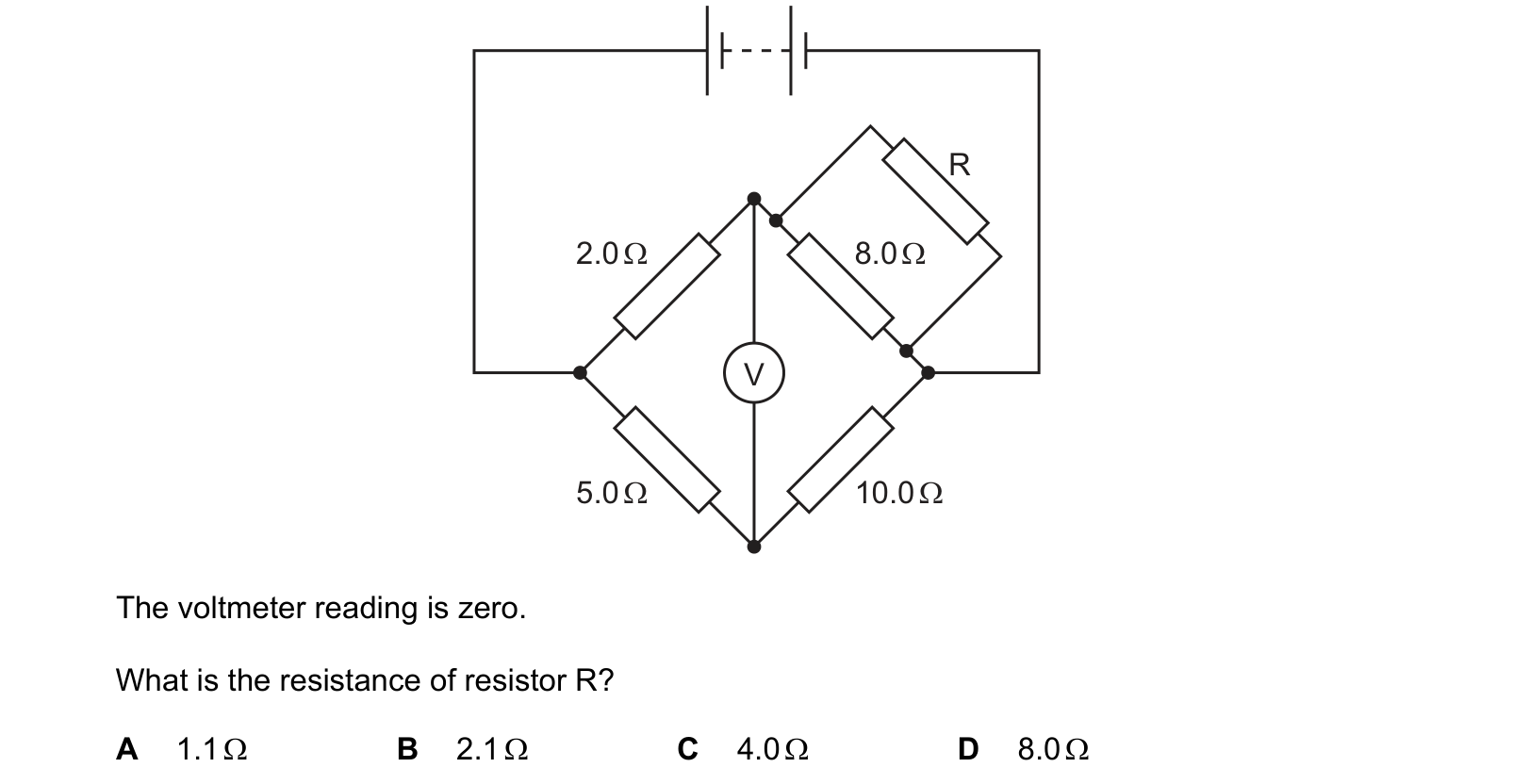
A circuit consists of a battery, a voltmeter and five fixed resistors, as shown. The voltmeter reading is zero.
What is the resistance of resistor R?
Answer: D.
The balance condition. The 2.0 Ω and 5.0 Ω form one pair from the left node, and the right-hand arms form the other:
2.0 / (upper right arm) = 5.0 / 10.0
so the upper right arm must be:
2.0 × 10.0 / 5.0 = 4.0 Ω
But that arm is not R alone. Looking at the circuit, R is in parallel with the 8.0 Ω, and it is their combination that must equal 4.0 Ω:
(8.0 × R)/(8.0 + R) = 4.0
8.0R = 32 + 4.0R
4.0R = 32, so R = 8.0 Ω
C, 4.0 Ω, is the combined resistance of that arm, which is a correct intermediate value and the wrong answer. Stopping there is the mistake the question is built around.
Two equal resistors in parallel always give half of one of them, so 8.0 Ω alongside 8.0 Ω giving 4.0 Ω is worth spotting directly.
Note that the battery's e.m.f. never appears. A bridge balances on ratios alone, which is why the method is so accurate and so insensitive to supply drift.
Question 3
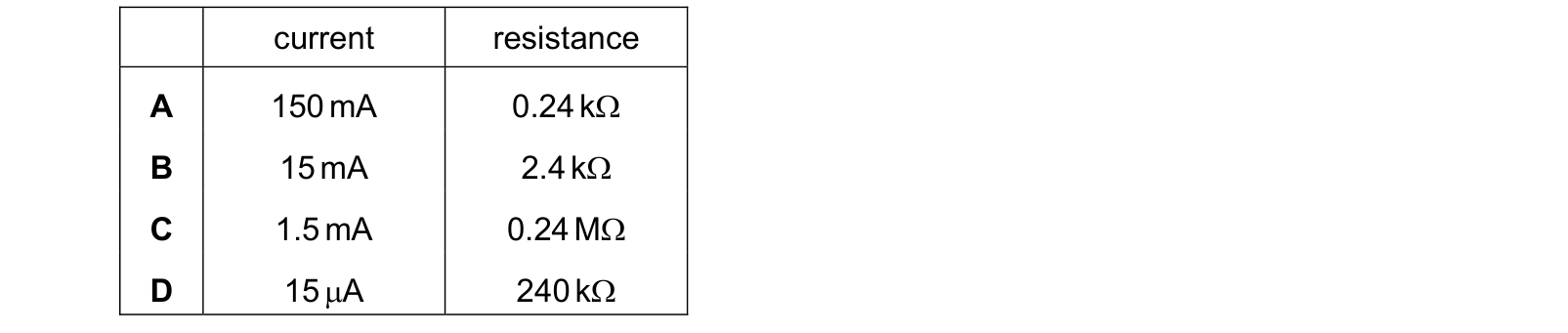
A voltmeter connected across a resistor in a circuit reads 3.6 V. What could be the current in the resistor and the resistance of the resistor? Each answer gives, in order: current; resistance.
Answer: D.
A: 150 mA × 0.24 kΩ = 0.150 × 240 = 36 V ✗
B: 15 mA × 2.4 kΩ = 0.015 × 2400 = 36 V ✗
C: 1.5 mA × 0.24 MΩ = 0.0015 × 240 000 = 360 V ✗
D: 15 µA × 240 kΩ = 15 × 10⁻⁶ × 240 × 10³ = 3.6 V ✓
So D.
Every option is a power of ten out except the right one, which makes this a pure test of prefixes. The safe method is to convert both quantities to amperes and ohms before multiplying, writing each as a plain power of ten.
The exponents then simply add: for D, 15 × 240 = 3600, and 10⁻⁶ × 10³ = 10⁻³, giving 3600 × 10⁻³ = 3.6.
A useful shortcut for circuit work is that milliamps times kilohms gives volts directly, since the 10⁻³ and 10³ cancel. On that basis A and B are 150 × 0.24 and 15 × 2.4, both 36, and can be dismissed at a glance.
Question 4
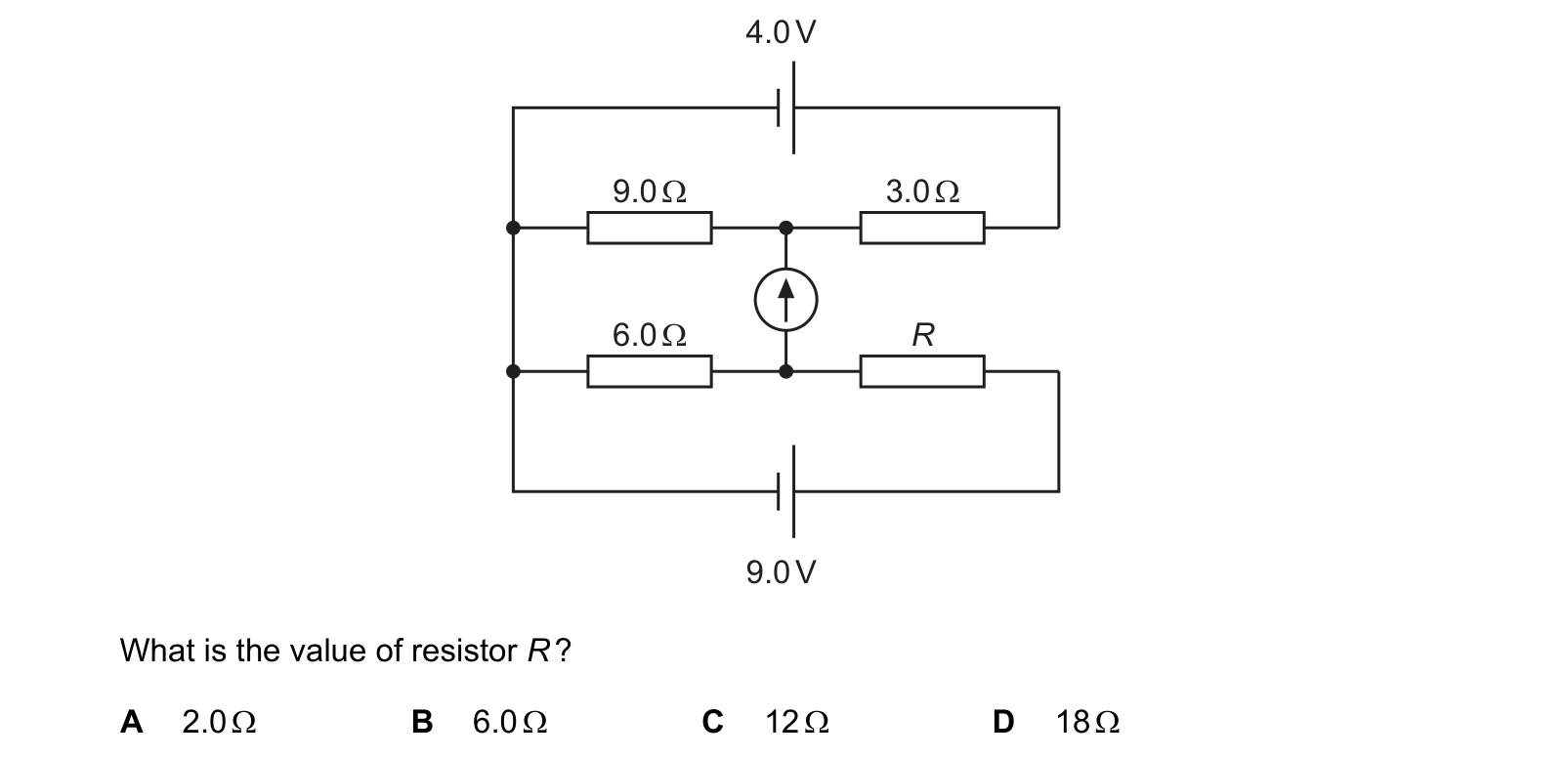
In the circuit shown, the cells have negligible internal resistance and the reading on the galvanometer is zero. What is the value of resistor R ?
Answer: C.
Top loop. The 4.0 V cell drives current round the 9.0 Ω and 3.0 Ω in series:
I = 4.0 / (9.0 + 3.0) = 1/3 A
The potential difference across the 9.0 Ω is therefore:
V = (1/3) × 9.0 = 3.0 V
Bottom loop. For the galvanometer to read zero, the potential difference across the 6.0 Ω must match that 3.0 V, since both branches start from the same left-hand rail:
I = 3.0 / 6.0 = 0.5 A
Then R. That current flows round the whole bottom loop, driven by the 9.0 V cell:
9.0 = 0.5 × (6.0 + R)
18 = 6.0 + R, so R = 12 Ω
D, 18 Ω, is 9.0/0.5, the total resistance of the bottom loop with the 6.0 Ω left in it.
Because no current passes through the galvanometer, the two loops can be treated as completely separate circuits, linked only by the condition that the two middle points sit at equal potential. That is the same idea as a balanced Wheatstone bridge.
Question 5
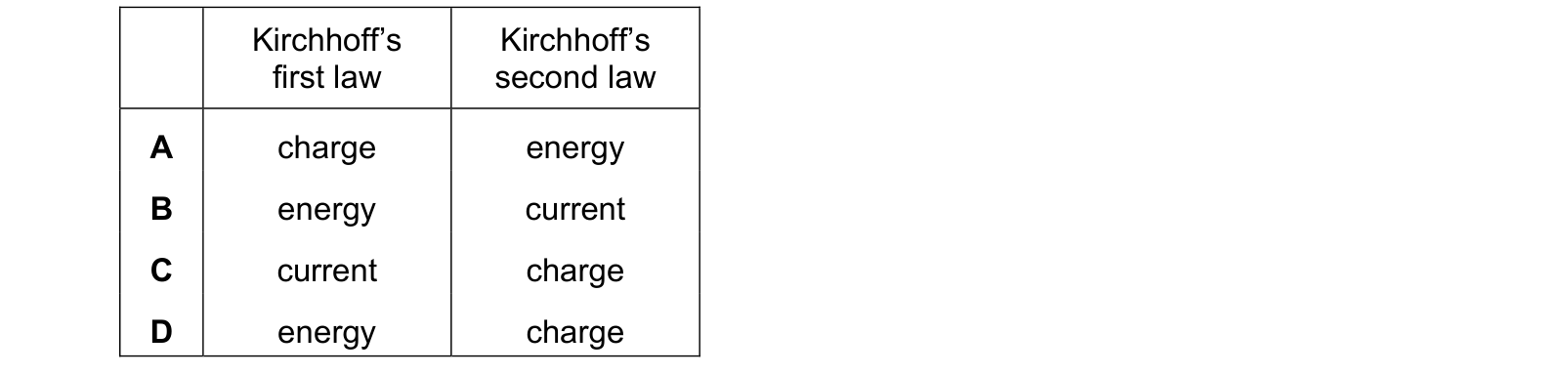
Kirchhoff’s first and second laws are consequences of the conservation of different quantities. What are those quantities? Each answer gives, in order: Kirchhoff’s first law; Kirchhoff’s second law.
Answer: A.
The first law is about current at a junction: what flows in must flow out. Current is the rate of flow of charge, so the law says charge does not accumulate at a point. It is the conservation of charge.
The second law is about e.m.f. and p.d. round a loop: the sum of the e.m.f.s equals the sum of the p.d.s. Both are energy per unit charge, so the law says the energy given to each coulomb by the sources is exactly the energy it gives up to the components. It is the conservation of energy.
So charge then energy, which is A.
The other three options shuffle charge, energy and current between the two laws. Current is not a conserved quantity in the sense meant here: that current is unchanged at a junction is what the first law says, and the reason it is true is that charge is conserved.
The pairing is easiest to hold by looking at what each law measures. Current is charge per second, so a law about currents conserves charge; voltage is energy per coulomb, so a law about voltages conserves energy.
What this practice covers
These questions are drawn from past CIE 9702 Physics papers. You answer, you find out immediately whether you were right, and you get the reasoning for the correct option and for each distractor. Wrong answers go to a mistakes locker so you can come back to exactly those.
Practice is free. You need an account only so your progress and your mistakes are still there next time.
What examiners see students get wrong here
These are the errors that cost marks on d.c. circuits, taken from our own topic notes. Read them before you practise and you will recognise the traps in the questions.
- Attributing Kirchhoff's first law to conservation of energy and the second to charge.
- Forgetting to invert 1/R at the end of a parallel calculation.
- Giving a parallel combination larger than one of its resistors.
- Saying the terminal p.d. equals the e.m.f. while current flows.
- Reading the internal resistance as a positive gradient from a V against I graph.
- Putting the wrong resistance on top in the potential divider equation.
- Saying an ammeter should have a high resistance.
- Ignoring the current a real voltmeter draws when explaining a low reading.
Revise it first
If any of the above is unfamiliar, work through the notes before practising: D.C. circuits revision notes.