Particle physics: five questions to try now
Real past-paper questions, the answer key from the mark scheme, and the explanation that goes with it. No account needed to answer them.
Question 1
A magnesium nucleus 23 Mg decays by emitting two particles. 12
The resulting nucleus is sodium 23 Na. 11
Which two particles are emitted?
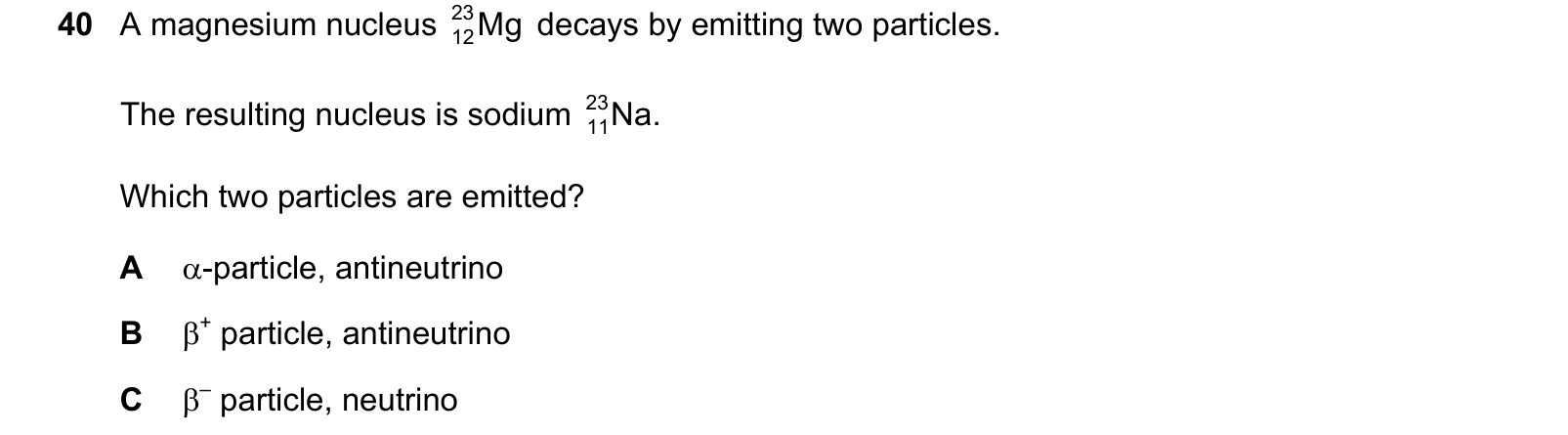
Answer: D.
Read the change in the nuclide notation first, then let the conservation rules pick the particles.
²³₁₂Mg → ²³₁₁Na + ?
- Nucleon number is unchanged at 23
- Proton number falls by one, from 12 to 11
p → n + β⁺ + ν
Checking the full equation:
²³₁₂Mg → ²³₁₁Na + ⁰₊₁β + ⁰₀ν
- nucleon number: 23 = 23 + 0 + 0 ✓
- proton number (charge): 12 = 11 + 1 + 0 ✓
The rule pairs up neatly, and is worth memorising in this form:
- β⁻ decay emits an electron (a lepton) with an antineutrino
- β⁺ decay emits a positron (an antilepton) with a neutrino
Why the others are there
A, an α-particle, would remove two protons and two neutrons, taking ²³₁₂Mg to ¹⁹₁₀Ne. The nucleon number alone rules it out, since it stayed at 23.
C has the right particle pairing for the wrong decay. A β⁻ particle would raise the proton number to 13, giving aluminium rather than sodium.
B gets the decay right and the pairing wrong, which is why it is the near miss here. β⁺ with an antineutrino would give a total lepton number of −2 on the right-hand side against 0 on the left, and no decay can do that.
Question 2
An α-particle passes close to a gold nucleus and is deflected through an angle greater than 90°.
Which property of the α-particle changes as a result of the deflection?
Answer: B.
Momentum is a vector, so changing direction changes momentum even at constant speed. That is B.
A, charge, does not change. The alpha is repelled by the nucleus without ever touching it, so no charge is transferred. It carries +2e before and after.
C and D, nucleon and proton number, do not change either. The alpha remains a helium nucleus throughout: two protons and two neutrons. It is scattered, not transformed, and no nuclear reaction takes place.
It is worth noticing what is not in the list: kinetic energy, which is essentially unchanged, and speed, likewise. If either had been offered they would have been wrong for the same reason: the collision is elastic and the target is so much more massive that it takes almost no energy away.
The deflection happens through the electrostatic repulsion between two positive charges, acting at a distance, which is why an alpha can be turned right round without ever reaching the nucleus.
Question 3
A uranium nucleus has 92 protons and 143 neutrons.
The nucleus emits a total of 3 α-particles and 4 β– particles to form nucleus X.
How can nucleus X be represented?
Answer: D.
Z = 92, A = 92 + 143 = 235
Now apply the decays. Each alpha takes 4 from A and 2 from Z; each beta-minus leaves A alone and adds 1 to Z.
3 alphas: A = 235 − 12 = 223, Z = 92 − 6 = 86
4 betas: A unchanged at 223, Z = 86 + 4 = 90
So X has A = 223 and Z = 90, which is D.
C, with Z = 82, applies the alphas and forgets the betas altogether. B, with A = 219, uses four alphas rather than three.
A, with A = 131, has subtracted the number of neutrons somewhere, and it is worth noticing that it can be rejected on sight: the nucleon number can only fall by 4 per alpha, so with three alphas it cannot drop below 223.
The step most often missed is that the neutron count has to be converted to a nucleon number first. The question gives protons and neutrons; the nuclide symbol wants protons and total nucleons.
Question 4
A nucleus X is radioactive and decays into a nucleus Y.
X and Y are isotopes of the same element.
Which combination of particles could have been emitted during the decay process?
Answer: B.
Each emission does this to the proton number:
α-particle: Z falls by 2, A falls by 4
β⁻ particle: Z rises by 1, A unchanged
So with a alphas and b betas, the net change in Z is −2a + b, and this must be zero.
A: −2 + 1 = −1 ✗
B: −2 + 2 = 0 ✓
C: −4 + 1 = −3 ✗
D: −4 + 2 = −2 ✗
So B. The nucleon number falls by 4 from the single alpha, which is what makes Y a different isotope rather than the identical nucleus.
The pattern worth carrying is that one alpha needs two betas to cancel it, and that this is exactly what happens repeatedly in the natural decay series: uranium works its way down to lead through a chain in which the alphas pull the proton number down and the betas push it back up.
Question 5
Carbon-14 decays into nitrogen-14 by emitting a β– particle.
Which statement explains why the β– particles are emitted with a range of different kinetic energies?
Answer: D.
Because there are three ways for the energy to divide, the electron can take almost all of it, almost none of it, or anything between. That is why the beta particles come out with a continuous range of kinetic energies rather than a single value.
The energy released per decay is the same every time, since it is fixed by the difference in mass between the parent and daughter nuclei. What varies is only how it is shared.
This was historically important. The continuous spectrum looked at first like a violation of conservation of energy, and the antineutrino was proposed to save it, twenty-five years before anyone managed to detect one.
By contrast, alpha decay gives a sharp line spectrum, because there only two bodies share the energy and the split is therefore fixed. Seeing a continuous spectrum is itself the evidence that a third particle must be involved.
So D.
What this practice covers
These questions are drawn from past CIE 9702 Physics papers. You answer, you find out immediately whether you were right, and you get the reasoning for the correct option and for each distractor. Wrong answers go to a mistakes locker so you can come back to exactly those.
Practice is free. You need an account only so your progress and your mistakes are still there next time.
What examiners see students get wrong here
These are the errors that cost marks on particle physics, taken from our own topic notes. Read them before you practise and you will recognise the traps in the questions.
- Saying the large-angle deflections show the nucleus is large; it is their rarity that shows it is small.
- Saying beta-minus decay decreases the proton number.
- Giving the ionising power and penetration in the same order.
- Saying alpha and beta deflect the same way in a magnetic field.
- Calling the electron a hadron, or the proton fundamental.
- Getting the quark charges the wrong way round, so a proton comes out neutral.
- Forgetting the antineutrino in beta-minus decay, and with it the explanation for the energy spectrum.
- Failing to check baryon and lepton number when only charge balances.
Revise it first
If any of the above is unfamiliar, work through the notes before practising: Particle physics revision notes.