Kinematics: five questions to try now
Real past-paper questions, the answer key from the mark scheme, and the explanation that goes with it. No account needed to answer them.
Question 1
The graph shows the variation of velocity with time for a stone that falls from a bridge into a lake and sinks to the bottom of the lake. What can be deduced about the motion of the stone?

Answer: B.
On a velocity–time graph, acceleration is the gradient, so questions like this are read by looking at how steep the line is and how that steepness changes.
In air, the curve rises steeply at first and then flattens progressively: still climbing, but less and less quickly. A falling gradient is a falling acceleration. This is exactly what air resistance does. At the moment of release the stone is slow, drag is negligible, and the acceleration is close to g. As it speeds up, drag grows, the resultant downward force shrinks, and the acceleration drops with it.
In water, the velocity falls sharply on entry and then settles onto a horizontal line, so the stone sinks at a constant velocity for the rest of the graph.
Why the others are there
A is the one to be careful with, because the graph does contain a horizontal section and a horizontal section does mean terminal velocity. But that section comes after the sharp drop, so it is the terminal velocity in the water, not in the air. In air the curve is still rising when the stone hits the surface, so it never reached terminal velocity there.
D contradicts B and describes a straight line. A constant rate of change of velocity would draw a straight sloping line in the air phase, which is what you would get if air resistance really were negligible. The curvature is the evidence that it is not.
C is about area, since the area under a velocity–time graph is the distance travelled. The air phase is a tall region under a steeply rising curve; the water phase is a long but very low strip, because the sinking speed is a small fraction of the entry speed. The tall region has the greater area, so the stone in fact travelled further in the air. A low velocity sustained for a long time need not beat a high velocity for a short one, and the graph is drawn so that it does not.
Question 2
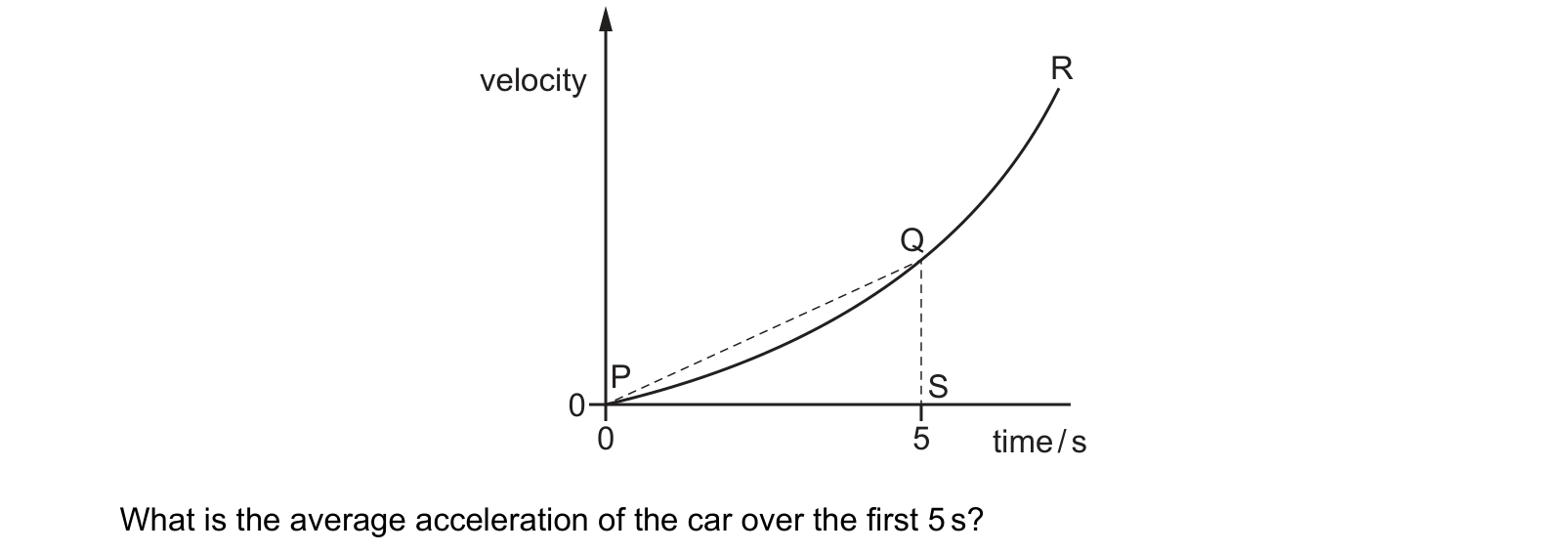
The curved line PQR is the velocity–time graph for a car starting from rest. What is the average acceleration of the car over the first 5 s?
Answer: C.
Average acceleration over an interval is the total change in velocity divided by the total time:
a = Δv / Δt
On a velocity–time graph that is exactly the gradient of the chord joining the two end points, which is the straight line from P at t = 0 to Q at t = 5 s. Nothing about the shape of the curve in between affects it.
D, the gradient of the tangent at Q, gives the instantaneous acceleration at the single moment t = 5 s. On a curve those two are different, and telling them apart is what this question tests. On a straight line they would agree, which is why the distinction only shows up here.
A and B both offer areas, and an area under a velocity–time graph has units of m s⁻¹ × s, which is metres. That is a displacement, not an acceleration. The area below PQ gives the distance travelled in the first 5 s, and the triangle PQS gives something with no useful meaning at all.
Gradient for acceleration, area for displacement, and chord for average against tangent for instantaneous. Those two pairs answer most velocity–time graph questions between them.
Question 3
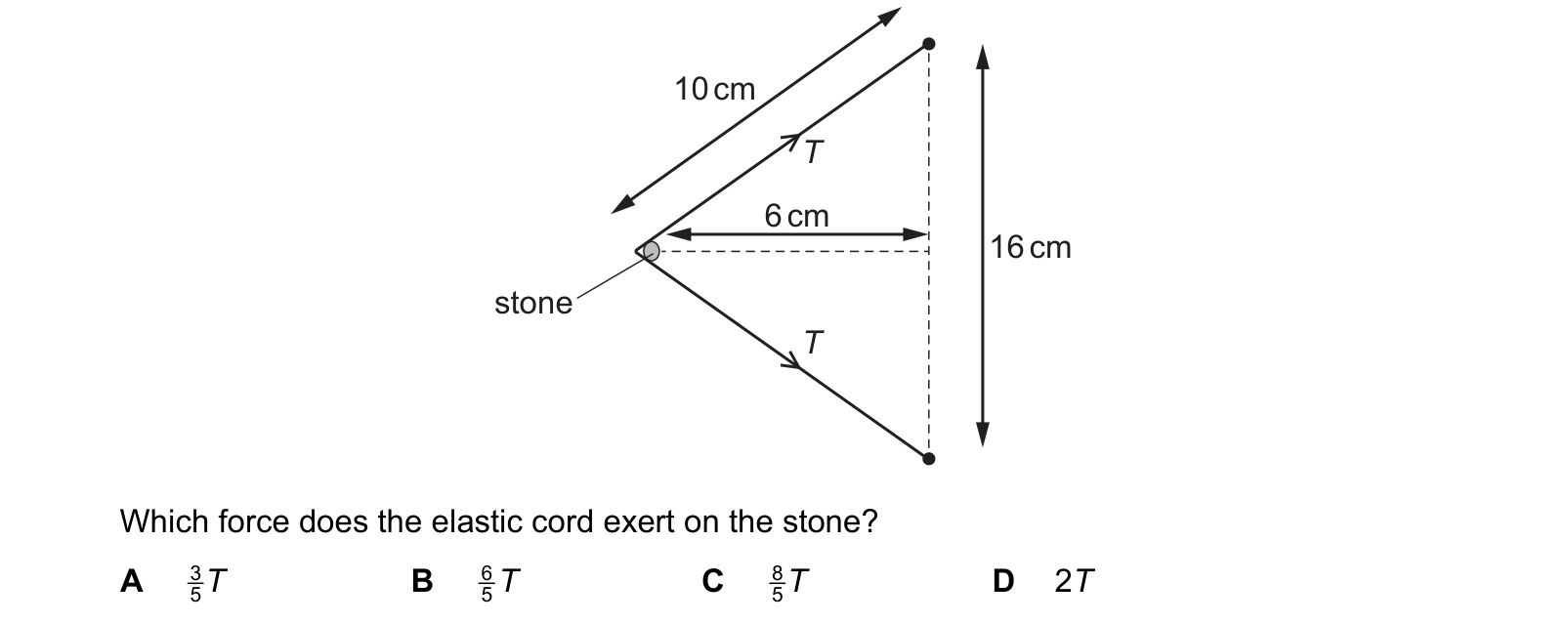
The diagram shows the dimensions of an elastic cord used to project a stone. The tension in the cord is T when the cord is pulled into the shape shown. Which force does the elastic cord exert on the stone?
Answer: B.
The geometry. Each arm is 10 cm long, the ends are 16 cm apart so each is 8 cm from the centre line, and the stone sits 6 cm back. That is a 6, 8, 10 right triangle, a scaled 3-4-5.
Resolving one arm. The component pointing along the centre line, towards the fixed ends, is:
T × (6/10) = 0.6T
The perpendicular components are 0.8T for each arm, but they point in opposite directions, one up and one down, so they cancel exactly.
Both arms together:
2 × 0.6T = 1.2T = 6/5 T
A, 3/5 T, counts only one arm. C, 8/5 T, uses the 8/10 ratio, resolving along the wrong side of the triangle. D, 2T, adds the two tensions as scalars, which would be right only if both arms pointed the same way.
The ratio to use is always adjacent over hypotenuse for the component along the direction you want, and here that direction is horizontal, so the 6 cm is the adjacent side.
Question 4
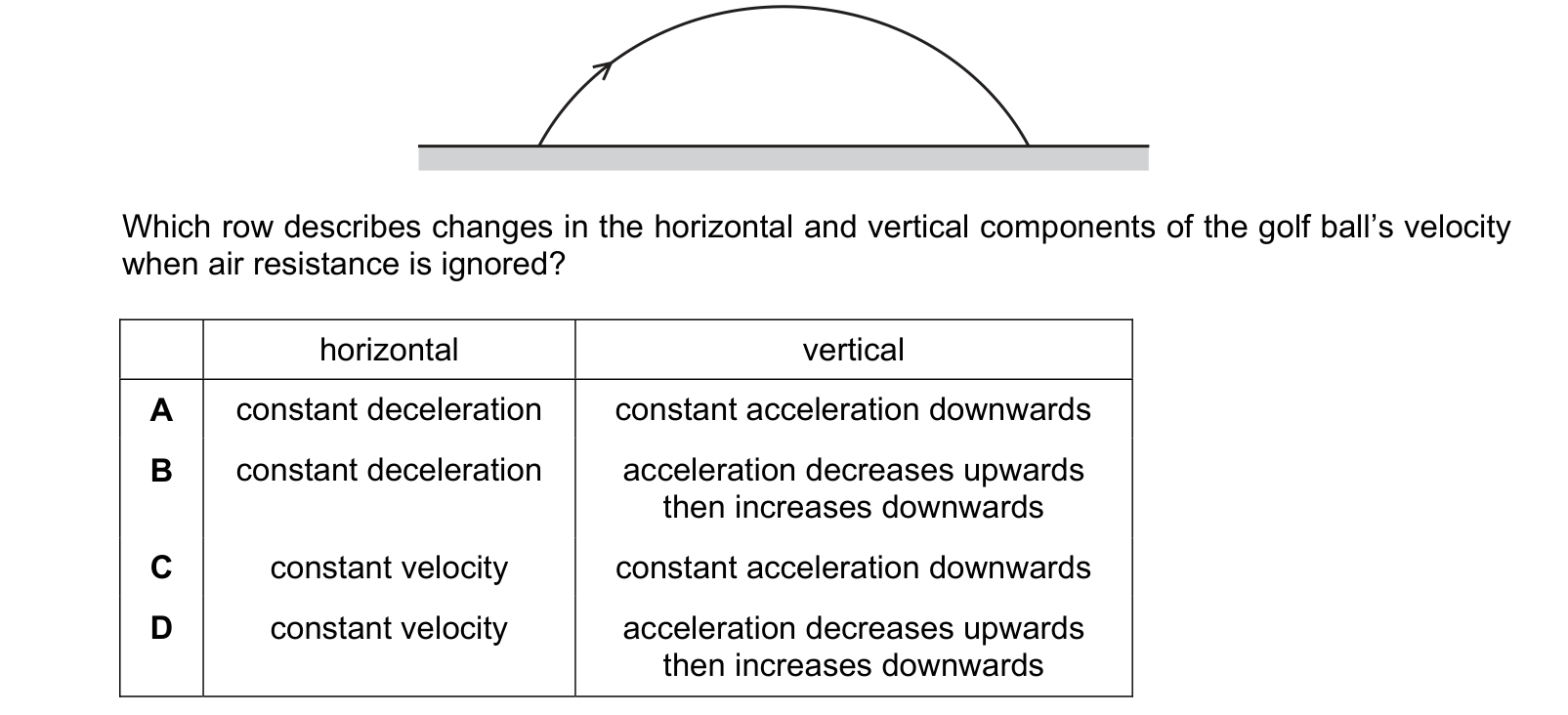
The diagram shows the path of a golf ball. Which row describes changes in the horizontal and vertical components of the golf ball’s velocity when air resistance is ignored? Each answer gives, in order: horizontal; vertical.
Answer: C.
With air resistance ignored, the only force on the ball in flight is its weight, which acts vertically downwards. Newton's laws then split the motion cleanly in two.
Horizontally there is no force at all, so there is no acceleration and the horizontal component of velocity stays constant for the whole flight. That disposes of A and B, which both have the ball decelerating horizontally: something would have to push backwards on it, and only air resistance could do that.
Vertically the weight is constant, so the acceleration is a constant 9.81 m s⁻² downwards throughout, including at the very top of the path. That disposes of B and D.
D describes what the velocity does, not the acceleration: the ball does slow going up and speed up coming down. But that is a steady change at a constant rate, which is exactly what constant acceleration means.
The point most often lost is that the acceleration does not become zero at the top. The vertical velocity passes through zero there, while g carries on unchanged, which is why the ball does not hover.
With air resistance included, both halves of the answer would change, and the path would no longer be a symmetrical parabola.
Question 5
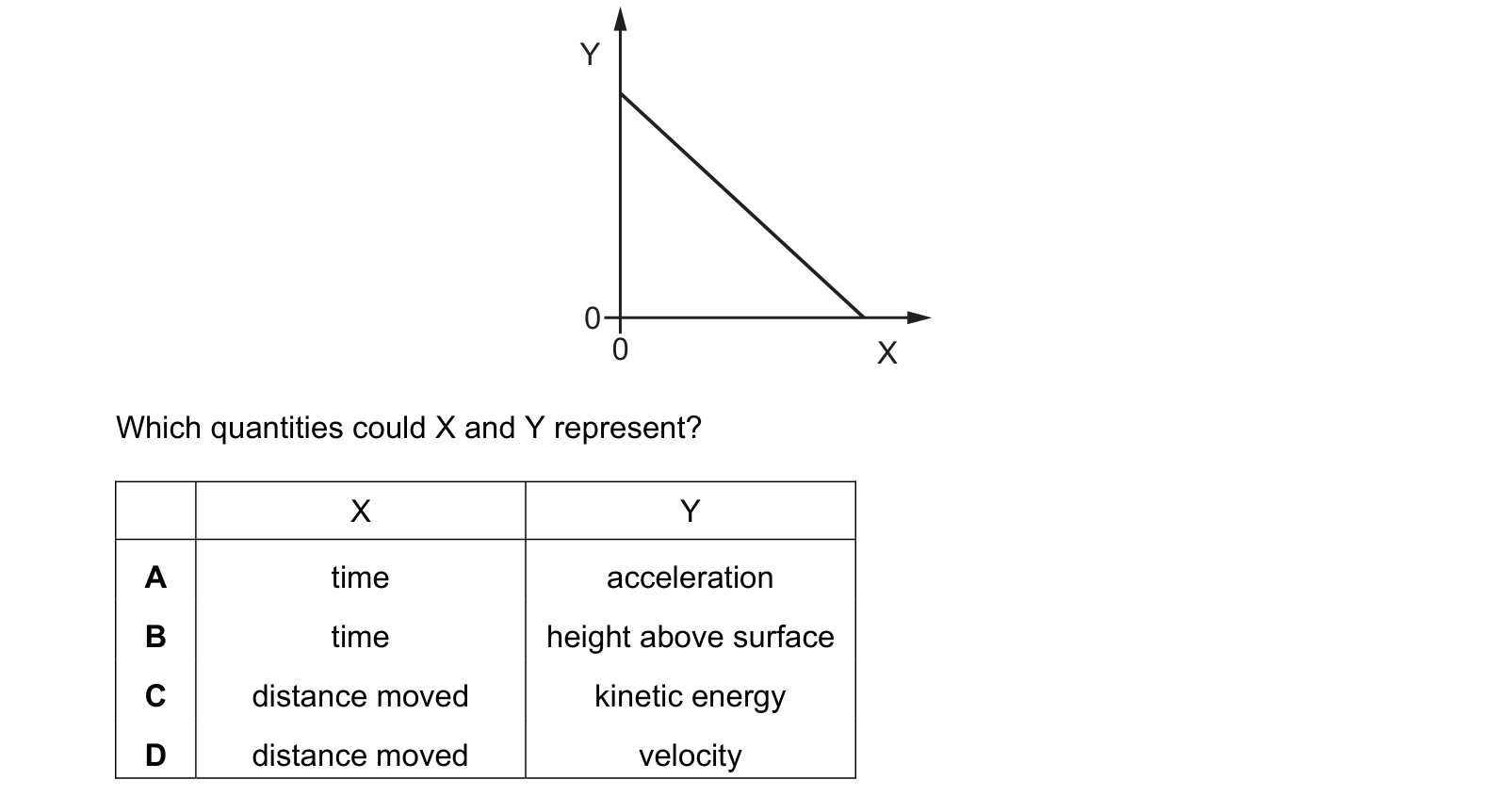
The graph shows how a quantity Y varies with a quantity X for an object falling vertically at its terminal velocity towards the surface of the Earth. Which quantities could X and Y represent? Each answer gives, in order: X; Y.
Answer: B.
At terminal velocity the object falls at a constant speed, which is the fact that decides everything. Test each pair against a straight line of negative gradient.
B works. Falling at a steady speed, the height decreases by the same amount every second, so height against time is a straight line sloping down, reaching zero when the object lands. That is exactly the graph.
A would be a line lying along the x-axis. At terminal velocity the acceleration is zero, since the weight and the drag balance exactly, and it stays zero.
C and D would both be horizontal lines above the axis. The velocity is constant, so it does not change with distance, and the kinetic energy ½mv² is constant for the same reason.
So three of the four give a flat line and only one gives a slope.
Note that the graph's line reaches zero at a finite value of X, which fits B neatly: the object hits the ground. The others have no reason to reach zero at all.
Terminal velocity is worth stating as the balance it is: weight equals drag, resultant zero, acceleration zero, speed unchanging.
What this practice covers
These questions are drawn from past CIE 9702 Physics papers. You answer, you find out immediately whether you were right, and you get the reasoning for the correct option and for each distractor. Wrong answers go to a mistakes locker so you can come back to exactly those.
Practice is free. You need an account only so your progress and your mistakes are still there next time.
What examiners see students get wrong here
These are the errors that cost marks on kinematics, taken from our own topic notes. Read them before you practise and you will recognise the traps in the questions.
- Using the equations of motion when the acceleration is not uniform. Check for a straight line on the velocity-time graph first.
- Taking the area under a velocity-time graph as distance when part of it is below the axis.
- Confusing gradient and area, so acceleration is read off as an area.
- Saying a body at terminal velocity has stopped, or that it is still accelerating.
- Giving a projectile a horizontal acceleration.
- Forgetting that the vertical velocity, not the speed, is zero at the top of the flight.
- Changing the sign convention partway through a question.
Revise it first
If any of the above is unfamiliar, work through the notes before practising: Kinematics revision notes.