Kinematics
Contents: 7 sections
The four quantities
- Distance is the path length travelled; a scalar.
- Displacement is the straight-line distance in a stated direction; a vector.
- Speed is distance per unit time; a scalar.
- Velocity is displacement per unit time; a vector.
- Acceleration is rate of change of velocity; a vector.
A body moving in a circle at constant speed has a changing velocity, because the direction changes, so it is accelerating. That sentence is worth a mark on its own and is the reason the scalar and vector distinction is taught here.
For a full lap of a circular track the displacement is zero, so the average velocity is zero while the average speed is not.
Reading the graphs
Most kinematics marks are graph marks. Two facts do almost all the work.
| Graph | Gradient gives | Area under gives |
|---|---|---|
| Displacement-time | Velocity | Nothing useful |
| Velocity-time | Acceleration | Displacement |
| Acceleration-time | Nothing useful | Change in velocity |
So to go down the list you differentiate (gradient) and to go up you integrate (area). Getting the direction right is the whole skill.
A curved displacement-time graph means changing velocity. A curved velocity-time graph means changing acceleration. A straight line on a velocity-time graph means uniform acceleration, which is the condition for the equations below.
Area below the time axis counts as negative displacement. A question where a body goes out and comes back relies on this, and a student who adds the two areas gets the distance rather than the displacement.
The equations of motion
Valid only for uniform acceleration in a straight line.
- v = u + at
- s = ut + ½at²
- v² = u² + 2as
- s = ½(u + v)t
Five quantities, and each equation omits one. Choosing the right equation is a matter of listing what you have and what you want, then picking the one that leaves out the quantity you neither have nor want.
Worked example. A car accelerates uniformly from 8.0 m s⁻¹ to 20 m s⁻¹ over 60 m. What is its acceleration?
Known: u = 8.0, v = 20, s = 60. Wanted: a. Time is neither, so use v² = u² + 2as.
400 = 64 + 2a(60), so 120a = 336, giving a = 2.8 m s⁻².
Signs
Choose a positive direction and hold it for the whole question. Going up is usually positive, which makes g = −9.81 m s⁻² for a body thrown upwards. Changing convention halfway through is the most common source of a wrong sign, and a wrong sign here is a wrong answer, not a lost mark for presentation.
Falling bodies
In the absence of air resistance every body has the same acceleration, g = 9.81 m s⁻², regardless of mass. A feather and a coin fall together in an evacuated tube, which is the standard demonstration and the standard question.
With air resistance the story changes:
- At release the only force is weight, so the acceleration is g.
- As speed rises, drag rises, so the resultant force falls and the acceleration falls.
- When drag equals weight the resultant force is zero, the acceleration is zero, and the body falls at constant terminal velocity.
The velocity-time graph is a curve of decreasing gradient flattening to a horizontal line. Note that the body is still moving at terminal velocity, and moving at its fastest: it is the acceleration that is zero, not the velocity.
Projectiles
The whole topic is one idea: the horizontal and vertical motions are independent, and time is what links them.
- Horizontally there is no force, so the velocity is constant: s = u_h t.
- Vertically the acceleration is g, so the equations of motion apply with u_v as the initial vertical velocity.
Worked example. A ball is thrown horizontally at 15 m s⁻¹ from a cliff 20 m high. How far from the base does it land?
Vertical: 20 = 0 + ½(9.81)t², so t² = 4.077 and t = 2.02 s.
Horizontal: s = 15 × 2.02 = 30 m.
The vertical calculation supplies the time and the horizontal one uses it. Notice the initial vertical velocity is zero for a horizontal throw, which is what makes that first step short.
At the highest point of a projectile's path the vertical velocity is zero but the horizontal velocity is unchanged, so the speed is not zero and the acceleration is still g downwards. Questions ask for all three.
For a projectile launched at an angle, resolve the initial velocity first: u_h = u cos θ and u_v = u sin θ. With no air resistance the path is a symmetrical parabola, so the time up equals the time down and the landing speed equals the launch speed.
With air resistance the path is no longer symmetrical: the descent is steeper than the ascent, the range is shorter, and the maximum height is lower.
Common mistakes
- Using the equations of motion when the acceleration is not uniform. Check for a straight line on the velocity-time graph first.
- Taking the area under a velocity-time graph as distance when part of it is below the axis.
- Confusing gradient and area, so acceleration is read off as an area.
- Saying a body at terminal velocity has stopped, or that it is still accelerating.
- Giving a projectile a horizontal acceleration.
- Forgetting that the vertical velocity, not the speed, is zero at the top of the flight.
- Changing the sign convention partway through a question.
Check you have it
Question 1
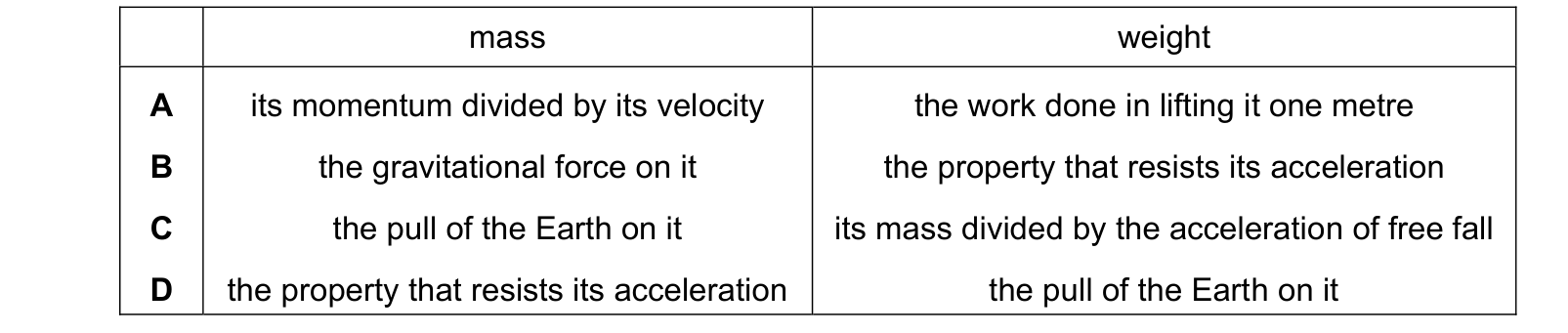
What is meant by the mass and by the weight of an object on the Earth? Each answer gives, in order: mass; weight.
Answer: D.
Weight is the gravitational force on the body, the pull of the Earth. It is a vector, measured in newtons, and it depends on where the body is: the same object weighs less on the Moon and nothing at all far from any mass.
So D.
B has the two exactly reversed, calling mass the gravitational force and weight the resistance to acceleration. It is the sharpest distractor because both halves are real definitions attached to the wrong word.
C calls mass the pull of the Earth, which is weight, and then defines weight as mass divided by g. The relationship is W = mg, so weight is mass multiplied by g.
A defines mass as momentum divided by velocity, which is correct arithmetic from p = mv but is a way of calculating it rather than saying what it is, and its weight is the work done lifting it a metre, which is mgh with h = 1, so numerically equal but a quantity of energy rather than force.
The everyday confusion comes from bathroom scales, which measure weight and are labelled in kilograms.
Question 2
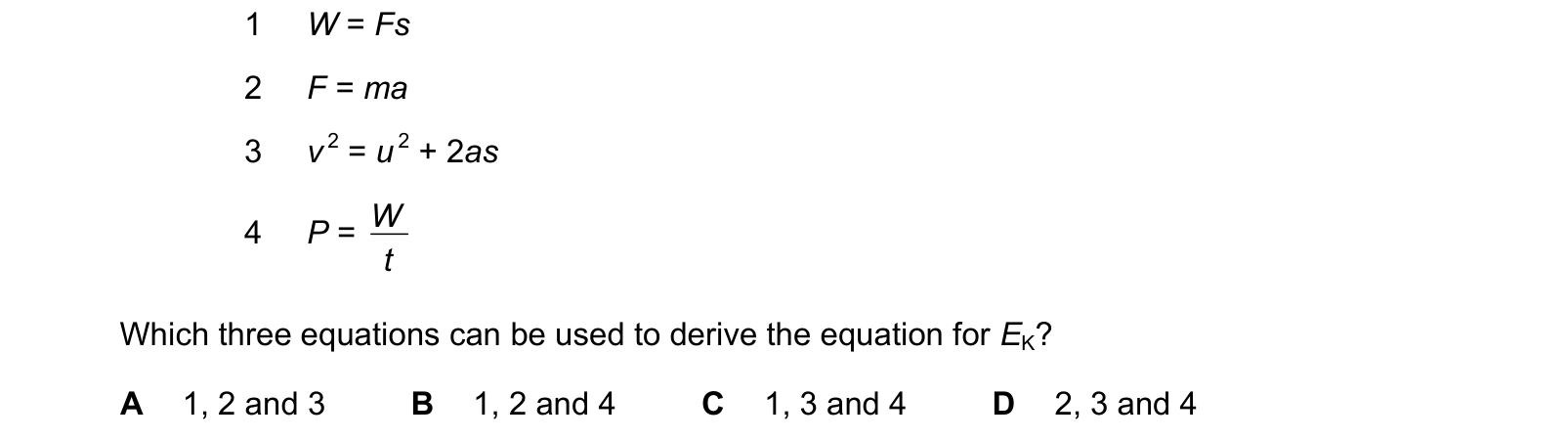
The equation for kinetic energy EK can be derived using the equations of motion.
Four equations relating to motion are listed.
1 W = Fs
2 F = ma
3 v ² = u ² + 2as Which three equations can be used to derive the equation for EK?
Answer: A.
The derivation of kinetic energy chains those three together, starting from an object accelerated from rest by a constant force over a distance s.
Start with the work done, equation 1:
W = Fs
Substitute for the force, equation 2:
W = (ma)s
Eliminate the acceleration using equation 3, v² = u² + 2as, with u = 0 for an object starting from rest:
v² = 2as, so as = v²/2
Putting it together:
W = m(as) = m(v²/2) = ½mv²
That work is the kinetic energy the object has gained, which is the result required.
Each of the three does one job: 1 connects force to energy, 2 connects force to acceleration, and 3 connects acceleration to speed. Remove any one and the chain breaks: without 2 there is no way to bring mass in, and without 3 no way to replace the acceleration and distance with a speed.
The derivation also shows why the result holds only for the resultant force. If other forces act, F in equation 1 must be the resultant, and W is then the net work, which equals the change in kinetic energy rather than the whole of it.
Question 3
An object falls from a stationary helicopter and reaches terminal velocity.
What happens to the acceleration of the object between leaving the helicopter and reaching terminal velocity?
Answer: B.
As the speed rises, the drag rises with it, so the resultant force falls and the acceleration falls with it.
At terminal velocity the drag equals the weight, the resultant force is zero, and so the acceleration is zero. That is B.
So the acceleration starts at 9.81 m s⁻² and decreases to zero, which is why A and C are both wrong: 9.81 is where it begins, not where it ends.
D would be true only in a vacuum.
Zero acceleration does not mean the object has stopped. At terminal velocity it is falling at its fastest, and that is the confusion this question is built on.
What the syllabus asks for on this topicSyllabus points
Syllabus points
- Define displacement, speed, velocity and acceleration.
- Use graphical methods to represent displacement, velocity and acceleration.
- Determine displacement from the area under a velocity-time graph, and velocity or acceleration from a gradient.
- Derive and use the equations of uniformly accelerated motion in a straight line.
- Describe the motion of a body falling in a uniform gravitational field with and without air resistance.
- Understand projectile motion as two independent perpendicular motions.
Related CIE 9702 Physics topics
Not the topic you were looking for? Describe what you are stuck on in your own words and we will take you to the notes that answer it.