Work, energy and power
Contents: 9 sections
Work
W = Fs cos θ
where θ is the angle between the force and the displacement. Work is a scalar, measured in joules, and 1 J is the work done when a force of 1 N moves its point of application 1 m in the direction of the force.
The cosine matters. Three cases are worth holding in mind:
- Force along the displacement: θ = 0, cos θ = 1, so W = Fs.
- Force perpendicular to the displacement: θ = 90°, cos θ = 0, so no work is done. This is why the tension in a string does no work on a body moving in a circle, and why carrying a bag horizontally does no work against gravity.
- Force opposing the motion: θ = 180°, so the work is negative. Friction does negative work.
For a force that varies, the work done is the area under a force-distance graph. That is how the work done stretching a spring is found in the next chapter.
Conservation of energy
Energy cannot be created or destroyed, only transferred from one form to another. The total energy of an isolated system is constant.
This is the most useful single principle in the AS course, because it lets you connect a starting state to a finishing state without knowing anything about what happened between them. A question giving a height and asking for a speed almost always wants energy, not the equations of motion.
Kinetic energy
E_k = ½mv²
Deriving it. A resultant force F accelerates a mass m from rest through a distance s.
Work done = Fs = mas.
From v² = u² + 2as with u = 0, as = v²/2.
So work done = m × v²/2 = ½mv².
Because of the square, doubling the speed quadruples the kinetic energy. That is behind questions on braking distance: at twice the speed a car needs four times the distance to stop with the same braking force.
Gravitational potential energy
E_p = mgh
Deriving it. Lifting a mass m at constant velocity needs an upward force equal to its weight mg. Work done = force × distance = mgh.
Two conditions are attached and are worth stating: the field must be uniform, which it effectively is near the Earth's surface, and h is the change in vertical height, not the distance travelled. A body sliding 5.0 m down a slope inclined at 30° falls 5.0 sin 30° = 2.5 m, and 2.5 m is the h in the equation.
Only changes in potential energy are meaningful; where you put the zero is your choice, so choose the lowest point in the question.
Putting them together
Worked example. A ball of mass 0.50 kg is thrown vertically upward at 12 m s⁻¹. Ignoring air resistance, how high does it rise?
At the top the kinetic energy has all become potential energy.
½mv² = mgh, so h = v²/2g = 144 / (2 × 9.81) = 7.3 m.
The mass cancels, which is worth noticing: every body thrown up at 12 m s⁻¹ rises the same height.
With resistance. If 20% of the initial kinetic energy is lost to air resistance, only 80% is available:
0.8 × ½mv² = mgh, so h = 0.8 × 144 / (2 × 9.81) = 5.9 m.
Power
P = W / t
measured in watts, where 1 W = 1 J s⁻¹.
Deriving P = Fv. In time t a constant force F moves a body a distance s = vt.
Work done = Fs = Fvt.
Power = work / time = Fv.
This is the form to use when a question gives a speed rather than a time. At constant speed the driving force equals the total resistive force, so a car's engine power at top speed equals the resistive force times the top speed.
Worked example. A car travels at a constant 25 m s⁻¹ against a total resistive force of 600 N. What is the useful output power?
At constant speed the driving force is 600 N, so P = 600 × 25 = 15000 W, or 15 kW.
Efficiency
efficiency = useful output energy / total input energy × 100%
or equivalently with powers. Efficiency has no unit and can never exceed 100%, so an answer above 100% means the input and output have been swapped.
Worked example. A motor is supplied with total energy E. Energy Q is wasted. What is the efficiency?
Useful output = E − Q, so the efficiency is (E − Q) / E, which can also be written 1 − Q/E.
Both forms appear as options in multiple-choice questions, and Q/E − 1 is the distractor: it is negative, which is the clue that it cannot be right.
The wasted energy is not destroyed. It is transferred to the surroundings as internal energy and sound, which is what conservation of energy requires.
Common mistakes
- Forgetting cos θ when the force is at an angle to the motion.
- Saying work is done by a force perpendicular to the motion.
- Using the distance along a slope as h in mgh instead of the vertical drop.
- Forgetting that kinetic energy depends on the square of the speed, so doubling the speed doubles the energy.
- Using P = Fv with a force that is not the driving force.
- Writing efficiency as input over output, giving an answer above 100%.
- Saying wasted energy is destroyed.
Check you have it
Question 1
The total energy supplied to an electric motor is E. Energy Q is wasted and the remaining energy does useful work.
What is the efficiency of the motor?

Answer: C.
efficiency = (E − Q) / E = 1 − Q/E
which is C.
The two forms are the same expression, and Cambridge offers both shapes in different years, so recognising (E − Q)/E and 1 − Q/E as identical is worth doing once.
B, Q/E − 1, is the same two terms subtracted the other way round. It is negative whenever Q is less than E, which is always, and an efficiency can never be negative. That single check rules it out without any algebra.
A, Q/E, is the fraction wasted rather than the fraction used.
Question 2
An object is displaced horizontally to the right in a uniform vertical gravitational field.
Which statement describes the change in the gravitational potential energy of the object?
Answer: B.
This is the same statement as "gravity does no work on an object moving horizontally", which follows from W = Fs cos θ with θ = 90°.
It is why carrying a heavy bag along a level corridor costs no work against gravity, however tiring it feels, and why the h in mgh is always measured straight up.
A, C and D all make the potential energy depend on horizontal displacement, which the field being vertical rules out.
Question 3
The graph shows how the length of a spring varies with the force applied to it. The spring has unstretched length L0. When a force F is applied, the spring has length L1.
What is the work done in stretching the spring to length L1?
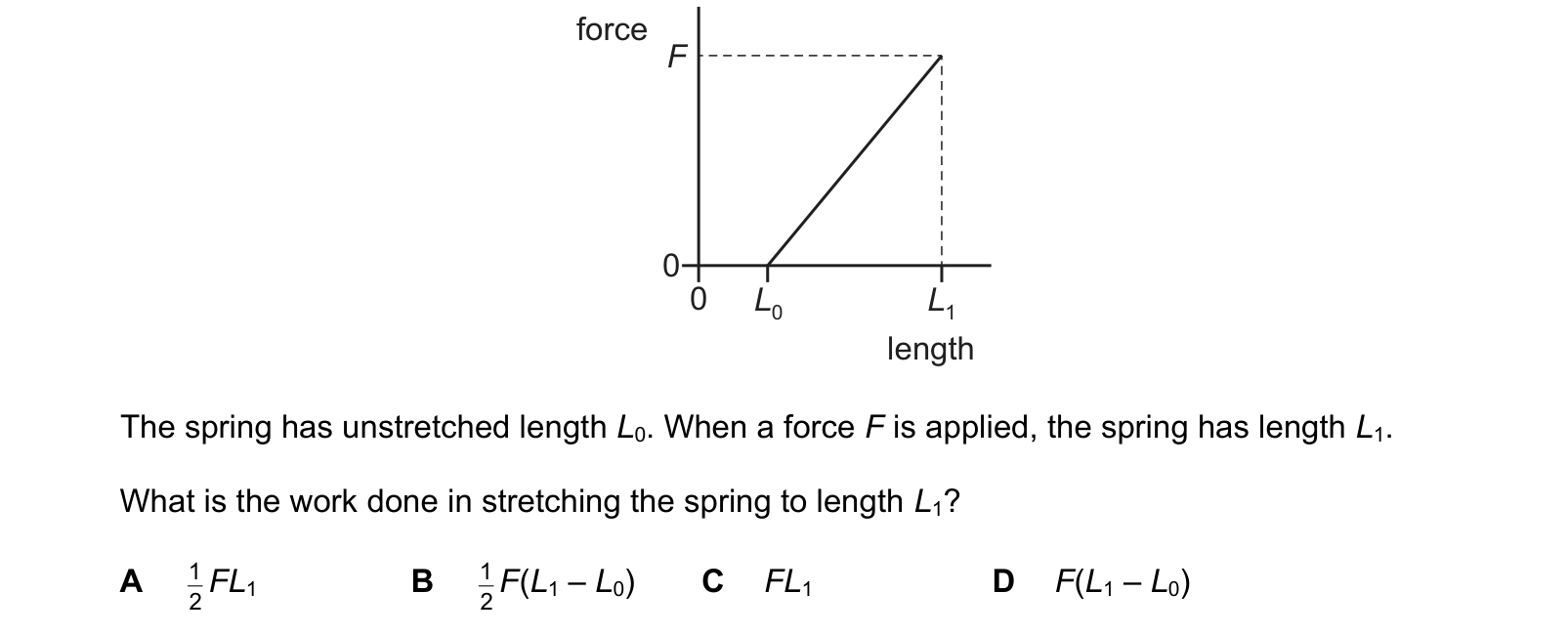
Answer: B.
Work done in stretching a spring is the area under a force–extension graph, and for a spring obeying Hooke's law that is a triangle:
W = ½ × force × extension
The catch is that this graph plots length, not extension, along the axis. The extension is how much longer the spring has become:
extension = L₁ – L₀
so the work done is ½F(L₁ – L₀).
A, ½FL₁, uses the final length as though it were the extension. That counts the unstretched spring as though it had been created from nothing, and it is the error the graph is drawn to encourage: the area under this particular line, measured from the vertical axis, includes a rectangle of width L₀ that represents no work at all.
C and D both drop the ½. That factor is there because the force grows from zero to F as the spring stretches, so the average force over the stretch is F/2. Using the full F throughout, as D does, counts twice the work actually done.
Read the axis label before taking an area. A length–force graph and an extension–force graph look identical apart from where the line starts.
What the syllabus asks for on this topicSyllabus points
Syllabus points
- Define work done by a force and calculate it, including when the force is at an angle to the displacement.
- Understand and apply the principle of conservation of energy.
- Derive and use the equations for kinetic energy and for gravitational potential energy near the Earth's surface.
- Define power and derive P = Fv.
- Define and calculate efficiency.
Related CIE 9702 Physics topics
Not the topic you were looking for? Describe what you are stuck on in your own words and we will take you to the notes that answer it.