Nuclear physics
Contents: 9 sections
Cambridge International AS & A Level Physics 9702 · A Level
Both subtopics here are printed under "A Level subject content" in the 9702 syllabus, and every objective carries the tier "A Level". None of it is AS. It is examined on Paper 4. Paper 1 is the AS multiple-choice paper, and the whole 9702 bank on this site comes from Paper 1, so no practice is tagged to this topic.
Mass and energy
Mass and energy are equivalent:
E = mc²
with c the speed of light, 3.00 × 10⁸ m s⁻¹. Because c² is about 9 × 10¹⁶, a very small mass corresponds to an enormous energy, which is why nuclear reactions release millions of times more energy per atom than chemical ones.
The unified atomic mass unit u is used for nuclear masses, where 1 u = 1.66 × 10⁻²⁷ kg. A useful conversion to memorise:
1.66 × 10⁻²⁷ × 9.00 × 10¹⁶ = 1.494 × 10⁻¹⁰
and dividing by 1.60 × 10⁻¹³ to convert to MeV gives 934, so 1 u is equivalent to about 934 MeV, often quoted as 931.5 MeV using more precise constants.
Nuclear equations
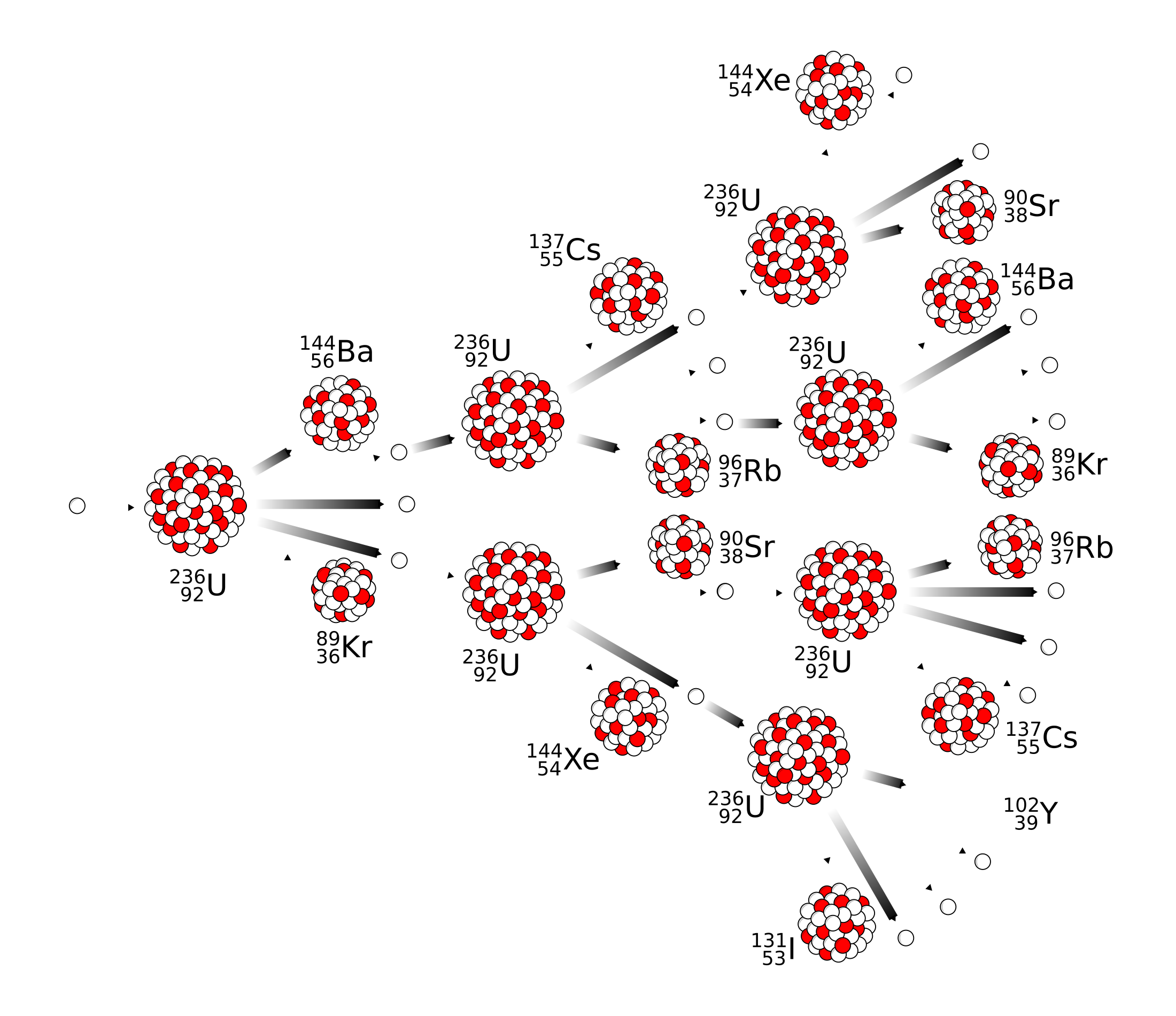
A nuclide is written with the nucleon number on top and the proton number below, as in ²³⁵₉₂U. In any nuclear equation, both must balance across the arrow:
¹⁴₇N + ⁴₂He → ¹⁷₈O + ¹₁H
Check: nucleon numbers 14 + 4 = 18, and 17 + 1 = 18. Proton numbers 7 + 2 = 9, and 8 + 1 = 9.
For the common decays: alpha decay reduces the nucleon number by 4 and the proton number by 2; beta-minus decay leaves the nucleon number unchanged and raises the proton number by 1, with an antineutrino; beta-plus decay lowers the proton number by 1, with a neutrino.
Mass defect and binding energy
Measure the mass of a nucleus and it comes out less than the sum of the masses of its separate protons and neutrons. That difference is the mass defect:
mass defect = total mass of separate nucleons - mass of the nucleus
The missing mass has become binding energy: the energy that would be required to separate the nucleus completely into its individual nucleons, or equivalently the energy released when those nucleons come together to form it.
Δm and the binding energy are linked by
E = c²Δm
A nucleus with a large binding energy is difficult to pull apart, which is another way of saying it is stable. But total binding energy grows simply because a larger nucleus has more nucleons, so it is a poor measure of stability by itself.
Binding energy per nucleon is the useful quantity. It is the binding energy divided by the nucleon number, and it measures how tightly each nucleon is held. The higher it is, the more stable the nucleus.
Worked example. A helium-4 nucleus has a mass of 4.00150 u. A proton is 1.00728 u and a neutron 1.00867 u.
Total mass of the separate nucleons, two of each:
2 × 1.00728 + 2 × 1.00867 = 4.03190
Mass defect:
4.03190 - 4.00150 = 0.0304
Binding energy, using 934 MeV per u:
0.0304 × 934 = 28.39
so about 28.4 MeV, and the binding energy per nucleon is
28.39 / 4 = 7.0975
that is about 7.1 MeV per nucleon.
The binding energy per nucleon curve
Sketching this curve correctly is worth several marks, and every feature of it means something:
- It rises steeply from hydrogen through the light nuclei, with helium-4 sitting notably above its neighbours.
- It reaches a maximum of about 8.8 MeV per nucleon at around nucleon number 56, which is iron-56, the most stable nucleus there is.
- Beyond iron it falls slowly and steadily out to uranium, at about 7.6 MeV per nucleon.
That single peak explains both ways of releasing nuclear energy. Energy is released whenever a reaction moves nuclei towards the peak, because the products are more tightly bound than the reactants and the surplus binding energy is released.
- Fusion: two light nuclei join to form a heavier one. Moving up the steep left-hand side gains a great deal of binding energy per nucleon, which is why fusion releases more energy per nucleon than fission and why it powers stars.
- Fission: a heavy nucleus splits into two lighter ones, usually after absorbing a neutron. Moving left along the shallow right-hand side also gains binding energy per nucleon, though less per nucleon than fusion.
Nothing beyond iron can release energy by fusion, and nothing below it by fission, which is why iron is the end point of fusion in a star's core.
Worked example. In a fission reaction the total mass on the left is 236.0526 u and on the right 235.8635 u.
Δm = 236.0526 - 235.8635 = 0.1891
energy released = 0.1891 × 934 = 176.6
so about 177 MeV, which is the familiar figure for a single fission of uranium-235.
The nature of radioactive decay
Radioactive decay is spontaneous and random.
- Spontaneous means it is not affected by external conditions. Heating the sample, applying pressure, putting it in a magnetic field or combining it chemically changes nothing.
- Random means it is impossible to predict which nucleus will decay next, or when a particular nucleus will decay. Every undecayed nucleus has the same constant probability of decaying in the next interval of time.
The evidence for randomness is the fluctuation in the count rate. Take repeated readings over equal intervals from a source whose activity is not changing appreciably, and the counts vary about a mean rather than repeating exactly: 412, 397, 421, 405 and so on. A process with a fixed schedule would give the same number every time. That is the observation the syllabus asks for, and answers that simply assert randomness without it earn nothing.
Note that measurements must be corrected for background radiation, measured with the source removed and subtracted from every reading.
Activity and the decay constant
The decay constant λ is the probability per unit time that a given nucleus will decay, with unit s⁻¹.
Activity A is the rate at which nuclei decay, measured in becquerels, where 1 Bq is one decay per second.
A = λN
where N is the number of undecayed nuclei present. The equation says the obvious thing: the more undecayed nuclei there are, the more decays per second, in direct proportion.
That proportionality is exactly the condition for exponential decay, so:
N = N₀e^(-λt)
A = A₀e^(-λt)
C = C₀e^(-λt)
where C is a received count rate. All three fall in the same way for the same reason that Q, V and I did in the capacitor topic: they are proportional to one another at every instant.
Half-life
Half-life t½ is the time taken for the number of undecayed nuclei, or the activity, to fall to half its initial value.
Because the decay is exponential, this time is the same wherever you start. From 800 nuclei to 400 takes as long as from 400 to 200.
Setting N = N₀/2 in the decay equation and taking logarithms gives
λ = 0.693 / t½
where 0.693 is ln 2. So a short half-life means a large decay constant, which means a high activity for a given number of nuclei. A highly radioactive source is one that is decaying away quickly.
Worked example. Strontium-90 has a half-life of 28 years.
Convert to seconds:
28 × 365 × 24 × 3600 = 883008000
λ = 0.693 / 883008000 = 7.848 × 10⁻¹⁰
so λ is about 7.85 × 10⁻¹⁰ s⁻¹.
The activity of 1.0 μg of strontium-90 requires the number of nuclei. One mole is 90 g and contains 6.02 × 10²³ nuclei, so 1.0 × 10⁻⁶ g contains
1.0 × 10⁻⁶ × 6.02 × 10²³ / 90 = 6.689 × 10¹⁵
A = 7.848 × 10⁻¹⁰ × 6.689 × 10¹⁵ = 5.25 × 10⁶
so about 5.2 × 10⁶ Bq. A microgram is a very small amount of material and still gives millions of decays per second, which is worth remembering when judging whether an answer is plausible.
Worked example, using whole half-lives. A source has an activity of 640 Bq and a half-life of 6.0 hours. What is its activity after 24 hours?
24 / 6.0 = 4
so four half-lives have passed, and the activity halves four times:
640 / 2⁴ = 40
that is 40 Bq. Whole numbers of half-lives are always quicker done this way than through the exponential.
Worked example, a time that is not a whole number of half-lives. How long until that source falls to 100 Bq?
λ = 0.693 / 6.0 = 0.1155
Rearranging A = A₀e^(-λt) and taking natural logarithms, ln(640/100) is ln 6.4, which is 1.856, so
t = 1.856 / 0.1155 = 16.07
that is about 16 hours.
Common mistakes
- Forgetting to square c in E = mc², which is out by a factor of 3 × 10⁸.
- Calculating the mass defect as the nuclear mass minus the sum of the nucleons, giving a negative answer.
- Using the mass of a hydrogen atom for a proton, or forgetting that atomic masses include electrons.
- Confusing binding energy with binding energy per nucleon, and saying uranium is the most stable nucleus because its total binding energy is largest.
- Drawing the binding energy curve peaking at uranium rather than at iron-56.
- Saying fusion joins heavy nuclei or that fission splits light ones.
- Saying binding energy is the energy holding the nucleus together in the sense of an energy the nucleus contains. It is the energy needed to take it apart.
- Asserting that decay is random without giving the fluctuating count rate as evidence.
- Saying half-life changes with temperature or with chemical state. Decay is spontaneous.
- Confusing the decay constant with the half-life, or forgetting that they are inversely related.
- Mixing units of time: a half-life in years with a time in seconds.
- Forgetting to subtract background count from measured count rates.
What the syllabus asks for on this topicSyllabus points
Syllabus points
23.1 Mass defect and nuclear binding energy
- Understand the equivalence between energy and mass as represented by E = mc² and recall and use this equation.
- Represent simple nuclear reactions by nuclear equations of the form ¹⁴₇N + ⁴₂He → ¹⁷₈O + ¹₁H.
- Define and use the terms mass defect and binding energy.
- Sketch the variation of binding energy per nucleon with nucleon number.
- Explain what is meant by nuclear fusion and nuclear fission.
- Explain the relevance of binding energy per nucleon to nuclear reactions, including nuclear fusion and nuclear fission.
- Calculate the energy released in nuclear reactions using E = c²Δm.
23.2 Radioactive decay
- Understand that fluctuations in count rate provide evidence for the random nature of radioactive decay.
- Understand that radioactive decay is both spontaneous and random.
- Define activity and decay constant, and recall and use A = λN.
- Define half-life.
- Use λ = 0.693/t½.
- Understand the exponential nature of radioactive decay, and sketch and use the relationship x = x₀e^(-λt), where x could represent activity, number of undecayed nuclei or received count rate.
Related CIE 9702 Physics topics
Not the topic you were looking for? Describe what you are stuck on in your own words and we will take you to the notes that answer it.