Deformation of solids
Contents: 9 sections
Tension and compression
A tensile force stretches a body; a compressive force squashes it. Both are described by the same quantities, and a question about a strut in compression uses exactly the equations below.
Hooke's law
For a material obeying Hooke's law, the extension is proportional to the force applied:
F = kx
where k is the spring constant or force constant, in N m⁻¹, and x is the extension, not the total length. Subtracting the natural length is the first step of most calculations here and the first thing people forget.
Hooke's law holds only up to the limit of proportionality. Beyond that the force-extension graph curves away from the straight line.
Springs in series and parallel
- In series, each spring carries the full load, so each extends by x and the total extension is doubled. Two identical springs in series have a combined spring constant of k/2, so the system is easier to stretch.
- In parallel, the load is shared, so each carries F/2 and extends half as much. The combined spring constant is 2k.
The reasoning is worth carrying rather than the result: work out what force each spring actually carries, and the rest follows.
The four points on the graph
Along a force-extension graph, in order:
- Limit of proportionality — the end of the straight line. Beyond it, F is no longer proportional to x.
- Elastic limit — the last point from which the material returns to its original length when the load is removed. It is at or just past the limit of proportionality.
- Yield point — where the material extends with little or no extra force.
- Breaking point — where it fractures.
The distinction between the first two is a favourite question. Proportionality is about the shape of the graph; the elastic limit is about whether the material returns to its original length. A material can be elastic without obeying Hooke's law: rubber does exactly that.
Elastic and plastic
- Elastic deformation: the body returns to its original shape when the load is removed. No permanent extension.
- Plastic deformation: a permanent extension remains after the load is removed.
Past the elastic limit, unloading follows a line parallel to the original loading line but displaced along the extension axis. The intercept on the extension axis is the permanent deformation. The area enclosed between the loading and unloading curves is the energy that has become internal energy in the material rather than being recovered.
Stress, strain and the Young modulus
The spring constant describes a particular object. To describe the material itself, independently of its dimensions, use:
Stress σ = F / A, in pascals. A is the cross-sectional area, so for a wire of diameter d it is πd²/4, not πd². Halving the radius quarters the area, and questions exploit that.
Strain ε = x / L, where L is the original length. Strain has no unit, being a ratio of two lengths, and is often given as a percentage.
Young modulus E = stress / strain = FL / Ax, in pascals.
E is a property of the material. A thicker wire of the same material has the same Young modulus but a larger spring constant, and separating those two statements is the point of the topic.
Worked example. A wire of length 2.00 m and diameter 0.50 mm is stretched by 1.2 mm under a load of 25 N. Find the Young modulus.
A = π(0.25 × 10⁻³)² = 1.963 × 10⁻⁷ m².
Stress = 25 / (1.963 × 10⁻⁷) = 1.27 × 10⁸ Pa.
Strain = 1.2 × 10⁻³ / 2.00 = 6.0 × 10⁻⁴.
E = (1.27 × 10⁸) / (6.0 × 10⁻⁴) = 2.1 × 10¹¹ Pa.
The radius is half the diameter, and forgetting that alone multiplies the answer by four.
The Young modulus is found in practice from the gradient of a stress-strain graph in its straight-line region. On a force-extension graph the gradient is the spring constant instead.
Elastic potential energy
The work done stretching a material is stored as elastic potential energy, and it is the area under the force-extension graph.
For a material obeying Hooke's law the graph is a triangle:
E = ½Fx = ½kx²
The ½ is not optional. Using Fx gives twice the right answer, and it comes from forgetting that the force starts at zero and builds up: the average force during the stretch is F/2.
Because of the square, doubling the extension quadruples the stored energy.
Beyond the limit of proportionality the graph is no longer a triangle, so the ½kx² formula fails and the area must be counted from the graph, usually by counting squares.
Ductile, brittle and polymeric
- A ductile material, such as copper, has a long plastic region and can be drawn into a wire.
- A brittle material, such as glass, breaks at the elastic limit with no plastic deformation at all.
- A polymeric material, such as rubber, has a curved loading line and does not obey Hooke's law, but is still elastic over a large extension.
Common mistakes
- Using the total length rather than the extension in F = kx.
- Confusing the limit of proportionality with the elastic limit.
- Using the diameter instead of the radius when finding the cross-sectional area.
- Giving strain a unit.
- Saying a thicker wire of the same material has a larger Young modulus.
- Omitting the ½ in the elastic potential energy.
- Reading the Young modulus off a force-extension graph instead of a stress-strain graph.
- Saying a material that does not obey Hooke's law cannot be elastic.
Check you have it
Question 1
A sample of material is stretched by a tensile force to a point beyond its elastic limit. The tensile force is then reduced to zero. The force–extension graph is shown. Which area represents the net work done on the sample?
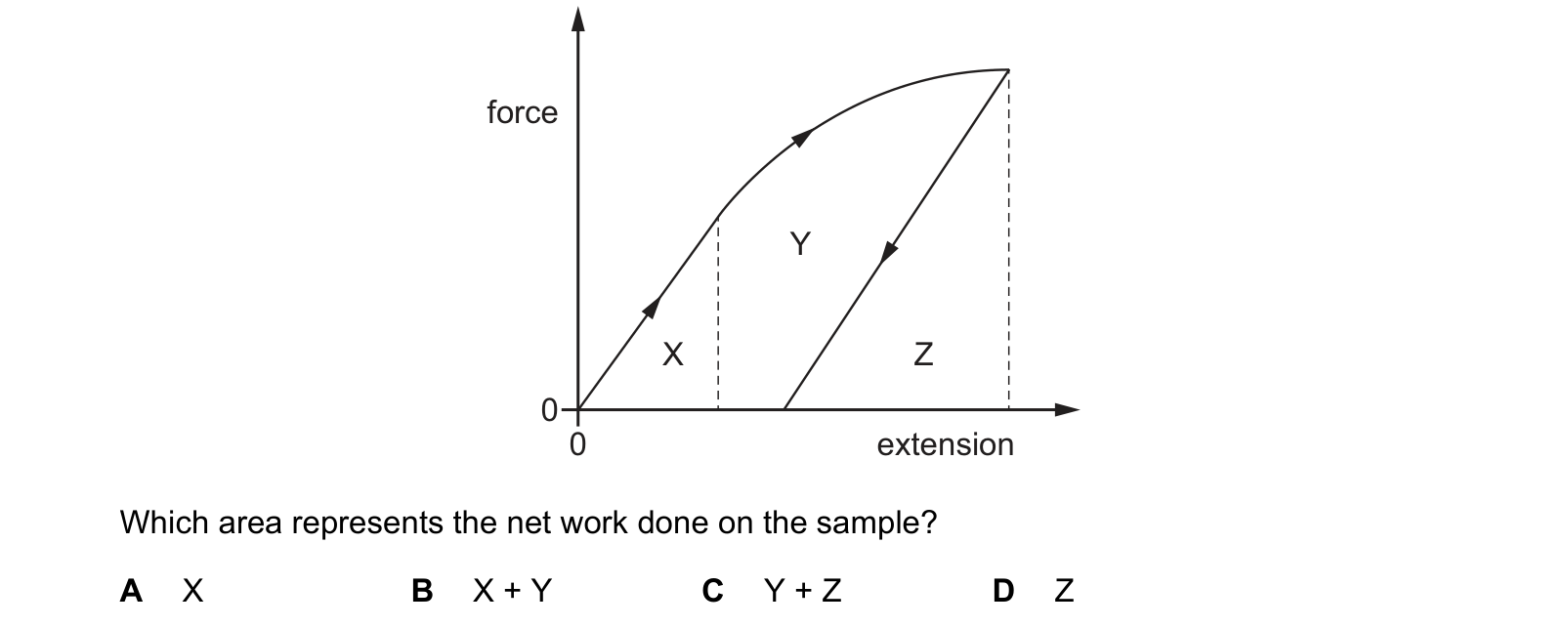
Answer: B.
Work done on the sample while stretching is the area under the loading curve, which is everything beneath it: X + Y + Z.
Work recovered while the force is removed is the area under the unloading line, which is Z.
The net work done on the sample is the difference:
(X + Y + Z) – Z = X + Y
That is the area of the loop enclosed between the two curves, and it represents energy the sample has kept: dissipated as heat and spent in permanently rearranging the material, which is why the unloading line does not return to the origin.
D, Z, is the energy given back by the sample as it contracts, the elastic part.
C, Y + Z, mixes the two.
The permanent extension where the unloading line meets the axis is what makes this different from an elastic sample. If the material had stayed within its elastic limit the two curves would coincide, the loop would have no area, and the net work would be zero: everything put in would come back out.
This loop area is called hysteresis, and it is why a rubber band warms up when repeatedly stretched and released.
Question 2
A known tensile force acts on a metal wire. The wire does not exceed its limit of proportionality.
Which two measurements enable the strain of the wire to be calculated?
Answer: B.
strain = x / L
so the two measurements needed are the unstretched length and the extension, which is B.
A offers the cross-sectional area, which is needed for stress, not strain.
C and D each offer the Young modulus. That would work only in combination with the stress, since strain = stress/E, and neither option supplies the force and area that the stress would need.
The distinction the question is drawing: strain is a purely geometric quantity, about lengths only. The force and the area never enter it.
Question 3
A copper wire of diameter 1.6 mm is stretched within its limit of proportionality by a tensile force of 430 N.
The Young modulus of copper is 130 GPa.
What is the strain in the wire?
Answer: C.
Area: r = 0.80 × 10⁻³ m, so A = π × (0.80 × 10⁻³)² = 2.01 × 10⁻⁶ m²
Stress: 430 / 2.01 × 10⁻⁶ = 2.14 × 10⁸ Pa
Strain: stress / E = 2.14 × 10⁸ / 130 × 10⁹ = 1.6 × 10⁻³
which is C.
A, 4.1 × 10⁻⁴, is exactly a quarter of the answer, which is the signature of using the diameter as the radius: the area comes out four times too large and the stress, and so the strain, four times too small.
Neither the length of the wire nor its extension is given, and neither is needed. Strain follows from stress and the Young modulus alone.
What the syllabus asks for on this topicSyllabus points
Syllabus points
- Understand that deformation is caused by tensile or compressive forces.
- State Hooke's law and define the spring constant.
- Define and use stress, strain and the Young modulus.
- Distinguish between elastic and plastic deformation.
- Determine the elastic potential energy from the area under a force-extension graph.
Related CIE 9702 Physics topics
Not the topic you were looking for? Describe what you are stuck on in your own words and we will take you to the notes that answer it.