Deformation of solids: five questions to try now
Real past-paper questions, the answer key from the mark scheme, and the explanation that goes with it. No account needed to answer them.
Question 1
A uniform wire is made of a metal that has a Young modulus of 1.3 × 10¹¹ Pa.
The wire is 2.4 m long and has a spring constant of 2.7 × 10⁴ N m⁻¹. What is the volume of the wire?

Answer: D.
The Young modulus and the spring constant describe the same stiffness, one as a property of the material and one as a property of this particular wire. What sits between them is the geometry, so this question is really asking you to work backwards from k and E to the cross-sectional area, then finish the job by multiplying by the length.
Two ways of writing the same stretch. Hooke's law gives F = kx. The Young modulus gives
E = stress / strain = (F/A) ÷ (x/L) = FL / (Ax)
Substituting F = kx cancels the extension out entirely:
E = (kx)L / (Ax) = kL / A
That result is worth remembering on its own: k = EA/L. Stiffness rises with a fatter wire and falls with a longer one, which is why a long thin wire stretches easily and a short thick one barely moves.
Rearranging for the area:
A = kL / E = (2.7 × 10⁴ × 2.4) / (1.3 × 10¹¹) = 6.48 × 10⁴ / 1.3 × 10¹¹ = 4.98 × 10⁻⁷ m²
And the volume of a uniform wire is just area × length:
V = AL = 4.98 × 10⁻⁷ × 2.4 = 1.2 × 10⁻⁶ m³
Why the others are there
C, 5.0 × 10⁻⁷, is the cross-sectional area. The physics is right and the arithmetic is right; the answer simply stopped one line early. The guard against it is units: the question asks for a volume, and 5.0 × 10⁻⁷ has come out of a calculation whose units are m², not m³.
A and B are the same pair one stage further down, an area and its volume, both about nineteen times too small. Since they differ from each other by exactly the factor 2.4, whatever went wrong went wrong in the rearrangement of E = kL/A and was then carried faithfully through the final multiplication. It is worth checking the rearrangement before checking the arithmetic: a slip there survives every step that follows and still produces a tidy-looking answer.
Question 2
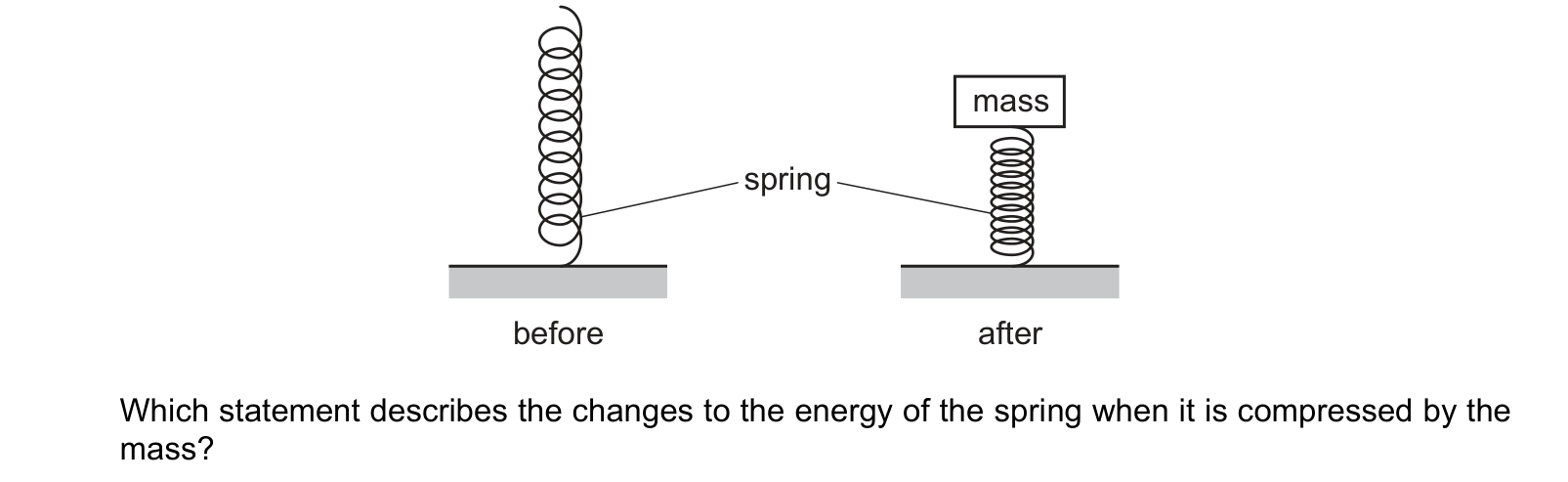
A spring is compressed by a mass, as shown. Which statement describes the changes to the energy of the spring when it is compressed by the mass?
Answer: D.
The question asks about the energy of the spring itself, not of the mass, and that is the whole difficulty.
Elastic potential energy: gained. Compressing a spring stores energy in it, which is what a compressed spring gives back when released. That much is straightforward and rules out B and C.
Gravitational potential energy: lost. As the spring is squashed it becomes shorter, so its own centre of mass moves downwards. Any object whose centre of mass falls loses gravitational potential energy, and the spring is no exception.
That is why A is wrong: it is tempting to think the spring gains everything, but nothing raises it. The mass presses down and the spring shortens.
Where does the energy come from? The mass loses far more gravitational potential energy as it descends than the spring does, and that supplies both the spring's elastic store and everything else in the exchange.
A useful habit on energy questions is to name the object first. The same compression that gives the spring elastic energy takes gravitational energy from both the spring and the mass.
Question 3
A wire is stretched by a gradually increasing force. The force–extension graph for the wire is shown. Which statement must be correct?

Answer: D.
That is always true. Work is force × extension summed over the stretch, which is exactly what the area under a force–extension graph represents, whatever the material does and whether or not the deformation is recoverable.
C says the same area is the elastic potential energy stored, and that is the one to be careful about. The two are equal only while the deformation is elastic. Beyond the elastic limit some of the work goes into permanently rearranging the material and is not recoverable, so the stored elastic energy is less than the area. Since the graph curves over well before S, that cannot be guaranteed.
A and B both name a specific point, and neither is safe. Q is where the line stops being straight, which makes it the limit of proportionality, not the elastic limit. The elastic limit lies at or just beyond it, and nothing on a loading graph alone shows exactly where. R is well into the curve and is neither.
The word must in the question is doing the work throughout. Three of the four statements might be true, or nearly true, and only one is guaranteed by what the graph actually shows.
Question 4
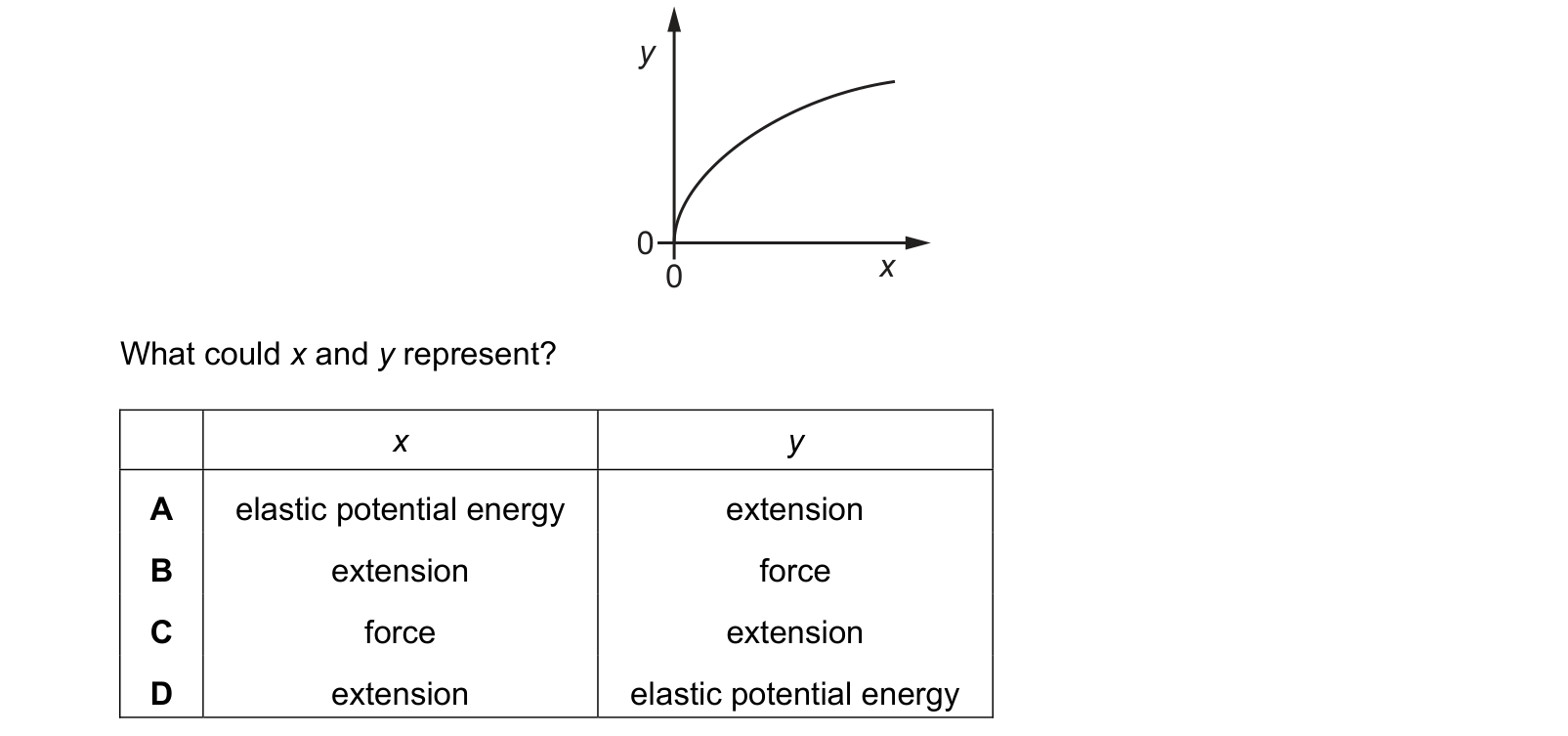
A wire is extended by different forces. The wire obeys Hooke’s law. A graph is plotted to show the variation of a quantity y with a quantity x. What could x and y represent? Each answer gives, in order: x; y.
Answer: A.
The curve rises from the origin with a decreasing gradient, which is the shape of a square root. Only one of the four pairs produces that.
Elastic potential energy is:
E = ½kx²
Rearranged for the extension:
x = √(2E/k), so extension ∝ √(energy)
Plotting extension against energy therefore gives exactly the flattening curve shown: quadrupling the stored energy only doubles the extension.
B and C both pair force with extension, and the wire obeys Hooke's law, so those are directly proportional and would give a straight line through the origin, whichever way round they are plotted.
D is the same relationship as A but with the axes swapped. Energy against extension goes as x², a parabola rising with an increasing gradient, which is the mirror image of the curve drawn.
Deciding between A and D is the whole question, and the test is the gradient: steepening means the y-quantity carries the square, flattening means the x-quantity does.
Question 5
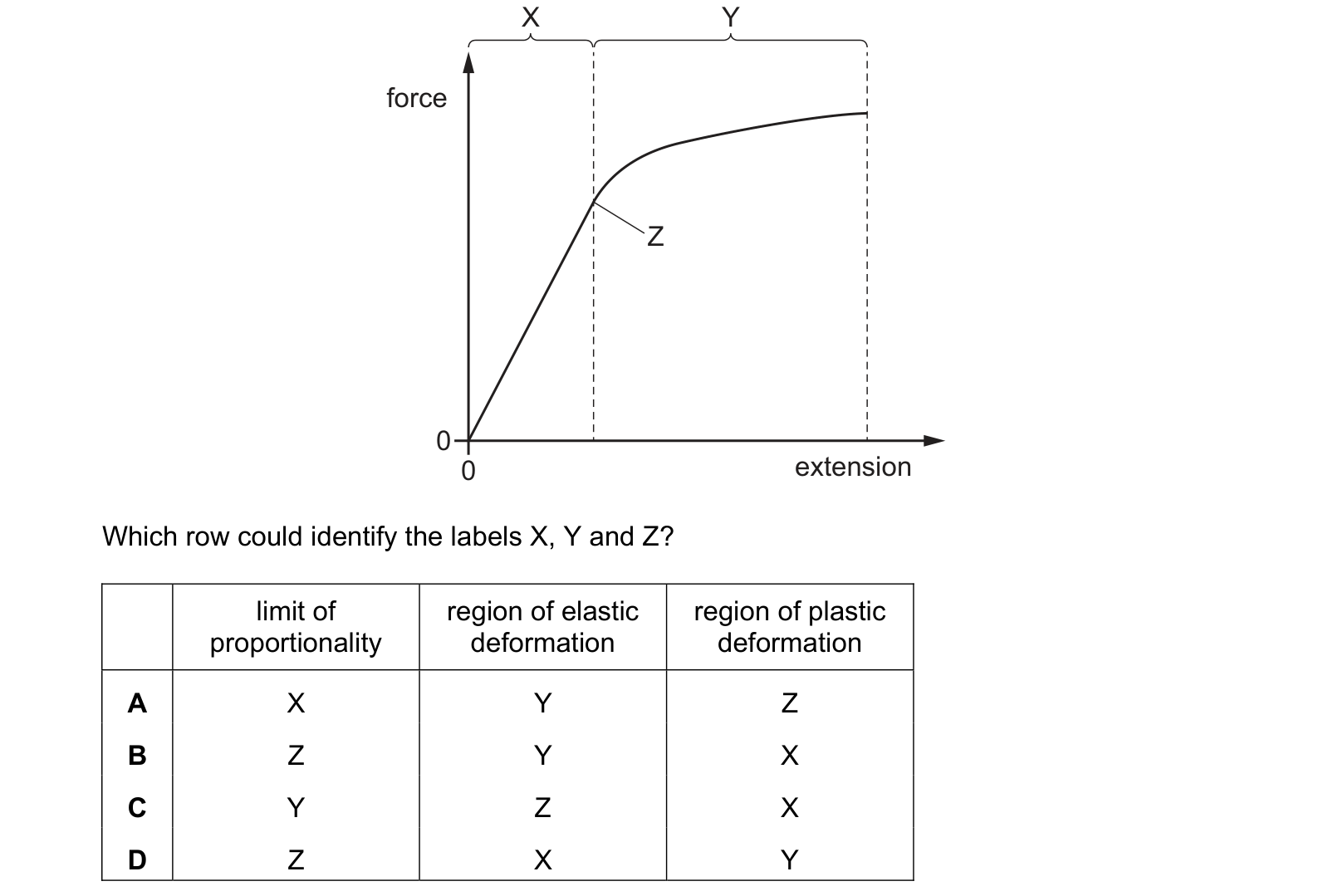
The force–extension graph for a wire is shown. Which row could identify the labels X, Y and Z? Each answer gives, in order: limit of proportionality; region of elastic deformation; region of plastic deformation.
Answer: D.
Read the graph shape first. It is straight from the origin up to the point marked Z, and curved beyond it.
Z is where the straight line ends, so it is the limit of proportionality: up to that point force is proportional to extension and Hooke's law holds.
X is the bracket over the straight section, where the wire returns to its original length when unloaded, so it is the region of elastic deformation.
Y is the bracket over the curved section beyond, where the wire has been stretched permanently, so it is the region of plastic deformation.
A and C both label a region as the limit of proportionality, which is a single point rather than a stretch of the graph. That alone disposes of them.
B has the two regions swapped, putting the plastic behaviour in the straight section.
The word "could" in the question is doing quiet work. Strictly the elastic limit lies a little beyond the limit of proportionality, so there is a short stretch just past Z that is still elastic without obeying Hooke's law. At this level the two are usually treated as the same point.
What this practice covers
These questions are drawn from past CIE 9702 Physics papers. You answer, you find out immediately whether you were right, and you get the reasoning for the correct option and for each distractor. Wrong answers go to a mistakes locker so you can come back to exactly those.
Practice is free. You need an account only so your progress and your mistakes are still there next time.
What examiners see students get wrong here
These are the errors that cost marks on deformation of solids, taken from our own topic notes. Read them before you practise and you will recognise the traps in the questions.
- Using the total length rather than the extension in F = kx.
- Confusing the limit of proportionality with the elastic limit.
- Using the diameter instead of the radius when finding the cross-sectional area.
- Giving strain a unit.
- Saying a thicker wire of the same material has a larger Young modulus.
- Omitting the ½ in the elastic potential energy.
- Reading the Young modulus off a force-extension graph instead of a stress-strain graph.
- Saying a material that does not obey Hooke's law cannot be elastic.
Revise it first
If any of the above is unfamiliar, work through the notes before practising: Deformation of solids revision notes.