Dynamics
Contents: 8 sections
Newton's laws
First law. A body remains at rest or moves at constant velocity unless acted on by a resultant force. So constant velocity and rest are the same state as far as forces go: both mean zero resultant force. A question saying a body moves at constant speed in a straight line is telling you the forces balance.
Second law. The resultant force is proportional to the rate of change of momentum and acts in the same direction:
F = Δp / Δt
For constant mass this becomes the familiar F = ma. The momentum form is the general one and is the one to quote when mass changes, as it does for a rocket or for a jet of water hitting a wall.
Third law. If body A exerts a force on body B, then B exerts an equal and opposite force on A.
The third law is the one most often stated wrongly. The two forces:
- act on different bodies, so they never cancel each other out
- are of the same type, so a gravitational pull is paired with a gravitational pull, never with a contact force
- are equal in magnitude and opposite in direction, always, whatever the masses
A book resting on a table is the classic trap. The weight of the book and the normal contact force from the table are not a third-law pair: they act on the same body and are different types. The pair for the book's weight is the gravitational pull of the book on the Earth. The pair for the contact force is the push of the book down on the table.
Weight
Weight is the force of gravity on a mass:
W = mg
Weight is a force measured in newtons and is a vector; mass is a scalar measured in kilograms and does not change with location. An astronaut's mass on the Moon is the same as on Earth; the weight is about a sixth.
g has two readings that are numerically equal: it is both the acceleration of free fall, 9.81 m s⁻², and the gravitational field strength, 9.81 N kg⁻¹.
Momentum
Momentum p = mv. It is a vector, measured in kg m s⁻¹ or equivalently N s, and its direction is the direction of the velocity.
Because it is a vector, direction must be handled with signs in every calculation. Choose a positive direction, write every velocity with a sign, and keep it.
Impulse
Impulse = FΔt = Δp
So the area under a force-time graph is the change in momentum. This explains crumple zones and airbags: they lengthen Δt for the same Δp, so the force is smaller.
Conservation of momentum
In the absence of external forces, the total momentum of a system is constant.
m₁u₁ + m₂u₂ = m₁v₁ + m₂v₂
This follows from the third law: the forces the two bodies exert on each other are equal and opposite and act for the same time, so the impulses are equal and opposite, so the momentum gained by one is the momentum lost by the other.
Worked example. A trolley of mass 2.0 kg moving at 3.0 m s⁻¹ collides with a stationary trolley of mass 4.0 kg. They stick together. What is their common velocity?
Before: 2.0 × 3.0 + 4.0 × 0 = 6.0 kg m s⁻¹.
After: (2.0 + 4.0)v = 6.0v.
So v = 1.0 m s⁻¹ in the original direction.
Worked example with a sign change. A ball of mass 0.20 kg hits a wall at 6.0 m s⁻¹ and rebounds at 4.0 m s⁻¹. What is the magnitude of the change in momentum?
Taking the initial direction as positive, the initial momentum is +1.2 kg m s⁻¹ and the final is −0.8 kg m s⁻¹.
Δp = −0.8 − (+1.2) = −2.0 kg m s⁻¹, so the magnitude is 2.0 kg m s⁻¹.
Answering 0.4 by subtracting the magnitudes is the standard error, and it is worth noting that the change is larger than either momentum on its own. That is why a ball that bounces exerts a bigger force than one that stops dead.
Elastic and inelastic
| Momentum | Kinetic energy | |
|---|---|---|
| Elastic collision | Conserved | Conserved |
| Inelastic collision | Conserved | Not conserved |
| Explosion | Conserved | Increases |
Momentum is conserved in every collision. Only kinetic energy distinguishes the two, and the lost kinetic energy becomes internal energy and sound.
Perfectly elastic collisions are rare in the everyday world; they are the model for gas molecules. Any collision where bodies stick together is inelastic, because they cannot separate and so cannot recover the energy.
For a perfectly elastic collision there is a useful shortcut: the relative speed of approach equals the relative speed of separation. It gives a second equation to sit beside conservation of momentum, and it is quicker than writing out the kinetic energy equation with its squares.
Non-uniform motion and drag
A body falling through air experiences drag, which increases with speed. The resultant force is W − F_drag, so the acceleration falls as the speed rises, and the body approaches terminal velocity asymptotically.
The same reasoning applies to a car reaching top speed: the driving force is constant and the drag rises with speed until they balance.
Common mistakes
- Naming the weight of a book and the table's normal contact force as a third-law pair.
- Saying the third-law forces cancel out. They act on different bodies.
- Adding magnitudes instead of using signed velocities when a body rebounds.
- Saying momentum is not conserved in an inelastic collision. It always is.
- Treating kinetic energy as conserved when two bodies stick together.
- Confusing mass and weight, particularly in a question about a different planet.
- Using F = ma when the mass is changing; the momentum form is needed.
Check you have it
Question 1
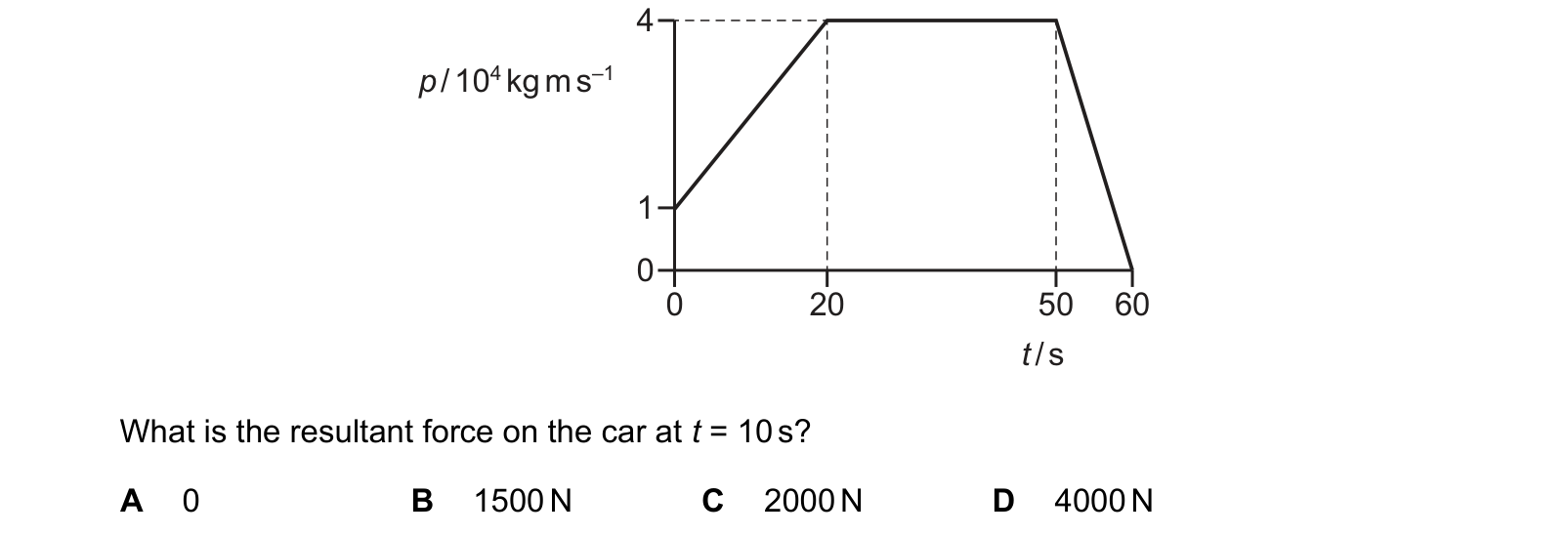
The graph shows the variation of the momentum p with time t for a car. t / s
What is the resultant force on the car at t = 10 s?
Answer: B.
Newton's second law in its general form says force is the rate of change of momentum:
F = Δp / Δt
which is the gradient of a momentum–time graph. So this question asks for nothing more than the slope of the line at t = 10 s, and the only real work is reading the axis scale correctly.
At t = 10 s the car is on the first, sloping section, which runs from t = 0 to t = 20 s. Take the two ends of that straight segment:
- at t = 0, p = 1 × 10⁴ kg m s⁻¹
- at t = 20 s, p = 4 × 10⁴ kg m s⁻¹
The segment is straight, so the gradient at t = 10 s is the gradient of the whole segment. There is no need to draw a tangent.
Why the others are there
C, 2000 N, is 4 × 10⁴ / 20, which reads the rise as the full height of the line rather than the change in it. The car does not start from rest: it already has 1 × 10⁴ kg m s⁻¹ of momentum at t = 0. Momentum–time graphs with a non-zero intercept are set precisely to catch this, and the fix is to always subtract the two readings rather than take the final one.
D, 4000 N, is the magnitude of the gradient of the last section, where the momentum falls from 4 × 10⁴ to zero between 50 s and 60 s. That is a real resultant force on this car, a braking force of 4000 N, but it acts at t = 55 s, not at t = 10 s.
A, zero, is the gradient of the flat section between 20 s and 50 s. Constant momentum means no resultant force, which is Newton's first law on a graph. Again true, and again at the wrong time.
Question 2
The graph shows the variation with time of the speed of a raindrop falling vertically through air. Which statement is correct?

Answer: A.
Two forces act: the constant weight downwards, and air resistance upwards, which grows as the drop speeds up. So:
resultant = weight – air resistance
As the speed rises, air resistance rises, the resultant shrinks, and since a = F/m the acceleration decreases. Eventually air resistance grows to equal the weight, the resultant reaches zero, and the drop continues at a constant terminal velocity. That is exactly the shape of the graph: steep at first, then flattening to a horizontal line.
C has the physics of air resistance backwards. Drag increases with speed, which is the whole reason a terminal velocity exists at all; if it decreased, the drop would accelerate without limit.
B and D describe the opposite trend. The resultant force and the acceleration both fall towards zero, which is why the graph levels off rather than curving ever upwards.
Note that the speed is still increasing throughout the curved part, even though the acceleration is falling. Speed rises whenever the acceleration is positive, however small it becomes, and only stops rising when the acceleration actually reaches zero.
Question 3
Two objects X and Y form an isolated system. X and Y collide and then separate. The mass of X is greater than the mass of Y.
Which statement about the collision is correct?
Answer: C.
That leads directly to A and B being wrong. Equal forces acting for equal times give equal and opposite impulses, so the changes of momentum are equal in magnitude whatever the masses, which is why momentum is conserved.
The masses do make a difference, but to the accelerations: from F = ma, the lighter object Y gets the larger acceleration and the larger change in velocity. Its change in momentum is still the same.
D is simply false. The forces in a collision are contact forces, not gravitational.
What the syllabus asks for on this topicSyllabus points
Syllabus points
- State and apply Newton's three laws of motion.
- Define linear momentum and relate resultant force to rate of change of momentum.
- Describe and use the concept of weight as the effect of a gravitational field on a mass.
- State the principle of conservation of momentum and apply it to collisions in one dimension.
- Distinguish between elastic and inelastic collisions.
Related CIE 9702 Physics topics
Not the topic you were looking for? Describe what you are stuck on in your own words and we will take you to the notes that answer it.