Dynamics: five questions to try now
Real past-paper questions, the answer key from the mark scheme, and the explanation that goes with it. No account needed to answer them.
Question 1
A car accelerates from rest. The graph shows the variation of the momentum of the car with time. What is the meaning of the gradient of the graph at a particular time?

Answer: C.
F = Δp / Δt
so the rate of change of momentum is the resultant force, and the gradient of a momentum–time graph is exactly that rate of change.
D, velocity, is what you would get by dividing momentum by mass, not by taking a gradient. It appears in the graph as the momentum value itself scaled by 1/m, and no gradient is involved.
A, kinetic energy, is not obtainable from a gradient at all. It would come from p²/2m, which uses the momentum value rather than its rate of change.
B, the rate of change of kinetic energy, is the power delivered to the car. That is a real and useful quantity, but it is the gradient of a kinetic energy–time graph, not this one.
The general form F = Δp/Δt is worth preferring to F = ma, because it still holds when the mass changes, as for a rocket burning fuel or a trolley collecting sand. F = ma is the special case where m is constant.
Since the car accelerates from rest with a constant mass, the graph's gradient here also equals ma, but the reasoning above does not depend on that.
Question 2
Two objects move towards each other along the same straight line.
After colliding, the two objects stick together and are stationary.
Which statement must be correct?

Answer: B.
Momentum is conserved in every collision, and after this one the objects are stationary and stuck together, so their total momentum afterwards is zero. It must therefore have been zero beforehand as well.
That is the only thing the question guarantees, and each other option overreaches.
A is definitely false. The objects finish at rest, so all of the kinetic energy has gone, converted into heat, sound and deformation. This is a perfectly inelastic collision, the case in which the greatest possible amount of kinetic energy is lost.
C and D each assume half of what zero momentum requires. The condition is m₁u₁ = m₂u₂, so the products must match, not the masses and not the speeds separately. A 2 kg object at 3 m s⁻¹ meeting a 6 kg object at 1 m s⁻¹ satisfies it perfectly well, and neither the masses nor the speeds are equal.
Only if the masses happened to be equal would the speeds have to be equal too.
Momentum is conserved in all collisions; kinetic energy is conserved only in elastic ones. This one is as far from elastic as a collision can be.
Question 3
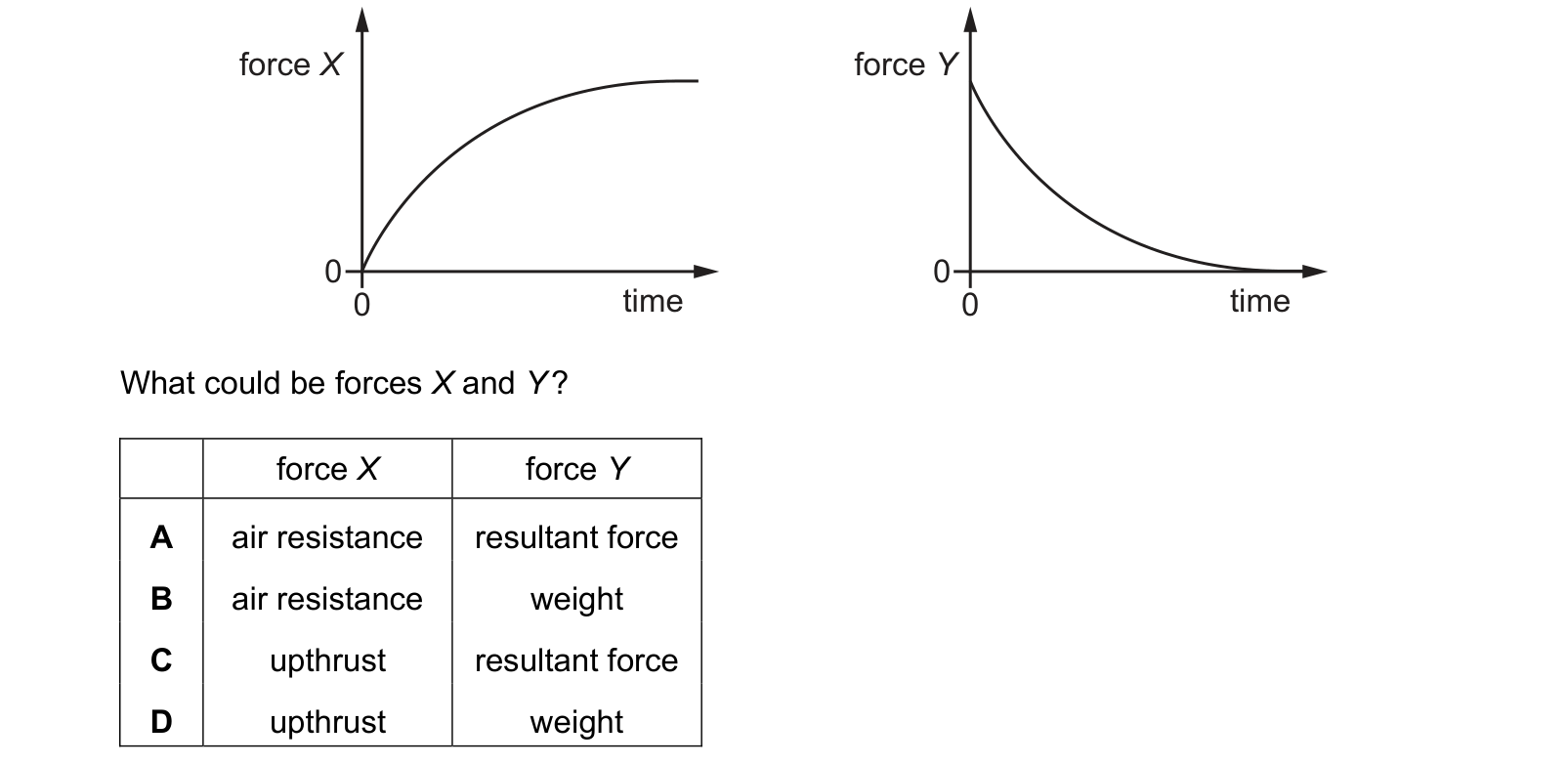
A ball falls from rest through air and eventually reaches a constant velocity.
For this fall, forces X and Y vary with time as shown. What could be forces X and Y ?
Answer: A.
Read the shape of each graph and match it to how the quantity must behave during a fall to terminal velocity.
X starts at zero and rises to a constant value. Air resistance is zero at the instant of release, since the ball is not yet moving, and grows as the ball speeds up. It levels off once the ball reaches terminal velocity and stops accelerating. That is exactly the curve shown.
Y starts at a maximum and falls to zero. The resultant force is the weight minus the air resistance. At the start there is no air resistance, so the resultant equals the full weight; as air resistance grows, the resultant shrinks, reaching zero at terminal velocity, which is what terminal velocity means.
Weight cannot be either graph, since it is constant throughout and would be a horizontal line from the vertical axis. That rules out B and D.
Upthrust from the air is also essentially constant and extremely small, so it cannot be X, which begins at zero and grows appreciably. That rules out C.
The two curves are complements: at every instant X + Y adds up to the same total, the weight.
Question 4
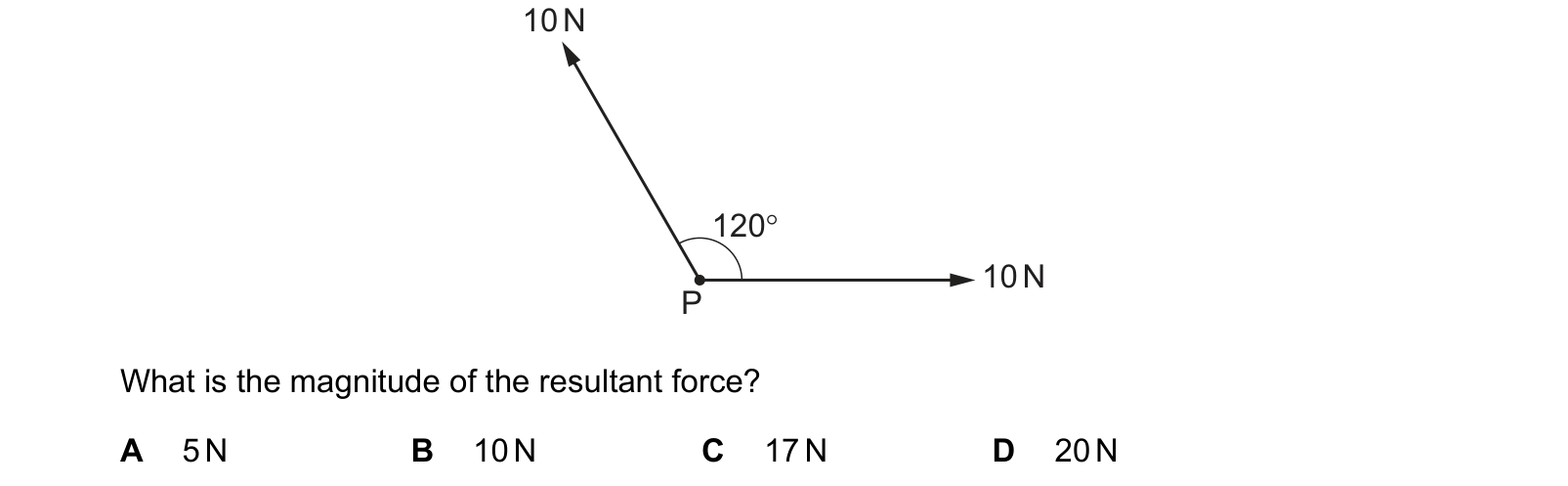
Two forces, each of 10 N, act at a point P, as shown. The angle between the directions of the forces is 120°. What is the magnitude of the resultant force?
Answer: B.
Using the cosine rule for the parallelogram of forces, with the angle between the two forces at 120°:
R² = 10² + 10² + 2(10)(10) cos 120°
R² = 100 + 100 + 200 × (–0.5)
R² = 200 – 100 = 100, so R = 10 N
Or, more quickly, resolve along the line that bisects the angle. Each force makes 60° with that bisector, and by symmetry the components at right angles to it cancel:
R = 2 × 10 cos 60° = 2 × 10 × 0.5 = 10 N
D, 20 N, is the answer for two forces acting in the same direction, at 0°. A, 5 N, would need an angle of about 151°. C, 17 N, is the resultant at 60°, since 2 × 10 cos 30° = 17.3, and it is what you get by using the angle the forces make with each other's line rather than with each other.
The 120° case is worth remembering as a special one: three equal forces at 120° to each other are in equilibrium, precisely because any two of them have a resultant equal and opposite to the third.
Question 5
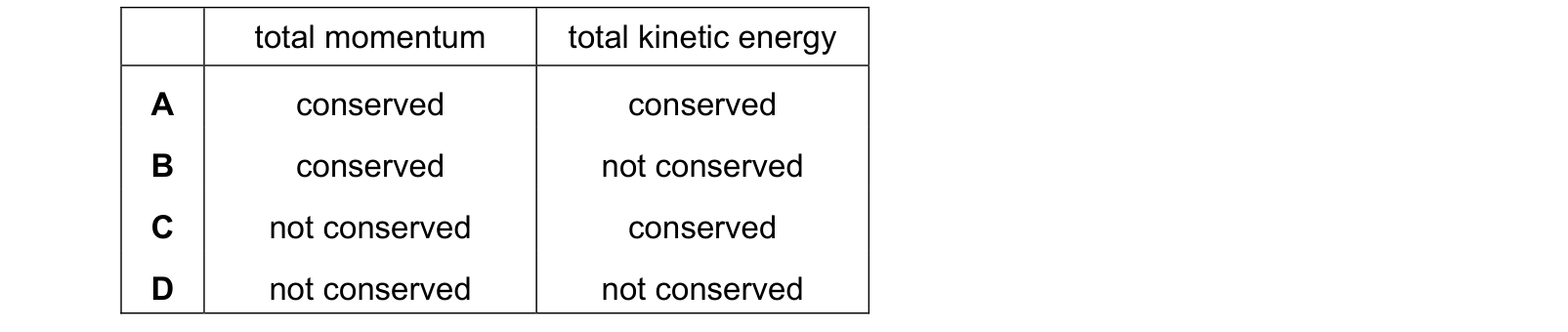
Which row states whether total momentum and total kinetic energy are conserved in an inelastic collision in which there are no external forces? Each answer gives, in order: total momentum; total kinetic energy.
Answer: B.
Kinetic energy is conserved only in an elastic collision. In an inelastic collision some of it becomes internal energy and sound, permanently deforming the bodies or heating them, so the total kinetic energy falls.
The energy is not destroyed. Total energy is always conserved; it is specifically the kinetic share that is reduced.
So conserved and not conserved, which is B.
A describes an elastic collision, where both are conserved. Collisions between gas molecules and between subatomic particles are close to elastic; ordinary collisions between real objects almost never are.
C and D both say momentum is not conserved, which the stem rules out by stating there are no external forces. Momentum can only change if something outside the system pushes on it.
What this practice covers
These questions are drawn from past CIE 9702 Physics papers. You answer, you find out immediately whether you were right, and you get the reasoning for the correct option and for each distractor. Wrong answers go to a mistakes locker so you can come back to exactly those.
Practice is free. You need an account only so your progress and your mistakes are still there next time.
What examiners see students get wrong here
These are the errors that cost marks on dynamics, taken from our own topic notes. Read them before you practise and you will recognise the traps in the questions.
- Naming the weight of a book and the table's normal contact force as a third-law pair.
- Saying the third-law forces cancel out. They act on different bodies.
- Adding magnitudes instead of using signed velocities when a body rebounds.
- Saying momentum is not conserved in an inelastic collision. It always is.
- Treating kinetic energy as conserved when two bodies stick together.
- Confusing mass and weight, particularly in a question about a different planet.
- Using F = ma when the mass is changing; the momentum form is needed.
Revise it first
If any of the above is unfamiliar, work through the notes before practising: Dynamics revision notes.