Forces, density and pressure
Contents: 10 sections
Moments
The moment of a force about a point is the force multiplied by the perpendicular distance from the point to the line of action of the force.
moment = F × d
measured in N m. The word perpendicular carries the marks. If the force is at an angle θ to the rod, the perpendicular distance is d sin θ, so the moment is Fd sin θ. Using the full length of the rod when the force is angled is the most common error in the topic.
Couples and torque
A couple is a pair of equal, antiparallel forces whose lines of action do not coincide. It produces a turning effect with no resultant force, so a body acted on by a couple alone rotates without its centre of mass accelerating.
torque of a couple = one force × perpendicular distance between them
Note "one force", not the sum. A steering wheel turned with 20 N at each side of a 0.30 m diameter has a torque of 20 × 0.30 = 6.0 N m, not 12 N m.
Equilibrium
A body in equilibrium satisfies two conditions, and both are needed:
- The resultant force is zero, so there is no linear acceleration.
- The resultant moment about any point is zero, so there is no angular acceleration.
The second condition holds about any point, which is the key to solving these questions quickly: take moments about a point where an unknown force acts, and that force disappears from the equation.
For three non-parallel coplanar forces in equilibrium, their lines of action must pass through a single point, and their vector triangle must be closed. Questions often show three forces and ask which diagram could be in equilibrium; the closed triangle is what you are looking for.
The principle of moments
For a body in equilibrium, the sum of the clockwise moments about any point equals the sum of the anticlockwise moments about that point.
Worked example. A uniform metre rule of weight 1.2 N is pivoted at the 34.0 cm mark. It balances when a mass is hung at the 10.0 cm mark. What is the mass?
A uniform rule has its weight acting at its centre, the 50.0 cm mark.
The rule's weight acts 50.0 − 34.0 = 16.0 cm from the pivot, clockwise. The mass acts 34.0 − 10.0 = 24.0 cm from the pivot, anticlockwise.
Taking moments: W × 24.0 = 1.2 × 16.0, so W = 0.80 N.
m = 0.80 / 9.81 = 0.082 kg, about 82 g.
The step people miss is the rule's own weight. It only vanishes if the rule is described as having negligible mass, and questions say so explicitly when they mean it.
Centre of gravity
The centre of gravity is the single point at which the whole weight of a body may be taken to act. For a uniform body it is at the geometric centre.
An object topples when a vertical line through its centre of gravity falls outside its base. So a low centre of gravity and a wide base make an object stable, which is the reasoning a question wants rather than the words "it is more stable".
Density
ρ = m / V
measured in kg m⁻³. Water is 1000 kg m⁻³, which is the same as 1.0 g cm⁻³, and converting between the two costs a factor of 1000, not 100.
Pressure
p = F / A
measured in pascals, where 1 Pa = 1 N m⁻². The force must be perpendicular to the area.
Pressure in a fluid acts equally in all directions at a given depth, and depends only on the depth, the density and g — not on the shape or width of the container. Two vessels of very different shape filled to the same depth have the same pressure at the base.
Deriving p = ρgh
Take a column of fluid of cross-sectional area A and height h.
Volume = Ah, so mass = ρAh, so weight = ρAhg.
Pressure at the base = weight / area = ρAhg / A = ρgh.
The area cancels, which is why the pressure does not depend on how wide the column is. Being asked to produce this derivation is common, and the cancellation is the point of it.
Remember that a question about the pressure at the bottom of a lake or a tank usually wants total pressure, so atmospheric pressure must be added to ρgh.
Upthrust and Archimedes' principle
Upthrust is the net upward force a fluid exerts on a body immersed in it. Its origin is that pressure increases with depth, so the pressure on the bottom face is greater than on the top face, and the difference in force is upward.
Archimedes' principle: the upthrust equals the weight of fluid displaced.
U = ρ_fluid × V_displaced × g
Two things follow, and both are examined:
- The upthrust depends on the volume displaced, not on the mass, shape or density of the body. A steel block and a wooden block of the same volume, both fully submerged, experience the same upthrust.
- If the body is fully submerged, rotating it or moving it deeper does not change the upthrust, because the volume displaced is unchanged. Questions that turn a block onto a different face are testing exactly this.
A body floats when the upthrust equals its weight, which means it displaces its own weight of fluid.
Worked example. A block of volume 2.0 × 10⁻³ m³ is fully submerged in water. What is the upthrust?
U = 1000 × 2.0 × 10⁻³ × 9.81 = 19.6 N, whatever the block is made of.
Common mistakes
- Using the distance along the rod rather than the perpendicular distance when the force is angled.
- Doubling the force when finding the torque of a couple.
- Forgetting the weight of a uniform rule, or placing it anywhere but the centre.
- Taking moments about a point and then forgetting that the same point must be used for every term.
- Saying pressure in a liquid depends on the width or shape of the container.
- Omitting atmospheric pressure when the question asks for total pressure.
- Saying a denser body experiences a greater upthrust when both are fully submerged and have the same volume.
- Converting g cm⁻³ to kg m⁻³ with a factor of 100.
Check you have it
Question 1
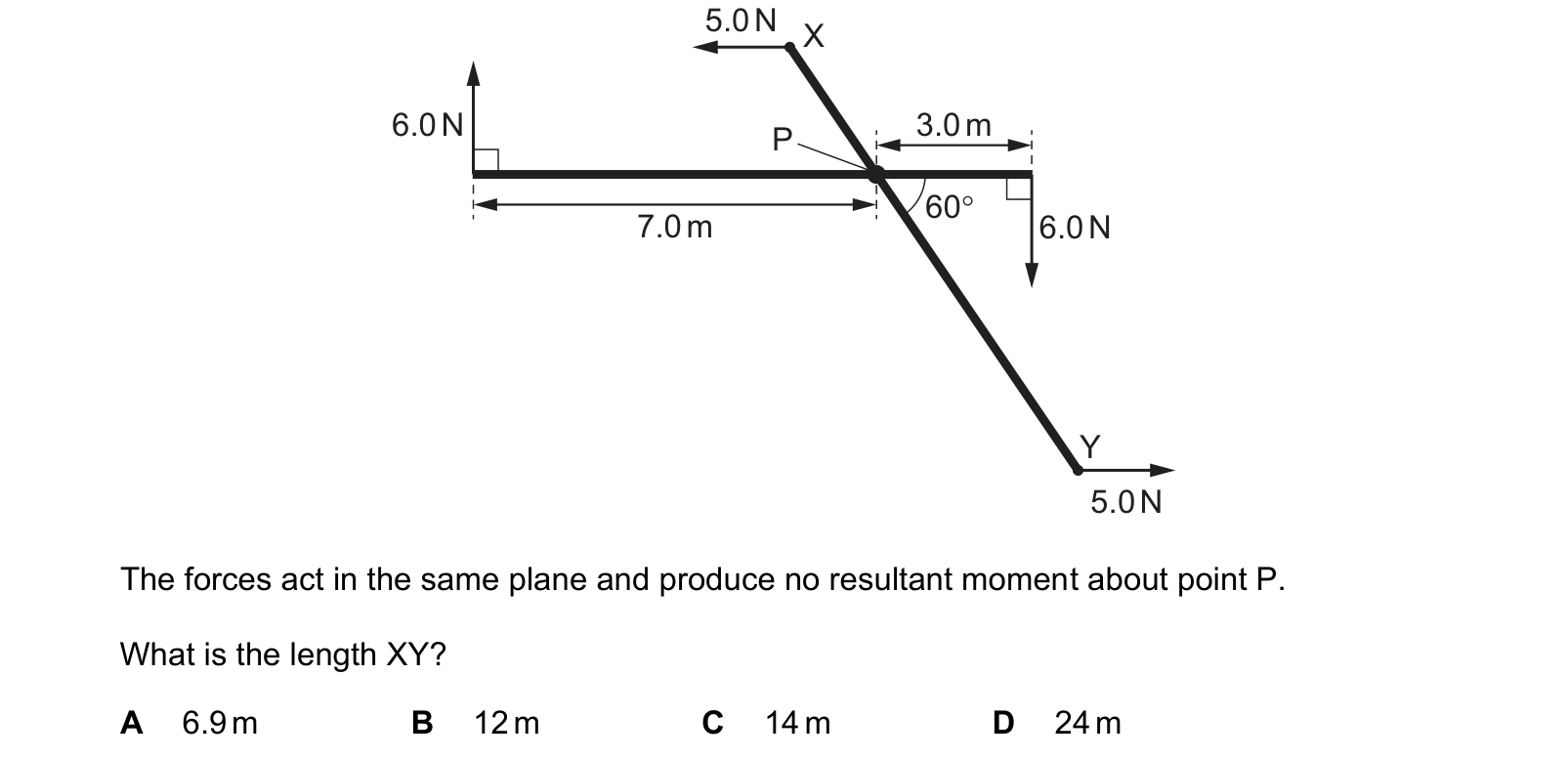
Four forces act about a point P, as shown. The forces act in the same plane and produce no resultant moment about point P.
What is the length XY?
Answer: C.
The 6.0 N couple. The two 6.0 N forces are vertical, one up and one down, acting at points 7.0 m and 3.0 m from P on the horizontal rod. The perpendicular distance between their lines of action is the whole span:
7.0 + 3.0 = 10.0 m
torque = 6.0 × 10.0 = 60 N m
The 5.0 N couple. The two 5.0 N forces are horizontal, one left and one right, acting at X and Y. The perpendicular distance between two horizontal lines of action is the vertical separation of X and Y, and the rod XY lies at 60° to the horizontal:
vertical separation = XY sin 60°
torque = 5.0 × XY sin 60° = 4.33 × XY
Balancing:
4.33 × XY = 60
XY = 14 m
B, 12 m, comes from using XY itself as the perpendicular distance, without resolving for the 60°. D, 24 m, counts only one of the 6.0 N forces against the 10 m span, doubling the required length.
The key step is realising the perpendicular distance for the second couple is not the length of the rod but its vertical projection, because the forces are horizontal.
Question 2
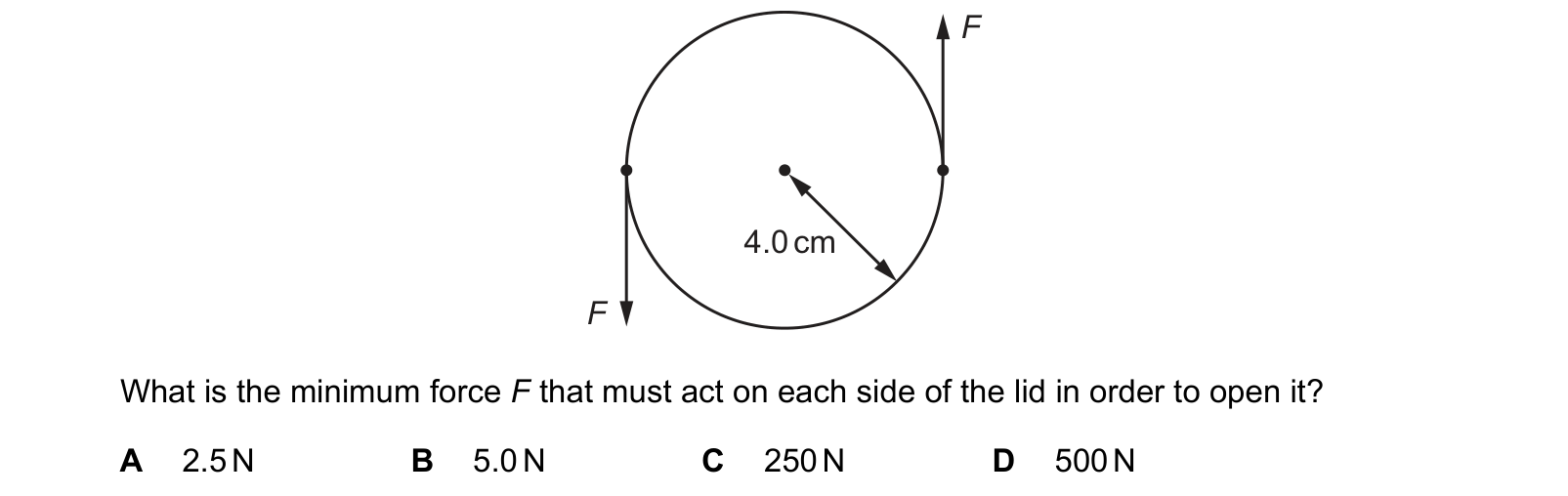
A minimum torque of 20 N m must be applied to the lid of a jar for it to open. The radius of the lid is 4.0 cm. What is the minimum force F that must act on each side of the lid in order to open it?
Answer: C.
The torque of a couple is one force times the perpendicular distance between the two lines of action. The forces act on opposite sides of a lid of radius 4.0 cm, so that distance is the diameter:
d = 2 × 4.0 = 8.0 cm = 0.080 m
torque = F × d
20 = F × 0.080
F = 250 N
Equivalently, take moments about the centre. Each force acts 0.040 m from it and both turn the lid the same way, so they add:
2 × (F × 0.040) = 20, giving the same F = 250 N
D, 500 N, counts only one force against the full diameter. B, 5.0 N, and A, 2.5 N, both have the centimetres left unconverted, which shifts the answer by a factor of a hundred.
The radius given, rather than the diameter, is the small trap. A couple's torque uses the separation of the two forces, and here that is twice the radius.
The force is large because the lever arm is so short, which is exactly why a jar opener with a wide handle works: doubling the effective radius halves the force needed.
Question 3
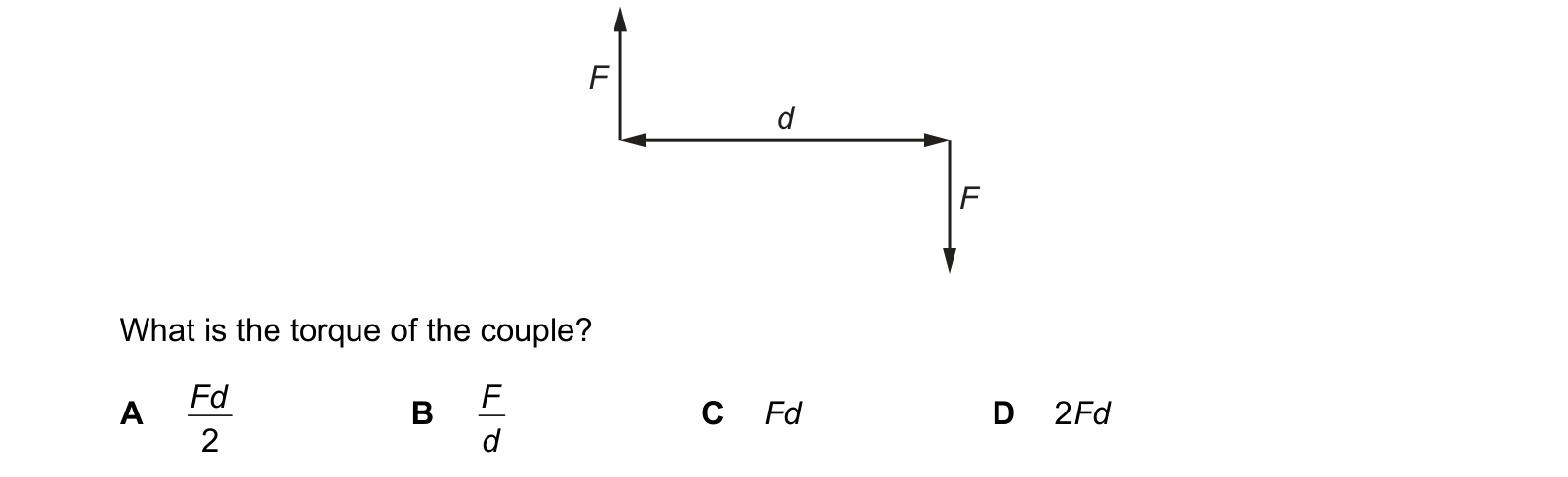
A couple consists of two forces, each of magnitude F, that act in opposite directions in the same plane.
The perpendicular distance between the two forces is d.
F d
F
What is the torque of the couple?
Answer: C.
A couple is a pair of equal, parallel forces acting in opposite directions but not along the same line. Its turning effect is:
torque = one force × perpendicular distance between the two lines of action = Fd
The neat property of a couple is that this torque is the same about every point, not just about the centre. Take moments about any point at all: whatever distance one force gains, the other loses by exactly the same amount, because they are equal and opposite. That is why the answer needs no pivot to be specified.
D, 2Fd, is the commonest error and comes from counting both forces against the full separation d. The distance d is already the separation of the two forces, so multiplying by two counts it twice. It is the same slip in reverse as forgetting the second force when taking moments about the centre, where each contributes F × d/2.
A, Fd/2, comes from using half the separation with only one force.
B, F/d, fails a unit check: newtons per metre is a spring constant, not a torque, which needs N m.
A couple has zero resultant force, which is why it produces pure rotation with no acceleration of the centre of mass.
What the syllabus asks for on this topicSyllabus points
Syllabus points
- Describe the turning effect of a force and define the moment of a force.
- Understand that a couple produces a turning effect with no resultant force, and define torque.
- State and apply the principle of moments and the conditions for equilibrium.
- Define density and pressure, and derive p = ρgh for a fluid column.
- Understand the origin of upthrust and calculate it using Archimedes' principle.
Related CIE 9702 Physics topics
Not the topic you were looking for? Describe what you are stuck on in your own words and we will take you to the notes that answer it.