Waves
Contents: 11 sections
The quantities
- Displacement: the distance of a particle from its equilibrium position, with direction.
- Amplitude: the maximum displacement.
- Wavelength λ: the distance between two adjacent points in phase.
- Period T: the time for one complete oscillation.
- Frequency f: oscillations per second, in hertz, and f = 1/T.
- Wave speed v: the distance a wavefront travels per unit time.
A wave transfers energy from one place to another without transferring matter. Each particle oscillates about a fixed position; nothing travels along with the wave except energy.
The wave equation
v = fλ
Deriving it. In one period the wave moves one wavelength, so v = λ/T, and since f = 1/T, v = fλ.
The consequence examined most often: when a wave passes from one medium to another its frequency is unchanged, because the source sets it. So if the speed changes, the wavelength must change in proportion. Light entering glass slows down and its wavelength shortens; the colour, which depends on frequency, is unchanged.
Two kinds of graph
This is the distinction that separates candidates, and both graphs look like a sine curve.
- A displacement-distance graph shows the wave frozen at one instant. Reading off the horizontal axis gives the wavelength.
- A displacement-time graph shows one particle over time. Reading off the horizontal axis gives the period.
Always read the axis label before answering. A question showing a displacement-distance graph and asking for the frequency needs the wavelength from the graph and the speed from the text.
Transverse and longitudinal
| Transverse | Longitudinal | |
|---|---|---|
| Oscillation direction | Perpendicular to travel | Parallel to travel |
| Structure | Crests and troughs | Compressions and rarefactions |
| Examples | All electromagnetic waves, water waves, waves on a string | Sound |
| Can be polarised? | Yes | No |
Sound cannot be polarised, and that single fact is the standard evidence that sound is longitudinal.
Phase difference
Two points on a wave are in phase if they are a whole number of wavelengths apart, and antiphase if they differ by an odd number of half wavelengths.
Phase difference in degrees = (path difference / λ) × 360°, or in radians × 2π. A path difference of λ/4 is a phase difference of 90°, or π/2 rad.
Intensity
Intensity is the power per unit area, in W m⁻².
I = P / A
Two proportionalities carry most of the marks:
- I ∝ A² where A is the amplitude. So halving the intensity divides the amplitude by √2, not by 2. Questions that halve the intensity and ask for the new graph are testing exactly this.
- For a point source radiating in all directions, I ∝ 1/r², because the power spreads over a sphere of area 4πr².
The Doppler effect
When a source of sound moves relative to an observer, the observed frequency changes:
f_o = f_s v / (v ± v_s)
with the minus sign when the source approaches, giving a smaller denominator and so a higher observed frequency, and the plus sign when it recedes.
Getting the sign right is easier from the physics than from the formula: an approaching source crowds the wavefronts together, so the wavelength is shorter and the pitch is higher. The moment of the largest change is as the source passes, and the observed frequency drops from above f_s to below it.
The speed of the wave itself is unchanged; it is set by the medium, not by the source.
Worked example. A train sounds a 400 Hz horn while approaching at 30 m s⁻¹. Take the speed of sound as 340 m s⁻¹.
f_o = 400 × 340 / (340 − 30) = 136000 / 310 = 439 Hz.
The electromagnetic spectrum
In order of increasing wavelength, so decreasing frequency:
gamma → X-rays → ultraviolet → visible → infrared → microwaves → radio
Approximate wavelengths worth carrying: gamma below 10⁻¹² m, X-rays 10⁻¹² to 10⁻⁹ m, ultraviolet 10⁻⁹ to 4 × 10⁻⁷ m, visible 4 × 10⁻⁷ to 7 × 10⁻⁷ m, infrared to 10⁻³ m, microwaves to 10⁻¹ m, radio above that.
All electromagnetic waves are transverse, travel at 3.0 × 10⁸ m s⁻¹ in a vacuum, and can be polarised. The visible range is the one to memorise precisely, because questions ask which region a given wavelength falls in and the boundaries either side are what decide the answer.
Visible light runs from violet at the short-wavelength end to red at the long, so red light has the lower frequency.
Polarisation
A wave is plane polarised when its oscillations are confined to a single plane. Only transverse waves can be polarised.
Unpolarised light passed through a polarising filter emerges plane polarised with half its original intensity, because the filter transmits the component in one plane only and unpolarised light has all planes equally represented.
Malus's law: for light that is already polarised, passing through a filter at angle θ to its plane gives
I = I₀ cos²θ
So at θ = 0 all the light passes, at 45° half passes, and at 90° none passes. Two filters at right angles, called crossed polarisers, block the light entirely.
The square is essential: at 60°, cos 60° = 0.5, so the transmitted intensity is 0.25 I₀, not 0.5 I₀.
Common mistakes
- Reading a wavelength off a displacement-time graph, or a period off a displacement-distance graph.
- Saying the frequency changes when a wave enters a new medium.
- Halving the amplitude when the intensity is halved.
- Saying sound can be polarised.
- Getting the Doppler sign the wrong way round, so an approaching source lowers the pitch.
- Putting ultraviolet on the long-wavelength side of visible light.
- Forgetting the square in Malus's law.
- Saying a polarising filter transmits all of an unpolarised beam.
Check you have it
Question 1
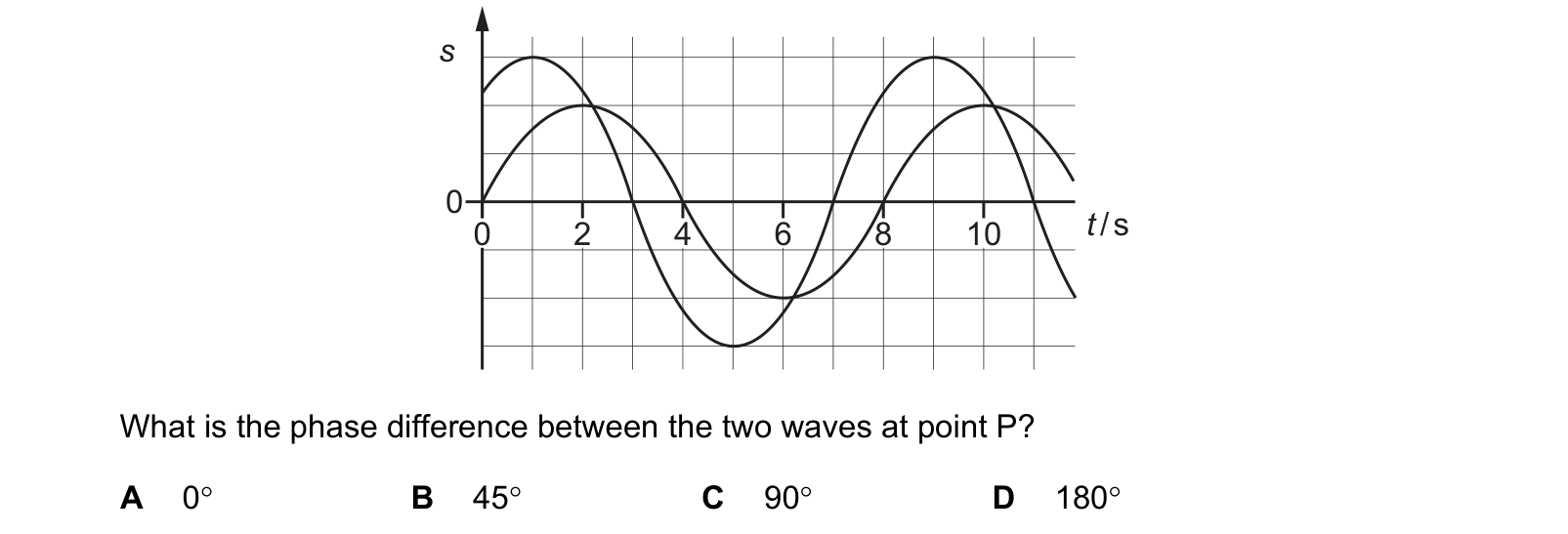
Two waves pass through a point P. The graph shows the variation with time t of the displacement s of the two waves at point P. What is the phase difference between the two waves at point P?
Answer: B.
Both waves have the same period. Reading the larger wave, it peaks at t = 1 s and again at t = 9 s, so:
T = 8 s
The two waves are the same shape but shifted along the time axis. The larger peaks at t = 1 s and the smaller at t = 2 s, so the shift between them is:
Δt = 1 s
Phase difference is that shift expressed as a fraction of a whole cycle, and one cycle is 360°:
phase difference = (1/8) × 360° = 45°
A, 0°, would need the two curves to peak at the same instant.
D, 180°, would put one wave's crest exactly where the other's trough is, so they would be complete mirror images about the axis. Here the two crests are only 1 s apart out of 8, nothing like half a cycle.
C, 90°, would need a shift of 2 s, a quarter of the period.
The amplitudes differ, but amplitude has nothing to do with phase. Only the horizontal offset matters, and the safest way to measure it is between two corresponding features, crest to crest or zero-crossing to zero-crossing in the same direction.
Question 2
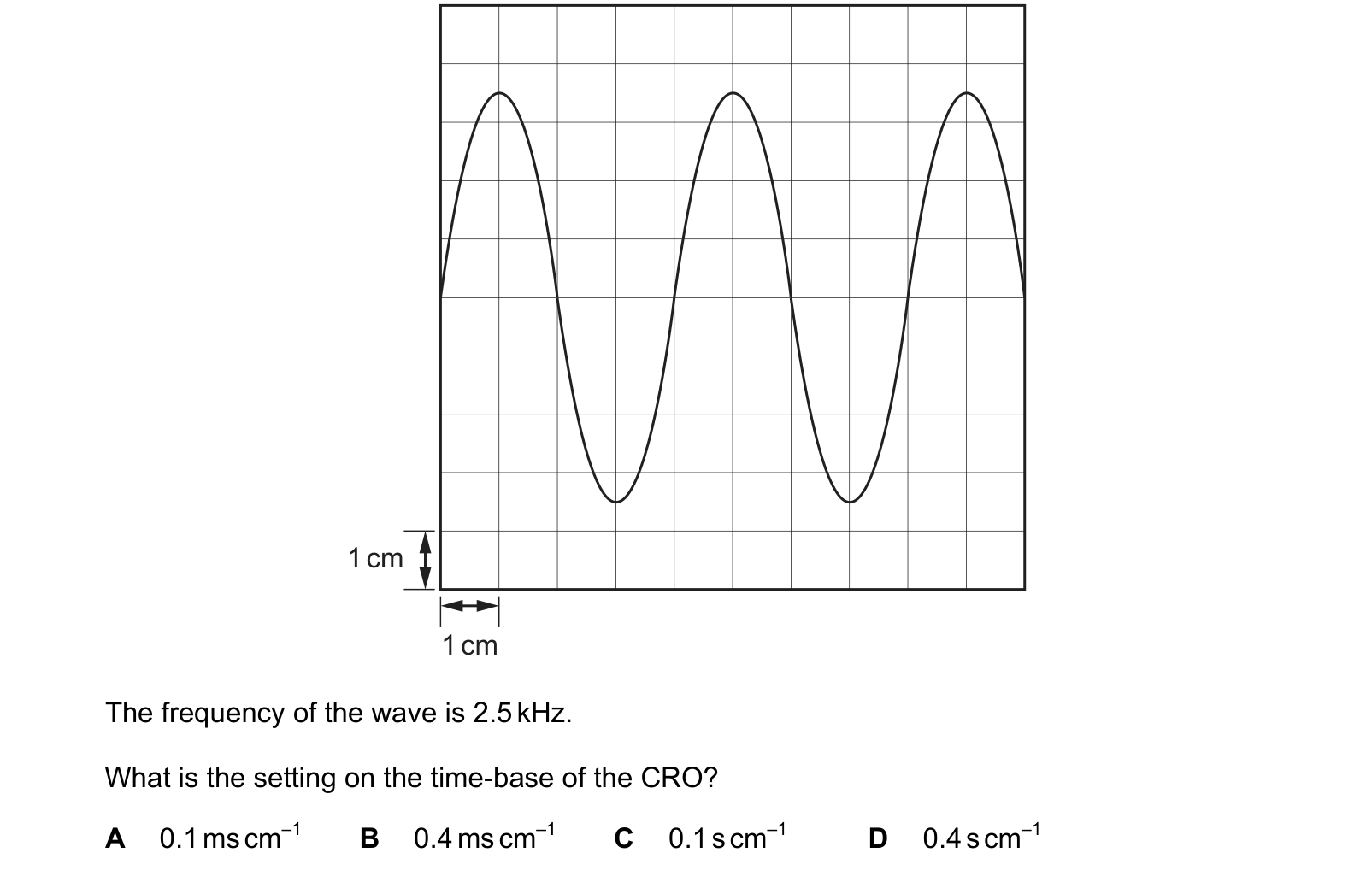
A sound wave is detected by a microphone and displayed on the screen of a cathode-ray oscilloscope (CRO). The frequency of the wave is 2.5 kHz.
What is the setting on the time-base of the CRO?
Answer: A.
The period.
T = 1/f = 1 / 2500 = 4.0 × 10⁻⁴ s = 0.4 ms
The width of one cycle. Reading peak to peak on the grid, each complete cycle occupies 4.0 cm, and the trace shows three cycles across the screen.
The setting.
time-base = 0.4 ms / 4.0 cm = 0.1 ms cm⁻¹
B, 0.4 ms cm⁻¹, is the period itself, which would be the setting only if one whole cycle fitted into a single centimetre. Reading the grid is what separates A from B, and skipping that step is the intended error.
C and D offer the same two numbers in seconds, a thousand times too slow. A quick sanity check kills both: at 0.1 s cm⁻¹ the screen would span about a second, and a 2.5 kHz wave would put 2500 cycles across it, far too many to draw.
Convert the frequency to a period first and keep the units explicit. Reading cm per cycle and then dividing the other way round is the other common slip, and it gives 10 cm ms⁻¹, which is not even one of the options.
Question 3
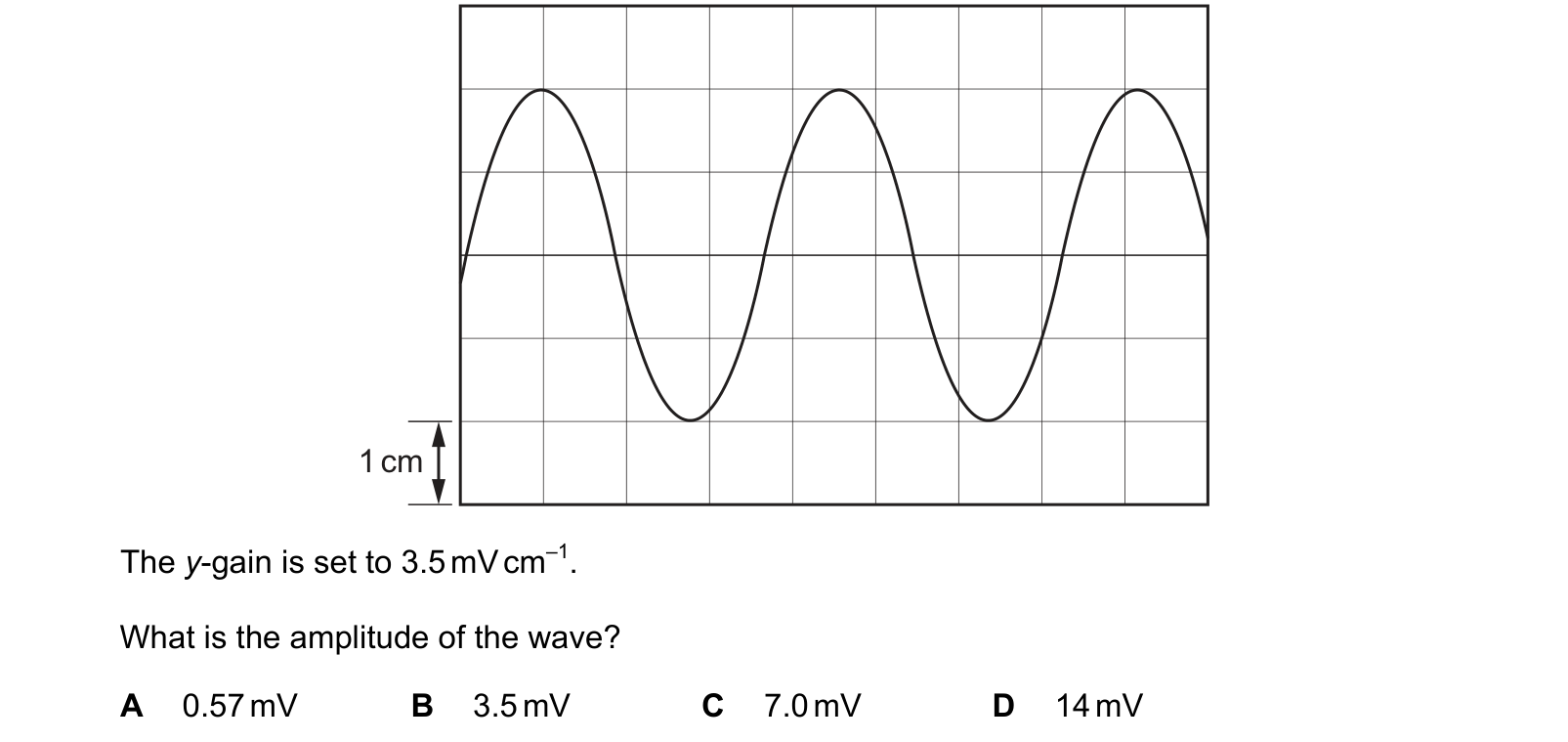
The diagram shows a representation of a wave on the screen of an oscilloscope. The y-gain is set to 3.5 mV cm⁻¹. What is the amplitude of the wave?
Answer: C.
Reading the grid, the trace runs from 2 cm above the centre line to 2 cm below it, so the peak-to-peak height is 4 cm and the amplitude is 2.0 cm.
Converting with the y-gain:
amplitude = 2.0 × 3.5 = 7.0 mV
D, 14 mV, uses the full peak-to-peak height of 4 cm. That is the commonest error on any oscilloscope question, and it is exactly twice the right answer.
B, 3.5 mV, reads the amplitude as a single centimetre.
A, 0.57 mV, divides by the y-gain instead of multiplying. The units settle that one: the gain is in millivolts per centimetre, so centimetres must be multiplied by it to give millivolts.
Amplitude is always the maximum displacement from the equilibrium position, which on a CRO is the horizontal line the trace is centred on. The same rule applies to a displacement–time graph of any wave, and it is the reason a trace filling the screen has an amplitude of only half the screen height.
What the syllabus asks for on this topicSyllabus points
Syllabus points
- Describe what is meant by wave motion, and define displacement, amplitude, period, frequency, wavelength and speed.
- Derive and use v = fλ.
- Distinguish between transverse and longitudinal waves.
- Understand that the intensity of a wave is proportional to the square of the amplitude.
- Describe the Doppler effect for a moving source of sound and use the equation for observed frequency.
- Recall the order of the electromagnetic spectrum and state that all its waves travel at the same speed in a vacuum.
- Understand polarisation and use Malus's law.
Related CIE 9702 Physics topics
Not the topic you were looking for? Describe what you are stuck on in your own words and we will take you to the notes that answer it.