Waves: five questions to try now
Real past-paper questions, the answer key from the mark scheme, and the explanation that goes with it. No account needed to answer them.
Question 1
The period of an electromagnetic wave in a vacuum is 1.0 ns. What are the frequency and wavelength of the wave? Each answer gives, in order: frequency / Hz; wavelength / m.
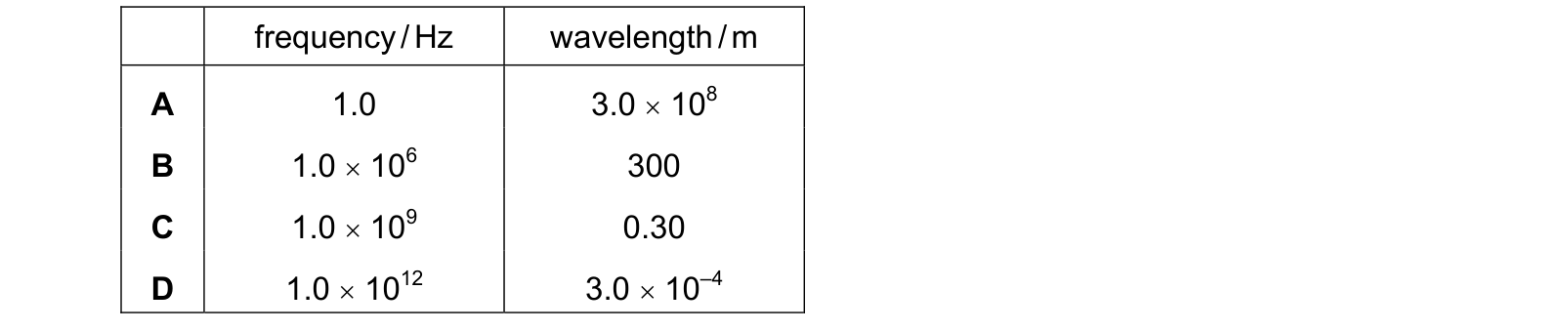
Answer: C.
1.0 ns = 1.0 × 10⁻⁹ s, so
f = 1 / T = 1 / (1.0 × 10⁻⁹) = 1.0 × 10⁹ Hz
That removes A, B and D, each of which has the frequency wrong by orders of magnitude.
Then the wavelength, using c = fλ in a vacuum:
λ = c / f = 3.0 × 10⁸ / 1.0 × 10⁹ = 0.30 m
So C.
A frequency of 10⁹ Hz is one gigahertz, and a wavelength of 0.30 m places the wave at the boundary between microwaves and radio waves, which is where mobile phone signals sit. That is a reasonable sanity check on both figures at once.
The useful reciprocal pair to remember is that 1 GHz corresponds to a period of 1 ns, which makes the first step immediate, and that c is 3 × 10⁸, so a gigahertz wave has a wavelength of about 30 cm.
Question 2
An electromagnetic wave is travelling through a vacuum. What could be the wavelength and period of the electromagnetic wave? Each answer gives, in order: wavelength; period.
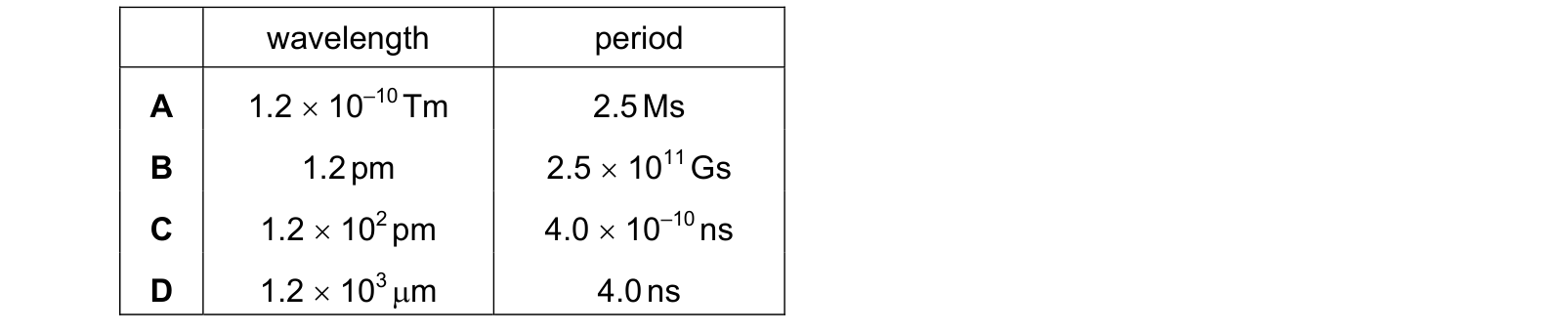
Answer: C.
A: 1.2 × 10⁻¹⁰ Tm is 1.2 × 10⁻¹⁰ × 10¹² = 1.2 × 10² m, and 2.5 Ms is 2.5 × 10⁶ s. The ratio is 4.8 × 10⁻⁵ ✗
B: 1.2 pm is 1.2 × 10⁻¹² m, and 2.5 × 10¹¹ Gs is 2.5 × 10¹¹ × 10⁹ = 2.5 × 10²⁰ s. Nowhere near ✗
C: 1.2 × 10² pm is 1.2 × 10² × 10⁻¹² = 1.2 × 10⁻¹⁰ m, and 4.0 × 10⁻¹⁰ ns is 4.0 × 10⁻¹⁰ × 10⁻⁹ = 4.0 × 10⁻¹⁹ s. The ratio is 3.0 × 10⁸ ✓
D: 1.2 × 10³ µm is 1.2 × 10⁻³ m, and 4.0 ns is 4.0 × 10⁻⁹ s, giving 3.0 × 10⁵ ✗
So C.
The question is entirely about prefixes, and it uses awkward ones deliberately: tera 10¹², giga 10⁹, mega 10⁶, micro 10⁻⁶, nano 10⁻⁹ and pico 10⁻¹². Writing each quantity in plain powers of ten before dividing is the only safe method.
A wavelength of 1.2 × 10⁻¹⁰ m is an X-ray, which is a sensible thing to be asked about.
Question 3
Which row is correct for both progressive transverse waves and progressive longitudinal waves? Each answer gives, in order: transverse waves; longitudinal waves.
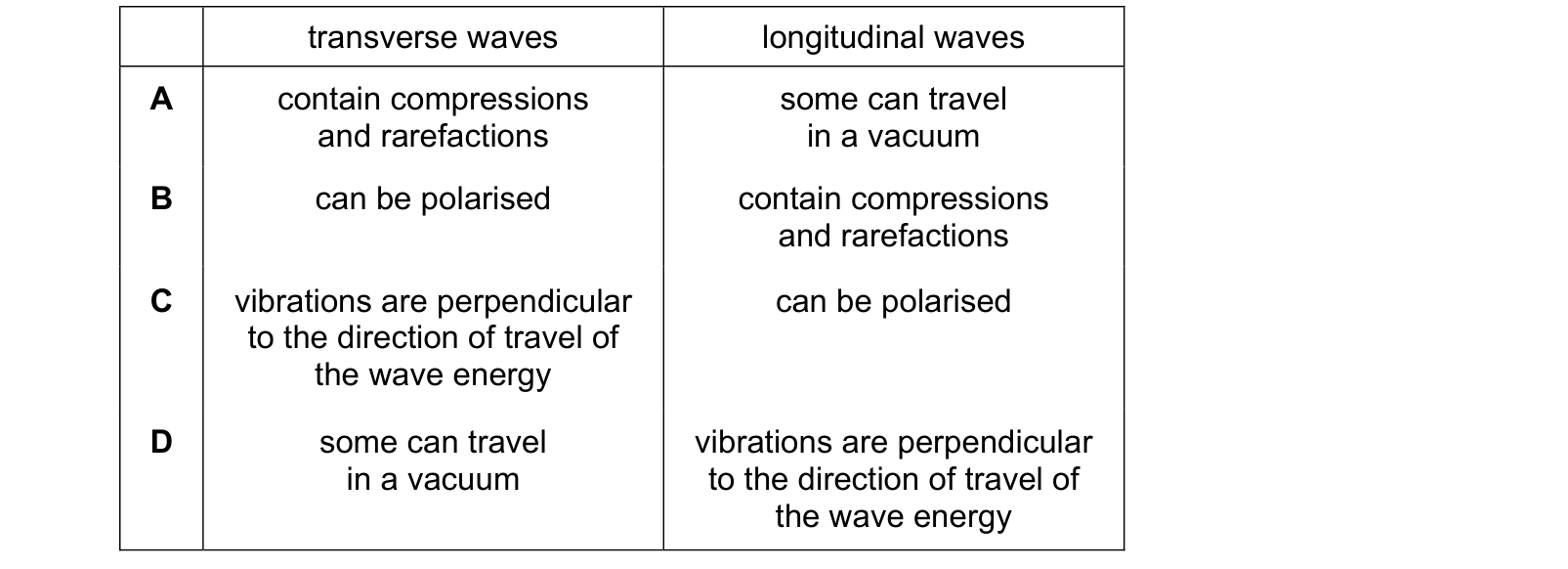
Answer: B.
B is correct. Transverse waves can be polarised, because their oscillations are perpendicular to the direction of travel and so a plane can be selected. Longitudinal waves contain compressions and rarefactions, which is exactly what their oscillation along the direction of travel produces.
A has both halves wrong for their wave. Compressions and rarefactions belong to longitudinal waves, and the ability to travel in a vacuum belongs to electromagnetic waves, which are transverse.
C gets the transverse half right and then claims longitudinal waves can be polarised, which they cannot. This is the only property that distinguishes the two types.
D gets the transverse half right in a different way, since some transverse waves are electromagnetic and do cross a vacuum, and then gives longitudinal waves perpendicular vibrations, which is the definition of transverse.
Two properties therefore do the work: polarisation is transverse only, and compressions and rarefactions are longitudinal only. Everything else, including diffraction, reflection and forming stationary waves, is common to both.
Question 4
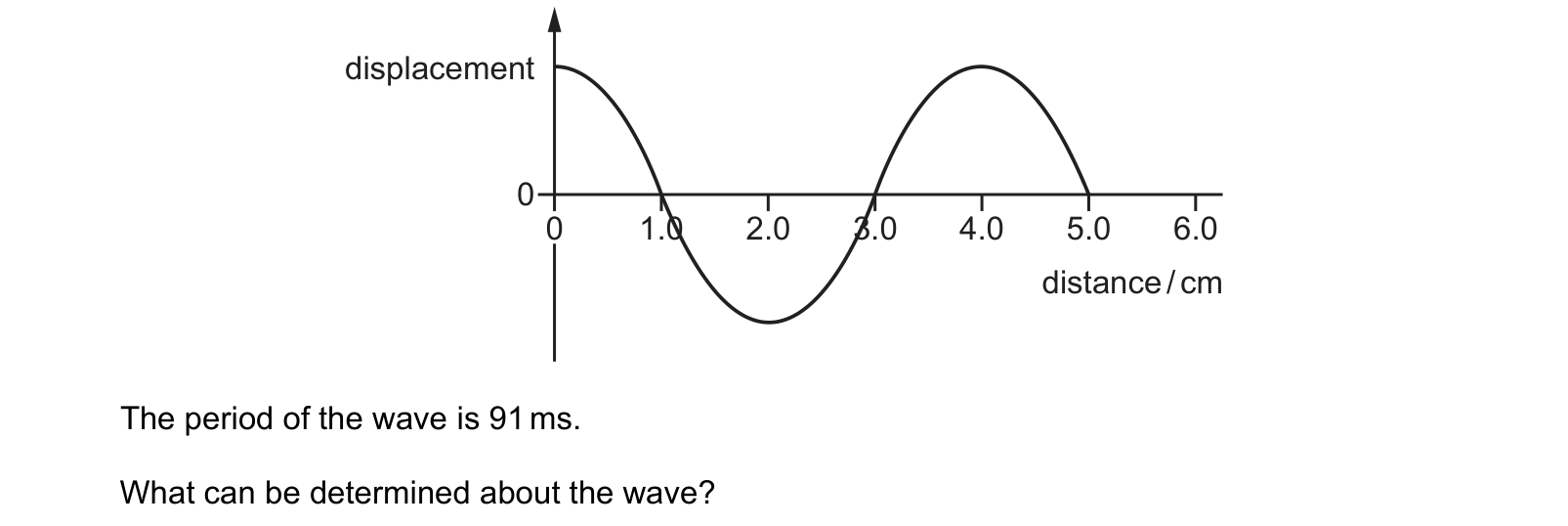
The graph shows the variation of the displacement with distance for a progressive wave at one instant in time. The period of the wave is 91 ms.
What can be determined about the wave?
Answer: A.
The wavelength comes from the graph, which plots displacement against distance. One complete cycle runs from the crest at 0 to the next crest at 4.0 cm:
λ = 0.040 m
The frequency comes from the period given in the stem:
f = 1/T = 1/(91 × 10⁻³) = 11 Hz
The speed:
v = fλ = 11 × 0.040 = 0.44 m s⁻¹
C and D are the interesting wrong answers, because each contains a true statement paired with an unsupportable one. D's wavelength of 4.0 cm is correct, and C's frequency of 11 Hz is correct. What neither can be justified is the claim about the type of wave.
A displacement–distance graph looks exactly the same for a transverse wave and a longitudinal one. For a transverse wave the displacement is at right angles to the direction of travel; for a longitudinal one it is along it. Either way the graph is the same sine curve, and nothing in it distinguishes them.
B simply misreads the wavelength as 5.0 cm, taking the distance to the next zero crossing rather than to the next crest.
Question 5
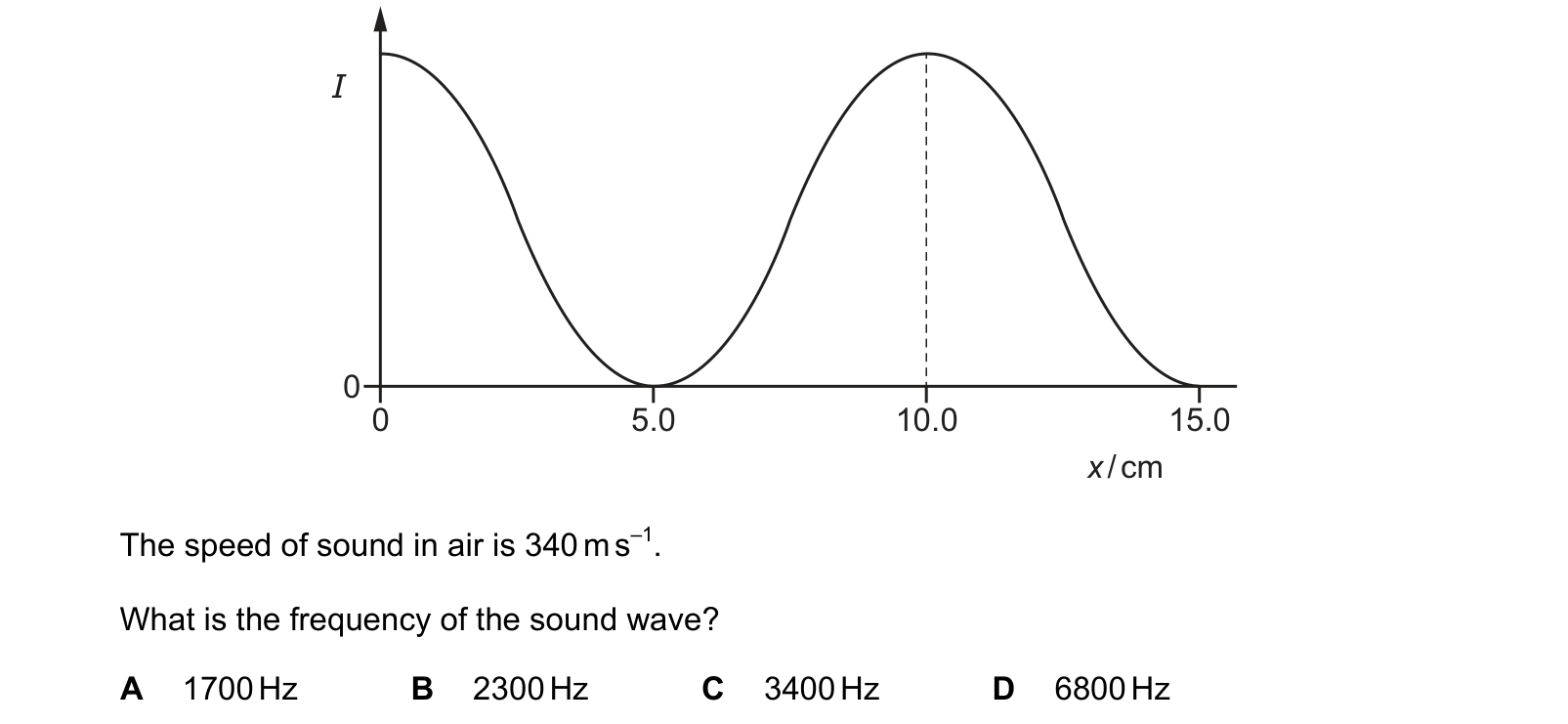
The variation with distance x of the intensity I along a stationary sound wave in air is shown. x / cm
The speed of sound in air is 340 m s⁻¹. What is the frequency of the sound wave?
Answer: A.
Reading the graph, the maxima sit at x = 0 and x = 10.0 cm, with the minima, the nodes, at 5.0 and 15.0 cm. So:
λ/2 = 10.0 cm, giving λ = 20.0 cm = 0.200 m
f = v/λ = 340 / 0.200 = 1700 Hz
C, 3400 Hz, takes the 10.0 cm between maxima as a whole wavelength. That halving is the whole question, and it catches people because an intensity graph genuinely does repeat every 10 cm: intensity is proportional to the square of amplitude, so it is always positive and shows a peak at every antinode whether the displacement there is up or down.
A displacement graph of the same wave would show alternate loops on opposite sides of the axis and would repeat only every 20 cm.
D, 6800 Hz, halves it once more.
The nodes at 5.0 and 15.0 cm are also 10.0 cm apart, which gives the same result: node-to-node and antinode-to-antinode are both λ/2, while node-to-antinode is λ/4.
What this practice covers
These questions are drawn from past CIE 9702 Physics papers. You answer, you find out immediately whether you were right, and you get the reasoning for the correct option and for each distractor. Wrong answers go to a mistakes locker so you can come back to exactly those.
Practice is free. You need an account only so your progress and your mistakes are still there next time.
What examiners see students get wrong here
These are the errors that cost marks on waves, taken from our own topic notes. Read them before you practise and you will recognise the traps in the questions.
- Reading a wavelength off a displacement-time graph, or a period off a displacement-distance graph.
- Saying the frequency changes when a wave enters a new medium.
- Halving the amplitude when the intensity is halved.
- Saying sound can be polarised.
- Getting the Doppler sign the wrong way round, so an approaching source lowers the pitch.
- Putting ultraviolet on the long-wavelength side of visible light.
- Forgetting the square in Malus's law.
- Saying a polarising filter transmits all of an unpolarised beam.
Revise it first
If any of the above is unfamiliar, work through the notes before practising: Waves revision notes.