Superposition
Contents: 7 sections
The principle of superposition
When two or more waves meet at a point, the resultant displacement is the vector sum of the individual displacements.
Everything in this chapter is that one sentence applied to different situations. Note that it is displacements that add, not intensities or amplitudes, and that displacement has a sign, so waves can cancel.
Stationary waves
A stationary wave forms when two waves of the same frequency and amplitude travel in opposite directions and superpose. In practice this is a wave and its own reflection.
- Nodes are points of permanently zero displacement, where the two waves always arrive in antiphase.
- Antinodes are points of maximum displacement, where they always arrive in phase.
The distance between adjacent nodes is λ/2, so the wavelength is twice the node spacing. Reading the node spacing as the wavelength halves every answer that follows, and it is the most common error in the topic.
Stationary against progressive
| Progressive | Stationary | |
|---|---|---|
| Energy | Transferred along the wave | Stored, not transferred |
| Amplitude | Same for all particles | Varies from zero at a node to a maximum at an antinode |
| Phase | Changes continuously along the wave | Particles between two nodes are all in phase; particles either side of a node are in antiphase |
| Waveform | Moves along | Does not move |
The phase row is worth learning as written. Between two nodes every particle reaches its maximum at the same instant, so they are in phase despite having different amplitudes, and everything on the far side of a node is exactly half a cycle behind.
Harmonics on a string
A string fixed at both ends has a node at each end.
- Fundamental (first harmonic): one antinode, length L = λ/2, so λ = 2L.
- Second harmonic: two antinodes, L = λ, so λ = L.
- nth harmonic: λ = 2L/n, and f_n = n f₁.
For a pipe closed at one end, there is a node at the closed end and an antinode at the open end, so the fundamental has L = λ/4 and only odd harmonics exist.
Diffraction
Diffraction is the spreading of a wave as it passes through a gap or around an obstacle.
The amount of spreading depends on the ratio of the wavelength to the gap width. The spreading is greatest when the gap is comparable to the wavelength. A gap much wider than the wavelength produces almost no spreading.
This is why sound diffracts around a doorway but light does not: the doorway is comparable to the metre-scale wavelength of sound and enormous compared with the 10⁻⁷ m wavelength of light.
Diffraction changes neither the wavelength nor the frequency nor the speed. Only the direction of travel and the amplitude change.
Two-source interference
For a stable interference pattern the sources must be coherent: they must have a constant phase difference, which requires the same frequency. In practice this is achieved by using a single source and splitting it, which is what the double slit does.
Similar amplitudes are needed for good contrast, so that the destructive minima are close to zero.
The conditions at a point:
- Constructive interference where the path difference is a whole number of wavelengths, nλ.
- Destructive interference where it is an odd number of half wavelengths, (n + ½)λ.
The double slit
λ = ax / D
where a is the slit separation, x is the fringe spacing, and D is the slit-to-screen distance.
Read the symbols carefully: a is the separation of the slits and x is the separation of the fringes, and swapping them is a common slip because both are called "the spacing" in conversation.
Rearranged as x = λD / a, the equation says what happens when something is changed:
- Longer wavelength, so red rather than blue: wider fringes.
- Slits moved further apart, larger a: narrower fringes.
- Screen moved further away, larger D: wider fringes.
Worked example. Light of wavelength 600 nm falls on slits 0.50 mm apart. The screen is 2.0 m away. What is the fringe spacing?
x = λD / a = (600 × 10⁻⁹ × 2.0) / (0.50 × 10⁻³) = 2.4 × 10⁻³ m, or 2.4 mm.
The diffraction grating
d sin θ = nλ
where d is the grating spacing, the distance between adjacent lines, and n is the order.
If a grating is quoted as having N lines per metre, then d = 1/N. For 500 lines per mm, d = 1 / (500 × 10³) = 2.0 × 10⁻⁶ m. Missing the conversion from lines per millimetre to lines per metre is the standard error.
Because sin θ can never exceed 1, the maximum order visible is the largest integer n for which nλ/d ≤ 1. Questions ask how many orders are seen, and the answer is 2n + 1 counting both sides and the central maximum.
A grating gives sharper and brighter maxima than a double slit, because many slits contribute, which is why it is used for measuring wavelengths.
With white light the central maximum is white, because all wavelengths have zero path difference there. Every other order is spread into a spectrum, with red deviated most because it has the longest wavelength. That is the opposite of a prism, where red is deviated least, and the pair is worth remembering together.
Common mistakes
- Taking the node spacing as the wavelength rather than as half of it.
- Saying particles between adjacent nodes are out of phase because their amplitudes differ.
- Saying diffraction changes the wavelength.
- Defining coherent as "in phase" rather than "constant phase difference".
- Swapping a and x in λ = ax/D.
- Forgetting that d = 1/N for a grating, or leaving N in lines per millimetre.
- Saying the central maximum of a grating with white light is a spectrum.
- Saying red is deviated least by a grating, which is true of a prism instead.
Check you have it
Question 1
A stationary wave on a stretched string is set up between two points P and T. Which statement about the stationary wave is correct?

Answer: B.
The string shows three loops: an antinode at Q, one at R and one at S, with nodes between them and at each end.
Within one loop every point moves in step, reaching its maximum displacement at the same instant. Between adjacent loops the motion is exactly out of phase: when one loop is up, its neighbour is down. Q and S are separated by two loops, so they are back in step, and they vibrate in phase.
A is wrong because R is drawn at a trough, which is an antinode, the point of largest amplitude. The nodes are the stationary points between the loops.
C confuses loops with wavelengths. Each loop is half a wavelength, so three loops make 1.5 wavelengths, not three.
D states the thing that most distinguishes a stationary wave from a progressive one. A stationary wave transfers no net energy along the string: it is formed by two waves of equal amplitude travelling in opposite directions, and their energy transfers cancel. The energy stays put, sloshing between kinetic and potential within each loop.
The phase rule is worth memorising as a pair: same loop means in phase, adjacent loops means antiphase, and beyond that just count loops between them.
Question 2
In an experiment, water waves in a ripple tank are incident on a gap, as shown.
Some diffraction of the water waves is observed.
Which change to the experiment would provide a better demonstration of diffraction?
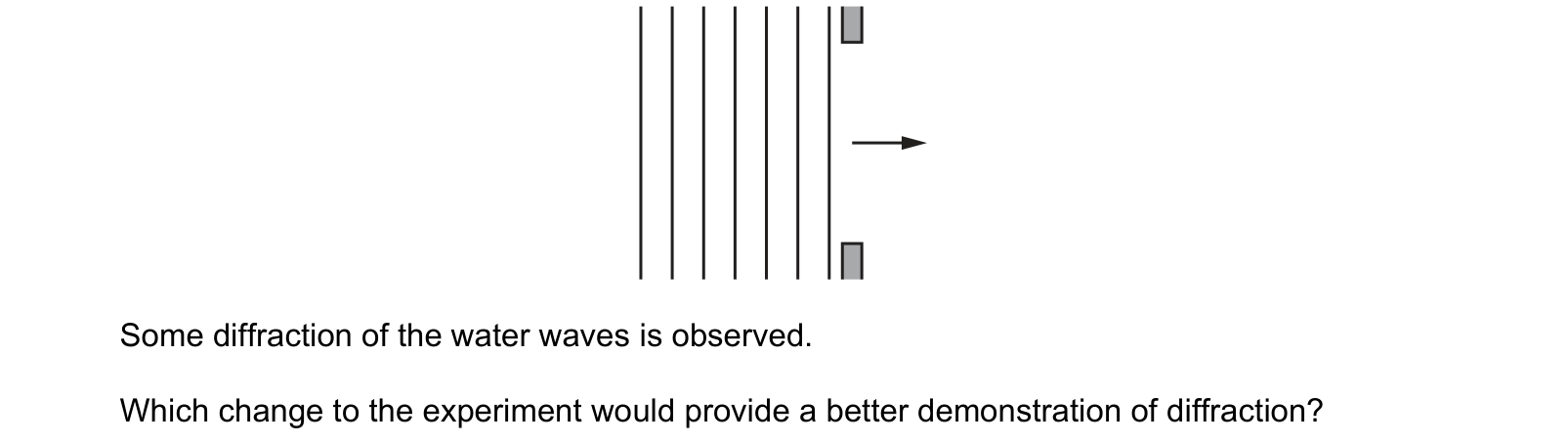
Answer: C.
The amount of diffraction depends on the ratio of wavelength to gap width. Making that ratio larger makes the spreading more obvious, and with the gap fixed the only way is a longer wavelength.
B does the opposite. Raising the frequency shortens the wavelength, since the speed of ripples on the water is set by the water itself and does not change:
v = fλ, so f up means λ down
The waves would then pass through more like a straight beam, with less spreading.
D also works against the effect, by increasing the denominator of the ratio. Narrowing the gap would help; widening it does not.
A changes nothing about the geometry. Amplitude sets how tall the ripples are, which is their energy, and diffraction depends only on wavelength and the size of the obstacle or gap. Larger ripples diffract through exactly the same angle as small ones.
The clearest demonstration comes when the wavelength is roughly equal to the gap, at which point the waves emerge as almost semicircular ripples spreading from the opening.
The same principle applies to increasing the wavelength in any diffraction demonstration, which is why sound round a doorway is obvious and light round the same doorway is not.
Question 3
A vibrating bar produces surface water waves in a ripple tank.
The wavelength of the waves is 5.0 cm and they pass through a gap of width 20 cm. Which change will increase the amount of diffraction that is observed?
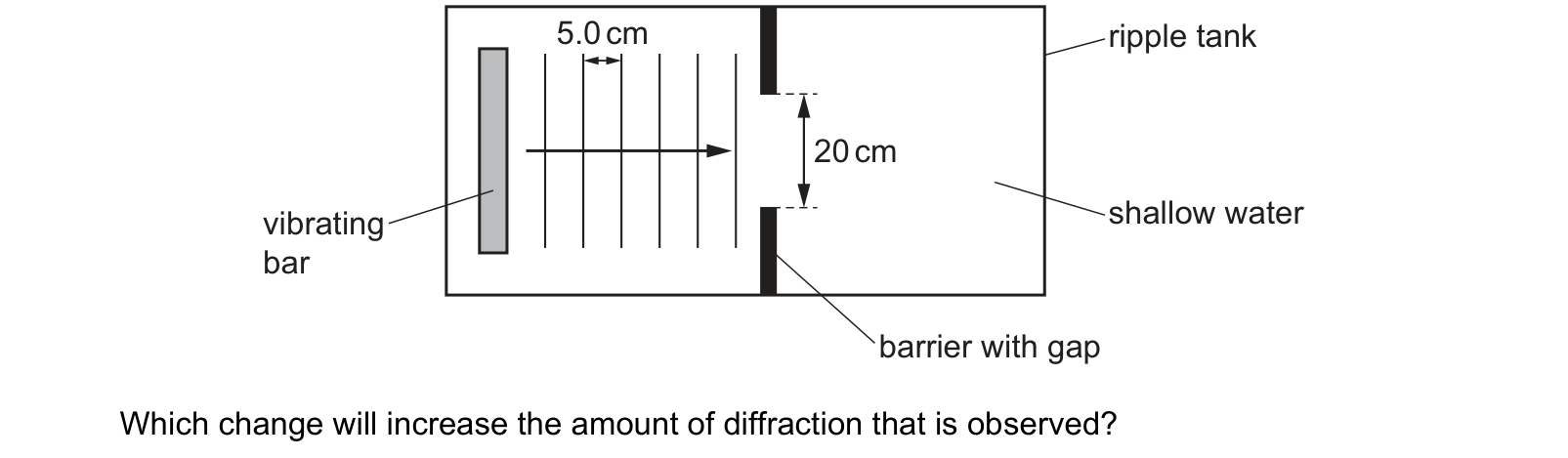
Answer: B.
Diffraction is governed by one ratio: the wavelength compared with the width of the gap. The closer λ gets to the gap width, the more the waves spread as they emerge. Here λ is 5.0 cm and the gap is 20 cm, a ratio of 0.25, so the waves spread somewhat but still emerge with a recognisable forward beam. To increase the spreading you must raise that ratio, either by lengthening the wave or by narrowing the gap.
Why lowering the frequency lengthens the wave. In a ripple tank the wave speed is set by the depth of the water, not by the bar that is driving it. With v fixed, v = fλ means f and λ are inversely related, so dropping the frequency stretches the wavelength out. The ratio λ/gap rises and the diffraction increases.
This is a point worth holding onto beyond this question: when a wave stays in the same medium, changing the source changes the frequency and the wavelength together, never the speed.
Why the others are there
D, increasing the width of the gap, moves the ratio the wrong way. A wider gap means less spreading, which is the everyday observation that a wide doorway casts a fairly sharp shadow while a narrow one lets sound spread all round the room.
C, increasing the amplitude, makes the waves taller. It changes neither the wavelength nor the gap, so the shape of the diffraction pattern is untouched. Amplitude affects energy, not geometry.
A, moving the bar closer to the gap, changes when the waves arrive and nothing else. By the time a wavefront reaches the barrier it is a plane wave of wavelength 5.0 cm meeting a 20 cm gap, and how far it travelled to get there does not enter into it.
What the syllabus asks for on this topicSyllabus points
Syllabus points
- State the principle of superposition and apply it to interference and to stationary waves.
- Explain the formation of a stationary wave and describe nodes and antinodes.
- Describe diffraction and its dependence on the size of the gap relative to the wavelength.
- Understand the conditions for two-source interference and the need for coherence.
- Use λ = ax/D for double-slit interference and d sin θ = nλ for the diffraction grating.
Related CIE 9702 Physics topics
Not the topic you were looking for? Describe what you are stuck on in your own words and we will take you to the notes that answer it.