Superposition: five questions to try now
Real past-paper questions, the answer key from the mark scheme, and the explanation that goes with it. No account needed to answer them.
Question 1
A wave on the surface of water passes through a gap between two barriers and is diffracted, as shown. What happens when the frequency of the wave is halved?

Answer: B.
The amount of diffraction depends on the ratio of wavelength to gap width. The gap here is fixed, so anything that lengthens the wave increases the spreading.
Halving the frequency does exactly that. The speed of water waves is set by the water itself and does not change, so from v = fλ:
f halved means λ doubled
With twice the wavelength passing through the same gap, the ratio λ/gap doubles and the waves fan out noticeably more beyond the barrier.
A and D would need the wavelength to shrink or stay the same, and C claims diffraction stops altogether, which never happens: some spreading occurs at any wavelength, it is simply too slight to notice when the wavelength is much smaller than the gap.
The maximum effect comes when the wavelength is roughly equal to the gap, at which point the waves emerge as almost semicircular ripples centred on the opening.
This is worth keeping straight from the other rule: frequency does not change when a wave passes into a new medium or through a gap. It is set by the source. Speed and wavelength are what adjust.
Question 2
Light of wavelength λ is incident normally on a diffraction grating with a total number of N lines in width w.
A second order maximum is observed at an angle of diffraction θ. What is N ?

Answer: C.
d sin θ = 2λ
The spacing d is the width divided by the number of lines:
d = w / N
Substituting:
(w / N) sin θ = 2λ
and rearranging for N:
N = w sin θ / 2λ
which is C.
D is the same expression without the order, so it is the answer for a first-order maximum. The 2 is easy to lose because it sits in the denominator after the rearrangement, having started in the numerator on the other side.
A and B both have sin θ in the denominator, which comes from rearranging the wrong way round.
A useful check is to reason about the direction. More lines in the same width means a smaller spacing and therefore a larger angle, so N should increase with sin θ. Only C and D do that, and the order then separates them.
The relationship d = w/N is worth stating explicitly, since gratings are quoted sometimes as a spacing and sometimes as lines per unit length.
Question 3
Light of wavelength 690 nm passes through a diffraction grating with 300 lines per mm, producing a series of bright spots (maxima) on a screen. What is the total number of bright spots that are produced?
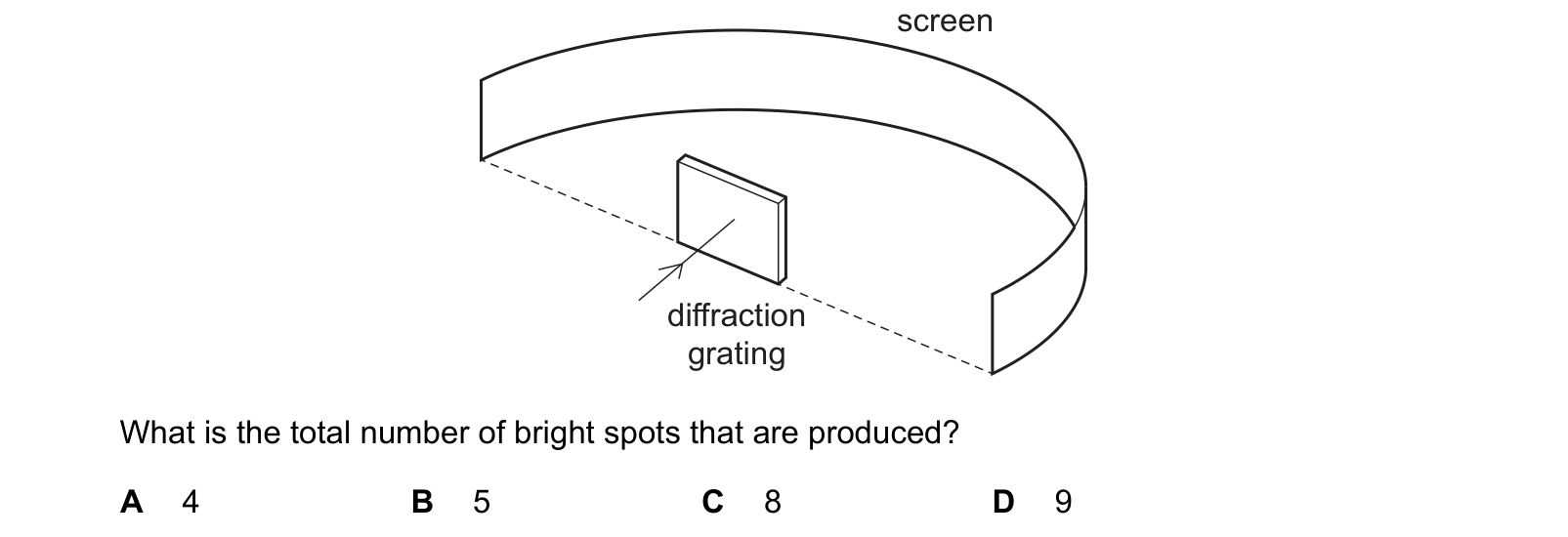
Answer: D.
The slit spacing. 300 lines per millimetre means:
d = 1/300 mm = 1/300 × 10⁻³ = 3.33 × 10⁻⁶ m
The grating equation.
sin θ = nλ/d = n × (690 × 10⁻⁹)/(3.33 × 10⁻⁶) = 0.207n
The highest order. sin θ cannot exceed 1:
0.207n ≤ 1, so n ≤ 4.8
Orders are whole numbers, so the highest is n = 4, emerging at sin θ = 0.828, about 56° from the straight-through beam. A fifth order would need sin θ = 1.04, which is impossible.
Counting the spots. Orders 1 to 4 each appear on both sides, and the zero order sits in the middle:
(2 × 4) + 1 = 9
C, 8, forgets the central maximum, which is a real bright spot: the light that passes straight through undeviated. B, 5, counts one side plus the centre, and A, 4, one side alone.
The number 4.8 is worth reading correctly: it must be rounded down, since order 4 exists and order 5 does not. Rounding up would give an order that physically cannot form.
Question 4
Light of frequency 6.7 × 10¹⁴ Hz in a vacuum is incident normally on a diffraction grating that contains 4.0 × 10⁵ lines m–¹. What is the angle between the adjacent second and third order intensity maxima?

Answer: A.
The wavelength, from the frequency:
λ = c/f = (3.00 × 10⁸) / (6.7 × 10¹⁴) = 4.48 × 10⁻⁷ m
The slit spacing. With 4.0 × 10⁵ lines per metre:
d = 1 / (4.0 × 10⁵) = 2.5 × 10⁻⁶ m
The two angles, from d sin θ = nλ:
sin θ₂ = 2 × 4.48 × 10⁻⁷ / 2.5 × 10⁻⁶ = 0.358, so θ₂ = 21.0°
sin θ₃ = 3 × 4.48 × 10⁻⁷ / 2.5 × 10⁻⁶ = 0.537, so θ₃ = 32.5°
The difference:
32.5 – 21.0 = 11.5° ≈ 12°
B, 21°, is the second-order angle on its own, and C, 33°, is the third-order angle, so both are answers to a question that was not asked.
The orders are not equally spaced, which is the point worth taking away. The first order here is at 10.3°, the second at 21.0° and the third at 32.5°, so the gaps grow: 10.3°, 10.7°, 11.5°. That happens because it is the sine of the angle that increases uniformly, not the angle itself.
Question 5
A stationary wave is set up on a string that is stretched between two fixed points that are 48 cm apart.
At one instant, the appearance of the string is as shown. What is the wavelength of the stationary wave?

Answer: B.
The string shows three humps between the fixed points: up, down, up. Each hump is one loop, bounded by nodes, and one loop is half a wavelength. There are nodes at the two fixed ends and two more between the loops.
So the 48 cm holds three half-wavelengths:
48 = 3 × (λ/2)
λ/2 = 16 cm, so λ = 32 cm
A, 16 cm, is the length of a single loop taken as the whole wavelength. A loop looks like a complete arch, which is why it is mistaken for a cycle, but a full wave needs one hump above the line and one below it.
C, 48 cm, is the length of the string, which would be the wavelength only if there were exactly two loops.
The fastest route is to count nodes: with n loops the string holds n half-wavelengths, so λ = 2L/n. Here n = 3, giving 2 × 48 / 3 = 32 cm.
This pattern is the third harmonic of the string, three times the frequency of the fundamental, which would show a single loop.
What this practice covers
These questions are drawn from past CIE 9702 Physics papers. You answer, you find out immediately whether you were right, and you get the reasoning for the correct option and for each distractor. Wrong answers go to a mistakes locker so you can come back to exactly those.
Practice is free. You need an account only so your progress and your mistakes are still there next time.
What examiners see students get wrong here
These are the errors that cost marks on superposition, taken from our own topic notes. Read them before you practise and you will recognise the traps in the questions.
- Taking the node spacing as the wavelength rather than as half of it.
- Saying particles between adjacent nodes are out of phase because their amplitudes differ.
- Saying diffraction changes the wavelength.
- Defining coherent as "in phase" rather than "constant phase difference".
- Swapping a and x in λ = ax/D.
- Forgetting that d = 1/N for a grating, or leaving N in lines per millimetre.
- Saying the central maximum of a grating with white light is a spectrum.
- Saying red is deviated least by a grating, which is true of a prism instead.
Revise it first
If any of the above is unfamiliar, work through the notes before practising: Superposition revision notes.