Forces, density and pressure: five questions to try now
Real past-paper questions, the answer key from the mark scheme, and the explanation that goes with it. No account needed to answer them.
Question 1
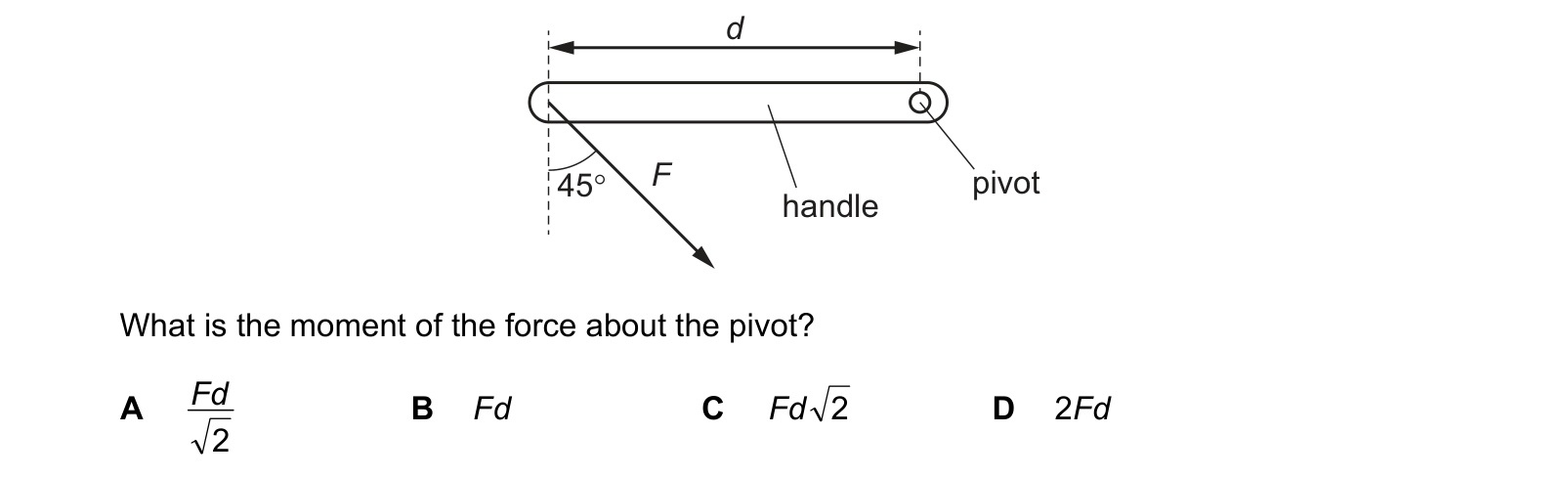
A force F is applied at an angle of 45° to a door handle at a distance d from the pivot of the handle, as shown. What is the moment of the force about the pivot?
Answer: A.
The moment of a force is the force multiplied by the perpendicular distance from the pivot to its line of action, or equivalently the perpendicular component of the force multiplied by the distance to where it acts.
The handle is horizontal and F is applied at 45° to the vertical, which is also 45° to the handle. So the component at right angles to the handle is:
F cos 45° = F/√2
and it acts a distance d from the pivot:
moment = (F/√2) × d = Fd/√2
B, Fd, is the answer if the force is taken as acting entirely at right angles to the handle, which would need it to be applied straight down or straight up.
C, Fd√2, and D, 2Fd, are both larger than Fd, and that alone rules them out: resolving a force can only ever make a component smaller than the force itself, so the moment must be less than Fd.
At 45° the sine and cosine are equal, so it makes no difference here which one is chosen. That is a small mercy: at any other angle, deciding whether the 45° is measured from the handle or from the perpendicular would matter a great deal.
Question 2
A rectangular block of lead of density 1.13 × 10⁴ kg m⁻³ has sides of length 12.0 cm, 15.0 cm and 10.0 cm.
What is the maximum pressure the block can exert when resting on a table?

Answer: D.
The weight, which is the same whichever way up the block sits:
V = 0.120 × 0.150 × 0.100 = 1.80 × 10⁻³ m³
m = ρV = 1.13 × 10⁴ × 1.80 × 10⁻³ = 20.3 kg
W = 20.3 × 9.81 = 199 N
The smallest face. Of the three possible faces, 12 × 15, 12 × 10 and 15 × 10 cm, the smallest is:
12.0 × 10.0 = 120 cm² = 1.20 × 10⁻² m²
The pressure:
p = 199 / 0.0120 = 16 600 Pa = 16.6 kPa
C, 11.1 kPa, uses the largest face, 15 × 10 cm, which gives the minimum pressure instead of the maximum.
A, 1.13 kPa, is the density with the powers of ten mishandled.
The word maximum is what selects the face, and it points the opposite way to intuition about which face a block would naturally rest on. Standing the block on its smallest face concentrates the same weight into the least area.
Converting centimetres to metres in three dimensions for the volume and two for the area is the other place this goes wrong.
Question 3
Two solid cubes X and Y are made of material of the same density. Cube X has twice the mass of cube Y.
Cube X has sides of length x. Cube Y has sides of length y.
x What is the ratio ? y

Answer: A.
Same density, so mass is proportional to volume:
m = ρV = ρ × (side)³
Cube X has twice the mass of cube Y, so:
x³ / y³ = 2
x / y = 2^(1/3) = 1.26
C, 2.00, applies the mass ratio directly to the lengths, which would be right only if mass went as the side rather than its cube. D, 8.00, is 2³, the ratio you would get if the lengths were in the ratio 2 and you were asked for the masses, so it is the same relationship read backwards.
B, 1.41, is √2, which is the answer for a ratio of areas rather than volumes.
The general rule is worth carrying: for similar shapes, lengths scale as the cube root of mass, areas as the two-thirds power, and volumes directly. Doubling the mass of a solid object increases every linear dimension by only 26%, which is why a doubling in weight is barely visible as a change in size.
Question 4
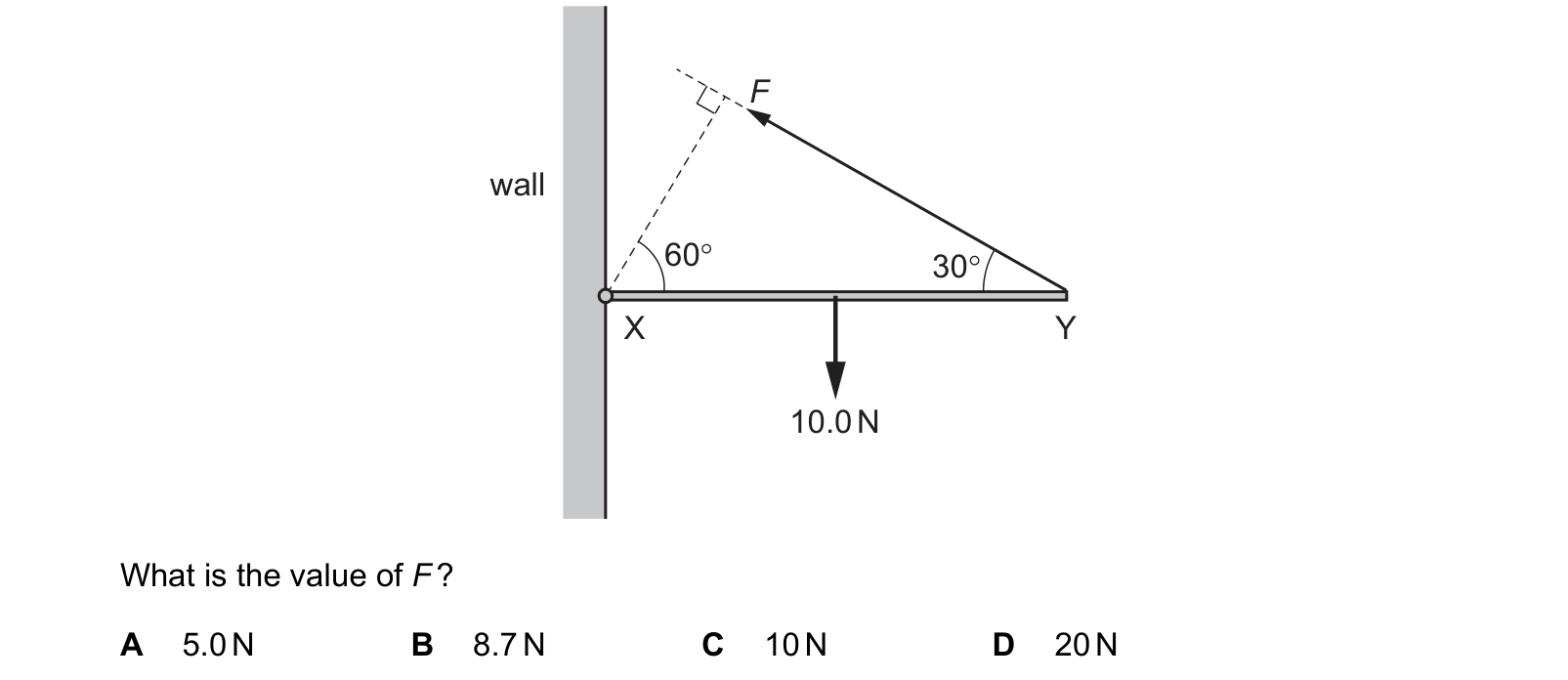
A uniform rod XY of weight 10.0 N is freely hinged to a wall at X. It is held horizontal by a force F acting from Y at an angle of 30° to the horizontal, as shown. What is the value of F ?
Answer: C.
Let the rod have length L. The rod is uniform, so its whole weight of 10.0 N acts at the midpoint, a distance L/2 from X. The force F acts at Y, a distance L from X, but at 30° to the rod, so only its perpendicular component turns the rod:
F sin 30° × L = 10.0 × L/2
F × 0.5 = 5.0
F = 10 N
The L cancels, which is why no length is given.
D, 20 N, forgets the sin 30° and balances F × L against 10.0 × L/2. A, 5.0 N, is the weight's moment divided by L without resolving F at all.
There are two separate halvings here, and they happen to cancel: the weight acts at half the length, and only half of F acts perpendicular, since sin 30° = 0.5. That coincidence is why the answer comes out equal to the weight, and it is worth noticing rather than relying on.
Choosing the hinge as the pivot is the standard move. The hinge force is unknown in both size and direction, and taking moments about the point it acts through makes it drop out.
Question 5
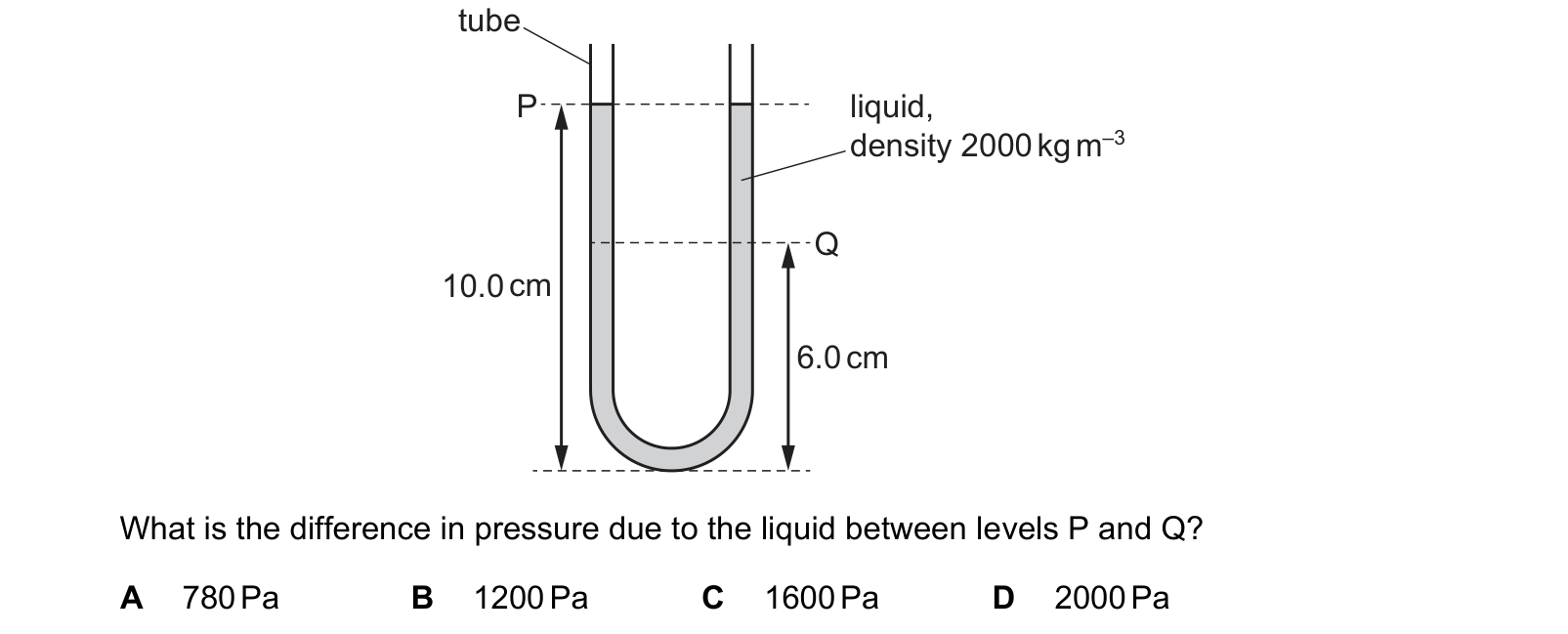
A U-shaped glass tube contains liquid of density 2000 kg m⁻³, as shown. What is the difference in pressure due to the liquid between levels P and Q?
Answer: A.
Reading the diagram, both marks are measured from the bottom of the tube: P is at 10.0 cm and Q is at 6.0 cm. So:
h = 10.0 – 6.0 = 4.0 cm = 0.040 m
Δp = ρgh = 2000 × 9.81 × 0.040 = 785 Pa ≈ 780 Pa
D, 2000 Pa, uses the full 10.0 cm, and B, 1200 Pa, uses the 6.0 cm. Both take one of the two labelled distances straight from the diagram without subtracting, and that is precisely what the question is set up to catch: the two arrows are drawn from the same baseline for exactly that reason.
Note also that the shape of the tube plays no part. Pressure in a liquid depends only on vertical depth, not on the path through the liquid or the width of the tube, so the fact that P and Q are in different arms and that the liquid curves round the bottom changes nothing.
Converting centimetres to metres is the other place this goes wrong. Working in centimetres would give an answer 100 times too large.
What this practice covers
These questions are drawn from past CIE 9702 Physics papers. You answer, you find out immediately whether you were right, and you get the reasoning for the correct option and for each distractor. Wrong answers go to a mistakes locker so you can come back to exactly those.
Practice is free. You need an account only so your progress and your mistakes are still there next time.
What examiners see students get wrong here
These are the errors that cost marks on forces, density and pressure, taken from our own topic notes. Read them before you practise and you will recognise the traps in the questions.
- Using the distance along the rod rather than the perpendicular distance when the force is angled.
- Doubling the force when finding the torque of a couple.
- Forgetting the weight of a uniform rule, or placing it anywhere but the centre.
- Taking moments about a point and then forgetting that the same point must be used for every term.
- Saying pressure in a liquid depends on the width or shape of the container.
- Omitting atmospheric pressure when the question asks for total pressure.
- Saying a denser body experiences a greater upthrust when both are fully submerged and have the same volume.
- Converting g cm⁻³ to kg m⁻³ with a factor of 100.
Revise it first
If any of the above is unfamiliar, work through the notes before practising: Forces, density and pressure revision notes.