Work, energy and power: five questions to try now
Real past-paper questions, the answer key from the mark scheme, and the explanation that goes with it. No account needed to answer them.
Question 1
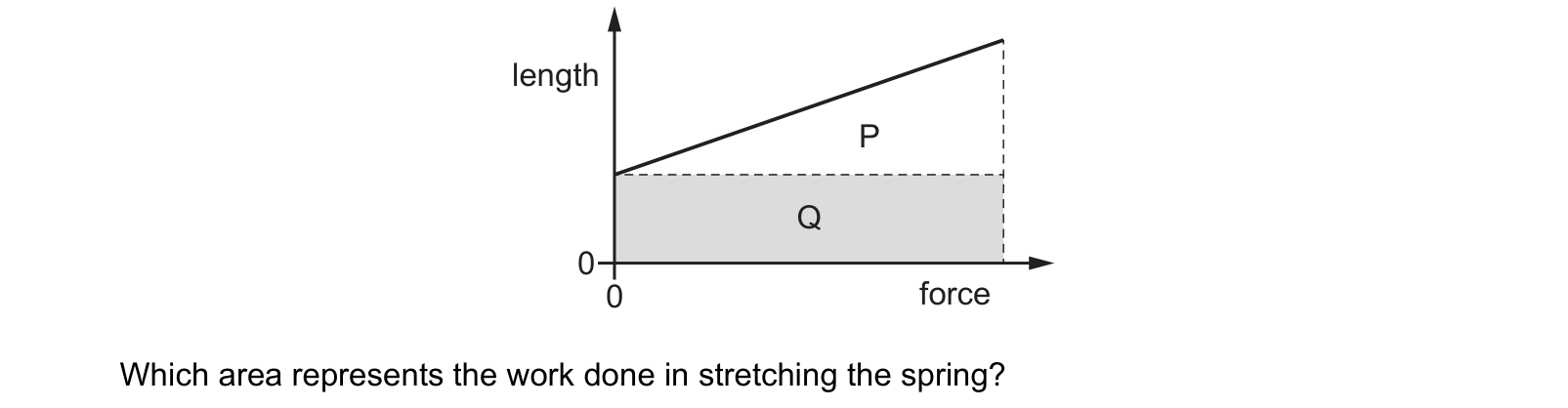
The graph shows how the length of a spring varies with the force applied to it. Two areas P and Q are labelled. Which area represents the work done in stretching the spring?
Answer: A.
The graph plots length against force, so the vertical axis starts at the spring's unstretched length rather than at zero. The extension at any force is the height of the line above that starting length, not the height above the axis.
Work done in stretching is the average force times the extension, which is the area of the triangle between the line and the horizontal dashed line at the unstretched length. That is P.
Q is the rectangle underneath, of area (unstretched length) × (force). It has the units of an energy, joules, which is why it looks plausible, but it corresponds to no stretching whatever: the unstretched length is not an extension, and no work is done merely by the spring existing.
C, P + Q, adds that meaningless rectangle to the real work.
The whole question turns on where the extension is measured from. Had the graph plotted extension against force, the line would pass through the origin, Q would vanish, and the area under the line would be the work directly.
For a spring obeying Hooke's law, P is a triangle of area ½Fx, which is the familiar result.
Question 2
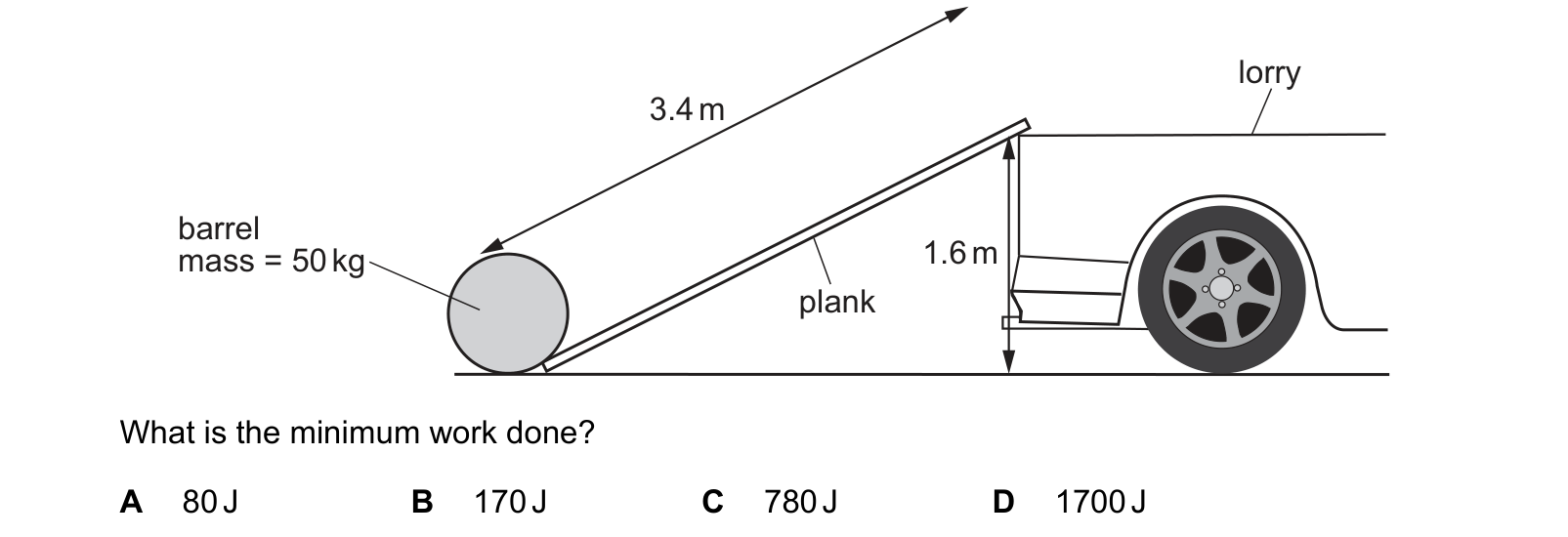
A barrel of mass 50 kg is loaded onto the back of a lorry 1.6 m high by pushing it up a frictionless plank 3.4 m long. barrel mass = 50 kg 1.6 m What is the minimum work done?
Answer: C.
W = mgh = 50 × 9.81 × 1.6 = 785 J ≈ 780 J
D, 1700 J, uses the 3.4 m length of the plank instead of the 1.6 m height. That is the trap the question is built around, and the plank's length is given for exactly that reason.
The plank is stated to be frictionless, so no energy is wasted, and the work needed is the same whether the barrel is lifted straight up or pushed along the slope. What the plank changes is the force required, not the work: pushing along 3.4 m needs only 785/3.4 = 231 N, against the 490 N needed to lift the barrel vertically. That is the whole point of a ramp, and it is why the two numbers multiply to the same total either way.
A, 80 J, and B, 170 J, both drop the factor of g, using the mass rather than the weight. The units expose it: kilogram metres are not joules.
The word minimum covers the fact that a real ramp has friction, and any real push would have to do more work than this.
Question 3
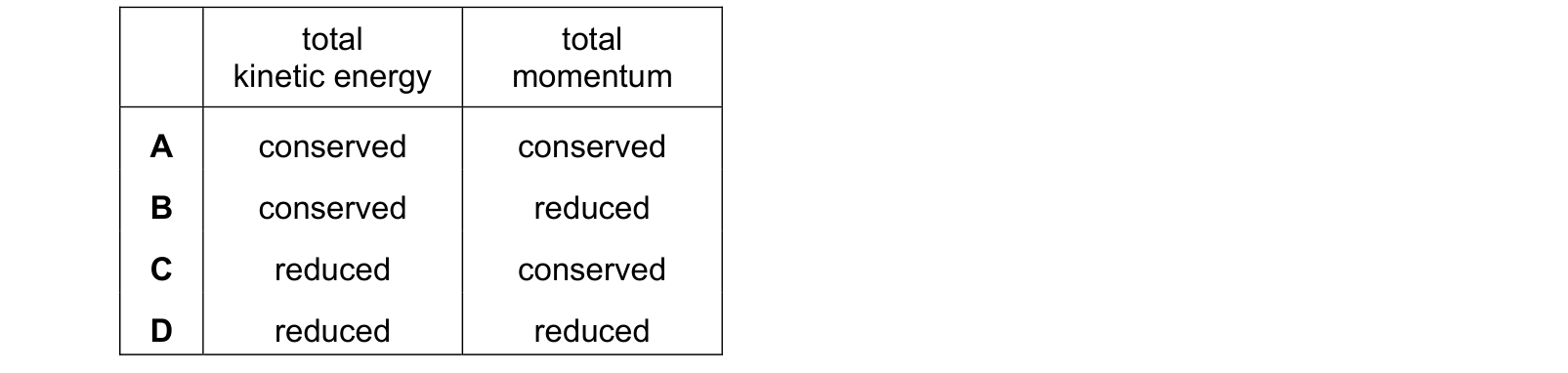
Two satellites in deep space collide inelastically. What happens to the total kinetic energy and total momentum? Each answer gives, in order: total kinetic energy; total momentum.
Answer: C.
Kinetic energy is conserved only in an elastic collision. In an inelastic collision some of it becomes internal energy and sound, permanently deforming the bodies or heating them, so the total kinetic energy falls.
The energy is not destroyed. Total energy is always conserved; it is specifically the kinetic share that is reduced.
So kinetic energy reduced, momentum conserved, which is C.
That the satellites are in deep space matters: with no gravity or air resistance acting, the system is genuinely isolated and the momentum conservation is exact.
The definition worth carrying is that an inelastic collision is one in which kinetic energy is lost, and a perfectly inelastic one is where the bodies stick together, which loses the most possible while still conserving momentum.
Question 4
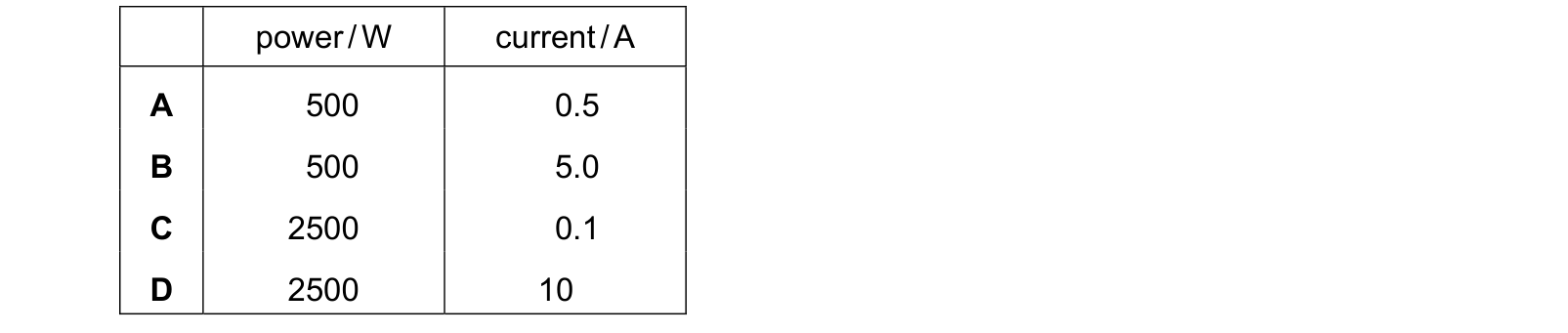
A kettle is connected to a 250 V mains supply. What are possible values for the power of the kettle and the current in the kettle? Each answer gives, in order: power / W; current / A.
Answer: D.
I = P / V
Test each pair against the 250 V supply:
A: 500 / 250 = 2.0 A, not 0.5 ✗
B: 500 / 250 = 2.0 A, not 5.0 ✗
C: 2500 / 250 = 10 A, not 0.1 ✗
D: 2500 / 250 = 10 A ✓
So D.
Both values are realistic for a kettle, which is worth a moment: a domestic kettle draws around 2 to 3 kW and about 10 A, which is why kettles are fitted with 13 A fuses and why they are the largest single load on most household circuits.
The two 500 W options would be a very feeble kettle, and 0.1 A would barely light a bulb, so C can be rejected on physical grounds as well as arithmetic ones: 2500 W at 0.1 A would need a supply of 25 000 V.
The relationship also explains why high-power appliances are the ones that need thick cable: the current, not the power, is what heats the wire, and the heating goes as I²R.
Question 5
A wooden cylinder floats partially submerged in a bath of water. A force F is applied to the cylinder until it is just fully submerged.
wooden cylinder Which statement is not correct?
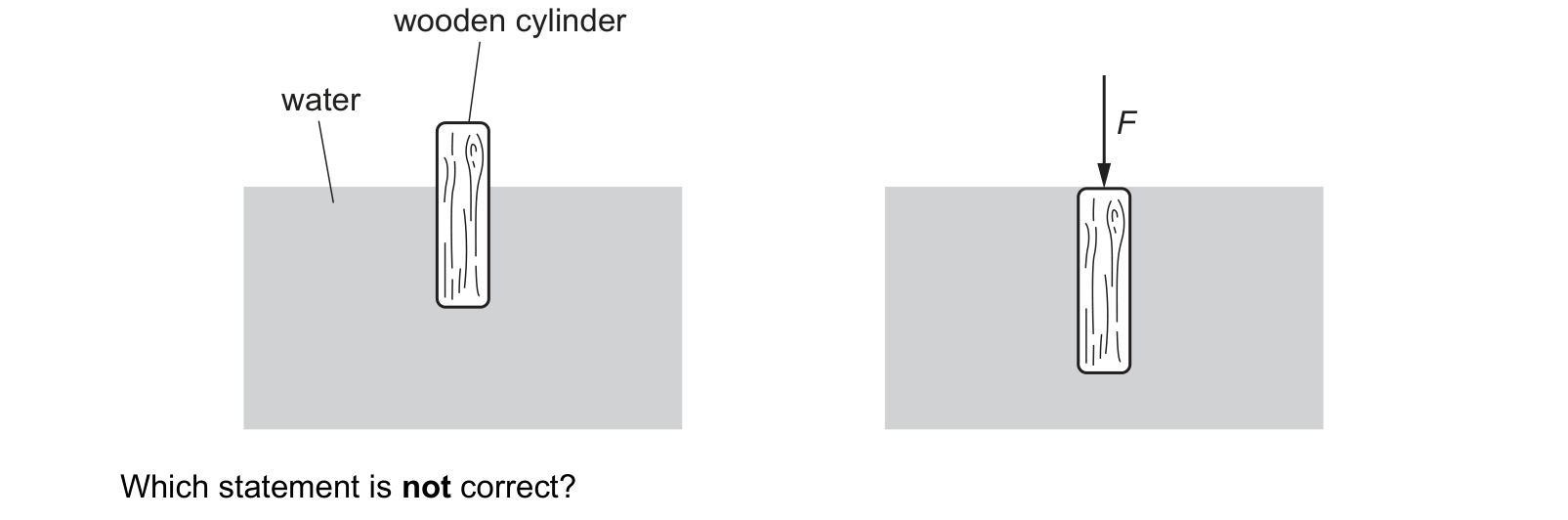
Answer: D.
The cylinder is pushed downwards while the upthrust acts upwards, so the force and the displacement are in opposite directions. The upthrust therefore does negative work on the cylinder: work is done against it, not by it. That is what makes D the odd one out.
The other three all hold.
C. F pushes down and the cylinder moves down, so F does positive work. It is that work which supplies the energy for everything else.
B. The cylinder sinks lower, so its centre of gravity falls and it loses gravitational potential energy.
A. The extra water displaced has to go somewhere, and it goes up, raising the level in the bath. That water therefore gains gravitational potential energy, and it gains more than the cylinder loses, since the wood is less dense than the water it displaces. The difference is exactly the work done by F.
The question asks which statement is not correct, which is easy to read past when three of the four are true. Checking the direction of a force against the direction of motion is the reliable test for the sign of the work it does.
What this practice covers
These questions are drawn from past CIE 9702 Physics papers. You answer, you find out immediately whether you were right, and you get the reasoning for the correct option and for each distractor. Wrong answers go to a mistakes locker so you can come back to exactly those.
Practice is free. You need an account only so your progress and your mistakes are still there next time.
What examiners see students get wrong here
These are the errors that cost marks on work, energy and power, taken from our own topic notes. Read them before you practise and you will recognise the traps in the questions.
- Forgetting cos θ when the force is at an angle to the motion.
- Saying work is done by a force perpendicular to the motion.
- Using the distance along a slope as h in mgh instead of the vertical drop.
- Forgetting that kinetic energy depends on the square of the speed, so doubling the speed doubles the energy.
- Using P = Fv with a force that is not the driving force.
- Writing efficiency as input over output, giving an answer above 100%.
- Saying wasted energy is destroyed.
Revise it first
If any of the above is unfamiliar, work through the notes before practising: Work, energy and power revision notes.