Electricity: five questions to try now
Real past-paper questions, the answer key from the mark scheme, and the explanation that goes with it. No account needed to answer them.
Question 1
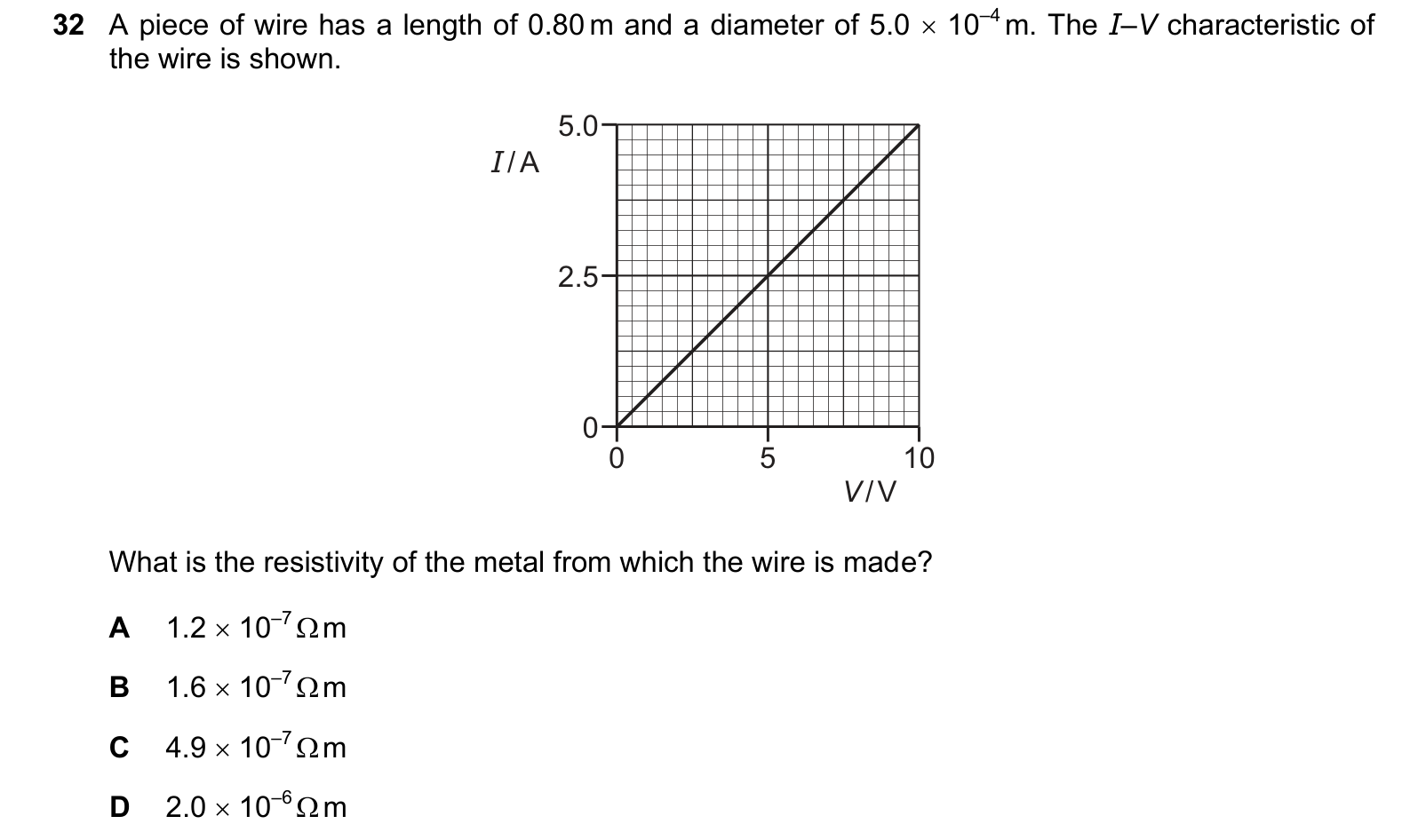
A piece of wire has a length of 0.80 m and a diameter of 5.0 × 10⁻⁴ m. The I–V characteristic of the wire is shown. What is the resistivity of the metal from which the wire is made?
Answer: C.
Resistance from the graph. The line is straight through the origin and reaches 5.0 A at 10 V:
R = V / I = 10 / 5.0 = 2.0 Ω
Cross-sectional area from the diameter. The wire is 5.0 × 10⁻⁴ m across, so the radius is 2.5 × 10⁻⁴ m:
A = πr² = π × (2.5 × 10⁻⁴)² = 1.96 × 10⁻⁷ m²
Resistivity.
ρ = RA / L = (2.0 × 1.96 × 10⁻⁷) / 0.80 = 4.9 × 10⁻⁷ Ω m
D, 2.0 × 10⁻⁶, is exactly four times too big, which is the signature of using the diameter as the radius. Squaring doubles the error, so a factor of two in the radius becomes a factor of four in the area and in the answer.
A, 1.2 × 10⁻⁷, comes from reading the gradient of the graph as the resistance. The graph is plotted with I on the vertical axis, so its gradient is 5.0/10 = 0.5, which is the conductance. Resistance is the reciprocal of that.
Check what is on which axis before taking a gradient. An I against V graph gives 1/R, and a V against I graph gives R.
Question 2
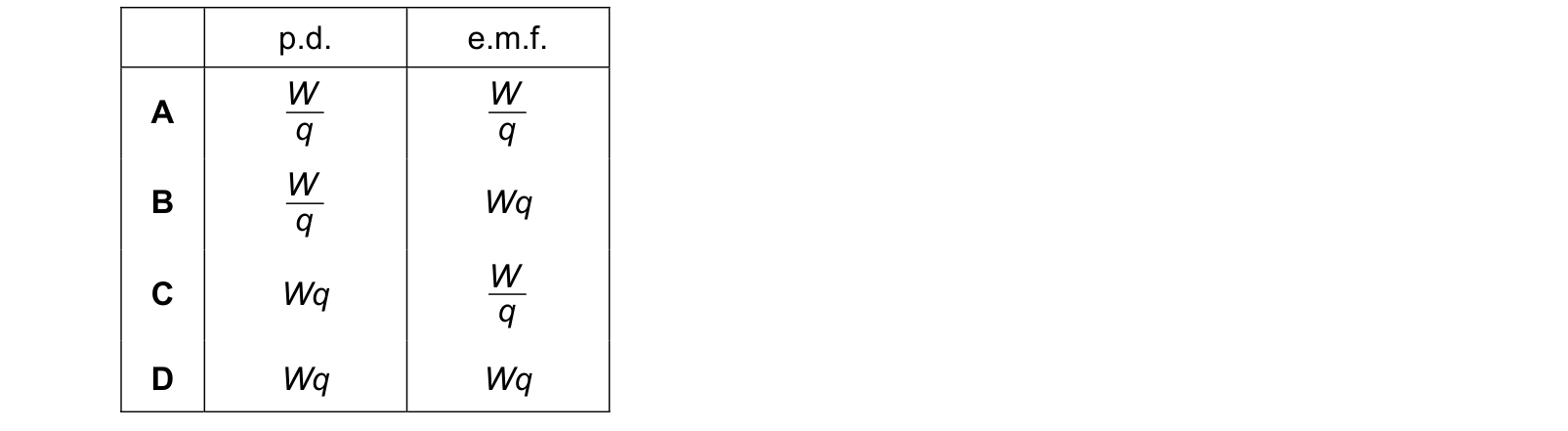
What are the definitions of potential difference (p.d.) and electromotive force (e.m.f.), in terms of energy transfer W and charge q ? p.d. e.m.f.
Answer: A.
Potential difference is the energy transferred from electrical energy to other forms, per unit charge, as charge passes through a component. In a resistor that means electrical energy becoming thermal energy.
Electromotive force is the energy transferred to electrical energy from other forms, per unit charge, by a source. In a chemical cell that means chemical energy becoming electrical energy.
Same quantity W/q, same unit, the volt, and the same joules per coulomb. Only the direction of conversion differs, which is why a definition in terms of W and q alone cannot separate them and every row offering different expressions must be wrong.
That leaves the shape of the expression to check. Wq would be a joule coulomb, not a volt, which rules out B, C and D on units alone, before the physics is considered.
Despite its name, e.m.f. is not a force at all. It is measured in volts, and the name survives only from the early history of the subject.
Question 3
Ten cells, each of electromotive force (e.m.f.) 1.5 V, are connected together, as shown. What is the combined e.m.f. between terminals X and Y?

Answer: C.
In a cell symbol the long line is the positive terminal and the short line is the negative one. Reading along the row, nine cells have their long line on the left and short on the right, and one near the right-hand end is drawn the other way round.
A reversed cell does not merely fail to contribute: it opposes the rest, subtracting its e.m.f. from the total. So the nine and the one cancel in pairs:
net = (9 – 1) × 1.5 = 8 × 1.5 = 12 V
D, 15 V, is all ten added, which is the answer if the orientations are not checked at all. B, 9 V, treats the reversed cell as simply absent, 9 × 1.5, which is the more subtle error and the one worth naming: leaving a cell out and turning it round differ by two cells' worth, not one.
A, 8 V, is the number of effective cells mistaken for the voltage.
Look at every cell symbol individually. The whole question is in the drawing, and a reversed cell is easy to miss in a row of ten identical-looking ones.
Question 4
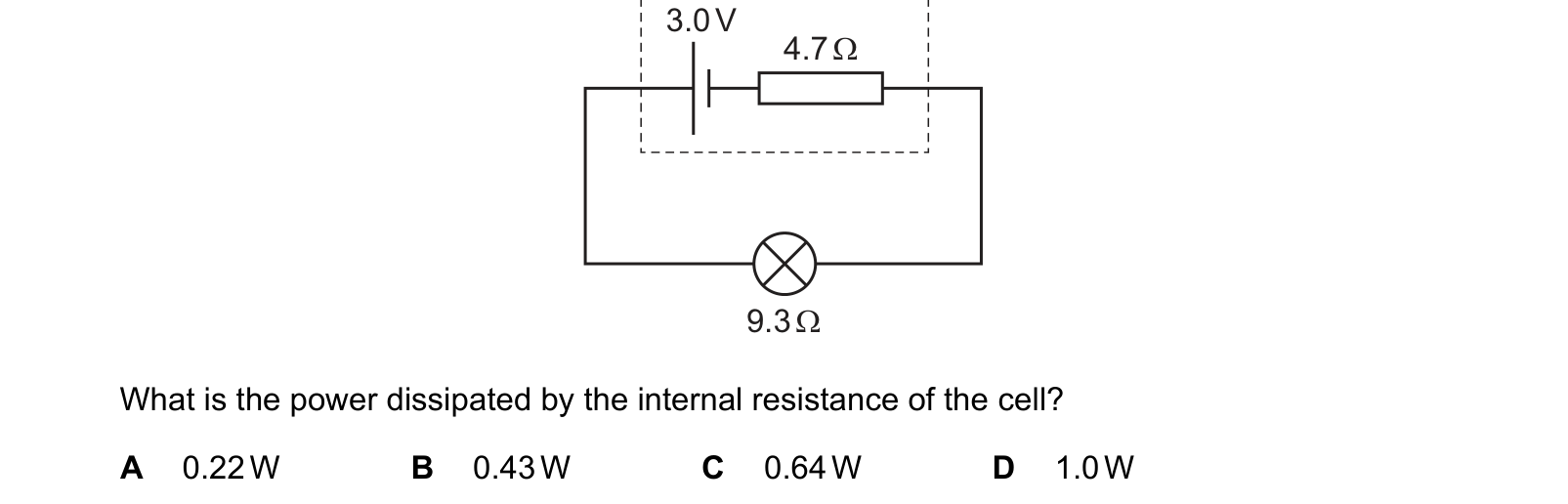
The diagram shows a cell of electromotive force (e.m.f.) 3.0 V and internal resistance 4.7 Ω connected across a lamp. The lamp has a resistance of 9.3 Ω. What is the power dissipated by the internal resistance of the cell?
Answer: A.
I = E / (R + r) = 3.0 / (9.3 + 4.7) = 3.0 / 14.0 = 0.214 A
Then the power dissipated inside the cell, using the internal resistance:
P = I²r = 0.214² × 4.7 = 0.0459 × 4.7 = 0.22 W
B, 0.43 W, is the power in the lamp: 0.214² × 9.3. That is the useful power, and the question asks for the wasted part.
C, 0.64 W, is the total power the cell supplies, EI = 3.0 × 0.214, and it is also the sum of the other two: 0.22 + 0.43 = 0.64 W.
D, 1.0 W, is E²/R for the lamp alone, 3.0²/9.3, which ignores the internal resistance entirely and so overstates the current.
Three of the four options are therefore real quantities in this circuit, and the question is which one is being asked for.
A cell with an internal resistance a third of the external one wastes a third of its energy internally, which is why it would grow warm in use. Making the internal resistance small is what makes a good power supply.
Question 5
An iron wire has length 8.0 m and diameter 0.50 mm. The wire has resistance R.
A second iron wire has length 2.0 m and diameter 1.0 mm.
What is the resistance of the second wire?
Answer: A.
The area of a circle is πd²/4, so A is proportional to d².
R₂ / R₁ = (L₂ / L₁) × (d₁ / d₂)²
= (2.0 / 8.0) × (0.50 / 1.0)²
= 0.25 × 0.25 = 1/16
so R₂ = R/16, which is A.
Two independent factors of four are at work. The second wire is a quarter of the length, which divides the resistance by 4, and it has twice the diameter, which gives it four times the area and divides the resistance by 4 again.
C, R/2, is what you get by treating the area as proportional to the diameter rather than to its square, which loses one of those factors of four.
The diameter-to-area step is the one to be careful about throughout this topic. Doubling the diameter quadruples the area, and questions are usually set with the diameter given precisely because that squaring is where the marks are lost. There is no need to work out either area here, since only the ratio matters.
What this practice covers
These questions are drawn from past CIE 9702 Physics papers. You answer, you find out immediately whether you were right, and you get the reasoning for the correct option and for each distractor. Wrong answers go to a mistakes locker so you can come back to exactly those.
Practice is free. You need an account only so your progress and your mistakes are still there next time.
What examiners see students get wrong here
These are the errors that cost marks on electricity, taken from our own topic notes. Read them before you practise and you will recognise the traps in the questions.
- Naming the coulomb as the SI base unit rather than the ampere.
- Saying electrons flow from positive to negative, or that conventional current follows the electrons.
- Saying the drift velocity is smaller in a thinner wire.
- Defining e.m.f. as a force, or defining either quantity per unit time rather than per unit charge.
- Using P = I²R to compare parallel branches, or P = V²/R to compare components in series.
- Reading the resistance of a lamp as the gradient of its I-V curve.
- Saying a filament lamp is ohmic because its graph passes through the origin.
- Forgetting that equal mass with a longer wire means a smaller area as well.
Revise it first
If any of the above is unfamiliar, work through the notes before practising: Electricity revision notes.