Living Standards: five questions to try now
Real past-paper questions, the answer key from the mark scheme, and the explanation that goes with it. No account needed to answer them.
Question 1
The birth rate and death rate in a country are the same. What is likely to happen if there is a decrease in the birth rate, while the death rate and migration remain the same?
Answer: B.
Start from the position given: the birth rate and death rate are equal, so natural change is zero, and with migration unchanged the population is stable. Now the birth rate falls while the death rate stays where it is. Deaths therefore exceed births, natural change turns negative, and the population declines.
Why the other options are wrong:
- A says the population structure remains the same. It must change: fewer babies means the young age groups shrink as a proportion, so the average age rises and the population ages. Structure and size both alter.
- C says the standard of living will decrease. This does not follow. Living standards depend on real output per head, and a smaller population divides output among fewer people. In the short run living standards may even rise, since there are fewer dependent children to support. Ageing does eventually strain pensions and healthcare, but no fall in living standards is implied by the data given.
- D says the working population will increase. Fewer births means fewer future workers, so the working population falls: though only after fifteen years or more, since the babies not being born now would not have entered the workforce until then.
Question 2
The Human Development Index (HDI) ranks human development in countries from 0 (lowest) to 1
(highest).
What does the calculation of HDI not take into consideration?
Answer: C.
The HDI is built entirely from national averages: average income per head, average life expectancy, average years of schooling. Averages conceal distribution, so a country where a prosperous capital city coexists with a neglected rural interior can score the same as one where provision is even. The index says nothing about how income, health or education are spread across regions or between social groups. This is its best-known limitation, and it is why the UN publishes a separate Inequality-adjusted HDI.
Why the other options are included:
- A, life expectancy at birth, is the health dimension.
- B, years of schooling, is the education dimension.
- D, standard of living linked to income per head, is the income dimension.
Question 3
Why is the Human Development Index (HDI) often considered to be better than Gross Domestic Product (GDP) per head as a measure of living standards?
Answer: C.
GDP per head measures only output: the value of goods and services produced, divided by the population. The HDI keeps that income measure but adds two others: life expectancy at birth and years of schooling. Two countries with identical GDP per head can differ greatly in how long their people live and how much education they receive, and those differences matter enormously to how good life actually is. Including health and education therefore gives a broader picture of living standards.
Why the other options are wrong:
- A says GDP per head excludes economic growth. Economic growth is the rate at which GDP rises, so GDP is the very thing growth is measured on.
- B says GDP per head ignores population growth. It does the opposite: dividing by population is exactly what the "per head" adjustment does, and it is why GDP per head is preferred to total GDP for comparing living standards.
- D says the HDI is calculated by the national government. It is compiled by the United Nations, and that independence is a strength, a government calculating its own score would have an incentive to flatter it.
Question 4
One of the indicators of living standards is the Human Development Index (HDI). What is not taken into consideration when calculating the HDI?
Answer: C.
The HDI has exactly three components: income per head for the standard of living, life expectancy at birth for health, and years of schooling for education. The level of savings is not among them. Savings matter greatly for development, since they finance investment, but the HDI measures outcomes: how long people live, how much education they get, how much they can consume, rather than the financial inputs that produce those outcomes.
Why the other options are included:
- A, education, is the schooling dimension.
- B, income per head, is the standard of living dimension.
- D, life expectancy, is the health dimension.
Question 5
The table shows the Human Development Index (HDI) for a country in two years. year HDI value
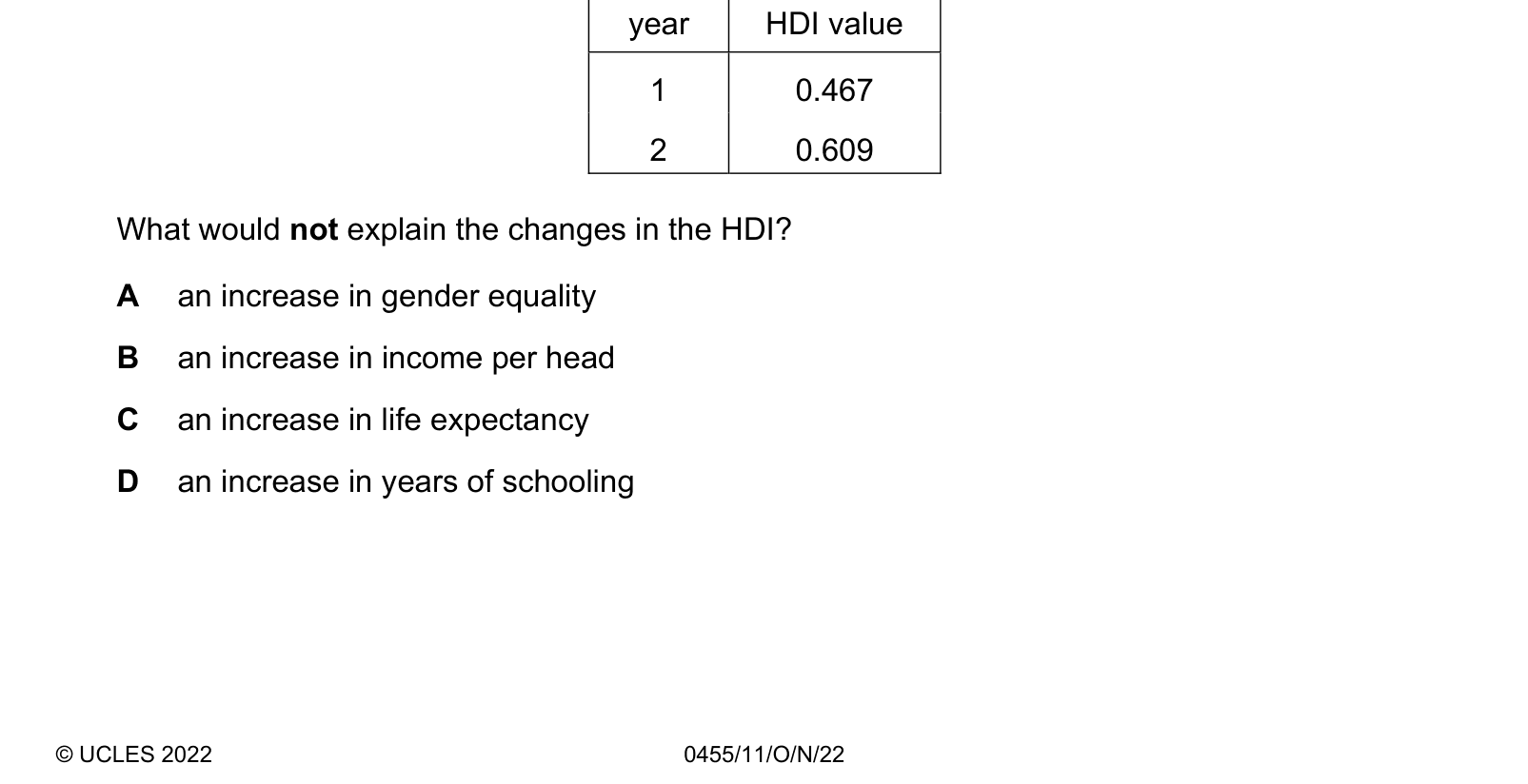
Answer: A.
The Human Development Index combines exactly three components: life expectancy at birth, education measured by mean and expected years of schooling, and income measured by gross national income per head. Gender equality is not one of them. It is measured separately, by the Gender Inequality Index, so an improvement in it would not by itself move the HDI value from 0.467 to 0.609.
Why the other options are wrong, in that each is a component of the index:
- B, an increase in income per head, is the standard of living dimension.
- C, an increase in life expectancy, is the health dimension.
- D, an increase in years of schooling, is the education dimension.
What this practice covers
These questions are drawn from past Cambridge IGCSE papers. You answer, you find out immediately whether you were right, and you get the reasoning for the correct option and for each distractor. Wrong answers go to a mistakes locker so you can come back to exactly those.
Practice is free. You need an account only so your progress and your mistakes are still there next time.
What examiners see students get wrong here
These are the errors that cost marks on living standards, taken from our own topic notes. Read them before you practise and you will recognise the traps in the questions.
- Saying GDP per capita measures living standards accurately.
- Forgetting that it is an average that hides inequality.
- Listing only two HDI components, or naming income as "GDP" when HDI uses GNI per capita at PPP.
- Confusing HDI with GDP.
- Giving limitations of GDP without suggesting a better measure.
Revise it first
If any of the above is unfamiliar, work through the notes before practising: Living Standards revision notes.