Differences in Economic Development Between Countries
Contents: 12 sections
Growth and development are not the same thing
This distinction is the foundation of the whole topic and is worth stating in the first line of any answer:
| Economic growth | Economic development | |
|---|---|---|
| Means | An increase in real GDP | An improvement in welfare and quality of life |
| Measured by | Real GDP, real GDP per capita | HDI, literacy, life expectancy, poverty rates, access to clean water |
| Scope | Purely quantitative | Qualitative as well as quantitative |
Growth usually helps development, because it raises incomes and tax revenue for schools and hospitals. But growth without development is possible: if the gains from an oil boom go to a small elite, GDP rises while most people's lives do not improve.
Ways countries differ
- Income levels: GDP per capita, and how evenly it is distributed.
- Productivity: output per worker, which depends on skills, capital and technology.
- Population growth: fast growth in low-income countries dilutes any rise in output.
- The size of the economy: a large economy supports economies of scale and a wider tax base.
- Economic structure: the balance of the three sectors:
| Sector | What it does | Typical share |
|---|---|---|
| Primary | Extracting raw materials: farming, mining, fishing | Large in low-income countries |
| Secondary | Manufacturing and construction | Large in newly industrialised countries |
| Tertiary | Services: finance, retail, healthcare, tourism | Dominant in developed economies |
The path of development is usually a shift from primary to secondary to tertiary, a process the syllabus expects you to be able to describe.
Reasons for the differences
- Low savings and investment. Poor households cannot save, so there is little to lend to firms → little capital investment → low productivity → low income → still no saving. This is the poverty cycle at national level (5.2).
- Low levels of education and health, so human capital and productivity stay low.
- Poor infrastructure: unreliable power, poor roads and ports, which raises firms' costs and deters investment.
- Rapid population growth, so output per head barely rises even when total output does.
- Dependence on primary products, whose world prices are volatile and whose demand is income-inelastic, making export earnings unpredictable.
- Debt, where interest payments absorb revenue that could fund schools and hospitals.
- Political instability, conflict and corruption, which deter both domestic and foreign investment.
- Trade barriers in rich countries limiting access to their markets.
- Geography and climate: landlocked countries, drought, disease burden.
Reducing the gap
Policies used include: investment in education and health; infrastructure projects; attracting foreign direct investment; diversifying away from primary products into manufacturing and services; debt relief; aid; and improved access to rich-country markets through fairer trade.
Each has a counter-argument worth having ready: aid can create dependency and may be misused; FDI brings jobs and technology but profits are sent abroad; diversification takes years and needs skills the country may lack.
Worked example
Two countries have similar populations. Country X relies on exporting one primary product; Country Y has a diversified manufacturing and service economy.
- Country X's export earnings depend on one world price
- if that price falls, export revenue collapses
- the current account worsens and government revenue falls
- spending on schools and hospitals is cut
- development stalls, even in a year when the economy was expected to grow.
Country Y's earnings come from many industries, so a fall in any one market is offset elsewhere. Its manufacturing and services also have higher value added per worker, so incomes and tax revenue are higher and more stable.
What Country X could do, and the drawbacks:
- Diversify into manufacturing, durable, but needs capital, skills and infrastructure it does not yet have, and takes a decade.
- Attract FDI: brings capital and technology quickly, but profits flow abroad and firms may leave.
- Invest in education: attacks the root cause, but the payoff is a generation away.
Judgement: diversification is the real solution, but it must be financed and staffed, so education and FDI are the steps that make it possible.
Common exam mistakes
- Treating growth and development as the same thing.
- Saying developing countries are poor simply because they are "less advanced", with no mechanism.
- Forgetting the poverty cycle, which explains why the gap persists.
- Ignoring population growth when comparing living standards. Always think per capita.
- Assuming all developing countries are alike; they differ enormously.
- Listing causes without saying which the country could actually change.
Exam technique
Open by distinguishing growth from development, it frames everything that follows and is often worth marks in itself.
For causes, group them: economic (low saving, low productivity, primary dependence, debt), social, education, health, population growth, and political/geographic (instability, corruption, landlocked).
For evaluation, ask who benefits and how long it takes, those two questions separate a top answer from a list.
Building an answer
4 marks, "Explain two reasons why living standards differ between countries."
Differences in capital stock: developed economies have more machinery, infrastructure and technology per worker, so output per worker is far higher.
Differences in human capital: better education and healthcare raise workers' skills and reduce time lost to illness, so the same hours produce more.
6 marks, "Analyse the barriers to development faced by a low-income country."
A savings gap: incomes are so low that little is saved, so there is little domestic finance for investment, and the capital stock stays low, the poverty cycle at national scale.
Dependence on primary product exports leaves the country exposed to volatile world prices, so export earnings and government revenue swing unpredictably.
Weak infrastructure raises the cost of everything: unreliable power and poor roads make firms uncompetitive however cheap the labour.
Debt servicing absorbs revenue that would otherwise fund health and education, and conflict or weak institutions deter the foreign investment that could break the cycle.
Comparing development
| Indicator | What it measures | Limitation |
|---|---|---|
| GDP per capita | Average income | Ignores distribution and unrecorded output |
| HDI | Income, health, education combined | Still an average; ignores inequality |
| Life expectancy | Health outcomes | Says nothing about income or freedom |
| Literacy rate | Educational attainment | Measures basic skills only |
| Infant mortality | Health and sanitation | Narrow, but strongly correlated with development |
Using more than one indicator is what a strong answer does, because each covers a different weakness.
A real case to quote
South Korea, 1960 to today. GDP per capita comparable to sub-Saharan Africa in 1960; now among the highest in the world. Sustained investment in education, an export-led industrial strategy and heavy capital accumulation drove it. It is the strongest available counterexample to the idea that development is fixed by geography or history, and worth quoting whenever a question asks whether the barriers can be overcome.
Quick revision
- Growth = more real GDP. Development = better living standards. Growth without development is possible.
- Countries differ in income, productivity, population growth, size and sector structure.
- Development path: primary → secondary → tertiary.
- Causes of the gap: low saving and investment, poor education and health, weak infrastructure, fast population growth, primary-product dependence, debt, instability.
- The poverty cycle keeps the gap open: low income → no saving → no investment → low productivity → low income.
- Policies: education, health, infrastructure, FDI, diversification, debt relief, fairer trade, each with a real drawback.
Check you have it
Question 1
The table shows the percentage (%) contribution of agriculture to the GDP of three countries in a year. country % X 18.5 Y 3.9 Z 2.2 What can be concluded from the table?

Answer: B.
Question 2
A country’s minister for agriculture said “the biggest challenge the country faces is to develop irrigation so that we are not at the mercy of the weather for crucial export earnings”. Which type of country is this most likely to be?
Answer: C.
Two clues in the quotation point the same way. The minister is concerned with irrigation and being "at the mercy of the weather", which means the country's output depends on rainfall, the characteristic vulnerability of agriculture. And those crops provide "crucial export earnings", meaning the country's foreign currency comes from selling primary products rather than manufactures or services. Dependence on weather-sensitive primary commodity exports is a defining feature of many developing economies.
Why the other options are wrong:
- A, developed exporting manufactured goods, would not describe a country whose export earnings hinge on rainfall. Factory output is unaffected by the weather.
- B, developed exporting services, is likewise insulated. Banking, tourism and software do not depend on irrigation.
- D, developing exporting services, gets the level of development right but the export type wrong. A service exporter would have no reason to describe irrigation as its biggest challenge.
Question 3
The table shows the percentage employment in the primary, secondary and service sectors in four countries. Which country is likely to be the most developed? Each answer gives, in order: primary sector (% employment); secondary sector (% employment); service sector (% employment).
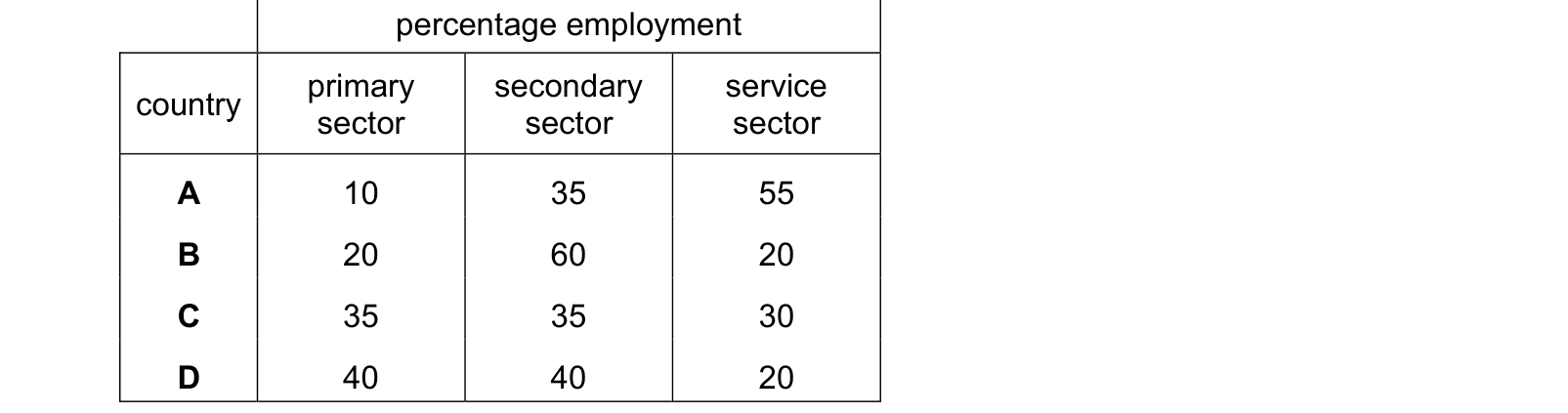
Answer: A.
What the syllabus asks for on this topicSyllabus points
Syllabus points
- Describe the differences in economic development between countries.
- Explain the reasons for those differences, including income, productivity, population growth, size and structure of the economy.
Related Cambridge IGCSE topics
Not the topic you were looking for? Describe what you are stuck on in your own words and we will take you to the notes that answer it.