Workers
Contents: 15 sections
Why wages differ
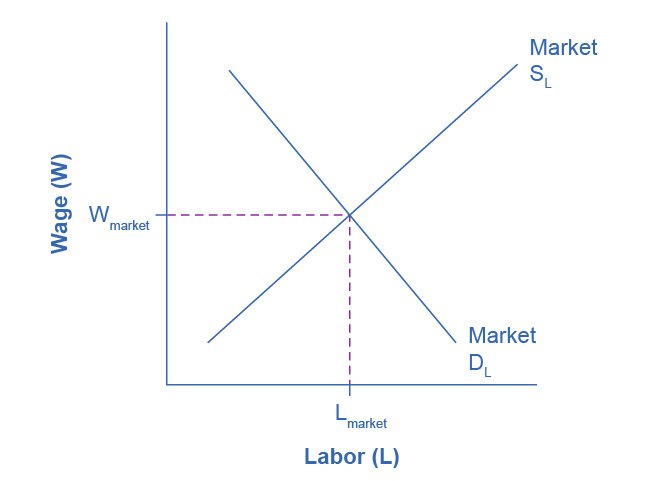
Wages are a price, the price of labour, so they are set by the demand for and supply of workers in each occupation.
High wages usually mean high demand for that type of labour combined with low supply of people able to do it. Low wages usually mean the opposite.
That single sentence explains most wage differences, and applying it beats listing factors.
Factors affecting the demand for labour
Demand for labour is derived demand, firms want workers for what they produce, not for their own sake.
- Demand for the product. If demand for the good rises, firms need more workers.
- Productivity. More productive workers add more output, so firms will pay more for them.
- The price of the product. A higher selling price makes each worker more valuable to the firm.
- The cost of machinery. If machines become cheap, firms may replace workers with capital, lowering demand for labour.
Factors affecting the supply of labour
- Qualifications and training required. Long, difficult training reduces the number of people able to do the job, one reason surgeons and pilots are well paid.
- Skill level. Unskilled work has a very large supply of potential workers, which pushes wages down.
- Working conditions. Dangerous, dirty or unsociable work reduces supply, so wages must be higher to attract people. Economists call this a compensating differential.
- Population and migration. More working-age people raises supply.
- Non-wage benefits. Job security, holidays, pensions and status attract workers even at lower pay, which is why some rewarding jobs are relatively low paid.
Other reasons wages differ
- Trade unions can raise wages through collective bargaining (3.4).
- Government policy: a national minimum wage raises the lowest wages.
- Discrimination by gender, ethnicity or age can cause unequal pay for similar work.
- Public versus private sector pay may differ for similar jobs.
- Region: wages are often higher in cities, partly to offset higher living costs.
- Immobility of labour. If workers cannot move occupation or region (1.2), wage differences persist instead of being competed away.
How earnings change over a lifetime
Earnings usually follow a pattern:
- Young workers earn less. They have little experience, may still be training, and are often in junior roles.
- Middle-aged workers earn most. Experience, skills and promotion raise productivity, so demand for them is highest.
- Older workers may earn less again, through moving to part-time work, retiring, or skills becoming outdated.
Why it matters: this pattern explains why people borrow when young, save in middle age, and spend savings in retirement, which links directly to household behaviour (3.2).
Worked example
Why is a surgeon paid far more than a supermarket cashier?
- Supply of surgeons is very low, the training takes many years, requires high qualifications, and few people can complete it
- demand is high, because the work is highly valued and productivity per surgeon is high
- high demand plus low supply gives a high wage.
- Supply of cashiers is very high, little training is needed, so almost anyone can do the job
- demand exists but is not scarce-supply-limited
- high supply gives a low wage.
Add an evaluation point. Wages also reflect bargaining power and government policy: cashiers' pay may be set close to the national minimum wage, while doctors in some countries are paid on public-sector scales rather than by market forces alone.
Common exam mistakes
- Saying a job pays well simply because it is "important". Nurses and teachers are important and not always well paid, what matters is supply and demand.
- Explaining only demand, or only supply. The wage is set by both.
- Forgetting that demand for labour is derived from demand for the product.
- Ignoring non-wage factors, which explain why some pleasant jobs pay less.
- Treating all low pay as discrimination without considering supply.
Exam technique
Structure every wage-difference answer around demand and supply, then add the extra factors, unions, government, discrimination, immobility, as further reasons.
Where the question names two specific jobs, compare them directly: say what supply and demand look like for each, rather than describing them separately.
For lifetime earnings, describe the shape, low, then rising to a peak, then falling, and give a reason for each stage.
Building an answer
4 marks, "Explain two factors that affect an individual's choice of occupation."
One is the wage. Higher pay raises the financial reward and attracts workers, particularly where skills transfer easily between jobs.
Another is job satisfaction. Many people accept lower pay for work they find worthwhile, or for better conditions, security or holidays, the non-wage factors that make up net advantages.
6 marks, "Analyse why a surgeon earns more than a cleaner."
Demand for surgeons is high because their marginal revenue product is high, the value of the work they do is large.
Supply is very restricted: years of training, high qualification requirements and limited places mean few people can do it, so supply is inelastic.
High demand meeting restricted supply produces a high equilibrium wage.
For cleaning, demand exists but the work requires little training, so supply is large and elastic. Almost anyone can enter, which keeps the equilibrium wage low.
The gap is therefore explained by supply conditions at least as much as by demand.
That final sentence is the analysis mark. Answers that say only "surgeons are more skilled" describe the difference without explaining it.
Wage and non-wage factors
| Wage factors | Non-wage factors |
|---|---|
| Basic pay and overtime | Job satisfaction |
| Bonuses and commission | Working hours and flexibility |
| Pension contributions | Holiday entitlement |
| Regional weighting | Job security |
| Promotion prospects and training | |
| Location and commute | |
| Working conditions and status |
Together these make up net advantages, the full package. It is why a nurse may stay in a job that pays less than a similar-skilled role elsewhere.
Trade unions
Trade unions stopped being a topic of their own for 2027. They are still referenced under 3.3.2, as one influence on wage determination, which is why they now sit inside Workers.
Syllabus points
- Define a trade union and explain its role.
- Explain the advantages and disadvantages of trade unions to workers, firms and the economy.
What is a trade union?
A trade union is an organisation of workers formed to protect and advance the interests of its members.
The core idea is bargaining power. One worker negotiating alone has very little; thousands negotiating together have a great deal, because the employer cannot easily replace them all. This is called collective bargaining, negotiating on behalf of all members rather than individually.
What trade unions do
- Negotiate pay and pay rises.
- Negotiate working conditions: hours, breaks, holidays, safety.
- Protect job security and challenge unfair dismissal.
- Represent individual members in disputes with employers.
- Provide training and, in some countries, legal advice or benefits.
- Lobby governments on employment law.
Industrial action is the union's ultimate threat if negotiations fail:
- Strike: refusing to work.
- Overtime ban: refusing extra hours.
- Work to rule: doing only the exact minimum the contract requires.
Industrial action is a last resort, because members lose pay and the firm may suffer lasting damage.
Advantages and disadvantages
To workers
| Advantages | Disadvantages |
|---|---|
| Higher wages through collective bargaining | Membership fees to pay |
| Better and safer working conditions | Lost pay during strikes |
| Protection from unfair dismissal | Higher wages may cost some members their jobs |
| A voice in decisions affecting them | May have to follow decisions they disagree with |
To firms
| Advantages | Disadvantages |
|---|---|
| Negotiating with one body is easier than with every worker individually | Higher wage costs reduce profit |
| Unions can help communicate changes to the workforce | Strikes stop production and lose revenue |
| Better conditions can raise motivation and productivity, and cut staff turnover | Union rules may resist changes in working methods |
To the economy
| Advantages | Disadvantages |
|---|---|
| Higher wages raise consumer spending and demand | Wage rises above productivity can cause cost-push inflation |
| Better conditions and training raise productivity | Strikes reduce output |
| Unions reduce inequality and can counter employer power | Higher labour costs may reduce international competitiveness and cost jobs |
The key economic argument
The most important point, and the one that earns evaluation marks, is about productivity:
If wages rise in line with productivity, firms can afford them: each worker is producing more, so unit costs do not rise. If wages rise faster than productivity, unit costs rise, which can cause cost-push inflation and job losses.
So the answer to "are trade unions good for the economy?" is genuinely conditional, not a simple yes or no.
What determines union strength?
- Membership size: a union representing most of the workforce is far stronger.
- The state of the economy: unions are stronger in a boom, when firms cannot afford to lose output and workers are hard to replace.
- How easily workers can be replaced: skilled workers have more power than unskilled.
- The law: some governments restrict strikes or ballot requirements.
- The firm's profitability: a profitable firm can afford to concede.
Worked example
A union at a car factory demands a 10% pay rise. Productivity has risen by 3%.
- The wage demand is higher than the productivity rise
- unit labour costs rise
- the firm's costs increase
- it may raise prices (contributing to cost-push inflation), accept lower profit, or reduce the number of workers.
For workers who keep their jobs, real incomes rise. For those made redundant, the outcome is far worse, so the union's gain is not shared evenly among its own members.
Evaluation. The outcome depends on the firm's ability to pay, how much competition it faces (a firm facing cheap imports cannot easily raise prices), and whether the pay rise improves motivation enough to raise productivity further. If it does, the higher wage may partly pay for itself.
Common exam mistakes
- Saying unions "always" raise wages. It depends on their strength and the firm's position.
- Discussing only workers when the question asks about firms or the economy too.
- Forgetting that higher wages can cost some union members their jobs.
- Ignoring the productivity comparison, which is the heart of the argument.
- Confusing a strike with a work-to-rule.
Exam technique
Organise evaluation by group, workers, firms, the economy, and give at least one advantage and one disadvantage for each. That structure produces balance automatically.
Use the productivity test as your judgement: wage rises matched by productivity are sustainable; wage rises above productivity raise costs.
For "how strong is this union?" questions. Use membership size, the state of the economy, and how replaceable the workers are.
Union power, and what limits it
| Union power is greater when… | Union power is weaker when… |
|---|---|
| Membership is high and unified | Membership is low or divided |
| Workers are skilled and hard to replace | Workers are easily substituted |
| Labour is a small share of total cost | Labour is a large share of total cost |
| The firm is profitable | The firm is close to shutting down |
| Demand for the product is inelastic | The product faces strong competition |
| Disruption is highly visible to the public | Work can be done remotely or by others |
A real case to quote
UK HGV drivers, 2021. A shortage of qualified drivers pushed advertised salaries up by a third in months. Demand had not changed much; supply had fallen, because the qualification takes time, testing was backlogged and drivers had left the profession. It is a clean, recent illustration that wages are set by both blades of the scissors, and that when supply is inelastic the adjustment comes almost entirely through pay.
Definitions the mark scheme accepts
| Term | Definition to learn |
|---|---|
| Wage | Payment for labour, usually per hour or per week |
| Net advantages | The total of wage and non-wage benefits of a job |
| Derived demand | Demand for labour comes from demand for what it produces |
| Division of labour | Breaking production into specialised tasks |
| Trade union | An organisation of workers that bargains collectively with employers |
Quick revision
- Wages are the price of labour, set by demand for and supply of workers.
- High pay = high demand + low supply.
- Demand for labour is derived from demand for the product.
- Supply is limited by qualifications, training, skills and conditions.
- Unpleasant jobs need higher pay to attract workers (compensating differential).
- Other factors: unions, minimum wage, discrimination, region, immobility.
- Earnings typically rise with experience, peak in middle age, then fall.
Check you have it
Question 1
Why might measures to reduce unemployment also make inflation rise?
Answer: B.
Measures to reduce unemployment usually work by raising aggregate demand: higher government spending, tax cuts, lower interest rates. Firms facing more orders take on more workers, which is the intended effect. But as the economy approaches full capacity, spare resources run short: firms compete for a shrinking pool of available workers and bid wages up, and because output cannot easily expand further, the extra demand shows up in prices rather than in real output. Lower unemployment is therefore bought at the cost of higher inflation, the short-run Phillips curve trade-off.
Why the other options are wrong:
- C, reducing firms' costs, would lower inflation. Falling costs shift aggregate supply outward, allowing more output at a lower price level, which is precisely why supply-side policies can reduce unemployment without inflationary cost.
- D, requiring wages to fall, would also reduce inflation, since lower wage costs mean lower prices.
- A, encouraging cheap imports, is disinflationary too. Cheaper imported goods and raw materials hold the price level down.
Question 2
What might prevent an individual choosing a particular occupation?
Answer: A.
People choose occupations on net advantage: the whole package of monetary and non-monetary rewards, less the drawbacks. Poor prospects for advancement is a genuine disadvantage: it means limited future earnings growth, less scope to use developing skills, and less job satisfaction. That would deter someone from entering the occupation.
Why the other options are attractions rather than deterrents:
- B, a low cost of travelling to work, reduces the effective cost of the job, so more of the wage is retained. That encourages rather than discourages.
- C, no risk to personal health, is a benefit. Dangerous work has to pay a premium to attract people, so the absence of risk makes a job more appealing at any given wage.
- D, a wage rate above the national minimum wage, is better pay than the legal floor requires, again an attraction.
Question 3
A musician has a choice of playing for an orchestra in either Germany or England. Which combination of incomes and cost of living is most likely to cause her to choose the German orchestra? incomes and cost of living in Germany compared with those in England pre-tax (gross) income after-tax (net) income cost of living
Answer: D.
What matters to the musician is her real net income: what she actually keeps after tax, measured against what it will buy where she lives. Two of the three figures decide it, and in D both favour Germany.
Higher after-tax income means she keeps more, whatever the headline salary. Germany's gross pay being lower is irrelevant once tax is accounted for: net income is what reaches her pocket.
Lower cost of living means that larger net income buys more. Real purchasing power is net income adjusted for prices, so a lower cost of living magnifies the advantage.
Why the other options are wrong:
- A has a higher after-tax income but a higher cost of living, so the two effects offset and the real gain is uncertain.
- B has a lower after-tax income. The lower cost of living helps, but she is keeping less, so the outcome is ambiguous.
- C has a higher after-tax income but a higher cost of living, the same ambiguity as A.
What the syllabus asks for on this topicSyllabus points
Syllabus points
- Explain the factors that determine wage differences.
- Explain why some occupations are paid more than others.
- Explain how earnings change over a person's life.
Related Cambridge IGCSE topics
Not the topic you were looking for? Describe what you are stuck on in your own words and we will take you to the notes that answer it.