Price elasticity of demand (PED)
Contents: 13 sections
What is PED?
Price elasticity of demand measures how much quantity demanded responds to a change in price.
PED = percentage change in quantity demanded ÷ percentage change in price
Because price and quantity move in opposite directions, PED is normally negative. In IGCSE we usually ignore the minus sign and judge by the size of the number.
| Value | Name | Meaning |
|---|---|---|
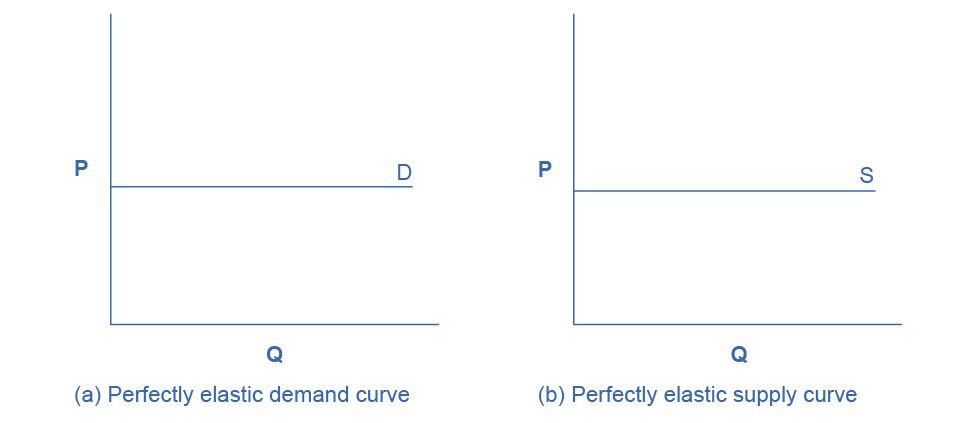
| Infinite | Perfectly elastic | Buyers take any quantity at that price and none at all above it, so the demand curve is horizontal |
| Bigger than 1 | Elastic | Quantity responds a lot, so a small price change causes a big change in demand |
| Exactly 1 | Unitary elastic | Quantity changes by exactly the same proportion as price |
| Smaller than 1 | Inelastic | Quantity responds little, so even a big price change causes only a small change |
| 0 | Perfectly inelastic | Quantity does not change at all, so the demand curve is vertical |
All five names are on the syllabus, so learn them as a set. The two extremes are worth knowing precisely: perfectly elastic demand is a horizontal line and perfectly inelastic demand is a vertical one, and candidates lose marks by drawing them the wrong way round. Unitary elastic is the term the mark scheme uses, so prefer it to "unit elastic".
A useful way to remember: elastic = easy to stretch, so demand stretches a lot when price changes.
What makes demand elastic or inelastic?
- Substitutes: the most important factor. The more close alternatives there are, the more elastic demand is, because buyers can switch. Demand for one brand of crisps is far more elastic than demand for food in general.
- Necessity or luxury: necessities like bread and medicine have inelastic demand; luxuries like holidays are elastic.
- Proportion of income: goods taking a large share of income (a car) get more thought, so demand is more elastic. A box of matches is inelastic because nobody notices the price.
- Habit or addiction: cigarettes and coffee have inelastic demand, because buyers keep buying regardless.
- Time: demand becomes more elastic over time, as people find alternatives. After a fuel price rise, drivers cannot change car immediately, but over several years they can.
PED and total revenue
Total revenue = price × quantity sold. When price changes, these two move in opposite directions, and PED decides which effect wins.
| Demand | Price rises | Price falls |
|---|---|---|
| Elastic | Revenue falls | Revenue rises |
| Inelastic | Revenue rises | Revenue falls |
The reasoning, written as a chain:
- Price rises
- quantity demanded falls
- if demand is inelastic, the fall in quantity is proportionately smaller than the rise in price
- total revenue rises.
Why this matters beyond firms. Governments tax goods with inelastic demand, fuel, alcohol, tobacco, because the tax raises a lot of revenue and people keep buying. That also means such taxes are not very good at changing behaviour, and they hit poorer households hardest.
Calculating PED
Always show the working.
Worked example
The price of a coffee rises from $2.00 to $2.20, and weekly sales fall from 500 to 400 cups.
% change in quantity = (500 − 400) ÷ 500 × 100 = 20% (a fall)
% change in price = (2.20 − 2.00) ÷ 2.00 × 100 = 10% (a rise)
PED = 20 ÷ 10 = 2
PED is greater than 1, so demand is elastic. Customers can easily buy coffee elsewhere or make it at home.
Now interpret it, because the number alone earns only part of the marks:
Because demand is elastic, the price rise causes a proportionately larger fall in sales → total revenue falls. Revenue before: 500 × $2.00 = $1,000. Revenue after: 400 × $2.20 = $880.
So raising the price was a bad decision for this café. If it wanted more revenue, it should have lowered the price.
Common exam mistakes
- Dividing the wrong way round. Quantity goes on top, price on the bottom.
- Saying a price rise always increases revenue, it depends on elasticity.
- Confusing elastic with inelastic. Elastic means demand changes a lot.
- Calculating PED correctly and then not explaining what it means.
- Forgetting that the same good can have different elasticity over different time periods.
Exam technique
Show the formula, then substitute, then calculate. You earn method marks even if the arithmetic slips.
Then always add a sentence of interpretation: state elastic or inelastic, and say what it means for the firm or the government. That final step is where most of the marks sit.
If asked whether a firm should raise its price, answer using PED: elastic → lower the price to raise revenue; inelastic → raise the price.
Building an answer
2 marks, "Define price elasticity of demand."
Price elasticity of demand measures the responsiveness of quantity demanded to a change in the price of the good.
4 marks, "A 10% rise in price causes a 4% fall in quantity demanded. Calculate the PED and comment on the result."
PED = percentage change in quantity demanded ÷ percentage change in price = −4 ÷ 10 = −0.4.
Ignoring the sign, 0.4 is less than 1, so demand is price inelastic: quantity demanded changed proportionally less than price.
Show the formula, then the numbers, then the interpretation. A bare "−0.4" scores the calculation marks and loses the comment mark.
6 marks, "Analyse why a firm would want to know the PED of its product."
PED tells the firm what a price change does to total revenue.
If demand is inelastic, raising price raises revenue, because the proportional fall in quantity is smaller than the proportional rise in price.
If demand is elastic, raising price lowers revenue, and a price cut would raise it instead.
Knowing which case applies is the difference between a price rise that increases profit and one that destroys it.
The revenue rule, which is what the exam actually tests
| If demand is… | PED value | Raise the price and revenue… | Cut the price and revenue… |
|---|---|---|---|
| Elastic | greater than 1 | falls | rises |
| Inelastic | less than 1 | rises | falls |
| Unit elastic | exactly 1 | unchanged | unchanged |
Learn it as one sentence: price and revenue move in the same direction when demand is inelastic, and in opposite directions when it is elastic.
What makes demand elastic
- Substitutes. The more close alternatives, the more elastic. One brand of crisps is elastic; crisps as a whole are not.
- Necessity or luxury. Necessities are inelastic, insulin has almost no substitutes and cannot be postponed.
- Proportion of income. A packet of salt takes so little of income that a price rise barely registers, so demand is inelastic.
- Time. Demand is more elastic over a longer period, because buyers have time to find alternatives.
- Habit or addiction. Cigarettes and fuel are inelastic in the short run for this reason.
A real case to quote
UK tobacco duty. Governments raise it repeatedly and revenue keeps rising, because demand is addictive and inelastic, roughly −0.4. That is also why it is a reliable tax and a weak deterrent at the same time: the same inelasticity that guarantees the revenue is what stops consumption falling much.
Definitions the mark scheme accepts
| Term | Definition to learn |
|---|---|
| Price elasticity of demand | The responsiveness of quantity demanded to a change in price |
| Elastic demand | PED greater than 1; quantity changes proportionally more than price |
| Inelastic demand | PED less than 1; quantity changes proportionally less than price |
| Total revenue | Price × quantity sold |
Quick revision
- PED = % change in quantity demanded ÷ % change in price.
- Greater than 1 = elastic. Less than 1 = inelastic.
- Substitutes are the main factor; time makes demand more elastic.
- Necessities and addictive goods are inelastic; luxuries are elastic.
- Inelastic + price rise → revenue rises. Elastic + price rise → revenue falls.
- Governments tax inelastic goods because the revenue is large and reliable.
- Always calculate, then interpret.
Check you have it
Question 1
What is likely to increase the bargaining power of a trade union?
Answer: D.
Question 2
What is the significance to firms of price elasticity of demand?
Answer: D.
Question 3
What is the definition of price elasticity of demand?
Answer: C.
What the syllabus asks for on this topicSyllabus points
Syllabus points
- Define and calculate price elasticity of demand (PED).
- Explain the determinants of PED.
- Explain the link between PED and a firm's total revenue.
Related Cambridge IGCSE topics
Not the topic you were looking for? Describe what you are stuck on in your own words and we will take you to the notes that answer it.